China completes launch abort test of Mengzhou capsule; also vertically lands Long March 10A 1st stage in ocean

Long March 10A 1st stage splashing down softly on test flight
Click for source.

China today completed a major test for its future manned lunar program. In launch for the first time the first stage of its new Long March 10A, it not only succeeded in completing a launch abort of its next generation Mengzhou manned capsule — intended not only for its space station but for its manned lunar program — the first stage successfully completed a vertical soft splashdown in the ocean.

The uncrewed vessel took off from the Wenchang Satellite Launch Centre on the southern island of Hainan aboard a Long March-10 prototype test rocket at 11am on Wednesday.

The Mengzhou vessel separated from the rocket shortly after launch, before splashing down in the ocean at its designated landing spot, according to the China Aerospace Science and Technology Corporation (CASC).

The first stage of the Long March-10 rocket also safely splashed down in its designated ocean landing spot, CASC said. The state-owned aerospace contractor developed both the rocket and the crewed spacecraft.

Courtesy of BtB’s stringer Jay, video of the launch can be seen here. Jay also found two additional images, one showing the stage just before splashdown standing vertical (as shown in the picture to the right) and the other of the stage floating in the water just before it was picked up by a recovery vessel. According to comments at these tweets, it is speculated that the interstage unit that connected the capsule to the stage was either ejected at landing or was torn off when the stage hit the water.

This is a major achievement for China. It gets it closer to being able to use Mengzhou for longer missions to places like the Moon.

The modular Mengzhou spacecraft has two variants: a seven-astronaut near-Earth model designed to support the country’s Tiangong space station and a model with a smaller crew capacity for missions to the moon. The latter is expected to work in tandem with the Lanyue lunar surface lander, designed to carry two astronauts to the moon’s surface.

The soft splashdown of the Long March 10A first stage also gets China closer to its first reuse of a rocket.

I must note that this success is part of a larger story about China’s space industry that is not so hopeful.
» Read more

3 comments

First Vulcan rocket arrives at Vandenberg for launch later this year

ULA has now delivered parts of a Vulcan rocket to Vandenberg Space Force Base in California as it prepares for that rocket’s first launch from that spaceport later this year.

ULA’s RocketShip recently docked at the harbor on the South Base with the Vulcan rocket components stowed inside the huge cargo vessel. … Crews spent several days offloading the hardware while mindful of tides that could have delayed the delivery.

…On the first day, workers removed the Vulcan’s Centaur upper stage from the RocketShip, followed by the booster the next day. “We tried to take off the payload adapter and the interstage adapter and, unfortunately, the swells were pretty bad,” Fortson said. After pausing the unloading chores for two days, the swells cooperated so the team didn’t have to wait for the next opportunity for suitable tides a couple of weeks away.

ULA hopes to get the launch off by June 2026, but that schedule will depend on whether the launchpad conversion from the Atlas-5 rocket can be completed. It also depends on whether the payload is ready on time. It appears this launch will be one of ULA’s seven national security launches for the Pentagon, though this is not confirmed.

8 comments

Has Roscosmos gotten its Baikonur Soyuz-2 launchpad fixed already?

According to a short sentence added today at the end of Anatoli Zak’s ongoing report on the damaged Soyuz-2 launchpad in Baikonur, Russia’s space agency Roscosmos has completed repairs on that pad early.

According to rumors from Baikonur, the new service platform was installed at Site 31 by Feb. 10, 2026.

That’s it. No other information. Furthermore, this follows the last report from a Roscosmos official in late January where he said repairing the pad by March was facing difficulties due to winter weather and delays in getting replacement parts.

The launchpad had become unusable following the last launch in November when a platform used to prepare the rocket fell into the pad’s flame trench. It had not been attached properly.

As this report is based on rumors and very limited information, it must be treated with caution.

4 comments

Voyager wins four-year $24.5 million ISS management contract from NASA

The space station startup Voyager Technologies yesterday won a four-year $24.5 million contract from NASA to apparently manage the agency’s missions to ISS.

Under the task-order contract, Voyager will deliver end-to-end mission services spanning payload integration, mission operations, safety and compliance, and post-mission closeout. NASA may add options that extend the scope and value of the agreement over its life, providing Voyager with a multi-year framework for recurring mission execution. Voyager anticipates onboarding three payload missions over the next quarter, reflecting near-term demand and a steady pipeline of task orders supporting ongoing ISS operations.

The company has been doing similar ISS work for NASA at the Johnson Space Center in Texas, though this contract appears to expand that work considerably. This deal provides the company further experience operating space station missions, crucial for the Starlab station that Voyager is listed as the consortium’s lead company.

Of the five stations under development, Axiom has run tourist missions to ISS to demonstrate this capability, Vast is launching its own demo single module station to demonstrate this capability, and now Voyager is doing this work for NASA to demonstrate this capability.

Max Space, which only entered this race late last year, has no such contract or experience, but it has recently partnered with Voyager in other work, and plans to launch its own demo station module in ’27.

The last proposed space station, Orbital Reef, has no such deal as far as I know. Led by Blue Origin (partnered with Sierra Space), this station project continues to show no progress of any kind.

0 comments

China and SpaceX complete launches

The pause in launches in the past week has now ceased, completely for SpaceX and partly for China.

Yesterday China completed its first launch in more than a week and only its second since it had two launch failures on January 17, 2026. It successfully launched its Shenlong X-37B copycat mini-reusable shuttle on its fourth mission, its Long March 2F rocket lifting off from its Jiuquan spaceport in northwest China.

No word on how long Shenlong will remain in orbit. All China’s state-run press would reveal is that it is performing “technological verification” in orbit. That state-run press also said nothing about where the rocket’s lower stages, using very toxic hypergolic fuels, crashed inside China.

SpaceX today resumed launches after its own weeklong pause, caused as the company investigated why the upper stage on the February 2nd launch did not complete its de-orbit burn as planned. The company has released no information on the results of that investigation, but apparently it was satisfied with the results to resume launches. It successfully placed 25 more Starlink satellites in orbit today, its Falcon 9 rocket lifting off from Vandenberg Space Force Base in California.

The first stage completed its 13th flight, landing on a drone ship in the Pacific.

The 2026 launch race:

15 SpaceX
7 China
2 Rocket Lab
1 Russia

1 comment

Isaacman issues directive to shift power back to NASA and away from private sector

Jared Isaacman, in announcing this directive

NASA administrator Jared Isaacman yesterday issued a major three-part directive which he claimed would save more than a billion dollars at NASA while allowing the agency to “regain its core competencies in technical, engineering, and operational excellence”.

The plan could actually backfire, however, as it appears to shift power and control back to NASA and away from private sector.

First, Isaacman wants to eliminate much of the outside contracting NASA now relies on, bringing that work back into the agency itself. Second, he wants eliminate “restrictive clauses that prevent us from doing our own work and addressing intellectual property barriers that have tied our hands.” Third, he wants to “restore in-house engineering,” having more work done by NASA engineers instead of depending on outside contractors.

To some extent, there is value in all these changes, because in many cases NASA employees use the policy of using contractors to outsource their entire work load, so they can sit and do practically nothing.

Overall however this directive could very well squelch the present renaissance in commercial space, because it will put NASA much more in control of everything. Rather than simply being a customer buying the products built and owned by the private sector (ie, the American people) — the capitalism model — the directive demands that NASA run things, the centralized Soviet-style top-down government model.

This aspect is best illustrated by the second part of his directive. Many contractors, such as SpaceX, do not wish to reveal everything about their product designs to NASA, because then it becomes public and can be stolen by their competitors. By requiring companies to release all proprietary data, those companies will no longer own that data, and thus will no longer be as easily able to benefit from its development. This will discourage private investment. It will also once again centralize development at NASA. Rather than getting multiple ideas and innovation from multiple companies, everything will funnel into the ideas NASA managers and engineers come up with.

Isaacman has come to this directive after spending his first two months as administrator delving into how the agency is operating. But he has gotten the solution entirely backwards. Rather than centralize and expand the work done inside NASA, thus justifying its large workforce that Isaacman has found isn’t doing much, wouldn’t it be better to simply eliminate those government jobs entirely? Trim NASA down to its essentials, and let the American people, not the government, come up with what they need and want in space.

Isaacman is not doing this however. Instead, he is apparently working to rebuild the NASA empire, so that it can once again design all, own all, and control all. That was how things were during the shuttle era, and the result was that for almost a half century, America went nowhere in space.

My doubts and concerns about Isaacman and his priorities, which started during his first nomination hearings, have only increased. Despite being a man who made billions in the free private sector, he increasingly appears to be someone eager to build a government empire to laud over everyone.

31 comments

A new American satellite constellation gets FCC approval

The satellite startup Logos has won approval from the Federal Communications Commission (FCC) for its proposed 4,178 satellite internet constellation.

The Federal Communications Commission partially granted the Redwood City, California-based venture’s constellation proposal Jan. 30, clearing operations in K-, Q- and V-band spectrum under certain conditions while deferring and denying parts of its higher-frequency requests. The satellites would operate across seven orbital shells ranging from 870 kilometers to 925 kilometers above Earth, with inclinations spanning 28 to 90 degrees.

Under FCC rules, Logos must deploy and operate half of the constellation within seven years, with the remainder in place by Jan. 30, 2035.

The company last year raised $50 million in private investment capital, and hopes to launch its first satellite by 2027.

It seems this constellation is coming to the game very late.

3 comments

Has the FAA officially approved Starship launches for Kennedy Space Center in Florida?

Proposed Starship/Superheavy launchsites at Kennedy and Cape Canaveral
Proposed Starship/Superheavy launchsites at
Kennedy (LC-39A) and Cape Canaveral (SLC-37)

It appears that though the FAA’s preliminary summary that it issued on January 30, 2026 only suggested it was leaning to approve Starship/Superheavy launches at SpaceX’s LC-39A launchpad at the Kennedy Space Center in Florida, it now appears that SpaceX is treating it as an official approval, and has begun work re-configuring LC-39A from the launchpad used for manned Falcon 9 launches to a facility for launching both Falcon Heavy and Starship/Superheavy.

The launch pad has seen a pause in action due to SpaceX working to finalize the Starship tower and launch pad on the site. Then on Wednesday, Feb. 4, a crane appeared next to the Falcon 9 launch tower, attaching to the crew access arm.

“For our manifest going forward, we’re planning to launch most of our Falcon 9 launches off of Space Launch Complex 40. That will include all Dragon missions going forward,” said Lee Echerd, senior mission manager of Human Spaceflight Mission Management at SpaceX during the Crew-12 prelaunch press briefing. “That will allow our Cape team to focus 39A on Falcon Heavy launches and hopefully our first Starship launches later this year.”

This Space News article today claims the FAA has issued a final approval for Starship/Superheavy at LC-39A, but it links to that preliminary summary from January 30th, which as far as I can tell is still preliminary and does not include an official approval.

Not that it matters. The FAA appears quite prepared to okay Starship/Superheavy launches at LC-39A, and it now appears SpaceX is proceeding under that assumption.

2 comments

Voyager Technologies and Max Space team up to develop inflatable planetary structures

The station designs as of the end of 2025

The space station startups Voyager Technologies, which is leading the consortium developing Starlab, and Max Space, which is developing its own inflatable Thunderbird station, have now partnered to use their combined talents to develop inflatable planetary structures for habitation and cargo.

In terms of their space stations, they are similar but different. Voyager’s Starlab station will be a single giant module launched on Starship. The consortium building this module had hired the interior decoration company Journey to design the interior, and yesterday showed off a mock-up of that interior.

Max Space’s Thunderbird is an equally large single module but because it uses inflatable technology it will launch on a Falcon 9. The company plans to launch a smaller demo module in ’27 to prove this technology.

Both companies will now use their skills together to begin design work on inflatable habitats that both NASA and SpaceX could use on the planned lunar and Mars colonies.

The phased development path includes ground validation and in-space demonstrations later this decade, with the goal of enabling operational lunar and Mars capabilities aligned with NASA’s exploration timelines. The partnership emphasizes early risk retirement, interoperability and commercial scalability as guiding principles.

In other words, these companies are expanding their business model to sell their products across a wider range of uses. This deal does not change my rankings of the five space stations currently under development, as shown below, but it is an interesting data point that suggests the technology of these space stations can be marketed in many other space-related areas.
» Read more

2 comments

French startup The Exploration Company completes first splashdown tests of Nyx capsule prototype

The French cargo capsule startup, The Exploration Company, has successfully completed the first splashdown tests of a smallscate prototype model of its proposed Nyx capsule.

On 5 February, The Exploration Company announced that it had successfully completed a splashdown test campaign at the National Research Council’s Institute of Marine Engineering (CNR-INM) in Rome.

A 1:4-scale mockup of Nyx, with a mass of around 135 kilograms, was built for the test campaign by Poli Model, a small Turin-based model builder. For reference, the full-scale capsule will be 4 metres wide and stand at 7 metres tall. The subscale model’s exterior was fitted with pressure sensors, accelerometers, and a gyroscope.

The tests were conducted in the CNR-INM facility’s Umberto Pugliese towing tank, a 470-metre-long pool measuring 13.5 metres across and 6.5 metres deep. Between 13 and 28 January, a total of 20 drops were conducted at varying heights and speeds in calm water, which the company explained maximised repeatability.

The company hopes to fly a fullscale demo mission to ISS in 2028, and wants to upgrade Nyx to manned capabilities in the 2030s.

2 comments

Israeli weather satellite startup raises $175 million in investment capital

An Israeli weather satellite startup, dubbed Tomorrow.io, has now raised $175 million in investment capital to build an AI-driven constellation of satellites to supplement the smallsat constellation it has already launched.

This financing builds on a proven foundation of execution. Tomorrow.io has completed the full deployment of its first satellite constellation, having launched 13 satellites to space, achieving 60-minute global revisit, while scaling an AI-driven intelligence platform now embedded across critical industries. DeepSky extends this foundation into the next phase of the company’s roadmap, supporting continued commercial growth, expanding data coverage, and unlocking new high-frequency sensing capabilities.

I find amusing this new desire to label all computer programming “AI”, when in many cases it is simply the same software slightly upgraded that these companies have been using for years.

Nonetheless, this story signals the continuing transition in the weather satellite industry from the government/Soviet-style model, where all weather satellites are built and operated by governments, to the capitalism model, where governments and industry buy weather data from privately built, launched, and maintained commercial constellations.

2 comments

German rocket startup Isar Aerospace opens new rocket testing facility at Esrange spaceport

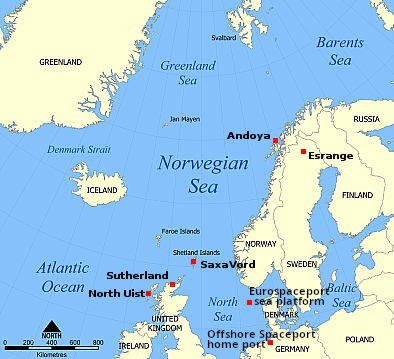
Proposed or active spaceports in North Europe

Though the German rocket startup Isar Aerospace is using Norway’s Andoya spaceport to launch its Spectrum rocket, it is now expanding significantly its testing facilities at Sweden’s Esrange spaceport to the east.

European space company Isar Aerospace is significantly expanding their testing operations with SSC Space at Esrange Space Center in Sweden, opening a second test site to support the development and production of its ‘Spectrum’ rocket. The new facility will enable testing of 30+ engines per month, along with expanded integrated stage testing capabilities, increasing testing capacity and enabling faster development.

Launching from Esrange is a problem because of its interior location, but testing engines there, close to Germany and the Andoya spaceport makes great sense.

Isar had hoped to make its second attempt to complete the first orbital launch of Spectrum in January, but postponed the launch until March to deal with a valve issue.

Hat tip to BtB’s stringer Jay.

0 comments
1 23 24 25 26 27 785