Vast wins sixth ISS slot for tourist mission

Haven-2
Vast’s full Haven-2 station once completed

NASA today announced that it has awarded the space station startup Vast its sixth slot for a manned commercial mission to ISS, scheduled for 2027.

The mission is expected to spend up to 14 days aboard the space station. A specific launch date will depend on overall spacecraft traffic at the orbital outpost and other planning considerations.

…Vast will submit four proposed crew members to NASA and its international partners for review. Once approved and confirmed, they will train with NASA, international partners, and SpaceX for their flight. The company has contracted with SpaceX as launch provider for transportation to and from the space station.

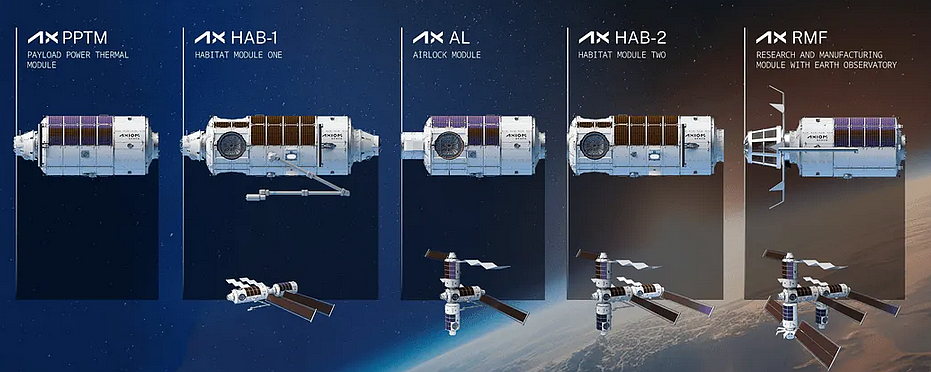
Vast already intends to fly four two-week missions to its single module Haven-1 demo station, scheduled to launch in the first quarter of 2027. This new ISS mission will demonstrate to NASA directly that Vast can handle manned missions. In both cases, the company is hoping its actions will convince NASA to award it a full construction contract to build its Haven-2 full-sized station, as shown in the graphic to the right.

Below are my rankings of the five private commercial space stations being developed. At this point the first three (Haven, Axiom, Starlab) are essentially tied, while the fourth (Thunderbird) is only trailing because it came late to the game. The fifth, Orbital Reef, seems practically out of the game.
» Read more

10 comments

New Zealand raises its annual cap of rocket launches from 100 to 1,000

The New Zealand government has now increased the number of launches it will allow from within its territory each year from 100 to 1,000.

The government is raising the total number of launches allowed to 1000, as the cap set at 100 in 2017 comes close to being breached. The US-NZ company Rocket Lab dominates the launch market from its pad at Mahia.

Space Minister Judith Collins said the 100 cap was likely to be hit this year. “This change ensures our space and advanced aviation industries can continue to expand while operating within clear environmental boundaries.” The environmental impact from more debris from space vehicle launches had been newly determined to be low.

The rules would have required a special marine consent for every launch over the 100 cap.

The article at the link is a typical leftist anti-achievement propaganda piece, spending more time airing the complaints by one physics professor than reporting the details of this new ruling. Nonetheless, this decision will likely benefit Rocket Lab’s operations significantly, as it hopes this year to make as many as two launches per month. While that remains below the old 100 launch cap, the new 1,000 launch cap gives it a limit it won’t face for decades, if ever.

It will also likely benefit several spaceports to the west in Australia. Some of their launches would likely need New Zealand clearance, and this new limit will ease their regulatory burden.

2 comments

Four launches today with mostly positive results

This morning saw a string of launches from China, Russia, America, and Europe, with all four appearing to get their payloads into orbit though the American launch, by ULA’s Vulcan rocket, appeared to have a problem with one of its solid-fueled boosters.

First, a Chinese pseudo-company owned entirely by a Chinese government agency successfully placed seven satellites in orbit, its Smart Dragon-3 rocket (also called Jielong-3) lifting off from a platform off the coast of northeast China. Of the satellites, the prime payload was a Pakistani Earth observation satellite.

Though this launch was from a pseudo-company, I think I can safely say that the pause in launches by China’s so-called commercial market continues. Smart Dragon-3 was built by the China Aerospace Science and Technology Corporation (CASC), which while structured as a private company is owned and controlled by several agencies of the Chinese government.

Next, Russia successfully launched a new weather satellite, its Proton rocket launching from Baikonur in Kazakhstan. This was the first Proton launch in three years, a pause partly because Russia is in the process of retiring that rocket. The lower stages crashed in a range of spots in Kazakhstan and across southern Russia, just missing China in two places.

The American company ULA then followed with its first launch in 2026, its Vulcan rocket lifting off from Cape Canaveral in Florida and carrying two military satellites designed to track other satellite operations in high geosynchronous orbit.

Unexpected debris falling from rocket at about T-1:00

While it appears the launch was able to get the satellites into their correct orbits, the Vulcan rocket had an issue during the launch. According to ULA, one of the rocket’s four solid-fueled boosters had a problem during its flight. More details can be found here, suggesting the booster, built by Northrop Grumman, might have had a been a failure of the booster’s nozzle, similar to the same burn-through that occurred on a booster during Vulcan’s second launch in 2024, and also occurred during a Northrop Grumman static fire test in 2025.

This issue is likely going to delay further Vulcan launches, and will likely make it impossible for ULA to meet its goal of launching 16 to 18 Vulcan missions this year. It will also raise hackles within the Pentagon, which certified Vulcan for military launches in 2025. That certification will likely be questioned, and possibly even pulled.

Finally, Arianespace sent 32 Leo satellites into orbit for Amazon, its Ariane-6 rocket lifting off from French Guiana. This was the first Ariane-6 launch in its most powerful variant, using four strap-on boosters.

Amazon has now launched 212 Leo satellites. Its FCC license however requires it to have 1,616 in orbit by July. The company has requested a waiver on that requirement, and is likely to get it, since it is now demonstrating that it is serious about launching the constellation.

The 2026 launch race:

16 SpaceX
8 China
2 Rocket Lab
2 Russia
1 ULA
1 Europe (Arianespace)

10 comments

British rocket startup Skyrora might buy Orbex assets

The British rocket startup Skyrora, which has been around since 2018 and has yet to complete an orbital launch, today indicated it might buy the remaining assets of the now bankrupt British rocket startup Orbex.

The company, which has a manufacturing facility in Cumbernauld, said its move would ensure Orbex technology and the spaceport remained under UK ownership. It also said its bid would safeguard products that had received public funding.

Skyrora has been making promises for almost a decade with no clear progress. It did two successful suborbital tests in 2020 (here and here), had a failed suborbital test in 2022, and applied for an orbital launch license with Britain’s Civil Aviation Authority (CAA) in January 2024. Not surprisingly, it is unclear whether that license has been approved. The company said last year it wants to do that orbital launch in ’26 from the Saxavord spaceport in the Shetland Islands. That gives the CAA two years to approve the license, which based on that agency’s track record might be enough time to get the job done. Or not.

Getting Orbex’s assets might actually be a good thing for Skyrora, which has not been very successful getting anything going with its own engineering. It will still face that odious regulatory regime of the United Kingdom, that has now killed two different rocket startups.

0 comments

Engineers have shut down the Gehrels-Swift space telescope in a last attempt to save it

Katalyst's proposed Swift rescue mission
Katalyst’s proposed Swift rescue mission.
Click for original image.

In order to delay the moment the orbit of the Gehrels-Swift Observatory decays — to increase the chance a rescue mission can get there in time — engineers have now stopped almost all scientific observations temporarily.

On Feb. 11, NASA’s Neil Gehrels Swift Observatory temporarily suspended most science operations in an effort to reduce atmospheric drag and slow the spacecraft’s orbital decay. Halting these activities will enable controllers to keep the spacecraft in an orientation that minimizes drag effects, extending its time in orbit in anticipation of a reboost mission.

“Normally, Swift quickly turns to view its targets — especially the fleeting, almost daily explosions called gamma-ray bursts — with multiple telescopes,” said principal investigator S. Bradley Cenko at NASA’s Goddard Space Flight Center in Greenbelt, Maryland. “Swift’s Burst Alert Telescope will continue to detect gamma-ray bursts, but the spacecraft will no longer slew to observe targets with its other telescopes.”

…To maximize the orbit boost’s chances of success, Swift’s average altitude needs to be above about 185 miles. As of early February, Swift’s average altitude had fallen below about 250 miles.

NASA has awarded the orbital repair startup Katalyst the contract to rescue Gehrels-Swift, but the company has a very challenging mission. It got the contract only a few months ago, in September 2025, and is refitting its planned satellite rescue demo mission to save the space telescope instead. The graphic to the right shows how its rescue robot will approach and grab Gehrels-Swift to raise its orbit, but it must be noted that the telescope has no planned grapple points, and Katalyst’s robot has never done this before.

Moreover, the robot will be launched using the last Pegasus rocket in Northrop Grumman’s warehouse, with a launch scheduled now for sometime this summer. That means Katalyst has had to go from contract award to launch in less than a year, a pace that up until now has been unheard of in the space business. If successful however Katalyst will once again demonstrate the benefits of the capitalism model, whereby NASA buys the product from the private sector rather than building it itself. Left to NASA, this rescue mission would never happen.

And even if Katalyst’s rescue fails, that the company could get it built and launched in such a short time still proves the value of the capitalism model. Freedom and capitalism and competition at least made the attempt possible.

1 comment

SpaceX completes extensive tank tests on next Superheavy booster

Link here. The story details the repeated tank tests just completed on Superheavy booster prototype #19, intended to fly on the 12th Superheavy/Starship test flight now targeting a mid-March launch.

The article also describes the extensive repairs and upgrades to the Massey test stand facility following the explosion during a static fire test in 2025.

It does appear that the issues that caused the two recent blow-outs of Superheavy boosters in the past few months have been fixed, and that flight testing will resume in about a month.

2 comments

SpaceX launches 24 more Starlink satellites

SpaceX today successfully launched another 24 Starlink satellites, its Falcon 9 rocket lifting off from Vandenberg Space Force Base in California.

The first stage completed its third flight, landing on a drone ship in the Pacific.

The 2026 launch race:

16 SpaceX
7 China
2 Rocket Lab
1 Russia

These numbers will definitely change in the next 24 hours, as there are launches planned from China, Russia, Europe, and ULA tomorrow, and a SpaceX Dragon manned launch to ISS the next day.

0 comments

ULA’s new management predicts it will achieve 18-22 launches in 2026

Before Tory Bruno resigned as CEO of the United Launch Alliance (ULA) to go work for Blue Origin, he had predicted in August last year that ULA was primed to complete two launches per month for the rest of ’25 and throughout ’26.

That prediction did not happen, as the company was only able to do four launches in the last five months of 2025, and no launches so far in 2026.

Yesterday the new management of ULA insisted that Bruno’s prediction was still reasonable, and that the company will complete between 18 to 22 launches before the end of this year.

Speaking during a virtual media roundtable on Feb. 10, Gary Wentz, ULA’s vice president of Atlas and Vulcan Programs, said the company aims to launch two to four Atlas 5 missions and 16 to 18 Vulcan missions. He said the Vulcan rockets will be split between pad 41 at Cape Canaveral Space Force Station and pad 3 at Vandenberg Space Force Base. “It’s a balance. We’re working with our customers to determine specific priorities and order of missions and in the case of Space Force and NRO (National Reconnaissance Office), to determine which missions they wan to get off with higher priority,” Wentz said. “And as we finalize that over the next about six to eight months out of the mission, then we’ll assign whether or not its going to be an Atlas mission or a Vulcan mission.”

John Elbon, the interim CEO following the departure of Tory Bruno in December, said that the company has a “strong commitment” from their commercial and government customers, citing a backlog of more than 80 missions.

That backlog is mostly split between ULA’s big contract to launch Amazon’s Leo satellites and a variety of different agencies in the Pentagon. Both are desperate to get their satellites into space, and it appears ULA is struggling to figure out how to do it. In its early years (from 2007 to 2016) the company was generally able to average about one launch a month, but since then that launch rate as been less than half that. To not only return to those launch rates from a decade ago but to almost double them will be challenging, to say the least.

12 comments

OHB Italia wins $96 million contract to build Ramses probe to visit the asteroid Apophis

Apophis' path past the Earth in 2029
A cartoon (not to scale) showing Apophis’s
path in 2029

The European Space Agency (ESA) yesterday announced that it has awarded the aerospace company OHB Italia a $96 million contract to build Ramses probe to rendezvous with the potentially dangerous asteroid Apophis when it makes its next close fly-by of Earth in 2029.

This contract is in addition to the $75 million development contract awarded OHB Italia in 2024. According to the company’s press release here:

The launch is scheduled for April 2028, with a rendezvous with Apophis planned for February 2029, approximately two months before its close approach to Earth. The spacecraft will accompany the asteroid until August 2029, in order to observe in detail how Earth’s tidal forces modify its shape, rotation, orbit and surface characteristics.

The initiative also benefits from strong international cooperation. The Japan Aerospace Exploration Agency (JAXA), drawing on its well-established expertise in asteroid science, will contribute by providing launch service onboard an H3 rocket, the spacecraft’s solar arrays and a Thermal Infrared Imager, further reinforcing the project’s global dimension.

In addition, two cubesats will be launched with Ramses and deployed once the spacecraft reaches Apophis.

This schedule is very tight, which places great pressure on OHB, especially because European space projects are traditionally built slowly after years of planning. ESA almost never does things fast like this.

At the moment, Osiris-Apex (formerly Osiris-Rex) is the only spacecraft that is on its way to Apophis.

1 comment

Rocket startup Stoke Space raises an additional $350 million in private investment capital

Stoke's Nova rocket
Stoke’s Nova rocket, designed to be
completely reusable.

The rocket startup Stoke Space yesterday announced that its most recent fund-raising round has raised an additional $350 million in private investment capital above the original target of $510 million.

Stoke Space Technologies, the rocket company developing fully and rapidly reusable medium-lift launch vehicles, announced today an extension of its previous Series D financing, bringing the total amount raised in the round to $860 million. The round was initially announced in October 2025 at $510 million. That funding focused on completing activation of Launch Complex 14 at Cape Canaveral Space Force Station, Fla., and expanding production capacity for the Nova launch vehicle. Stoke will use the additional capital to accelerate future elements of its product roadmap.

In total the company has now raises $1.34 billion. Though it has been moving steadily towards the first test launch of its totally reusable Nova rocket, it has so far refused to announce any launch dates. Based on all accounts, it appears that launch could occur before the end of this year, but nothing is confirmed.

Stoke’s ability to raise so much capital contrasts sharply with the failure of the British rocket startup Orbex, as noted in my previous post. Investors know that when Stoke is ready to launch from Florida, it will be able to do so, and so they have confidence in the company. With Orbex no one was willing to invest because the investors recognized that red tape was handicapping the company.

3 comments

British rocket startup Orbex goes under

Prime rocket prototype on launchpad
The prototype of Orbex’s never-launched Prime rocket,
on the launchpad in 2022

After waiting four years to get the necessary launch licenses from the United Kingdom’s Civil Aviation Authority (CAA), delays that forced it to abandon its preferred spaceport in Sutherland to go to the SaxaVord spaceport in the Shetland Islands, the British rocket startup Orbex today announced its effort to find a buyer or new financing had failed and it is going into receivership with the goal of selling off its assets.

Orbex has filed a notice of intention to appointment Administrators and will continue trading while all options for the future of the company are explored, including potential sale of all or parts of its business or assets. The notice provides short-term protection and allows the business time to secure as positive an outcome as possible for its creditors, employees and wider stakeholders.

The funding required for Orbex to remain a viable business was sought from a variety of public and private investors during its Series D funding round, which has ultimately failed. Several merger and acquisition opportunities have also been explored, with none resulting in a favourable outcome.

To repeat this company’s sad story, Orbex had hoped to do its first launch from the proposed Sutherland spaceport on the north coast of Scotland in 2022, but was blocked for four years because of red tape. First, the UK’s Civil Aviation Authority would not issue the spaceport and launch licenses. Second, local opposition delayed approvals as well. Those delays ate into the company’s resources, until it became entirely dependent on grants from the UK government (some through the European Space Agency) to keep it afloat.

By 2024 Orbex realized launching from Sutherland was impossible, and it then switched to the Saxavord spaceport in the Shetland Islands. This forced more delays because the company had no facilities there. It had already spent a fortune building everything for Sutherland.

There will be many who will blame this failure on the difficulty of rocket science, but it appears the fault almost entirely lies with the UK government and its odious regulatory regime. Neither Sutherland nor SaxaVord have been able to get anything off the ground, and it appears right now that rocket companies are going everywhere else to find launch sites. New rockets must launch and fail so that they can eventually succeed. The sense I get from the CAA is that it is treating every launch not as a test but as an operational launch that must succeed. Orbex couldn’t meet that standard.

Nor can any other rocket startup. At the moment SaxoVord has only one customer planning to launch, the German startup Rocket Factory Augsburg, but after a static fire explosion in 2024 blocked the launch nothing has happened since. I suspect the company is having problems getting new launch approvals from the CAA.

17 comments
1 22 23 24 25 26 785