ArianeGroup successfully tests solid rocket booster

Capitalism in space: ArianeGroup today successfully tested the solid rocket booster that it will use on both its Ariane 6 and Vega-C rockets in the 2020s.

The test success is good news for ArianeGroup, but this quote is actually more significant:

A compromise reached in May by European Space Agency members funding launch vehicle development will keep production of the P120C in Italy, allowing Avio to produce up to 35 boosters annually. A previous arrangement would have split production between Colleferro, Italy-based Avio and MT Aerospace of Augsburg, Germany.

The economies of scale provided by using the same booster for two rockets and concentrating production in one place are a key aspect of reducing the price for Ariane 6 missions by 40 to 50 percent compared to the Ariane 5 in use today.

Faced with stiff competition from SpaceX, the European Space Agency (ESA) gave ArianeGroup the power to structure operations more efficiently rather than cater to the pork desires of the agency’s many member nations.

Whether either Ariane 6 or Vega-C can compete with SpaceX’s reusuable rockets however remains doubtful. I expect that almost all of ArianeGroup’s customers in the next decade will be ESA member nations, required to buy its more expensive services.

5 comments

SpaceX’s first test crew Dragon capsule arrives in Florida

Capitalism in space: The first man-rated Dragon capsule set to fly has arrived in Florida to be prepped for launch.

Even though the vehicle is called a “Crew Dragon,” this Dragon won’t carry crew on its first flight. Instead, it’s due to make an uncrewed practice run to the space station during what’s known as Demonstration Mission 1, or DM-1.

Before this week’s shipment to Florida, the Dragon underwent thermal vacuum tests as well as acoustic tests at NASA’s Plum Brook Station in Ohio. Today SpaceX showed off a picture of the Crew Dragon, which is a redesigned, beefed-up version of its robotic cargo-carrying Dragon, via Twitter and Instagram.

NASA’s current schedule calls for SpaceX’s Falcon 9 rocket to launch the DM-1 mission next month from Kennedy Space Center. However, that schedule is dependent not only on the pace of preparations, but also on the timetable for station arrivals and departures.

SpaceX is clearly on schedule to fly the first unmanned test flight in September, and the first manned flight in January 2019. And once that manned flight take place, I can see no reason why operational flights shouldn’t follow soon thereafter.

Yet, NASA said earlier this week that those operational flights will almost certainly be delayed until 2020, mainly because SpaceX might not be able to get the paperwork filled out fast enough.

Here’s my prediction: If SpaceX flies that manned mission in early 2019, expect their operational flights to begin soon thereafter, not in 2020. NASA will have no choice but to accept the capsule and begin flights.

6 comments

SpaceX delivers huge supply tank to Boca Chica spaceport site

Capitalism in space: SpaceX yesterday delivered a huge oxygen supply tank to its future Boca Chica spaceport site, now aimed as the main initial test site for its Big Falcon Rocket.

“Delivery of a new liquid oxygen tank, which will be used to support propellant-loading operations during launch and vehicle tests, represents the latest major piece of launch hardware to arrive at the site for installation,” he said.

In February, SpaceX CEO and lead designer Elon Musk said brief “hopper flights” of the company’s Big Falcon Rocket spacecraft component probably will take place at Boca Chica, possibly next year.

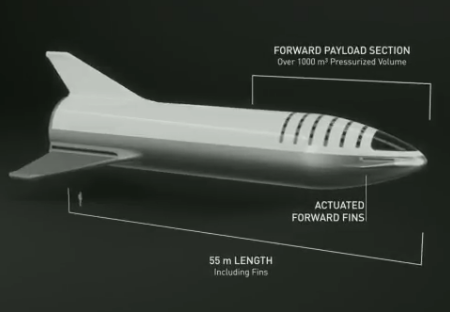
SpaceX is focusing on the development of the BFR to get the first humans to Mars, Musk’s ultimate goal, though it had originally planned to develop the smaller Falcon Heavy rockets for the purpose. The BFR rocket/spacecraft system will be built at a SpaceX facility at the Port of Los Angeles. Fully assembled, it is expected to stand 340 feet tall, according to the Los Angeles Times.

Do not put much faith in the predicted dates above. I am confident that we will not see a test flight of BFR for at least three, if not five years. I think it will happen, but not as quickly as Musk and SpaceX likes to predict.

3 comments

SpaceX installs much larger arms for net on ship for fairing recapture

Capitalism in space: SpaceX has completed the installation of much larger arms for the net that will be used to try catching rocket fairings.

While it’s difficult to estimate from photos alone, it appears that Mr Steven’s new arms are minimum of roughly 65 meters squared, assuming a square aspect ratio. In other words, the vessel’s next and newest net could have an area as large as 3600 square meters (~40,000 square feet, ~0.85 acres), easily more than quadruple the size of Mr Steven’s previous net. For comparison, the massive autonomous spaceport drone ships (ASDS) SpaceX often recovers its Falcon 9 and Heavy boosters aboard have a usable landing area of roughly 45,000 square feet, a little more than 10% larger than Mr Steven’s new net.

With these vast new arms, struts, and (soon enough) net, SpaceX is likely as close as they have ever been to successfully catching a Falcon 9 fairing, an achievement that would likely allow the company to begin reusing the large carbon fiber-composite shrouds almost immediately. Critically, although SpaceX appears to have begun attaching recovery hardware to both fairing halves in recent West Coast attempts, it remains to be seen whether Mr Steven’s new claw apparatus will be able to catch both halves, thus closing the gap on fairing recovery without necessitating the leasing and modification of perhaps three additional copies of the vessel.

This new net setup is big. We shall see if it works during an Iridium launch later this month.

11 comments

Engine tests for reusable Phantom Express space plane completed

Boeing and Aerojet Rocketdyne have successfully completed ten engine firings in ten days of an rocket engine originally designed for the space shuttle and now being recycled as part of Boeing’s Phantom Express reusable rocket being built for DARPA.

I honestly am not that excited by this. The Merlin engine has been able to do some variation of this now for a half decade. Firing an engine repeatedly is required to get satellites into geosynchronous orbit. This really isn’t news.

Nonetheless, it will be news if they can get this engine installed in a rocket that they actually fly to orbit ten times in ten days.

0 comments

Rocket Lab plans second launch site in U.S.

Capitalism in space: Rocket Lab is considering opening a second launch site in U.S.

American sites being considered were Cape Canaveral in Florida, Wallops Flight Facility in Virginia, Pacific Spaceport Complex in Alaska and Vandenberg Air Force Base in California, Rocket Lab said.

The firm expected its first launch from the United States would take place in the second quarter of 2019.

Since the company has not yet succeeded in initiating commercial operations, we should not get too excited by this news. At the same time, that they are considering doing this suggests they are increasingly confident about their future.

1 comment

Cygnus fires engine to test reboost of ISS

The Cygnus freighter presently berthed to ISS yesterday did a successful test engine firing to see if it could raise the orbit of ISS.

The cargo resupply vehicle provided a reboost to the Station at 4:25 pm Eastern, with a short 50 second burn of its main engine on the aft of the vehicle, raising the Station’s altitude by 295 feet. This test will pave the way for future, longer burns, removing some of the orbital stationkeeping strain from the Russian assets.

This was the first time since the retirement of the Space Shuttle fleet in July 2011, a US spacecraft had performed a reboost of the ISS.

Northrop Grumman proposed the idea, considering it a way to enhance the value of Cygnus for future NASA contracts. It also appears that NASA is looking to see if the Dragon and Starliner capsule can do this. If so, it will free the U.S. from another dependency it presently has with Russia, who today has the only approved ability to raise the station’s orbit, using Progress and Soyuz capsules and sometimes the engine on its Zvezda module.

0 comments

The dying Russian space program, from a Russian’s perspective

Link here. I have written previously about how Russia’s space effort seems to be steadily shrinking, month-to-month. This article gives the perspective from the point of view of a Russian who writes about space, and provides some concrete further examples of the program’s bureaucratic problems:

For example, the Russian space agency has been developing a “new” science and research module for the space station, “Nauka,” since 1995. More than two decades later, the module still awaits a decision on whether it should actually be completed.

Borisov asserts that this is because there are concerns about post-launch problems. “No official from Russia’s space industry wants to take responsibility for the laboratory module and its safety for use as part of the ISS, about which many questions have arisen,” he writes. (A translation of the 3,000-word article was provided to Ars by Robinson Mitchell).

The story is similar for Russia’s next-generation spacecraft, Federation. Instead of investing in this new vehicle designed for deep-space crew activities, which has been under development for a decade, Russia will likely opt to continue revising the Soyuz spacecraft, which first launched 52 years ago. This was before NASA’s Apollo capsule had flown.

The Putin government made a decision in the past decade to consolidate their entire space industry into one giant government-run corporation. In the process they eliminated all competition, and put every new project under the control of government bureaucrats whose first concern is not innovation and risk, but covering their behinds. As such, Russia has found it impossible to produce new space technology fast enough to compete.

2 comments

Israel’s former Google Lunar X-Prize contestant to launch in 2018

Capitalism in space: Despite a failure of all contestants to to win the Google Lunar X-Prize, Israel’s competitor announced today that they still plan to launch, and will do so in December of this year.

The SpaceIL spacecraft will be launched from the United States on a Falcon 9 orbital launch vehicle, built by Elon Musk’s Space Exploration Technologies Corporation, or SpaceX. At a press conference on Tuesday, SpaceIL representatives announced that the unmanned lunar landing craft will be transferred to the US in November, with a launch date in December.

According to SpaceIL, the unmanned space vessel will reach the moon and complete the lunar landing on February 13th next year.

They say the lander will plant an Israeli flag on the Moon, but the images at the link, as well as the announcement, suggests that the lander will no longer have the ability to rove, as required for the X-Prize. It appears to me that they have simplified the mission in order to fly it quickly and gain the public relations such a flight will give them.

4 comments

First manned Dragon capsule completes thermal vacuum tests

Capitalism in space: SpaceX’s first manned Dragon capsule has completed its thermal vacuum tests ahead of its test orbital flight, presently scheduled for September of this year.

There have been hints that this schedule could be further delayed. That neither SpaceX nor NASA were willing to comment about the results of the thermal tests could be a cause for concern, or it could simply be that they have not yet digested the material and wish to do so first before commenting.

I suspect a more firm schedule will be announced before the end of this month.

0 comments

China launches GPS satellite, matches record for annual launches

China today completed its 20th launch in 2018, putting a GPS satellite into orbit with its Long March 3C rocket.

Twenty launches matches China’s 2016 record for annual launches, but they have done so in just over half a year. They continue on track to meet their prediction of about 40 launches in2018.

The updated 2018 leader launch standings:

20 China
12 SpaceX
8 Russia
5 ULA
4 Japan

China now leads the U.S. 20 to 18 in the national rankings.

2 comments

Interorbital successfully test flies its upper-stage engine

Capitalism in space: The smallsat rocket company Interorbital Systems successfully test flew the upper-stage engine for its rocket last week.

Video of the test below the fold. This company had appeared to be moving towards test flights in 2014, than nothing seemed to happen until earlier this year. The four year gap made me suspect they were in trouble. It now appears they are moving forward towards their first flight, though when that will happen remains unclear.
» Read more

7 comments

China launches two satellites on Long March 2C

China today launched two satellites for Pakistan using its Long March 2C rocket.

Both satellites are for observing the Earth. Both were built by China for Pakistan.

The leaders in the 2018 launch standings:

19 China
12 SpaceX
7 Russia
5 ULA
4 Japan

In the national standings, China now leads the U.S. 19 to 18. China is also one short of matching its highest ever total of launches for a single year, 20, and it is getting there in just over half a year.

0 comments

China reveals details of its planned heavy-lift and reuseable rockets

The new colonial movement: At a conference in late May a senior designer for China’s space program revealed details of their planned heavy-lift rocket, called the Long March 9 and comparable to SLS, as well as their first reusable rocket, the Long March 8.

The Long March 9 will be a Saturn 5-class super-heavy-lift rocket comparable in capacity to the Space Launch System currently being developed under NASA.

According to Long, the Long March 9 will be capable of lifting 140 metric tons to low Earth orbit, 50 tons to Earth-Moon transfer orbit, and 44 tons to Earth-Mars transfer orbit. The 93-meter-high Long March 9 is expected to have a launch mass of over 4,000 metric tons, producing close to 6,000 tons of thrust.

…Long explained in the lecture that the Long March 8 would be CALT’s first rocket to attempt first stage reusability, which will launch for the first time in 2021.

As previously reported, the Long March 8 is based on the existing Long March rockets, using a core very similar to that of the 3.35-meter-diameter Long March 7, a new-generation medium-lift rocket that had its maiden flight in 2016, with the second stage to be based on the 3-meter-diameter liquid hydrogen-liquid oxygen second stage of the older Long March 3A. The rocket will also use two solid propellant boosters, likely based on the Long March 11.

Long stated that both the first stage and boosters will attempt vertical landing.

At this moment we must take China’s future space plans somewhat seriously. The upper management of their government is packed with former space program managers, all of whom are likely to view space development favorably. They have also done a good job either stealing our ideas and technology and adapting it, or building their own. And they have a somewhat robust economy, much of which has been privatized, that is generating a lot of cash for their government.

We must also remember that though the Chinese are signatories to the Outer Space Treaty, and will not publicly claim any territory they eventually possess on the Moon, Mars, or asteroids, they are likely to privately ignore that treaty and make it very clear to everyone that any territory they possess is theirs, and theirs alone. I also expect them to devise ways to expand that definition of possession to make it as extensive as possible.

The problem we have in competing with them is that our government seems more focused on creating pork instead of affordable and useful rockets. SLS’s design is cumbersome, expensive, and inefficient. It can’t fly often enough to accomplish much. And though private options that are more efficient and practical are now being built, the federal government seems very uninterested in buying them.

5 comments

India tests launch abort system for its own manned capsule

India on July 5 successfully tested its own launch abort system for use on its own manned capsule.

The test was over in 259 seconds, during which the crew escape system along with crew module soared skyward, reached an altitude of nearly 2.7 km, swerved over the Bay of Bengal and floated back to Earth under its parachutes about 2.9 km from Sriharikota.

A video showing excerpts of the test can be viewed here.

India has not yet fully committed to building a manned capsule, but they have been moving forward on testing for several years now, and I expect them to make a commitment within the next year. In fact, I think it likely that India will be the fourth nation, after Russia, the U.S., and China, to launch its own astronauts into space on its own spacecraft.

4 comments

More launch delays from Russia

Russia has decided to delay one of three commercial Soyuz rocket launches to 2019 due to unspecified “readiness” issues.

The launch of Soyuz-ST launch vehicle with a European satellite was initially scheduled for October 6, a source in the aerospace industry told Interfax. “However, evaluating relevant conditions and the launch vehicle’s readiness, the decision was made to move the launch to November 6,” the source said.

In all, three Russian launch vehicles were expected to take off from the Kourou Space Center by the yearend. Italy’s CSG-1 satellite was scheduled to be launched in November, which was to be followed by the launch of OneWeb’s pilot mini-satellites. Due to the delay of the European weather-forecasting satellite’s launch, the launch of two more rockets from Kourou was endangered. “One of the three launches has to be postponed until next year. This is most likely to be Italy’s CSG-1 satellite. However, a lift-off of satellites under the contract with OneWeb may be adjourned,” he said.

In addition, there was this story (behind a paywall) that noted that the only Proton-M launch in 2018 will also be delayed until 2019.

While such delays in rocket launches are not unusual and are an accepted part of the business, these delays for Russia do not help them. The technical problems in recent years that have caused many launch failures, combined with these delays, will further encourage their international customers to go elsewhere.

2 comments

Virgin Orbit gets first launch license

Capitalism in space: Virgin Orbit has obtained its first launch license from the FAA.

They hope to fly this first orbital flight before the end of the summer. Previously they have announced launch contracts calling for commercial launches in 2019, which requires these test flights in 2018.

Either way, it appears that, as I predicted in 2016, Virgin Orbit will achieve its first operational flight ahead of Virgin Galactic, even though the latter has been in development more than twice as long.

0 comments
1 301 302 303 304 305 472