
Falcon 9 Dragon launch to set used booster turnaround record

Capitalism in space: The planned launch on June 29th of Dragon to ISS will set a new turnaround record for a used first stage, just over two months.

This first stage is not a Block 5 first stage, it is the last older Block 4. What this quick turnaround means for the upcoming Block 5 launches however is important.

Although CRS-15 will likely see its venerable Block 4 Falcon 9 booster expended in the ocean without a recovery attempt, the speed of Falcon 9 B1045โ€™s refurbishment is thrilling for another, more abstract reason: if the design functions largely as intended, a Falcon 9 Block 5 booster should be able to handily crush that already impressive record with ease, and one will perhaps do just that within a handful of months of this launch.

Currently scheduled for no earlier than (NET) July 19 and late July to early August, the Telstar 19V and 18V communications satellites will require their own Block 5 launches roughly a month from today, and July 20โ€™s Iridium NEXT-7 mission will further require its own Falcon 9 Block 5 booster for a mission from California. It remains to be seen what boosters will launch those three missions, as well as an additional two SpaceX missions tentatively scheduled for August and September.

In other words, there is a very strong likelihood that SpaceX will be reusing its Block 5 boosters almost immediately this summer.
2 comments

A NASA astronaut’s detailed look at Dragon and Starliner

Link here. Lots of interesting details about both spacecraft from an experienced astronaut’s perspective.

The Commercial Crew program will launch uncrewed ships first. SpaceX is aiming to do that in September and Boeing in October. If successful, crewed launches will follow on December 31 (Boeing) and January 17 (SpaceX).

“We’ve gotten into the cockpit in both spacecraft. We’ve run through parts of the profile, from launch to rendezvous docking, un-docking, and [atmospheric] entry. But everything’s not been tied up, not quite yet,” Williams said. She didn’t say which company’s spaceship is her favorite.

In fact, crewed launch dates may slip to mid-2019. Williams said she expects NASA to announce her official mission selection this summer, and from there about a year of more deliberate mission training will follow.

This is a delay from the previously planned summer launches. This had been expected, but it also looks like both companies are trying hard to get things off the ground this year.

0 comments

The ship cut in half

An evening pause: The youtube page explains:

Norwegian cruise ship “Braemar” was literally split in half. Carried out at the shipyard in Hamburg operation was aimed at extending the hull by 30 feet. Between the two separated parts inserted third. The ship was repainted and with a new name – “Balmoral” – went on another tour.

Hat tip Edward Thelen.

11 comments

SpaceX’s Falcon Heavy wins Air Force launch contract

Capitalism in space: SpaceX has won a $130 million Air Force contract to use its Falcon Heavy rocket to launch a military satellite.

The Falcon Heavy beat out a bid from United Launch Alliance for the mission labeled Air Force Space Command-52, or AFSPC-52, which is targeting liftoff from KSC’s pad 39A in 2020.

United Launch Alliance’s most powerful launcher, the Delta IV Heavy, has a price tag approaching $400 million.

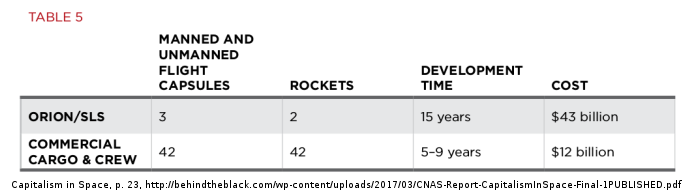
The price comparison bears repeating: ULA: $400 million, SpaceX: $130. It is not surprising that SpaceX got the contract, though it does illustrate the difference between the Air Force’s space effort and NASA’s. The Air Force is making a concrete and real effort to lower its launch costs, using competition as a tool to do so. NASA, which faces the same kind of price comparison when comparing SLS to SpaceX, continues however to ignore that price difference and insist its future interplanetary manned programs must go with SLS, and SLS only.

In this context, I think this graph from Capitalism in Space is worth another look:

SLS vs commercial space

8 comments

UAE signs deal with Russia for UAE astronaut flight

The new colonial movement: The United Arab Emirates (UAE) and Russia signed an agreement this week to fly an UAE astronaut on a Russian Soyuz capsule to ISS in April 2019.

The mission will be a standard 10-day tourist mission, though of course they are not describing it like that. The announcement also does not state if the UAE paid Russia for this flight, but I expect so, just like any tourist flight. The price however was likely a lot less than Russia has been squeezing from the U.S. for its astronaut flights. UAE had also been discussing this with China, and the competition probably forced Russia to lower its price.

I had been hoping that one of the U.S.’s commercial capsules could have gotten this business, but because of the delays NASA has imposed on their initial launches, they haven’t yet flown, so they lost the chance to compete for this.

0 comments

European satellite designed to test space junk removal released from ISS

Europe’s RemoveDEBRIS satellite was released from ISS yesterday in preparation for its testing a variety of technologies for removing and deorbiting space junk.

The article at the link does a terrible job trying to describe this mission. Better to return to a news story from 2016, when Europe first announced this project. The video from that story, embedded below the fold, does an excellent job detailing the four experiments, which are mostly aimed at testing technologies that could be added to satellites that would make either their capture or deorbit easier.

Maybe the most interesting aspect of this mission however is how it got into space. It was launched as part of a SpaceX Dragon cargo mission. It was deployed by NanoRacks, using its privately developed deployment system attached to Japan’s Kibo module.

Launch from ISS means that the satellite’s deployment and orbit were far more controllable than if it had been launched directly into space as a secondary payload during a rocket launch. NanoRacks is selling this approach commercially, and this satellite is the largest deployed by them to date.
» Read more

4 comments

Deorbit soon for China’s second test space station module?

China has lowered the orbit of Tiangong-2, its second test space station module, suggesting that they intend to deorbit the station in a controlled manner in the near future.

Orbital information published by the U.S. Strategic Commandโ€™s Joint Force Space Component Command, through the Joint Space Operations Center, indicates that Tiangong-2 has moved from an altitude of around 380 by 386 kilometers down to 292 by 297 kilometers.

No announcement regarding the status of the Tiangong-2 space lab has been made. The China Manned Space Engineering Office (CMSE), which manages Chinaโ€™s human spaceflight and space station related missions, did not respond to a SpaceNews request for comment.

Jonathan McDowell, an astrophysicist at the Harvard-Smithsonian Center for Astrophysics, told SpaceNews that, โ€œit seems likely that the lowering of Tiangong-2โ€™s orbit is the first step in safely disposing of it.โ€

Like Tiangong-1, this module was built to test a variety of technologies required for China’s full size station, planned for assembly in the next two years. Unlike Tiangong-1, they have not lost control of it, so they will be able to deorbit it properly.

0 comments

Trump replaces Obama’s oceans policy

President Trump yesterday issued an executive order replacing the oceans policy Obama had established with a policy that emphasizes “…the economy, security, global competitiveness, and well-being of the United States.”

The full executive order is here. The Science article at the link above not surprisingly provides quotes from a number of Trump opponents, including the head of NOAA during Obama’s administration, to express their opposition to this change.

One author of the Obama oceans policy is disappointed. The Trump policy โ€œrepresents a significant step backward, a throwback to the 1960s when the primary focus was on aggressively expanding the use of the ocean with the assumption that it is so immense, so bountiful that it must be inexhaustible,โ€ marine ecologist Jane Lubchenco, who led the National Oceanic and Atmospheric Administration under Obama, tells ScienceInsider. โ€œWe learned through painful experience that the ocean is indeed exhaustible, but we also learned that if we are smart about how we use the ocean, it can provide a wealth of benefits for decades and decades.โ€

Obamaโ€™s policy had emphasized โ€œstewardship,โ€ she notesโ€”a word not used in the new order. Trump โ€œblatantly rejects this all-important focus on stewardship,โ€ Lubchenco says. โ€œPut another way, the policy reflects a shift from โ€˜use it without using it upโ€™ to a very short-sighted and cavalier โ€˜use it aggressively and irresponsibly.โ€™โ€

Lubchenco is significantly overstating the negatives of Trump’s new policy. Its language is hardly “aggressive” or “irresponsible.” It does shift the focus from restricting the use of the oceans by regulation to encouraging their use for the “economic, security, and environmental benefits for present and future generations of Americans.” It that context the policy recognizes that “clean, healthy waters” are essential to provide those benefits.

I suspect that little will really change with this order. It will take years, if ever, to get the federal bureaucracy to shift its culture from controlling what Americans do to working with them. Nonetheless, this order demonstrates that Trump, unlike the past two Republican presidents, is serious about shifting federal policy in a conservative and less intrusive direction. The Bushes mouthed conservative ideas, but did little to stop the over-regulation imposed by the federal government. Bush Jr was especially worthless, as he did practically nothing to overturn the regulations that Clinton imposed, and in many ways supplemented or encouraged more regulation.

0 comments

Dubai to fund 36 science space projects

The new colonial movement: Dubai has chosen 36 science space projects to fund out of 260 proposals from across the world.

The 36 funded projects include some from universities in the United States, Poland, the UK, and Italy and deal with a variety of topics, ranging from mushrooms on Mars to the study of possible landing sites on the planet.

The article at the link provides very few details. It appears that Dubai’s program is designed to bring in international talent to help train its own people in the science and engineering of space.

0 comments

S7 Space wants to build Soviet era rocket engines

The private Russian company S7 Space, which recently took over Sea Launch, wants to buy the blueprints and resume building the Soviet era rocket engines developed for the N1 heavy-lift rocket.

Russia’s S7 Space, part of the S7 Group, plans to build a plant in Samara to produce Soviet-designed NK-33 and NK-43 rocket engines for super heavy-lift launch vehicles and intends to purchase production capacities from the state-owned United Engine Corporation (UEC) for this purpose, S7 Space General Director Sergey Sopov said in an interview.

“We would like to buy from the state the well-known engines NK-33 and NK-43, produced earlier by the Samara-based Kuznetsov plant, as well as the documentation, equipment, technical backlog. In general, everything that has survived on this theme from the Soviet program. We intend to restore production and build our own rocket engine plant in Samara,” Sopov said in an interview to be published in the Vedomosti newspaper.

As with everything now in Russia, this company not only needs to buy the rights to these engines, it needs to get government permission to do this. Also, because it will take five to six years to get the new engine plant up and running, they plan in the interim to use the available engines left over from the 1960s. Considering the launch failure caused by one of these engines in an Orbital ATK Antares launch, I am not sure this is wise.

Overall, S7 Space has the right idea. The company wants to compete, and it wants to innovate. Whether it can do so in the top-down culture of Russia remains the unanswered question.

2 comments

Private company to offer tourist trips to its own facility on ISS

Capitalism in space: The private company Axiom has announced that it will offer tourist trips to its own facility it will add to ISS, and then eventually detach when the station is retired.

Axiomโ€™s timeline has some flex, because itโ€™s not yet clear how long the larger station will keep going, or what the assembly schedule will be for the companyโ€™s custom-built habitation module. But a weekend feature about the project in The New York Times cited 2022 as the supposed opening date.

In addition to the 10-day orbital stay, the $55 million would cover a 15-week training experience on Earth. Axiom is targeting space tourists as well as researchers and entrepreneurs who want to develop in-space manufacturing facilities.

Is this doable? Axiom isnโ€™t yet laying out the complete logistical details, but the company will almost certainly rely on the likes of SpaceX and Boeing, which are developing space taxis for NASAโ€™s use. Once those spaceships go into operation, sometime in the 2018-2019 period, thereโ€™s likely to be excess transportation capacity that Axiom could buy into.

This is the future of ISS, a privately run hotel. The Russians have announced a similar plan, attaching a module to ISS that will be designed as a hotel room for tourists. I expect others will eventually do the same. Once these profitable operations take hold, I guarantee that ISS will not be retired. There will be vested interests who will apply the right political pressure to keep it in orbit.

Will that be a good thing? It depends. From a taxpayer perspective, it might not be. ISS is very expensive to operate. Privately built and independent stations would be much cheaper, and would not involve any federal subsidy. At the same time, these private stations might not be doable at affordable prices in the near term. Maintaining ISS for these private companies might in this case be a very reasonably use of federal funds. As the profits rise, the companies will eventually be able to afford building their own stations that will serve their needs better than ISS. That will then be the time to retire ISS, when other private and profitable stations are there, ready to replace it.

6 comments

Vector plans first orbital flight this October

Capitalism in space: Smallsat rocket company Vector now plans its first orbital flight this coming October, and also plans to have a commercial payload on board.

The article also states that the company already has launch contracts for almost 400 launches.

This story, consistent with a previous report in March, suggests that their build toward that first orbital launch is holding to its schedule.

1 comment

SpaceX outlines plans for major expansion at Kennedy

Capitalism in space: According to plans outlined in a draft environmental statement, SpaceX is planning a major mission control and new rocket processing facility at the Kennedy Space Center.

It will be an operational monument to Elon Musk’s vision: a towering SpaceX launch control center, a 133,000-square-foot hangar and a rocket garden rising in the heart of Kennedy Space Center.

According to plans detailed in a draft environmental review published recently by KSC, SpaceX will undertake a major expansion of its facilities at the space center sometime in the not-too-distant future. The review says SpaceX is seeking more room and a bigger presence “in its pursuit of a complete local, efficient, and reusable launch vehicle program.” The expansion would enable SpaceX to store and refurbish large numbers of Falcon rocket boosters and nose cones at the operations center down the road from NASAโ€™s Vehicle Assembly Building.

The most eye-opening detail in this environmental draft is a statement that this SpaceX facility will be designed to support an expectation of up to 63 launches per year. In the first decade of this century that’s about how many launches the entire world accomplished per year. SpaceX’s ambitions here however are not absurd. They instead hearken to the expected upcoming boom in the entire aerospace, mostly fueled by the lower launch costs that SpaceX forced on the launch industry. SpaceX might manage that many launches, but it will be only a part of the entire booming launch market.

12 comments

Northrop Grumman’s first Pegasus launch delayed indefinitely

The first launch of a Pegasus rocket following the completion of the sale of Orbital ATK to Northrop Grumman has been delayed indefinitely because of “off-nominal data” detected in the rocket.

The payload is a NASA climate research satellite dubbed ICON. The rocket and launch crew were on board the L1011 carrier plane on they way to the Pacific launch area for next week’s launch when they detected the issue and decided to return to California.

This is not the first problem with this particular Pegasus launch.

ICONโ€™s launch has been delayed a year by a pair of concerns with its Pegasus launcher. Engineers wanted more time to inspect the Pegasus rocket motors after they were mishandled during shipment to Vandenberg, officials said. That pushed the launch back from June to December 2017, the next availability in the military-run range at Kwajalein.

Then managers decided to ground the mission to assess the reliability of bolt-cutters used to jettison the Pegasus rocketโ€™s payload fairing and separate the satellite in orbit. Workers installed smaller bolts in the fairing and satellite separation mechanisms, a measure officials said will ensure the cutters do their jobs.

For Northrop Grumman this isn’t the best way to start its new rocket business, but better a delay than a failed launch.

4 comments

Aerojet Rocketdyne completes first rocket engine for DARPA’s quick launch rocket

Aerojet Rocketdyne has completed assembly of the first rocket engine for DARPA’s quick launch rocket, Phantom Express, being built by Boeing.

[The engine] can fly for 55 missions with servicing only every 10. To speed up turnarounds, the engines will be installed in a hinged nacelle for better access and the entire spacecraft will use an operations procedure similar to those developed for aircraft.

The first AR-22 engines will be used for daily hot-fire tests at Rocketdyne’s Stennis Space Center facility in Mississippi to demonstrate that it can handle multi-mission conditions and that the fast turnarounds are both feasible and practical. In addition, Rocketdyne says that the test information will help spaceplane builder Boeing to improve the Phantom Express ground infrastructure.

Boeing and Aerojet Rocketdyne both have it very sweet. They have gotten DARPA to fund the development of their own low-cost reusable rocket, while other private companies have to go it alone.

Still, it appears that Boeing is leveraging its engineering experience from building the X-37B for the Air Force for this project. Whether the company can expand the rocket’s customer base beyond the Air Force remains unclear.

0 comments

Northrop Grumman purchase of Orbital ATK approved

Capitalism in space: Northrop Grumman’s acquisition of Orbital ATK has been approved by the Federal Trade Commission.

With this purchase, the name Orbital ATK will recede into history. This division of Northrop Grumman will now be called Northrop Grumman Innovation Systems. Here at Behind the Black I will simple call it Northrop Grumman.

The FTC ruling carried with it one caveat:

As a condition for the approval of the merger, the company will have to supply solid rocket motors โ€œon a non-discriminatory basis under specified circumstances,โ€ the FTC ruled.

Ensuring competition in the solid rocket motors industry is a key issue for the Defense Department because only two manufacturers remain in the business, Orbital ATK and Aerojet Rocketdyne. The Air Force plans to acquire a new strategic intercontinental ballistic missile, the so-called Ground Based Strategic Deterrent, with Northrop Grumman and Boeing competing for the award. The intent was for both Orbital ATK and Aerojet to supply both prime contractors. The FTC decision requires Northrop Grumman to separate its solid rocket motors business with a firewall so it can continue to support Boeing.

It will be up to the Defense Department to ensure compliance with the firewall mandate.

It is unclear from the press report what this firewall accomplishes. It sounds like there was fear that Northrop Grumman would not have sold its solid rocket boosters to competitor Boeing, but I don’t see that happening. This acquisition was designed to put Northrop Grumman back in the rocket business just as that business is booming. Part of that business is selling solid rockets.

Either way, the company that David Thompson started in the early 1980s to challenge the big space companies, Orbital Sciences, has now completely vanished into one of those big space companies.

1 comment
1 308 309 310 311 312 478