
The dying Russian space program, from a Russian’s perspective

Link here. I have written previously about how Russia’s space effort seems to be steadily shrinking, month-to-month. This article gives the perspective from the point of view of a Russian who writes about space, and provides some concrete further examples of the program’s bureaucratic problems:

For example, the Russian space agency has been developing a “new” science and research module for the space station, “Nauka,” since 1995. More than two decades later, the module still awaits a decision on whether it should actually be completed.

Borisov asserts that this is because there are concerns about post-launch problems. “No official from Russia’s space industry wants to take responsibility for the laboratory module and its safety for use as part of the ISS, about which many questions have arisen,” he writes. (A translation of the 3,000-word article was provided to Ars by Robinson Mitchell).

The story is similar for Russia’s next-generation spacecraft, Federation. Instead of investing in this new vehicle designed for deep-space crew activities, which has been under development for a decade, Russia will likely opt to continue revising the Soyuz spacecraft, which first launched 52 years ago. This was before NASA’s Apollo capsule had flown.

The Putin government made a decision in the past decade to consolidate their entire space industry into one giant government-run corporation. In the process they eliminated all competition, and put every new project under the control of government bureaucrats whose first concern is not innovation and risk, but covering their behinds. As such, Russia has found it impossible to produce new space technology fast enough to compete.
2 comments

Israel’s former Google Lunar X-Prize contestant to launch in 2018

Capitalism in space: Despite a failure of all contestants to to win the Google Lunar X-Prize, Israel’s competitor announced today that they still plan to launch, and will do so in December of this year.

The SpaceIL spacecraft will be launched from the United States on a Falcon 9 orbital launch vehicle, built by Elon Musk’s Space Exploration Technologies Corporation, or SpaceX. At a press conference on Tuesday, SpaceIL representatives announced that the unmanned lunar landing craft will be transferred to the US in November, with a launch date in December.

According to SpaceIL, the unmanned space vessel will reach the moon and complete the lunar landing on February 13th next year.

They say the lander will plant an Israeli flag on the Moon, but the images at the link, as well as the announcement, suggests that the lander will no longer have the ability to rove, as required for the X-Prize. It appears to me that they have simplified the mission in order to fly it quickly and gain the public relations such a flight will give them.

4 comments

First manned Dragon capsule completes thermal vacuum tests

Capitalism in space: SpaceX’s first manned Dragon capsule has completed its thermal vacuum tests ahead of its test orbital flight, presently scheduled for September of this year.

There have been hints that this schedule could be further delayed. That neither SpaceX nor NASA were willing to comment about the results of the thermal tests could be a cause for concern, or it could simply be that they have not yet digested the material and wish to do so first before commenting.

I suspect a more firm schedule will be announced before the end of this month.

0 comments

China launches GPS satellite, matches record for annual launches

China today completed its 20th launch in 2018, putting a GPS satellite into orbit with its Long March 3C rocket.

Twenty launches matches China’s 2016 record for annual launches, but they have done so in just over half a year. They continue on track to meet their prediction of about 40 launches in2018.

The updated 2018 leader launch standings:

20 China
12 SpaceX
8 Russia
5 ULA
4 Japan

China now leads the U.S. 20 to 18 in the national rankings.

2 comments

Interorbital successfully test flies its upper-stage engine

Capitalism in space: The smallsat rocket company Interorbital Systems successfully test flew the upper-stage engine for its rocket last week.

Video of the test below the fold. This company had appeared to be moving towards test flights in 2014, than nothing seemed to happen until earlier this year. The four year gap made me suspect they were in trouble. It now appears they are moving forward towards their first flight, though when that will happen remains unclear.
» Read more

7 comments

China launches two satellites on Long March 2C

China today launched two satellites for Pakistan using its Long March 2C rocket.

Both satellites are for observing the Earth. Both were built by China for Pakistan.

The leaders in the 2018 launch standings:

19 China
12 SpaceX
7 Russia
5 ULA
4 Japan

In the national standings, China now leads the U.S. 19 to 18. China is also one short of matching its highest ever total of launches for a single year, 20, and it is getting there in just over half a year.

0 comments

China reveals details of its planned heavy-lift and reuseable rockets

The new colonial movement: At a conference in late May a senior designer for China’s space program revealed details of their planned heavy-lift rocket, called the Long March 9 and comparable to SLS, as well as their first reusable rocket, the Long March 8.

The Long March 9 will be a Saturn 5-class super-heavy-lift rocket comparable in capacity to the Space Launch System currently being developed under NASA.

According to Long, the Long March 9 will be capable of lifting 140 metric tons to low Earth orbit, 50 tons to Earth-Moon transfer orbit, and 44 tons to Earth-Mars transfer orbit. The 93-meter-high Long March 9 is expected to have a launch mass of over 4,000 metric tons, producing close to 6,000 tons of thrust.

…Long explained in the lecture that the Long March 8 would be CALT’s first rocket to attempt first stage reusability, which will launch for the first time in 2021.

As previously reported, the Long March 8 is based on the existing Long March rockets, using a core very similar to that of the 3.35-meter-diameter Long March 7, a new-generation medium-lift rocket that had its maiden flight in 2016, with the second stage to be based on the 3-meter-diameter liquid hydrogen-liquid oxygen second stage of the older Long March 3A. The rocket will also use two solid propellant boosters, likely based on the Long March 11.

Long stated that both the first stage and boosters will attempt vertical landing.

At this moment we must take China’s future space plans somewhat seriously. The upper management of their government is packed with former space program managers, all of whom are likely to view space development favorably. They have also done a good job either stealing our ideas and technology and adapting it, or building their own. And they have a somewhat robust economy, much of which has been privatized, that is generating a lot of cash for their government.

We must also remember that though the Chinese are signatories to the Outer Space Treaty, and will not publicly claim any territory they eventually possess on the Moon, Mars, or asteroids, they are likely to privately ignore that treaty and make it very clear to everyone that any territory they possess is theirs, and theirs alone. I also expect them to devise ways to expand that definition of possession to make it as extensive as possible.

The problem we have in competing with them is that our government seems more focused on creating pork instead of affordable and useful rockets. SLS’s design is cumbersome, expensive, and inefficient. It can’t fly often enough to accomplish much. And though private options that are more efficient and practical are now being built, the federal government seems very uninterested in buying them.

5 comments

India tests launch abort system for its own manned capsule

India on July 5 successfully tested its own launch abort system for use on its own manned capsule.

The test was over in 259 seconds, during which the crew escape system along with crew module soared skyward, reached an altitude of nearly 2.7 km, swerved over the Bay of Bengal and floated back to Earth under its parachutes about 2.9 km from Sriharikota.

A video showing excerpts of the test can be viewed here.

India has not yet fully committed to building a manned capsule, but they have been moving forward on testing for several years now, and I expect them to make a commitment within the next year. In fact, I think it likely that India will be the fourth nation, after Russia, the U.S., and China, to launch its own astronauts into space on its own spacecraft.

4 comments

More launch delays from Russia

Russia has decided to delay one of three commercial Soyuz rocket launches to 2019 due to unspecified “readiness” issues.

The launch of Soyuz-ST launch vehicle with a European satellite was initially scheduled for October 6, a source in the aerospace industry told Interfax. “However, evaluating relevant conditions and the launch vehicle’s readiness, the decision was made to move the launch to November 6,” the source said.

In all, three Russian launch vehicles were expected to take off from the Kourou Space Center by the yearend. Italy’s CSG-1 satellite was scheduled to be launched in November, which was to be followed by the launch of OneWeb’s pilot mini-satellites. Due to the delay of the European weather-forecasting satellite’s launch, the launch of two more rockets from Kourou was endangered. “One of the three launches has to be postponed until next year. This is most likely to be Italy’s CSG-1 satellite. However, a lift-off of satellites under the contract with OneWeb may be adjourned,” he said.

In addition, there was this story (behind a paywall) that noted that the only Proton-M launch in 2018 will also be delayed until 2019.

While such delays in rocket launches are not unusual and are an accepted part of the business, these delays for Russia do not help them. The technical problems in recent years that have caused many launch failures, combined with these delays, will further encourage their international customers to go elsewhere.

2 comments

Virgin Orbit gets first launch license

Capitalism in space: Virgin Orbit has obtained its first launch license from the FAA.

They hope to fly this first orbital flight before the end of the summer. Previously they have announced launch contracts calling for commercial launches in 2019, which requires these test flights in 2018.

Either way, it appears that, as I predicted in 2016, Virgin Orbit will achieve its first operational flight ahead of Virgin Galactic, even though the latter has been in development more than twice as long.

0 comments

Private Japanese smallsat rocket fails at launch

Capitalism in space: The second test flight of a private Japanese smallsat rocket company, Interstellar Technologies, today failed immediately at launch.

A rocket developed by a Japanese startup company burst into flames seconds after a failed liftoff Saturday in northern Japan.

The MOMO-2 rocket, developed by Interstellar Technologies, was launched in Taiki town on Hokkaido, Japan’s northernmost main island. It was supposed to reach as high as 100 kilometers (62 miles) into space. Television footage showed that the 10-meter (33-foot) pencil rocket lifted only slightly from its launch pad before dropping to the ground, disappearing in a fireball. Footage on NHK public television showed a charred rocket lying on the ground.

The incident caused no injuries.

Rocket science is hard. Competition and freedom carries risks. This company might not be dead, but this failure is definitely a significant setback.

Posted from Belize.

3 comments

Heading to Belize again

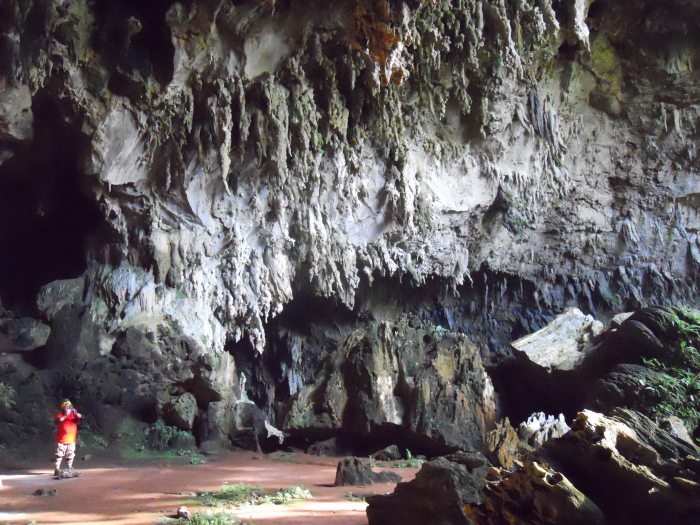
Today I am flying to Belize for a week long caving expedition. This will be the third trip there as part of a project to complete the mapping of a well known and very spectacular cave located in St. Herman’s Blue Hole National Park

As I did on the previous two trips, first in May 2016 and second in February 2017, I will continue to post on Behind the Black, though my posting will generally occur in the evening when we get back from the caves. I will also do at least one Batchelor appearance from Mayan Mountain Lodge in San Ignacio, where we will be staying. The lodge has been gracious enough with each visit to let me use their office and phone.

I very much want to finish the map this trip. The local cave guides, who depend on keeping the caves in pristine condition so that they can show off their beauty to tourists, need the map to help protect the cave. They will be helping with the survey, as they have previously. As I noted after my first trip in 2016,

Because Belize’s law puts the ownership of all caves under the jurisdiction of the Institute of Archaeology, which generally lacks the resources to protect them all, this work by the tour guides is essential. For example, Barton Creek Cave is a major tourist river cave that requires a canoe to see. Though the property surrounding the entrance is privately owned, the landowner, Mike Bogart, cannot prevent access to the cave to others. He offers tours, using the canoes he provides, but others can do the same and access the cave by canoeing up the river past his property. They need only get a government permit.

Thus, under this socialized system, with no single owner responsible for each cave, the only way the caves can be protected is for the tour guides and operators to band together to protect the caves themselves. In fact, their effort to flag the trails these past few weeks was begun expressly because they all saw the damage that uncontrolled visitation was causing, and wanted to stop it

Hopefully, their effort will bear fruit, and the caves and their guides’ livelihoods will prosper for years to come. And if the cave maps we Americans produce can help contribute to that success, then my short trip to Belize will have accomplished a lot more than provide me a few days of vacation pleasure.

On to Belize! The image below, of one of the many caves there, will give you a taste of their beauty.

Small side passage

4 comments

SpaceX successfully launches Dragon to ISS

Capitalism in space: SpaceX early this morning successfully launched Dragon to ISS using its last Block 4 Falcon 9.

Both the first stage and Dragon were used components. As planned, they did not recover the first stage.

The leaders in the 2018 launch standings:

18 China
12 SpaceX
7 Russia
5 ULA
4 Japan

The U.S. and China are once again tied at 18 in the national standings.

At the moment the 2018 worldwide totals for launches is 54, and this is only for the first half of the year. As I predicted in my January review of 2017’s launch totals, we continue to trend to having more than 100 launches in 2018, the first time this has happened since before the fall of the Soviet Union. Then, the numbers were inflated because the Soviets launched a lot of out-of-date spy satellites more out of habit than practicality, which is why, when the Soviet Union fell, the launch totals dropped precipitously. Now, the numbers reflect the real commercial market in space, and suggest real sustained growth, largely fueled by SpaceX’s forcing of lower launch prices.

6 comments

Long March 2C first stage crashes into Chinese town

Footage showing the first stage from yesterday’s Long March 2C launch crashing into a city has now been released.

The Chinese government issues warnings and even evacuates areas calculated to be under risk of impact during these interior launches, but it appears that many locals stick around to film the event. I have embedded below the fold this most recent footage.

The fuel from the first stage of the Long March 2C is very toxic, so China is increasingly facing a bad PR problem they don’t want. They are using their space program, much like the Soviets did, to highlight China’s new first world status. Images of an out-of-control rocket crashing into populated areas does not serve that purpose well. Expect them to accelerate their efforts to either develop reusable first stages, and to abandon this launch site.
» Read more

8 comments

Rocket Lab cancels Electron launch for this launch window

In reviewing the motor controller problem that caused a launch scrub earlier this week, Rocket Lab has decided to cancel further launch attempts during the present launch window ending July 6.

In a statement, Rocket Lab said “the motor controller behaviour was similar to that previously identified during wet dress rehearsal operations in April.”

“This issue was analysed and corrective measures [put] in place, however a similar issue presented during yesterday’s pre-launch operational checks. All systems had previously performed nominally during a wet dress rehearsal on 16 June.”

A motor controller is a device that governs commands given to selected hardware and software systems throughout the launch vehicle.

My guess is that they are now worried about a systemic problem with the motor controllers, since the same problem has now occurred on two different units, and it has been an intermittent problem as well.

0 comments

China launches two satellites

China today successfully launched what it called two “technology test satellites,” using its Long March 2C rocket.

No further information about the satellites was released. The Long March 2C is comparable to India’s PSLV rocket, and thus is used for smaller payloads.

The leaders in the 2018 launch standings:

18 China
11 SpaceX
7 Russia
5 ULA
4 Japan

This launch puts China ahead of the U.S. in the national race, 18-17, though SpaceX’s Dragon launch later this week should tie things up again.

1 comment

Arianespace lowers its launch forecast for 2018

Capitalism in space: Because of a launch miscue in January and a decision by India to delay a satellite launch, Arianespace today admitted that it will not meet its forecast of fourteen launches in 2018.

Arianespace, majority-owned by a joint venture of Airbus and Safran, has so far conducted only three launches, but expects a busier second half, CEO Stephane Israel said. He now expects around 11 satellite launches for the year.

There might be a similar number of launches in 2019, but it is too early to give a definitive forecast, Israel said, adding the company was now focusing on gaining customers for the lower cost Ariane 6 rocket due to debut in 2020.

The article states the launch cost for Ariane 6 will be 40% less than Ariane 5, which cost $100 million per satellite. This brings the per satellite price for Ariane 6 to $60 million, about what SpaceX presently charges. Whether that can compete with the prices that SpaceX and others will be charging in 2020, when Ariane 6 is expected to become operational, remains unknown.

0 comments

The slow death of Planetary Resources

Link here. The article tries to put a positive spin on the company’s decline, but the facts described tell a different story, with its failure to raise investment capital essentially forcing it to shut down, with its best people leaving for greener pastures.

[The fund-raising failure] forced a sharp reduction in Planetary Resources’ workforce. How sharp? Lewicki declined to say, but LinkedIn’s listings show that a number of employees have moved on to Blue Origin, Amazon and other companies.

Several former members of the team have started up a new engineering services company called Synchronous. Maggie Scholtz, a Planetary Resources veteran who is now Synchronous’ president of aerospace and space, will be one of the speakers at the NewSpace conference. The event gets under way on Tuesday at the Hyatt Regency Lake Washington in Renton, Wash. Other Synchronous partners include Chris Voorhees, who was Planetary Resources’ chief engineer until February; Peter Illsley, Planetary Resources’ former director of mechanical and thermal engineering; Brian Geddes, former director of software; and Rhae Adams, former director of mining and energy.

Planetary Resources had to let a robotic worker go as well. Arkyd-6A, the experimental Earth-observing satellite that was launched for the company in January, is now idle in low Earth orbit.

When this company made its splashy appearance in 2012, claiming it planned to do asteroid mining, I said hogwash. They weren’t an asteroid mining company, at best they were a cubesat-sized orbiting telescope company, testing technologies for looking at asteroids.

In the end, they weren’t even that. Arkyd-6A has taken one picture of the Earth, and is not competitive with numerous other Earth-observation companies that have already launched many superior and commercially profitable satellites.

I am not optimistic for the future of this company. The lesson it provides however is important. Companies that oversell themselves should be viewed with great skepticism.

1 comment
1 307 308 309 310 311 478