
Want to watch the launch of Falcon 9/Dragon? Here’s the low down.
Want to watch the launch of Falcon 9/Dragon? Here’s the low down.
Want to watch the launch of Falcon 9/Dragon? Here’s the low down.
The competition continues to heat up: Engineers in Great Britain have begun testing a new hybrid engine for lifting a spaceplane into orbit.
The financial foolishness in Congress, by Republicans this time, continues. In making its budget recommendations for NASA, the report [pdf] of the House Appropriations Commerce, Justice, Science, and Related Agencies subcommittee also demands that NASA immediately choose one commercial company for its commercial space program. (Hat tip to Clark Lindsey for spotting this.)
The number of ways this action is counter-productive almost can’t be counted.
» Read more
The competition continues to heat up: India yesterday successfully launched its own all-weather imaging satellite.
To mine the asteroids, first build small cheap space telescopes.
The space telescope will be based on the same design Planetary Resources will eventually use for its asteroid-prospecting spacecraft: a 30-kilogram to 50-kilogram flier packed with imaging sensors and a laser-optical communication system the company is developing to avoid encumbering its spacecraft with large antennas. The company, which says it has about two dozen employees, will market these spacecraft as cheap but effective telescopes for both astronomical and Earth-observing applications. Sales would provide cash for the company’s core work on asteroid mining, Eric Anderson, co-founder and co-chairman of Planetary Resources, said.
The telescope slated for launch sometime in the next two years “would be something, let’s say, a university buys [for astronomical observations], or a commercial company that wants to monitor shipping traffic or something like that,” Anderson said in a phone interview. The cost for the telescope, which Planetary Resources is calling Arkyd-101, would be “millions of dollars, including launch.”
At the Planetary Resources press conference today, there was a lot of talk about the benefits and profits to be gained from mining the asteroids. However, this ain’t gonna happen for quite a few years. In the meantime, the company plans to make money building space telescopes which scientists and others can use, for a fee, to do research.
In other words, the government and astronomers dropped the ball on replacing the Hubble Space Telescope. Now, private enterprise is going to pick it up and run with it.
SpaceX and NASA have now set May 7 as the planned launch date for the Dragon test flight to ISS.
No announcement yet, but of the many stories available this Wired article appears to provide the best overview of the asteroid mining plans of Planetary Resources.
The company’s first phase is most interesting:
Within the next 18 to 24 months, Planetary Resources hopes to launch between two and five space-based telescopes at an estimated cost of a few million dollars each that will identify potentially valuable asteroids. Other than their size and orbit, little detailed information is available about the current catalog of near-Earth asteroids. Planetary Resources’ Arkyd-101 Space Telescopes will figure out whether any are worth the trouble of resource extraction.
The actual press conference is scheduled for 10:30 am (Pacific). Stay tuned.
Update: The Planetary Resources website has now been updated. You can read more about their space telescope proposal here.
SpaceX has delayed the launch of its Dragon test mission to ISS, with the launch now scheduled sometime between May 3 and May 7.
“After reviewing our recent progress, it was clear that we needed more time to finish hardware-in-the-loop testing and properly review and follow up on all data,” SpaceX spokeswoman Kirstin Brost Grantham wrote in an email. “While it is still possible that we could launch on May 3rd, it would be wise to add a few more days of margin in case things take longer than expected. As a result, our launch is likely to be pushed back by one week, pending coordination with NASA.”
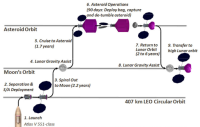
Want to get a jumpstart on Tuesday’s asteroid-mining announcement by Planetary Resources? Read this NASA report [pdf], released April 2.
Orbital Sciences has released an updated launch schedule for its Antares rocket and Cygnus capsule.
The significance?
» Read more
The death of the double click.
The story includes some nice history behind the invention of the GUI.
Interestingly, I could probably count on one hand the times I have double-clicked on a computer, since I rarely use the mouse at all. Instead, I have found it is far faster to use the keyboard to access commands, files, programs, etc.
Is asteroid mining about to begin?
Considering some of the major players who are either investors or advisers for this company, this story could get very exciting when the company’s full plans are revealed on April 24.
NASA budget battles: House panel proposes giving commercial space $500 million.
The Obama administration proposed giving commercial space $830 million, the Senate appropriations subpanel earlier this week proposed $525 million. All in all, this looks good for commercial space.
One other thing: that the House did not propose taking from NOAA the job of launching weather satellites and giving it to NASA is more proof to me that the proposal was merely an attempt by Barbara Mikulski (D-Maryland) to shift federal dollars to the Goddard Space Flight Center in Maryland.
There are really only two important stories today concerning space exploration. The story that is getting the most coverage is the big news that the space shuttle Discovery is making its last flight, flying over Washington, DC, as it is delivered to the Smithsonian for permanent display.
Of these stories, only Irene Klotz of Discovery News seems to really get it. This is not an event to celebrate or get excited about. It is the end of an American achievement, brought to a close probably three to five years prematurely so that the United States now cannot even send its own astronauts to its own space station.
The other news, actually far more important, has gotten far less coverage, and includes three different stories all really about the same thing.
» Read more
Some wisdom from Pravda: “Humans explore space only for profit.”
And then there’s this, from the U.N., not surprisingly published at MSNBC: “Private property in outer space: The other side of the argument.” To quote the U.N. expert: “More rules are needed, but I am also of the opinion that you do not need to create property rights [in space].”
It is a sad world when support for capitalism, private property rights, and competition comes from Pravda, while in the U.S. such ideas get slapped down.
Want to own a cave? Now you can buy one, and even move it and install it wherever you want!
ISS’s robot arm has now been moved into position in preparation for the Dragon berthing flight, scheduled for April 30.
The article also gives a nice outline of the entire Falcon 9/Dragon test flight.
European subsidies have put Arianespace in the black for 2011 and 2012.
The key quote however is this:
But ESA governments have made clear they are not happy having to cover losses, especially since the workhorse Ariane 5 rocket, introduced in the mid-1990s, is well past its teething stage and has conducted 47 consecutive launch successes. Its last failure was in late 2002.
Arianespace has dominated the commercial launch market in recent years, yet can’t make a profit. In this case, however, I suspect that if the company lost its subsides it would somehow find a way to finally reduce its budget.
Good news: Virgin Galactic has been cleared by the State Department to fly foreign tourists without obtaining an export license.
[Mark Sundahl, an associate professor of law at Cleveland State University in Ohio], said that without this determination from State, allowing a non-U.S. citizen to ride in a Virgin spacecraft — or even training a non-U.S. citizen to do so — would legally have been an export activity that required federal approval. The time it takes to obtain an export license varies, but several months is a reasonable estimate, said Sundahl, who specializes in international commerce and space law. “Under ITAR, any disclosure of controlled technical data to a foreign national, even if the disclosure takes place in the U.S., is treated as an ‘export’ of the technical data — which would require a license from the Department of State in addition to imposing other regulatory burdens on the exporter,” Sundahl said.
Freed from this regulatory requirement will make it easier for Virgin Galactic, as well as others, to sell tickets.
SpaceX is planning its own spaceport about three miles north of Mexico at the southern tip of Texas.
SpaceX had been looking at sites at various potential sites, including ones in Florida, Hawaii and Puerto Rico. Company officials have said they plan to operate out of Cape Canaveral and Vandenberg Air Force Base as well. A third, commercial launch site frees them from range restrictions that exist at the other two locations.