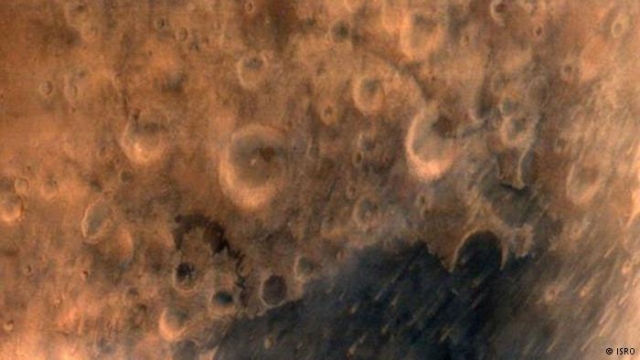
Mangalyaan sends its first Mars pictures

Mangalyaan's first image of Mars

Indian engineers have posted Mangalyaan’s first image on the spacecraft’s Facebook and Twitter accounts, as well as presented the photo to their nation’s leader.

My first reaction when I looked at the image above was an immediate flashback to 1969, when the American probes Mariner 6 and Mariner 7 flew past Mars, taking images of its cratered southern hemisphere and thus making scientists think for several years that Mars was not much different than the Moon. The Indian image is of about the same quality, and shows lots of moon-like craters.

Image if this was the first close-up image of Mars anyone had ever seen. It would be very easy to assume that Mars is pockmarked with craters everywhere, just like the Moon.

1 comment

Europe struggles to contain costs on its next generation rocket

New budget estimates for replacing Arianespace’s Ariane 5 rocket now say that they will have to include the construction of an entirely new launchpad, raising costs.

Nonetheless, Europe is trying to keep its per launch cost down and competitive.

ESA and the Airbus-Safran joint venture that proposes to manage Ariane development also floated per-launch costs that were lower than previous estimates. The lighter-version Ariane 62, with two solid-rocket boosters, could be built for as little as 65 million euros assuming a nine-per-year launch rhythm, officials said. The heavier Ariane 64, intended mainly for the commercial market and capable of carrying two satellites weighing a combined 11,000 kilograms into geostationary transfer orbit, could be built for 85 million euros each, again assuming a nine-per-year production rate.

These numbers are tiny compared to what they have charged in the past, and though higher than SpaceX’s, are within a price range that will keep them in business, assuming they can achieve them.

0 comments

Why India’s Mars probe was so cheap

Alan Boyle has some interesting thoughts on why it cost India so little, less than the budget of the movie Gravity, to build and send its probe Mangalyaan to Mars.

The $74 million Mars Orbiter Mission, also known by the acronym MOM or the Hindi word Mangalyaan (“Mars-Craft”), didn’t just cost less than the $100 million Hollywood blockbuster starring Sandra Bullock. The price tag is a mere one-ninth of the cost of NASA’s $671 million Maven mission, which also put its spacecraft into Mars orbit this week. The differential definitely hints at a new paradigm for space exploration β€” one that’s taking hold not only in Bangalore, but around the world. At the same time, it hints at the dramatically different objectives for MOM and Maven, and the dramatically different environments in which those missions took shape.

Read it all. It gives us a hint at the future of space exploration.

0 comments

Russia announces plans to fund its share of ISS through 2025

In a somewhat unexpected development today, Russian Deputy Prime Minister Dmitry Rogozin revealed today that Russia intends to spend $8.2 billion (321 billion rubles) on research and development at the International Space Station through 2025.

β€œThe 2016-2025 draft of the target federal program provides for allocating 321 billion rubles for the ISS development and operation, including the creation of new modules for unmanned spacecraft,” Rogozin said during a visit to a cosmonaut training center. β€œRussia channels considerable funds into development of this area of Russian space science. We are now thinking of research projects designed to explore outer space, as well as new projects in manned cosmonautics,” Rogozin said.

Up until now the Russians have been unclear about what they intend to do at ISS. NASA had asked them to extend the partnership to 2024. Their initial response was almost hostile, with Rogozin even threatening to stop flying American astronauts to ISS on Russian Soyuz rockets/capsules. Now it appears that they have decided to up their participation with new modules and agree to the extension.

Moreover, Rogozin’s statement suggests they are going to take a more independent position when it comes to human research in space. Up until now, they have allowed NASA a veto on flying any long manned missions on ISS, which is why no yearlong expeditions prior to next year’s have taken place. NASA kept saying no. This report suggests that once we have our own methods for getting astronauts to ISS they are going to go their own way and begin flying their own long term missions to ISS. We will fly our astronauts there on our schedule, and they will fly their astronauts there on their schedule.

Should make for some interesting news stories, eh? Will Russian and American astronauts even be allowed in each other’s modules? I am reminded of stories of messy divorces where the couples still had to live in the same house.

1 comment

Success for India’s Mars Orbiter Mission

The competition heats up: On Wednesday morning India’s Mars orbiter Mangalyaan successfully fired its engines and attained Mars orbit.

More here.

There are probably three dozen stories in the India press today extolling this success. And there should be. As described in detail in the second link above, India did this mission smart, simple, and fast, showing everyone else that a science mission doesn’t have to take a decade and a billion dollars to be get built.

I expect that this success will quickly lead to the Indian manned flight tests their space agency ISRO has been advocating for the past few years.

0 comments

The Great Space Race

Yesterday the private commercial launch company SpaceX broke ground on its own private spaceport near Brownsville, Texas.

“This feels great. It feels like the future,” [SpaceX founder Elon] Musk said at the ground-breaking. … He intends to have the first launch in late 2016, with an initial 12 launches a year. Ultimately, β€œthousands of launches,” he projected. Furthermore, β€œwhen we start doing commercial crew activities, I would expect us to launch a crew from here,” he said.

The significance of this construction is not trivial. This will be the first spaceport built by a private company that will be used to launch its privately-built commercial rockets, and will do it for profit. Other spaceports have been established in the last decade for the purpose of private space tourism, but none have seen anything fly, and all those spaceports were some form of quasi-government operation.

SpaceX’s Brownsville spaceport, rumored to be dubbed Mars Crossing, is not a government-run operation, however. It will be wholly owned and operated by the company, and is being built to allow them to launch commercial satellites unconstrained by the rules that make launches from the government controlled spaceports at the Kennedy Space Center as well as Vandenberg Air Force Base in California difficult and complicated.

This ground-breaking also comes on the heels of last week’s announcement that SpaceX and Boeing have been chosen by NASA to build spacecraft to ferry human astronauts to and from the International Space Station.

It also comes at the same time the Russian government has reorganized its entire aerospace industry to place it under government control, committed billions for the accelerated construction of a new spaceport on Russian territory, and launched the first test flight of its own new rocket, Angara, designed to compete for commercial market share while also reenergizing the entire Russian space effort.

Nor is that all.
» Read more

6 comments
1 684 685 686 687 688 784