Curiosity finds organic materials on Mars, including fluctuating levels of methane

Data from Curiosity has found both organic chemicals in the surface of Mars as well as quickly changing levels of methane in the nearby atmosphere.

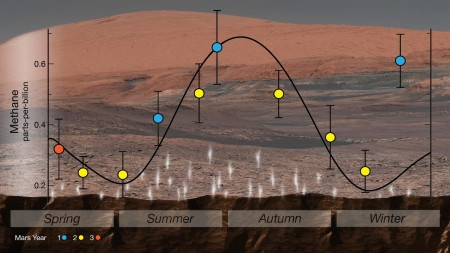
NASA’s Mars Curiosity rover has measured a tenfold spike in methane, an organic chemical, in the atmosphere around it and detected other organic molecules in a rock-powder sample collected by the robotic laboratory’s drill. “This temporary increase in methane — sharply up and then back down — tells us there must be some relatively localized source,” said Sushil Atreya of the University of Michigan, Ann Arbor, and Curiosity rover science team. “There are many possible sources, biological or non-biological, such as interaction of water and rock.”

The organic material does not prove there is or was ever life on Mars. What it shows is that conditions on Mars could have once supported life. The methane detection, however, is a more significant finding, as it suggests that something very nearby to Curiosity is causing the spike. It could be life, or it could be chemical activity, but in either case, it means there is activity.

The one caveat is that the spike still did not amount to much, 7 parts per billion. Whatever is causing it is not really doing very much.

Curiosity confirms that Gale Crater was once a water filled lake.

New geological data from Curiosity suggests that the interior of Gale Crater was shaped by sediments placed there by the rise and fall of a lake over millions of years.

The data also confirms that conditions on Mars were good enough for liquid water to be maintained on the surface for long periods of time. The problem is that scientists still do not understand how Mars could have maintained such kind of atmosphere and environmental conditions, based on its location and size.

A geological score for Curiosity!

Spectroscopy from Curiosity’s most recent drilling has been found to match and thus confirm the spectroscopy of the same spot taken years ago from orbit.

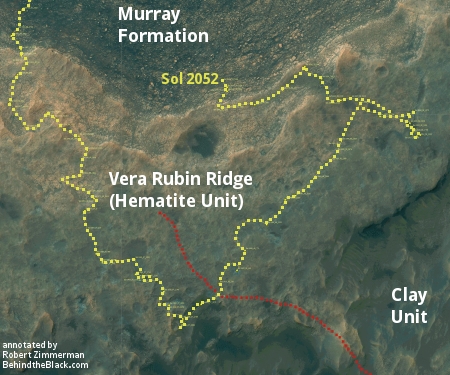
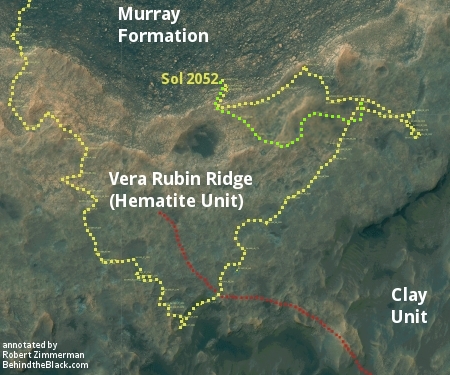
In observations reported in 2010, before selection of Curiosity’s landing site, a mineral-mapping instrument on NASA’s Mars Reconnaissance Orbiter provided evidence of hematite in the geological unit that includes the Pahrump Hills outcrop. The landing site is inside Gale Crater, an impact basin about 96 miles (154 kilometers) in diameter with the layered Mount Sharp rising about three miles (five kilometers) high in the center.

“We’ve reached the part of the crater where we have the mineralogical information that was important in selection of Gale Crater as the landing site,” said Ralph Milliken of Brown University, Providence, Rhode Island. He is a member of Curiosity’s science team and was lead author of that 2010 report in Geophysical Research Letters identifying minerals based on observations of lower Mount Sharp by the orbiter’s Compact Reconnaissance Imaging Spectrometer for Mars (CRISM). “We’re now on a path where the orbital data can help us predict what minerals we’ll find and make good choices about where to drill. Analyses like these will help us place rover-scale observations into the broader geologic history of Gale that we see from orbital data.”

This is a significant finding. Not only does this data now prove that the orbital data is correct, it demonstrates that scientists can now use that orbital data to direct Curiosity to even more interesting geological surface features. In fact, this ground-based data will help them calibrate all their orbital data more precisely, thus making our geological knowledge of Mars more accurate and reliable.

Curiosity to begin climbing

Scientists have decided to begin Curiosity’s climb of Mount Sharp immediately rather than continue a planned traverse along the base of the mountain prior to heading uphill.

Curiosity’s trek up the mountain will begin with an examination of the mountain’s lower slopes. The rover is starting this process at an entry point near an outcrop called Pahrump Hills, rather than continuing on to the previously-planned, further entry point known as Murray Buttes. Both entry points lay along a boundary where the southern base layer of the mountain meets crater-floor deposits washed down from the crater’s northern rim.

The issues with Curiosity’s wheels also played a part in this decision.

Review panel approves extensions for seven planetary missions.

In approving extensions of seven NASA planetary missions, a review panel concluded that the Curiosity rover wasn’t doing the best it could, and that the project scientist didn’t work hard enough to change their minds.

The Mars Science Laboratory’s Curiosity rover landed on the red planet in August 2012. Equipped with a drill to gather surface samples and spectroscopy equipment to analyze the samples, the rover has collected and analyzed five surface specimens so far and, according to the extended mission proposal just approved by NASA, would analyze another eight over the next two years. That is “a poor science return for such a large investment in a flagship mission,” a 15-person senior review panel chaired by Clive Neal, a geologist at the University of Notre Dame in South Bend, Indiana, wrote in a report published Sept. 3.

The report also chided John Grotzinger, the lead Curiosity project scientist at NASA’s Jet Propulsion Laboratory in Pasadena, California, for neglecting to show up in person during a Mars-focused senior review panel meeting in May. “This left the panel with the impression that the [Curiosity] team felt they were too big to fail,” the senior review panel wrote.

This sounds like a pissing war between scientists. Grotzinger didn’t give them the required deference so they slammed him. No matter happened, however, we know they weren’t going to cancel Curiosity’s funds.

A problem with drilling on Mars

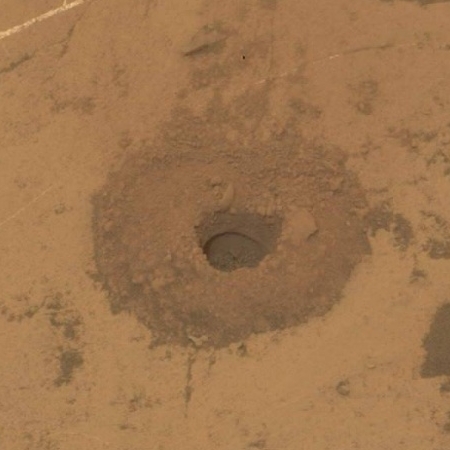
In drilling a new hole while scientists considered Curiosity’s future route to Mount Sharp, the drill cut off operations prematurely.

Engineers think that the rock might have shifted during drilling, causing the robot rover to abort. They have ordered the rover to take a lot of pictures of the situation so they can figure out what happened.

I should note that engineers take a large risk every time they use Curiosity’s drill, as the design of the rover’s electrical system is such that the drill might short everything out while it operates. Thus, when I see a story about a problem with any drilling operation, I become very concerned. In this case, however, it appears to not be a problem with the rover itself.

Curiosity retreats from Hidden Valley

Finding its sandy floor slipperier than expected, engineers have backed Curiosity out of Hidden Valley to drill some holes while they reassess the rover’s route.

The rover’s wheels slipped more in Hidden Valley’s sand than the team had expected based on experience with one of the mission’s test rovers driven on sand dunes in California. The valley is about the length of a football field and does not offer any navigable exits other than at the northeastern and southwestern ends. “We need to gain a better understanding of the interaction between the wheels and Martian sand ripples, and Hidden Valley is not a good location for experimenting,” said Curiosity Project Manager Jim Erickson of JPL. …

Curiosity reversed course and drove out of Hidden Valley northeastward. On the way toward gaining a good viewpoint to assess a possible alternative route north of the valley, it passed over the pale paving stones on the ramp again. Where a rover wheel cracked one of the rocks, it exposed bright interior material, possibly from mineral veins.

More and more, the journey to Mount Sharp appears to be increasingly adventurous for the rover.

Curiosity’s journey continues

After more than a full Martian year, Curiosity has finally traveled beyond the area of its initial landing zone.

The 1-ton Curiosity rover has now cruised out of its landing ellipse, the area — about 4 miles wide by 12 miles long (7 by 20 kilometers) — regarded as safe ground for its August 2012 touchdown within Mars’ huge Gale Crater, NASA officials said.

The interesting factoid from this article is how much smaller this landing zone was for Curiosity compared to all other previous landers, illustrating how the technology has advanced during the last four decades since Viking.

The Curiosity science team celebrates the completion of a full Martian year since the rover’s landing.

The Curiosity science team celebrates the completion of a full Martian year since the rover’s landing.

This is mostly a press event aimed at convincing the world that the project is accomplishing its goals. Though they are justified in touting the many significant things about Mars and the past environment in Gale Crater that Curiosity has uncovered, we mustn’t forgot that the main goal was always to climb the slopes of Mt Sharp in order to study its geological layers and thus the long term geological history of Mars. The rover has not yet done this, and because of the greater-than-expected wheel damage the rover is experiencing, is at risk of not being able to get where it has to go.

Engineers commanded Curiosity to drill its third drill hole on Tuesday on what looks like an outcrop of sandstone in Gale Crater.

Engineers commanded Curiosity to drill its third drill hole on Tuesday on what looks like an outcrop of sandstone in Gale Crater.

This hole is shallow and is merely a test to see if a deeper full bore would be worthwhile geological.

That Curiosity has only drilled three holes, and is now only doing a test bore first is partly because engineers fear that using the drill too much will cause a short circuit that will disable the rover entirely. This fear is because of a design flaw in the construction of the rover and the drill.

Curiosity has reached another area of interesting terrain: rows of layered curvy rocks.

Curiosity has reached another area of interesting terrain: rows of layered curvy rocks.

The science team has been hunting for tasty rock outcrops suitable for the first drilling campaign since she departed the dried out lakebed at Yellowknife Bay in July 2013 and began her epic trek across the floor of Gale Crater towards the base of Mount Sharp. With each passing Sol, or Martian day, Mount Sharp looms larger and larger and the historical layers with deposits of hydrated minerals potentially indicative of an alien habitable zone come ever clearer into focus.

The panoramas are quite spectacular as the rover continues its journey toward Mt Sharp.

In celebration of the tenth anniversary of Opportunity’s landing on Mars, the journal Science publishes a special section of the newest findings from Mars.

In celebration of the tenth anniversary of Opportunity’s landing on Mars, the journal Science has published a special section of the newest findings from Mars.

The main conclusion of all this research is that Mars was once potentially habitable, though there is no evidence so far to show that anything actually inhabited it. The data obtained however is now giving scientists clues on the best places to look for the remains of that ancient life, should it exist.

It seems Curiosity’s wheels are wearing out faster than expected and engineers want to know why.

It seems Curiosity’s wheels are wearing out faster than expected and engineers want to know why.

The increasedwear recently appears to be because the rover was traveling over rougher terrain. Nonetheless, JPL engineers are going to monitor the rover’s travel and wheel damage more closely in order to gauge that wear better for future travel.

Curiosity has succeeded in dating the age of one of its rock samples, the first time this has ever been done remotely on another planet.

Curiosity has succeeded in dating the age of one of its rock samples, the first time this has ever been done remotely on another planet.

The second rock Curiosity drilled for a sample on Mars, which scientists nicknamed “Cumberland,” is the first ever to be dated from an analysis of its mineral ingredients while it sits on another planet. A report by Kenneth Farley of the California Institute of Technology in Pasadena, and co-authors, estimates the age of Cumberland at 3.86 billion to 4.56 billion years old. This is in the range of earlier estimates for rocks in Gale Crater, where Curiosity is working.

This is significant engineering and scientific news. In the past the only way to date the rocks on another world was to bring them back to Earth. This was how the moon’s geology was dated. On Mars, dating has only been done by crater counting, comparing those counts with those on the Moon, and then making a vague guess. To have the ability to date rocks remotely means that geologists can begin to sort out the timeline of Mars’s geology without having to bring back samples.

Fresh impacts caused by Curiosity during landing

impacts from Curiosity debris

The image on the right is a cropped close-up of a Mars Reconnaissance Orbiter image taken in early September that shows a fresh cluster of impacts, all smaller than six feet across. Nearby but not visible in this image are four larger craters about 12 to 15 feet in diameter. The impact cluster is located just northwest of Gale Crater and was not present in images taken before Curiosity’s arrival on Mars. The cluster is also in line with other impact craters produced by other debris dropped by Curiosity as it descended onto the Martian surface.

Scientists are at the moment unsure what spacecraft debris caused these impacts.

Assigning each of the impacts to specific pieces of hardware is a challenging puzzle, but it is thought that the four large craters were produced by two large tungsten weights that broke in half to make these four craters, or by pieces of the cruise stage, which was designed to break up in the atmosphere for planetary protection purposes, to kill any Earthly microbes.

The cluster imaged here adds to the mystery, and may have been produced by a piece of the cruise stage that traveled farther through the Martian atmosphere and was therefore more thoroughly fragmented by the time it crashed onto the surface.

Identifying the source of the debris is a challenging engineering problem that also has scientific interest. Knowing what caused the impacts and then studying how the surface was changed by them will tell geologists a great deal about the make up of that surface.

Curiosity has found that water and other interesting things permeate the soil of Mars.

Curiosity has found that water and other interesting things permeate the soil of Mars.

When [a soil sample was] heated, the instrument detected the abundance of water [about 2% of the sample] plus significant quantities of carbon dioxide, oxygen and sulfur compounds, according to the researchers. Carbonate materials — compounds that form in the presence of water — were also identified. The experiment confirmed the presence of oxygen- and chlorine-containing compounds — likely chlorates or perchlorates. Originally discovered by NASA’s 2008 Phoenix Mars Lander (and likely detected by NASA’s Viking landers in 1976), perchlorates were found in the soil of high-latitude arctic regions. This indicates that perchlorates occur globally over Mars. Though highly toxic to human biology, some microbes are known to use the oxidizing chemical for energy. This finding intensified the debate over whether hypothetical microbes on Mars could metabolize perchlorates in a similar way.

Perchlorates were proposed as an explanation for the Viking results by scientists who did not believe those results suggested the presence of microbiological life. I find it interesting that now scientists are saying that the perchlorates might actually be evidence of life. Once again, the uncertainty of science rules the day!

1 10 11 12 13 14 15