
How a big impact gave Vesta its grooves

New data suggests that when a large impact hit Vesta’s Rheasilvia basin sometime in the past, the entire asteroid was shaken up, producing ripples that eventually surfaced as the giant grooves that circle the asteroid’s equator.

“Vesta got hammered,” said Peter Schultz, professor of earth, environmental, and planetary sciences at Brown and the paper’s senior author. “The whole interior was reverberating, and what we see on the surface is the manifestation of what happened in the interior.”

The research suggests that the Rheasilvia basin on Vesta’s south pole was created by an impactor that came in at an angle, rather than straight on. But that glancing blow still did an almost unimaginable amount of damage. The study shows that just seconds after the collision, rocks deep inside the asteroid began to crack and crumble under the stress. Within two minutes major faults reached near the surface, forming deep the canyons seen today near Vesta’s equator, far from the impact point.

Essentially, for a very very short period of time, immediately after the impact, the solid material of the asteroid acted more like a liquid, producing ripples that immediately settled down as the solid deep equatorial grooves we see today.
0 comments

Dawn’s arrival at Ceres delayed one month

Though engineers have solved the problems caused when a radiation blast disabled Dawn’s ion engine and put it into safe mode for a week, the fix will cause a one month delay in its arrival at the asteroid Ceres.

Controllers discovered Dawn was in safe mode Sept. 11 after radiation disabled its ion engine, which uses electrical fields to “push” the spacecraft along. The radiation stopped all engine thrusting activities. The thrusting resumed Monday (Sept. 15) after controllers identified and fixed the problem, but then they found another anomaly troubling the spacecraft.

Dawn’s main antenna was also disabled, forcing the spacecraft to send signals to Earth (a 53-minute roundtrip by light speed) through a weaker secondary antenna and slowing communications. The cause of this problem hasn’t been figured out yet, but controllers suspect radiation affected the computer’s software. A computer reset has solved the issue, NASA added. The spacecraft is now functioning normally.

1 comment

Astronomers have detected water vapor spurting from Ceres, the solar system’s largest asteroid.

Using the Herschel Space Telescope astronomers have detected water vapor spurting from Ceres, the solar system’s largest asteroid.

Herschel’s sensors spied plumes during three of the four observation periods. The strength of absorption varied over a matter of hours, a trend probably caused by relatively small sources of water vapour rotating in and out of view of Earth, the researchers say.

Data gathered in March 2013 suggest that the plumes originated from two widely separated, 60-kilometre-wide spots in the dwarf planet’s mid-latitude regions. Together, these spots ejected about 6 kilograms of water vapour into space each second. Neither ground-based observations nor images from the Hubble Space Telescope are keen enough to identify the as-yet-mysterious areas, says Küppers. “We don’t know what these features are, we just know that they’re darker than their surroundings,” he notes.

The NASA probe Dawn will arrive at Ceres early next year, and take a good look at these plumes. Should be exciting.

0 comments

An update on Dawn in its journey from the asteroids Vesta to Ceres.

An update on Dawn in its journey from the asteroids Vesta to Ceres. Bottom line:

Dawn is 18 million kilometers (11 million miles) from Vesta and 50 million kilometers (31 million miles) from Ceres. It is also 3.47 AU (519 million kilometers or 322 million miles) from Earth, or 1,310 times as far as the moon and 3.42 times as far as the sun today. Radio signals, traveling at the universal limit of the speed of light, take 58 minutes to make the round trip.

0 comments

NASA scientists in a battle with astronomers over who gets to name things on Vesta and Mars.

A rose by any other name: NASA scientists are in a battle with astronomers over who gets to name things on Vesta and Mars.

This is not a new problem. The International Astronomical Union (IAU) has maintained its power over naming everything in space since the 1960s, even though the IAU has sometimes ignored the wishes of the actual discoverers and explorers and given names to things that no one likes. For example, even though the Apollo 8 astronauts wanted to give certain unnamed features on the Moon specific names, the IAU refused to accept their choices, even though those astronauts were the first human beings to reach another world and see these features up close.

Eventually, the spacefarers of the future are going to tell the IAU where to go. And that will begin to happen when those spacefarers simply refuse to use the names the IAU assigns.

1 comment

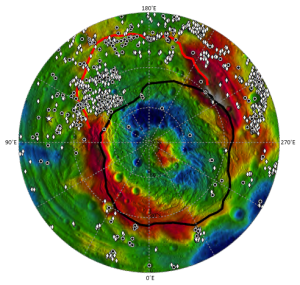
The mysterious dark streaks on Vesta

dark material on Vesta

In a preprint paper published today at the Los Alamos astro-ph website, scientists have taken a detailed look at the mysterious dark streaks seen by Dawn on the surface of the asteroid Vesta and have concluded that the material comes from impacts, not from volcanic activity.

The scientists also concluded that

the majority of the spectra of [dark material] are similar to carbonaceous chondrite meteorites mixed with materials indigenous to Vesta.

Carbonaceous chondrite meteorites are considered to be the most primeval material in the solar system. This means that Vesta has the potential to give scientists a convenient laboratory for studying that primeval material and the early formation of the solar system. Ideally, the best way to do this would of course be to go there.

The scientists also theorize that much of this material was brought to Vesta by a single large impact.
» Read more

0 comments

One of Dawn’s reaction wheels, used to orient the spacecraft, shut down last week.

Uh-oh: One of Dawn’s reaction wheels, used to orient the spacecraft, shut down last week.

During a planned communications pass on Aug. 9, the team learned that the reaction wheel had been powered off. Telemetry data from the spacecraft suggest the wheel developed excessive friction, similar to the experience with another Dawn reaction wheel in June 2010. The Dawn team demonstrated during the cruise to Vesta in 2011 that, if necessary, they could complete the cruise to Ceres without the use of reaction wheels.

That the spacecraft can get to Ceres without reaction wheels is good. However, can it be oriented precisely to do science without these wheels? The JPL press release does not say.

0 comments

Dawn has begun its slow departure from Vesta in anticipation of its journey to the solar system’s largest asteroid, Ceres.

Dawn has begun its slow departure from Vesta in anticipation of its journey to the solar system’s largest asteroid, Ceres.

The departure was actually announced two weeks ago, but since this is a very slow process it isn’t like we have missed anything. Dawn’s ion engines are very efficient, but they work at a very leisurely pace. It will take a month for the engine’s thrusters to push Dawn out of its orbit around Vesta.

0 comments

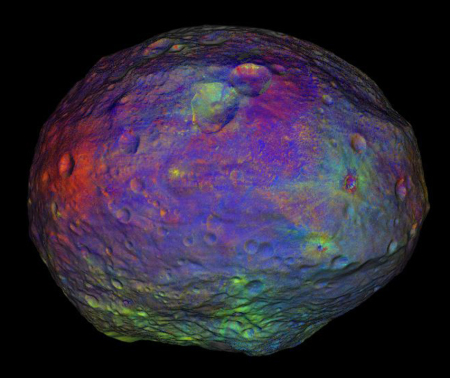
A global view of Vesta

Vesta

The accumulating data from Dawn has now allowed scientists to compile a global picture of the varied surface makeup of the asteroid Vesta.

The colors were chosen to highlight differences in surface composition that are too subtle for the human eye to see. Scientists are still analyzing what some of the colors mean for the composition of the surface. But it is clear that the orange material thrown out from some impact craters is different from the surrounding surface material. Green shows the relative abundance of iron. Parts of the huge impact basin known as Rheasilvia in Vesta’s southern hemisphere, for instance, have areas with less iron than nearby areas.

It also makes for a very nice image of the giant asteroid.

0 comments
1 4 5 6 7 8