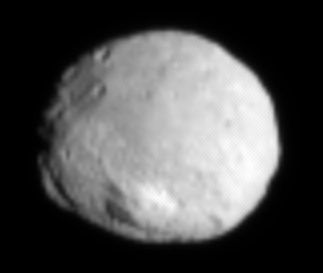
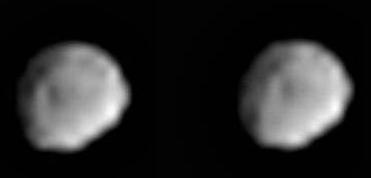
Dawn’s approach to Vesta continues.
Starting at the beginning of the approach phase on May 3, Dawn interrupted thrusting once a week to photograph Vesta against the background stars. These images help navigators determine exactly where the probe is relative to its target. This technique does not replace other means of navigation but rather supplements them. One of the principal methods of establishing the spacecraft’s trajectory relies on accurately timing how long it takes radio signals, traveling, as all readers know, at the universal limit of the speed of light, to make the round trip between Earth and Dawn. Another uses the Doppler shift of the radio waves, or the slight change in pitch caused by the craft’s motion. These sensitive measurements remain essential to navigating the faraway ship as it sails the interplanetary seas.
Despite the very slow approach, the distance is small enough now that observing Vesta weekly is no longer sufficient. To achieve the navigational accuracy required to reach the intended orbit in early August, last week the frequency of imaging was increased to twice per week. In each session, half of the pictures are taken with long exposures to ensure many stars are detectable, thus overexposing the much brighter disc of the nearby Vesta. The other half use short exposures to ensure that the rocky world shows up correctly so its precise location can be measured. The visible and infrared mapping spectrometer has been commanded to observe Vesta during three of these sessions, each time providing valuable information that will help scientists select instrument settings for when Dawn is close enough to begin its detailed scientific measurements.