Lab tests suggest water brines could also exist on large asteroids

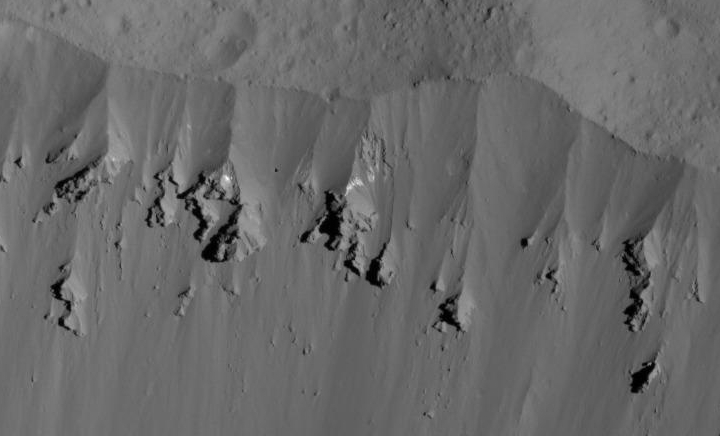
Gullies in crater on Vesta
Click for original image.

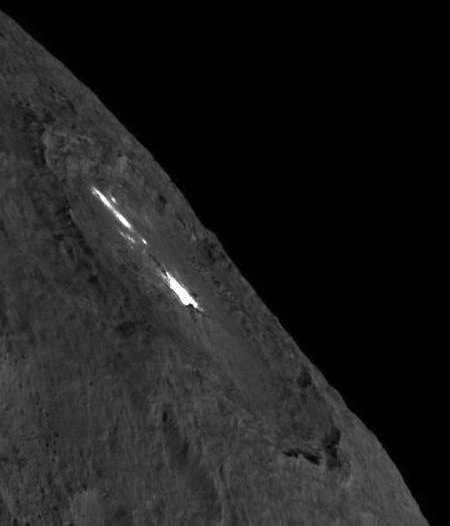
In attempting to explain the existence of flow features that have been found on the interior walls of craters on the asteroids Ceres and Vesta — as shown in the image above — scientists recently performed a laboratory experiment which determined that a mixture of water and salt could produce those gullies.

The team modified a test chamber at the Jet Propulsion Laboratory to rapidly decrease pressure over a liquid sample to simulate the dramatic drop in pressure as the temporary atmosphere created after an impact on an airless body like Vesta dissipates. According to Poston, the pressure drop was so fast that test liquids immediately and dramatically expanded, ejecting material from the sample containers.

“Through our simulated impacts, we found that the pure water froze too quickly in a vacuum to effect meaningful change, but salt and water mixtures, or brines, stayed liquid and flowing for a minimum of one hour,” said Poston. “This is sufficient for the brine to destabilize slopes on crater walls on rocky bodies, cause erosion and landslides, and potentially form other unique geological features found on icy moons.”

The press release makes it sound as if this result makes the existence of subsurface water ice more likely on such asteroids as Ceres and Vesta, but previous research from the Dawn asteroid probe made that fact very clear, especially for Ceres, years ago. All this does is provide some evidence of what might be one process by which these erosion gullies form.

Hat tip to reader Milt.
1 comment

Scientists: Any ice trapped in Ceres’ permanently shadowed craters has to be very young

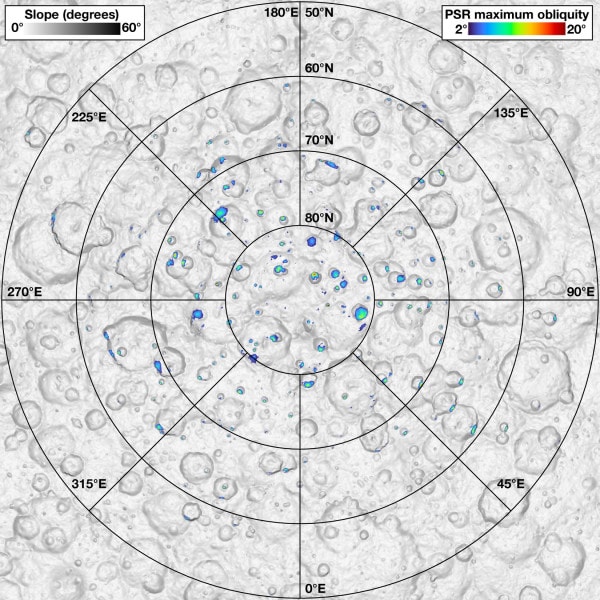
The permanently shadowed craters at Ceres' north pole
The permanently shadowed craters (blue) at Ceres’
north pole. Click for original image.

Scientists reviewing the archive data from the Dawn probe that orbited the asteroid Ceres from 2016 to 2018 have found that the permanently shadowed craters at the asteroid’s poles are periodically exposed to sunlight due to long term variations in Ceres’ orbit, meaning that any of the ice in those craters detected by Dawn must be extremely young.

When Ceres reaches its maximum axis tilt, which last occurred about 14,000 years ago, no crater on Ceres remains perennially shadowed and any ice in them must have quickly sublimated into space. “That leaves only one plausible explanation: The ice deposits must have formed more recently than that. The results suggest all of these ice deposits must have accumulated within the last 6,000 years or less. Considering that Ceres is well over 4 billion years old, that is a remarkably young age,” Schorghofer said.

This does not mean that Ceres doesn’t have ice. In fact, it is very ice rich, below the surface. This data instead suggests that the surface remains active, and that there are processes bringing that underground ice to the surface on a regular basis. Except for these craters, which remain permanently shadowed for long time spans, that ice sublimates away relatively quickly. This result fits with earlier data from Dawn, that suggested many active locations on the surface, including its most distinct crater, Occator.

0 comments

Cryovolcanism on Ceres still ongoing?

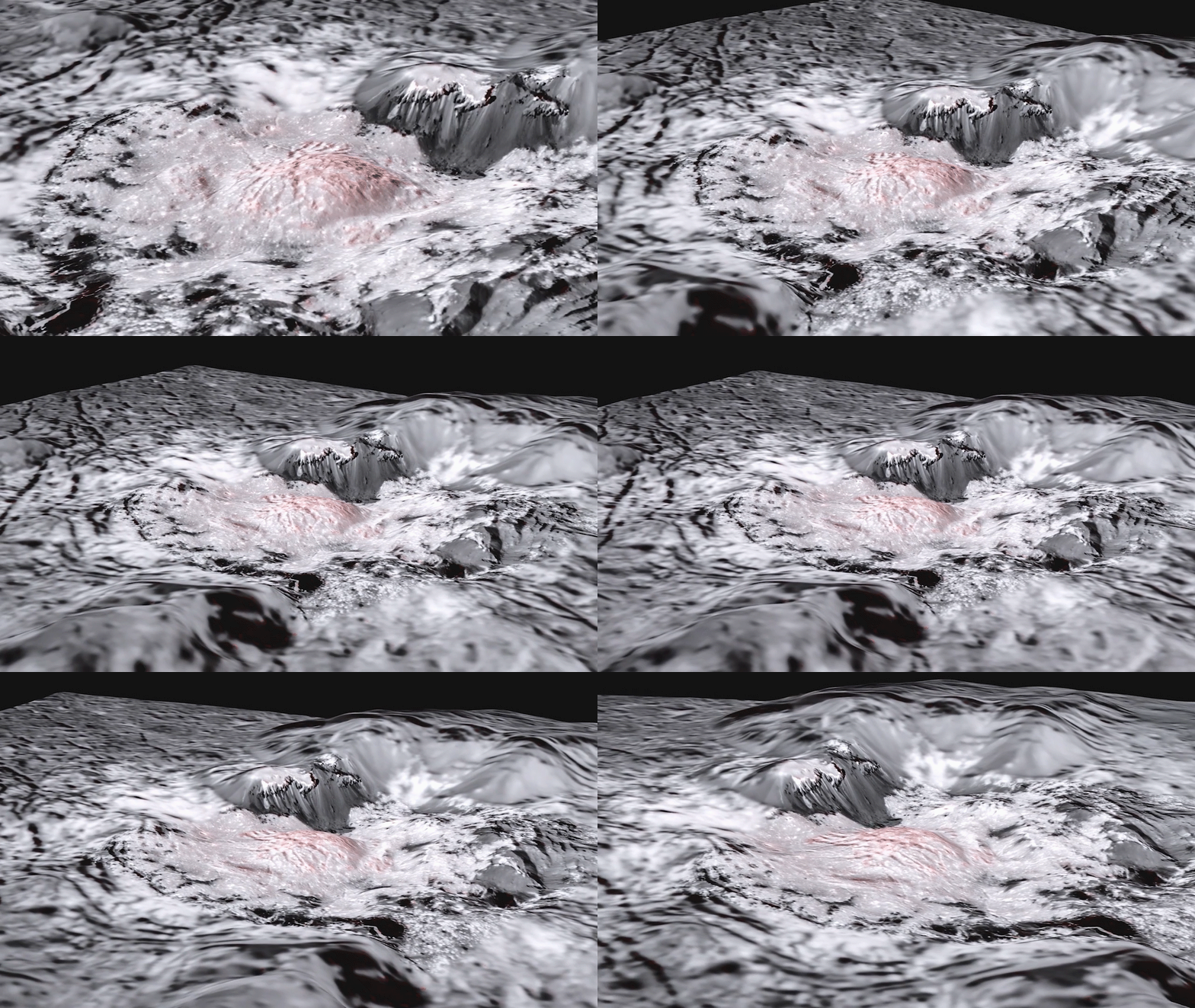
3D simulation of Occator Crater on Ceres
Click for full 3D simulation image.
Click here for animated movie.

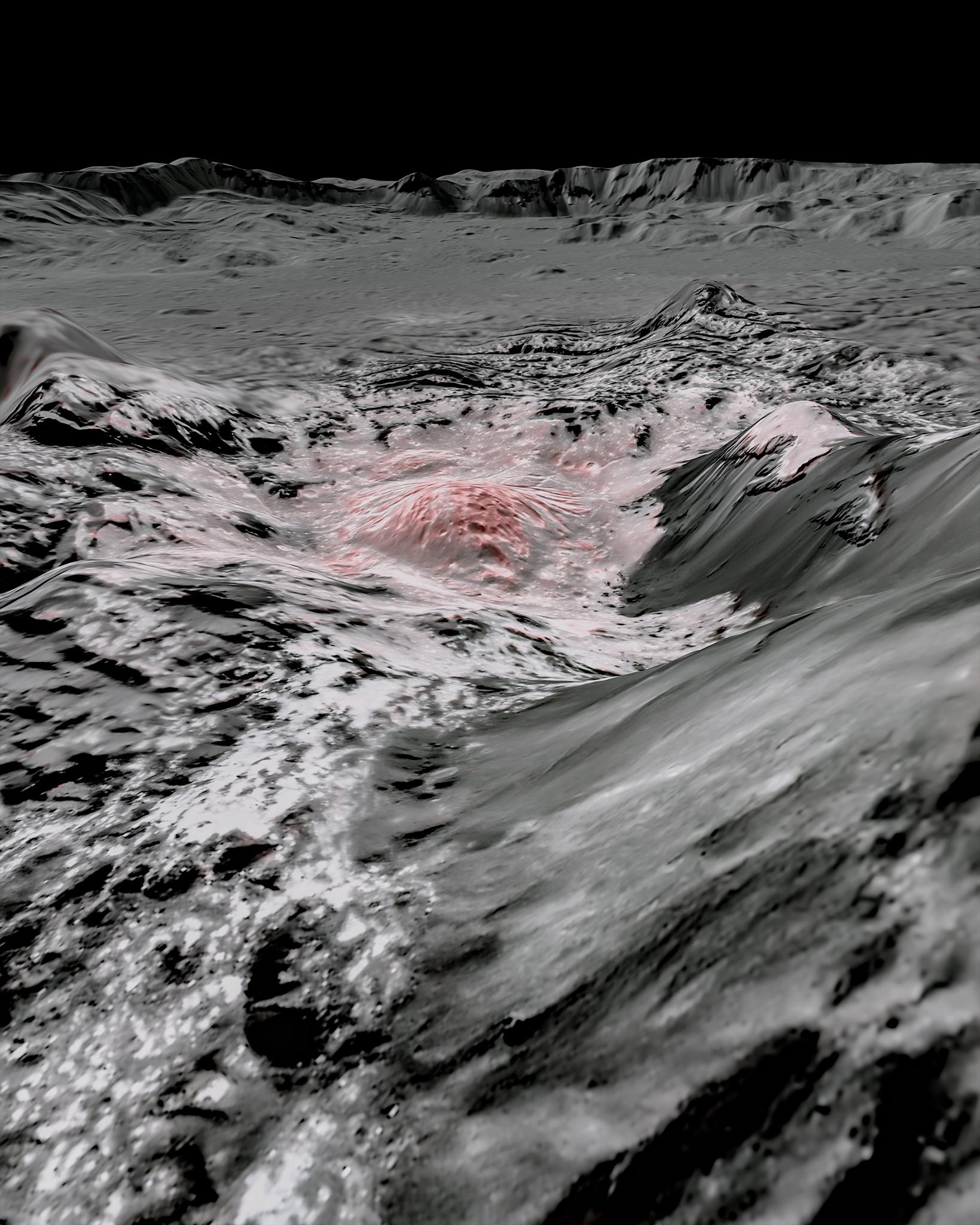
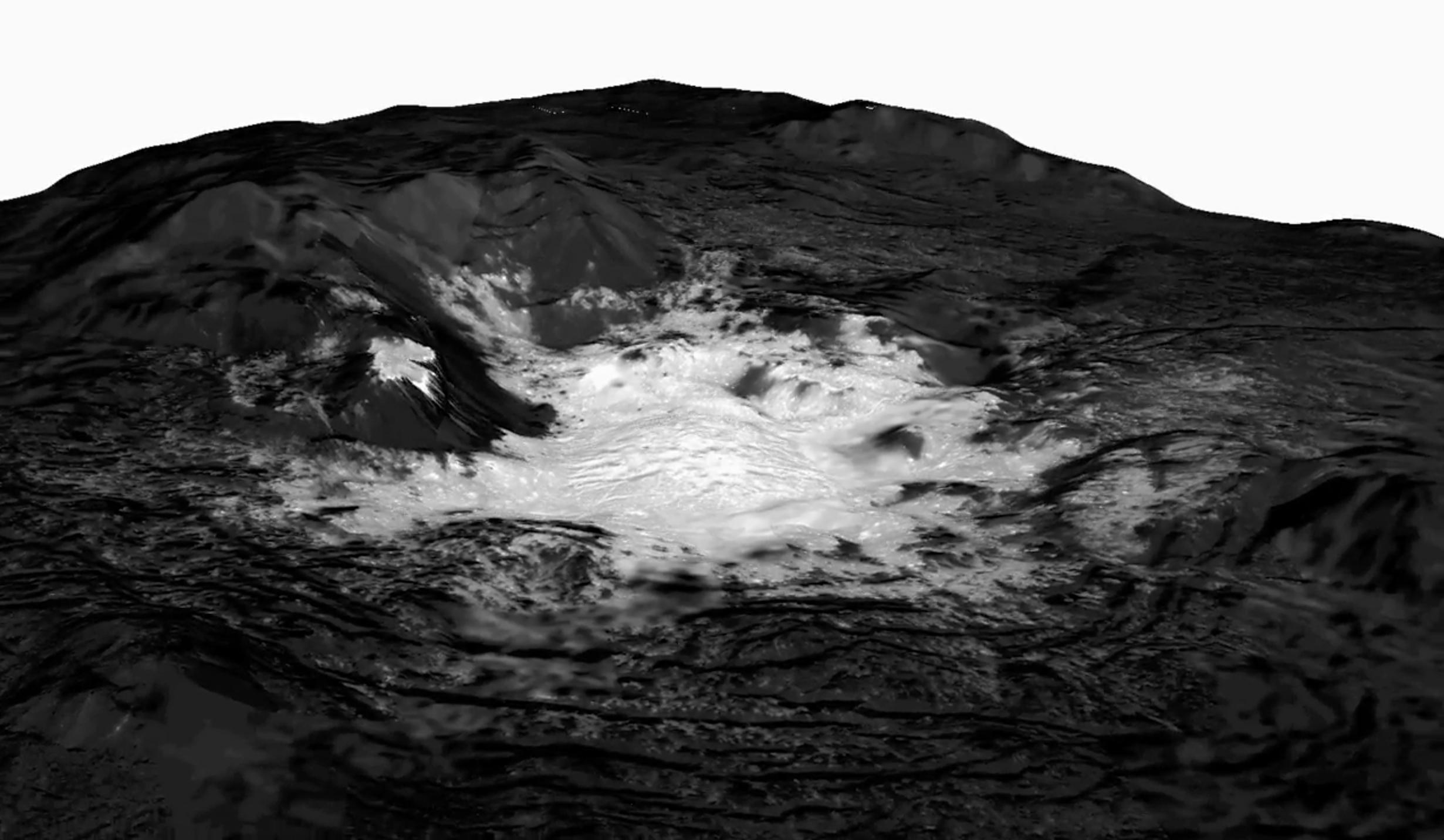
According to a new detailed analysis of data from the Dawn mission, scientists are now postulating that cryovolcanism in Occator Crater on Ceres began immediately after impact about 22 million years ago and has continued in fits and starts since.

Occator Crater was formed about 22 million years ago by a large impact. As in many other impact craters on Earth and on other planets, a central peak was formed, which collapsed again after some time. About 7.5 million years ago, brine rose to the surface within the remnants of the central peak. The water evaporated and certain salts, so-called carbonates, remained. They are responsible for the prominent bright deposits we see today, called Cerealia Facula, in the center of Occator Crater. Due to the loss of material in the interior, the inner part of the crater subsided. A round depression with a diameter of about 15 kilometers formed.

In the following millions of years, activity concentrated mainly on the eastern part of the crater floor. Through cracks and furrows, brine also rose to the surface there and produced further bright deposits, the Vinalia Faculae. About 2 million years ago the center of the crater woke up again: brine rose to the surface and within the central depression a dome of bright material was formed. “This process continued up to a million years ago and maybe even until today,” Dr. Nico Schmedemann from the University of Münster summarizes.

This hypothesis is further supported by second paper that proposes there remains a reservoir of salty underground liquid water in the tiny planet’s interior. Both add weight to the idea that any object in space that is large enough for gravity to force it into a spherical shape is going to behave like a planet, with a complex and active geology.

The first paper has a lot of uncertainty, however, centering entirely on its dependence on crater counts to determine age. While providing a rough age estimate, the method depends on many assumptions, is indirect, and could easily be entirely wrong.

0 comments

Ceres has too much water!

The uncertainty of science: In a paper released today, scientists puzzle over the amount of water they have detected evaporating from the dwarf planet Ceres, finding that observations by Dawn of its surface do not provide enough water sources to explain the amount of water in its thin atmosphere.

From the abstract:

The dwarf planet Ceres, the largest object in the asteroid belt, is known to contain large amounts of water ice, and water vapor was detected around it. Possible sources of the water are surface exposure of ice through impacts and subsequent sublimation when heated by sunlight, or volcanic activity. It turns out that with either process it is difficult to create sufficient water vapor to explain the observations. This means that the geological processes on Ceres are not fully understood.

They propose several possible explanations for the discrepancy. Either the measurements of evaporation are wrong, or they have not fully mapped the surface water sources on Ceres. Either or both are certainly possible, as there are great uncertainties here.

To me, the most interesting quote from their paper however is the amount of water discovered. Besides finding water on the surface at nine locations “localized on crater floors or slopes, and generally in or close to shadows,” they also found a lot of water under the surface.

The gamma ray and neutron detector on Dawn discovered a global ice‐rich layer in the subsurface of Ceres, at a depth of ~1 m in equatorial regions and much closer to the surface in polar regions. The estimated abundance of ice in this layer is ~10%. … Evidence for ice on depth scales of a few kilometers is [also] reported by Sizemore et al. (2018). From the analysis of geomorphological features, they find that the distribution of ice is heterogeneous on scales of 1 km to hundreds of kilometers.

In other words, Ceres has a lot of water below the surface, even if the evaporation rate observed by Dawn does not at present match the amount of water vapor observed surrounding Ceres.

0 comments

Oblique close-up image of Ceres

Ceres from Dawn

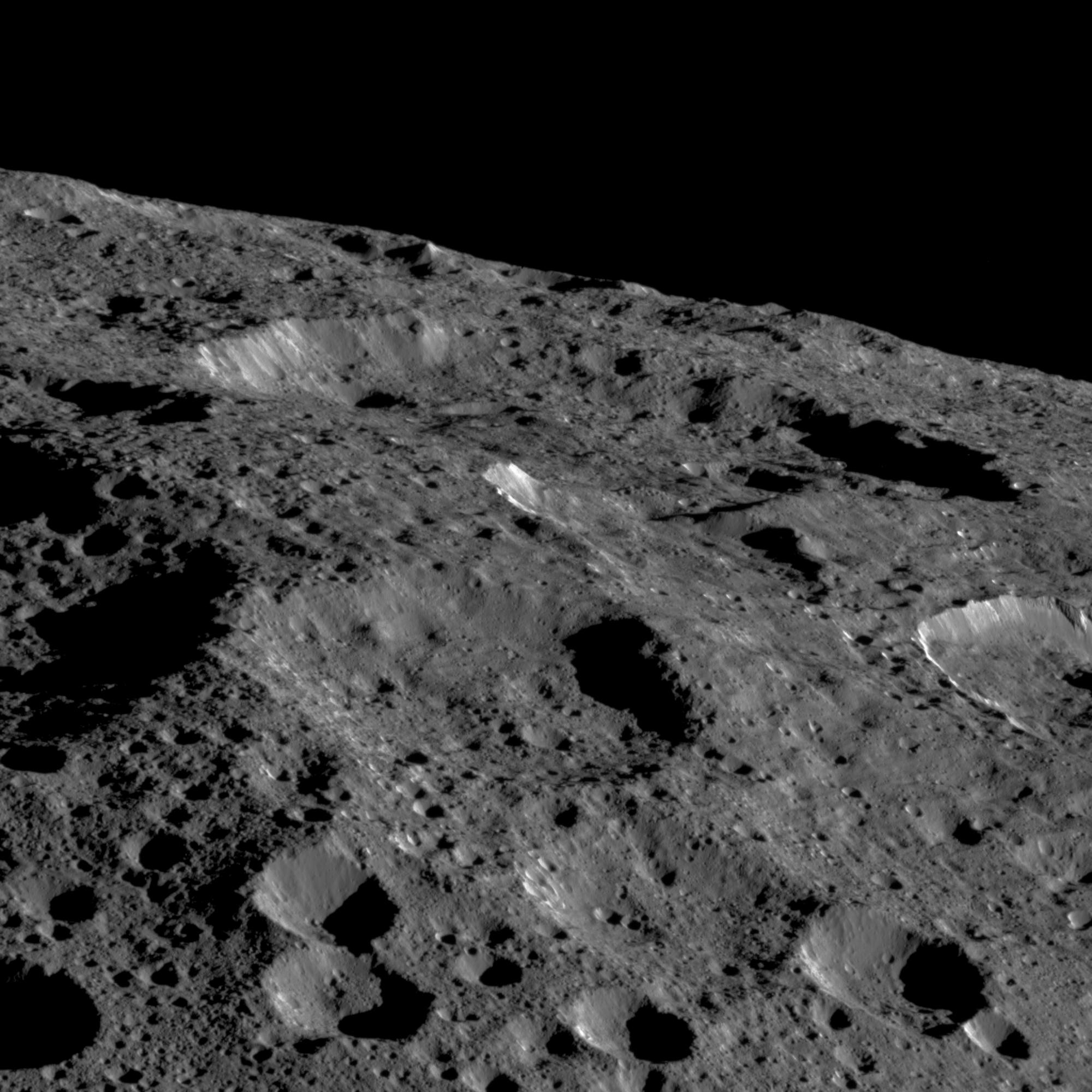
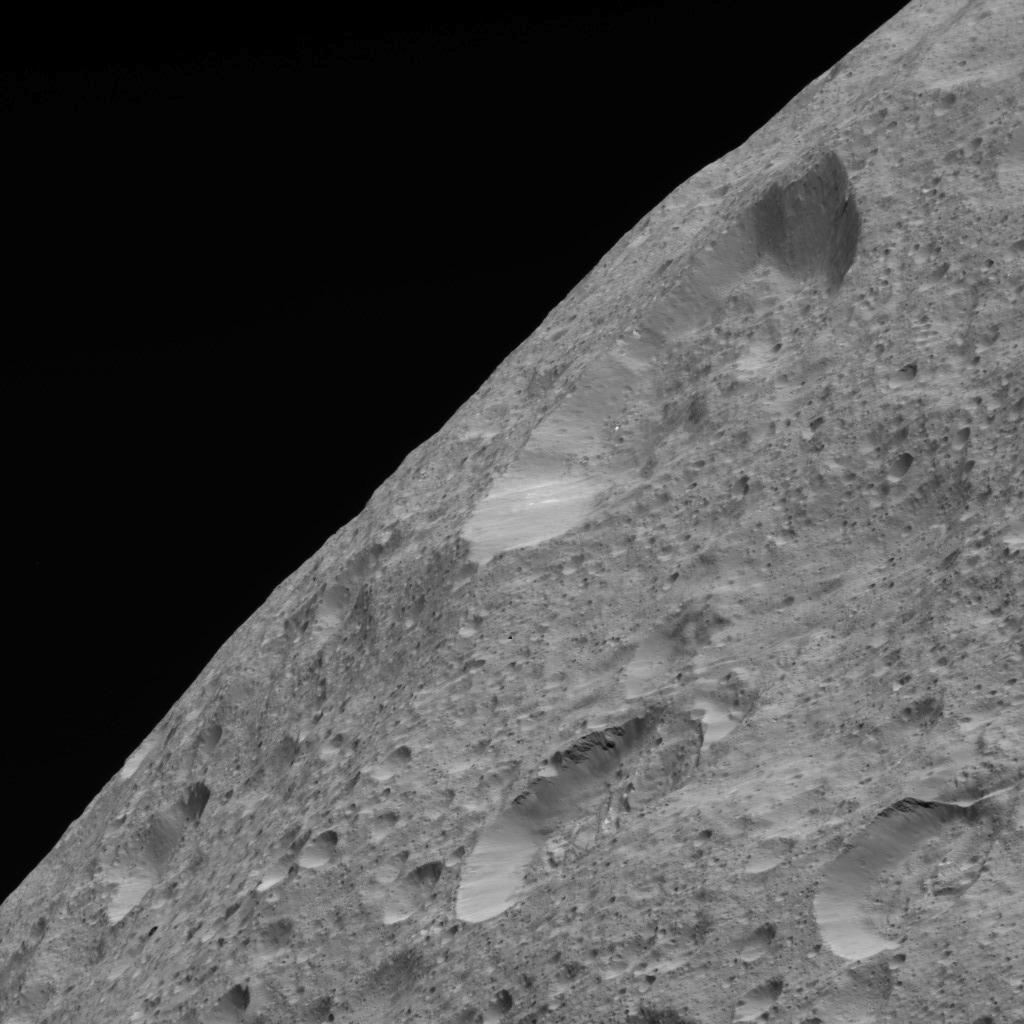
The Dawn science team has released an oblique close-up image of Ceres, taken in May 2018 before the Dawn mission ended. To the right is a reduced resolution version, with the full resolution photograph viewable if you click on it.

Dawn captured this view on May 19, 2018. The image shows the limb of Ceres at about 270E, 30N looking south. The spatial resolution is about 200 feet (60 meters) per pixel in the nearest parts of the image. The impact crater to the right (only partially visible) is Ninsar, named after a Sumerian goddess of plants and vegetation. It is about 25 miles (40 kilometers) in diameter.

Bright seeps running down the interior rims of several craters are visible. To my eye, the image also suggests an overall softness to Ceres. Its surface is like a sandbox, easily reshaped significantly by each impact.

1 comment

Ceres’ bright spots in Occator Crater

Occator Crater bright spot

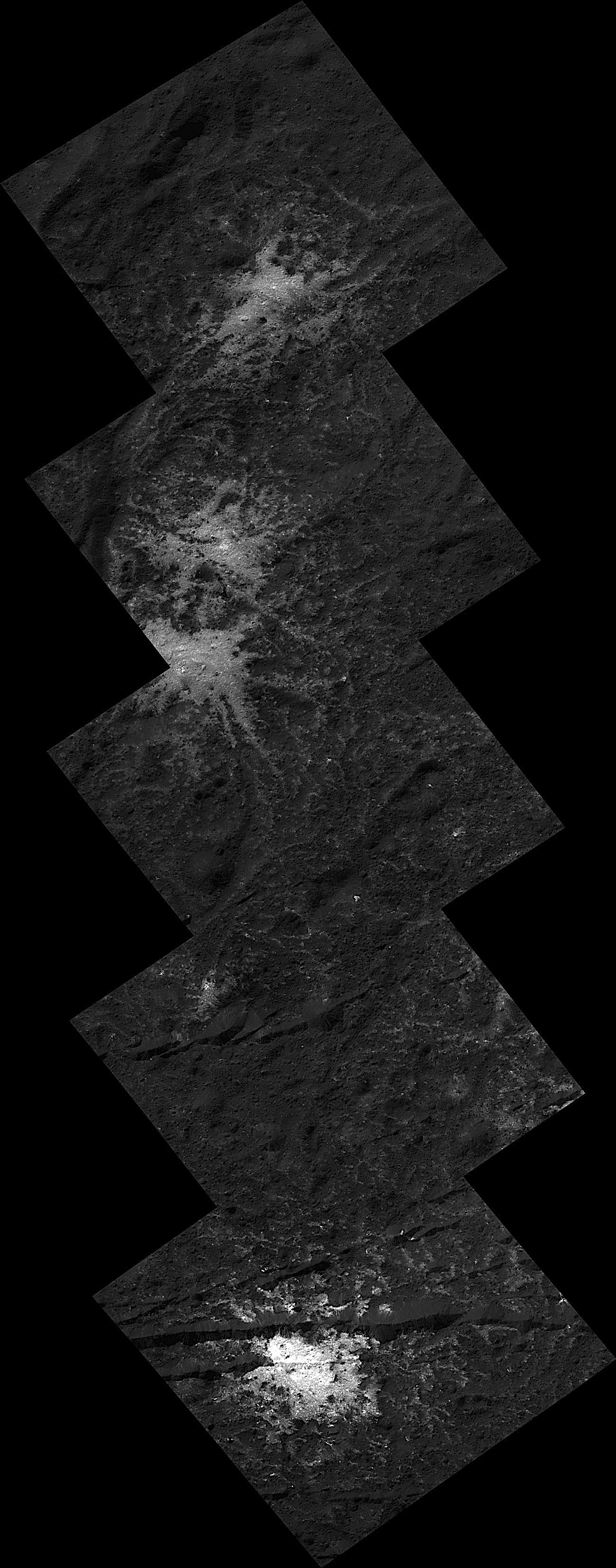
Cool image time! The Dawn science team has released some additional images taken shortly before the mission’s conclusion when Dawn was in its closest orbit of the dwarf planet Ceres. On the right is a tiny cropped portion of a much larger mosaic of the bright spots on the floor of Occator Crater, focusing on one large bright spot that also includes a fissure cutting across it. If you click on the image you can see the entire mosaic, covering an additional four more bright areas.

The mosaic was taken in June 2018 from a distance of 21 miles.

The press release describes these bright areas as “deposits of salts, in particular sodium carbonate, possibly extruded through fractures connecting the surface to a deep reservoir of salty liquid.” That surely looks confirmed by the fissures in the image to the right.

0 comments

Dawn’s last look at Ceres

Ceres

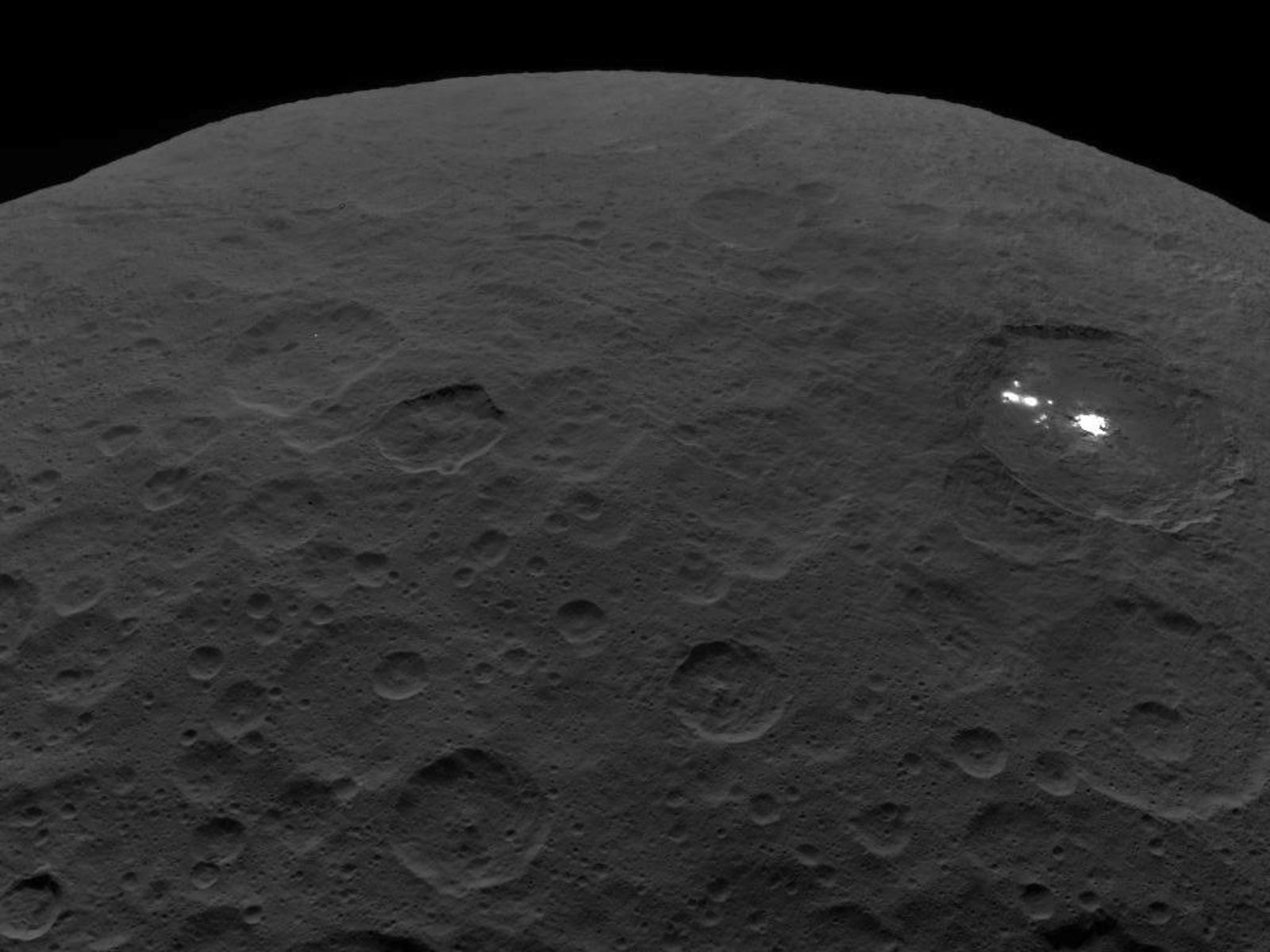
The Dawn mission has ended, and the image on the right, reduced to post here, is one of its last views of Ceres, with the bright spots of Occator Crater clearly visible, before its fuel ran out. You can see the full resolution image by clicking on the image.

This photo of Ceres and the bright regions in Occator Crater was one of the last views NASA’s Dawn spacecraft transmitted before it depleted its remaining hydrazine and completed its mission.

This view, which faces south, was captured on Sept. 1, 2018 at an altitude of 2,340 miles (3,370 kilometers) as the spacecraft was ascending in its elliptical orbit. At its lowest point, the orbit dipped down to only about 22 miles (35 kilometers), which allowed Dawn to acquire very high-resolution images in this final phase of its mission. Some of the close-up images of Occator Crater are shown here.

Occator Crater is 57 miles (92 kilometers) across and 2.5 miles (4 kilometers) deep and holds the brightest area on Ceres, Cerealia Facula in its center and Vinalia Faculae in its western side. This region has been the subject of intense interest since Dawn’s approach to the dwarf planet in early 2015.

If NASA made any specific announcement about the end of the mission, I have missed it. Either way, this end is not a surprise, because they have made it clear for the past few months that the spacecraft was about to run out of fuel.

They have also posted today an image of Ceres’ largest mountain, Ahuna Mons.

Update: Even as I posted this, NASA sent out this press release: NASA’s Dawn mission comes to an end

2 comments

Ceres’s poles have shifted by as much as 36 degrees

A new analysis of Dawn data suggests that the poles of Ceres have wandered by as much as 36 degrees, and the data also adds further support for the existence of a liquid water layer between the dwarf planet’s crust and mantle.

“The most surprising aspect of this paper is to me the observation that the pole of Ceres must have followed an indirect path to its current pole. A multi-step reorientation could mean that the equatorial density anomaly was still evolving during the reorientation, and this could be because the crust and mantle were weakly rotationally coupled, allowing the crust to start reorienting while the mantle would lag behind,” Tricarico said. “If crust and mantle are allowed to shift with respect to one another, that could point to a layer of reduced friction between crust and mantle, and one of the possible mechanisms to reduce friction could be an ancient water ocean beneath the crust.”

In other words, the crust and mantle are not locked together. Imagine a baseball where the ballcover is not tightly held to the inner core, and slides around it. (Boy there are a lot of pitchers who wish they could get a hand on that baseball.) The cause of that looseness on Ceres is possibly because of a liquid layer in-between the crust and the mantle.

Need I note that there are uncertainties here?

0 comments

Occator Crater on Ceres

Occator Crater

Cool image time! As Dawn’s long and successful mission to the asteroids Vesta and Ceres winds down, the spacecraft is taking a slew of spectacular close-up images of Ceres. The image on the right, cropped slightly to post here, is an oblique view of Occator Crater, home to the double bright spots that scientists now believe are caused by the upward seepage of a water-based brine from the interior.

The image was taken August 14, 2018 from a distance of 1149 miles. It clearly shows how the bright spots are depressions, not raised features. Additional images released this week of the floor of the crater capture a complex fracture network (seen here and here) with some fractures apparently quite deep.

All this suggests that the surface crust of Ceres is not very structurally strong, allowing a churning process that plows material up and down. The data also suggests that even on a small planetary body like Ceres the geological processes are going to be complex and often on-going, depending on material, energy, and the size of the body.

1 comment

Cryo-volcanism had less influence on shaping Ceres than predicted

The uncertainty of science: A careful analysis of the Dawn data has found that though cryo-volcanism has occurred repeatedly on Ceres, it had less influence on the dwarf planet’s surface than previous models had predicted.

At the same time, the data also suggests that Ceres has been more active throughout its history than predicted. They found about 22 domes that are apparently past cryo-volcanoes that have flattened out.

“Given how small Ceres is, and how quickly it cooled off after its formation, it would be exciting to identify only one or two possible cryovolcanoes on the surface. To identify a large population of features that may be cryovolcanoes would suggest a long history of volcanism extending up to nearly the present day, which is tremendously exciting,” said Sizemore. “Ceres is a little world that ought to be ‘dead,’ but these new results suggest it might not be. Seeing so much potential evidence for cryovolcanism on Ceres also lends more weight to discussions of cryovolcanic processes on larger icy moons in the outer solar system, where it’s likely more vigorous.”

1 comment

Oblique mosiac of bright spot on Ceres

Cerealia Facula on Ceres

Cool image time! With the Dawn spacecraft now swooping with 22 miles of the surface of Ceres every 27 hours, the science team has assembled a spectacular oblique image of Cerealia Facula, one of the dwarf planet’s bright spots thought to be brine deposits that at some point erupted up from below the surface.

The image on the right, reduced in resolution to show here, shows that mosaic. If you click on the image you can see the full resolution version. From the image webpage:

This mosaic of Cerealia Facula combines images obtained from altitudes as low as 22 miles (35 km) above Ceres’ surface. The mosaic is overlain on a topography model based on images obtained during Dawn’s low altitude mapping orbit (240 miles or 385 km altitude). No vertical exaggeration was applied.

There are a lot of intriguing details in the full resolution image. I have highlighted one feature, indicated by the white box and shown in full resolution below.
» Read more

4 comments

Ceres’ internal structure

The Dawn science team has released their first artist’s concept of the interior of Ceres, based on data gathered by the spacecraft.

Using information about Ceres’ gravity and topography, scientists found that Ceres is “differentiated,” which means that it has compositionally distinct layers at different depths. The most internal layer, the “mantle” is dominated by hydrated rocks, like clays. The external layer, the 24.85-mile (40-kilometer) thick crust, is a mixture of ice, salts, and hydrated minerals. Between the two is a layer that may contain a little bit of liquid rich in salts, called brine. It extends down at least 62 miles (100 kilometers). The Dawn observations cannot “see” below about 62 miles (100 kilometers) in depth. Hence, it is not possible to tell if Ceres’ deep interior contains more liquid or a core of dense material rich in metal.

The most intriguing part of this concept is the existence of a brine layer below the crust. I suspect it is this layer that they believe is the source of the white salty brine that produces Ceres’ ice volcanoes and bright spots.

0 comments

More close-up images of Ceres

Dome and fractures in Occator Crater

Strange image time! The Dawn science team today released a set of new images taken by the spacecraft in its new very close orbit of Ceres. The image on the right is a cropped section of one of those images, and shows some fractures and a dome in Occator Crater. The image was taken from 28 miles altitude, and if you click on it you can see the entire photograph.

What immediately stands out in this image is the strange bright flow on top of the dome. At first glance it looks like someone put a seashell there. In reality I think it is showing us a landslide of bright material flowing downward, towards the top of the image. The flow was significant enough that it piled up as it went down, which is why it created a cliff edge and shadow line at its base.

Everything we see here is influenced by Ceres’s tiny gravity. It is not unusual to see fractures in the floor of a crater, the nature of these fractures and domes is different, and will require a lot of work by scientists to interpret, because of the different environment.

0 comments

Close-up of bright spot in Occator Crater

Vinalia Faculae in Occator Crater

Cool image time! The Dawn science team today released some new images taken by the spacecraft in its final tight orbit around the dwarf planet Ceres. The image on the right is a cropped section of the full image. It shows some interesting details of part of one of the two bright spots in Occator Crater, dubbed Vinalia Facula, and was taken from a distance of 36 miles.

Other images show small bright spots in another small crater, fractures and interesting patterns in the floor of Occator crater, a dome in Occator Crater suggestive of underground processes pushing up, and other close-ups of its crater walls.

While all of these features are reminiscent of geology on Earth, none are really the same. Ceres’ light gravity and harsh environment, plus its history in the asteroid belt, requires alien processes that only hint at similarities to what we see on Earth.

5 comments

New close-up images of Ceres

Cerealia Facula on Ceres

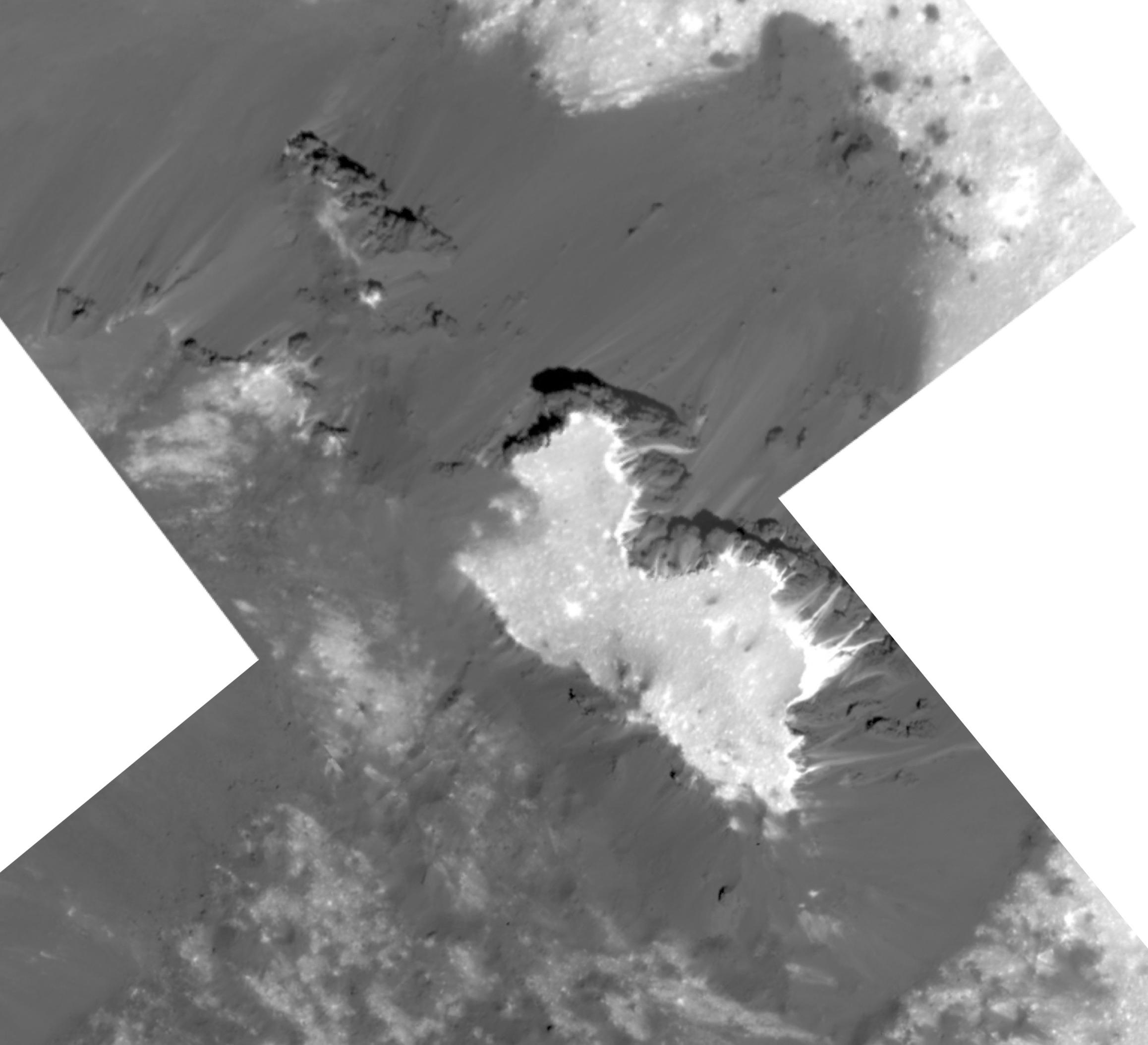
Cool image time! The image on the right, cropped and reduced in resolution to post here, is one of two images released today by the Dawn science team of the double bright spots found in Occator Crater, taken from the spacecraft’s tight final orbit above Ceres. This image shows what they have dubbed Cerealia Facula. The second image shows Vinalia Faculae.

This mosaic of Cerealia Facula is based on images obtained by NASA’s Dawn spacecraft in its second extended mission, from an altitude as low as about 21 miles (34 kilometers). The contrast in resolution obtained by the two phases is visible here, reflected by a few gaps in the high-resolution coverage. This image is superposed to a similar scene acquired in the low-altitude mapping orbit of the mission from an altitude of about 240 miles (385 km).

Inset of Cerealia Facula

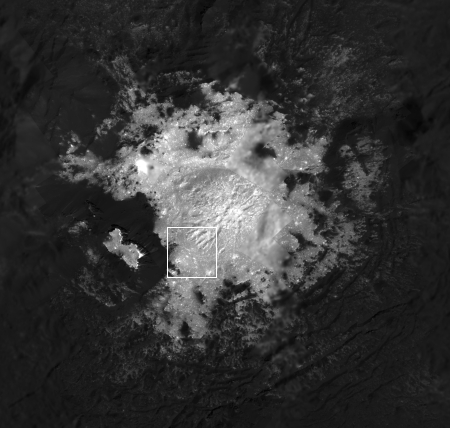
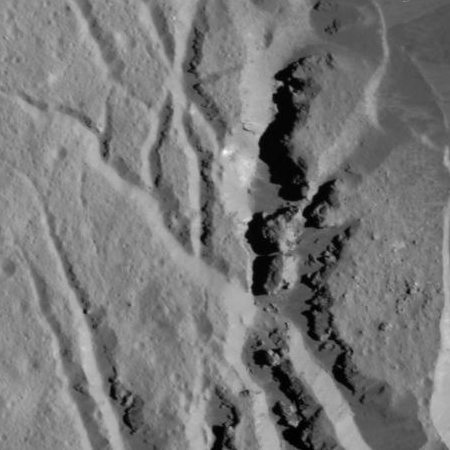
The second image on the left is a crop at full resolution of the area in the white box above. This gives you a taste of the many interesting things found in the full resolution image. For example, the bright spots scattered throughout this image suggest they are recent upwellings from below. The ridgelines in the upper right are either the remains of the water-ice volcano they think once stood here but subsequently slumped back down to form a depression, or pressure ridges being pushed up by later upwellings.

The full image has lots more. So does the image of Vinalia Faculae. Check them out.

14 comments

Close look at bright spots in Occator Crater on Ceres

Bright spot in Occator Crater on Ceres

Cool image time! In this week’s release of new images from Dawn, the science released close-ups of one of the bright spots located on the floor of Occator Crater on Ceres. The image on the right, cropped and reduced in resolution to post here, shows one white-topped mesa in that crater.

The geometry of this feature is similar to a mesa or large butte with a flat top. It has been puzzling scientists since its discovery in the early images of the Dawn mission at Ceres. These new images reveal many details. In particular, the relationships between the bright material, mostly composed of sodium carbonate, and the dark background might hold clues about the origin of the facula.

If you click on the image you can see the full image at full resolution.

The sun appears to be coming from the southeast, with the mesa’s cliff’s at the top. Along with some scattered bright spots, the white material appears to have a bright area aligned along the cliff’s rim. The white material also appears to be flowing down one gully in that cliff face.

It is important to remember that these bright spots are generally found in a depression in the crater. scientists now think they are remnants of a volcano-like mound that after erupting slowly slumped back down. Note also that the soft puffiness of the cliff faces probably indicates the lower density of this material due to Ceres’s tiny gravity, about 3% that of Earth’s.

4 comments

More close-up images of Ceres

On Monday the Dawn science team released more close-up images of Ceres, taken from Dawn’s final close orbit of the dwarf planet, with the focus of this release Occator Crater and its bright spots.

The current images now show numerous sections of Occator Crater from an altitude of 35 kilometers and with a resolution less than 5 meters per pixel. “The data exceeds all our expectations,” Dr. Andreas Nathues from the MPS, Framing Camera Lead Investigator, says. In the new images, the surface is now ten times better resolved than in the best images from the previous three years.

Impressive avalanches reveal themselves in the new views of the eastern wall of Occator Crater: there are clear signs that material has been recently moving down the slopes; some of it remains stuck halfway. Other images allow a close look at the interplay of bright and dark material in the eastern part of the crater. “We now hope to understand how the bright deposits outside the crater center came about – and what they tell us about Ceres’ interior,” says Nathues. Various analyses of the past years suggest that Ceres has a water-rich crust. Small impacts and landslides regularly expose ice at the surface, which produces a thin exosphere of water vapor.

I have posted some of these images previously, but there are several new ones at the link.

0 comments

Fractured surface in Occator Crater on Ceres

fractures in Occator Crater

Cool image time! Dawn, now in its final very close orbit above the surface of Ceres, has released some new images. The image on the right, cropped to post here, was taken from a distance of only 22 miles, and shows a fracture network and some very pronounced cliffs on the wall of Occator Crater. The sunlight is coming from the right. You can also see a bright spot on an east-facing slope with what looks like an apron of lighter avalanche material below it. The flat smooth surface of the floor of this same canyon is likely because it is filled with dust, which has ponded there.

These fractures suggest that the wall of the crater is undergoing a slow motion avalanche, with sections separating off and slowly sagging into the crater below, creating the fractures.

0 comments

Landslides on Ceres

Landslides on rim of Occator Crater

Cool image time! With Dawn completing its descent into its final low orbit only about 30 miles above the surface of Ceres, it is beginning to take some very spectacular images. Above is a cropped section from a full image taken on June 9th of the rim of Occator Crater from an altitude of 27 miles. It shows evidence of landslides on the crater’s rim, as well as at least two bright patches. If you click on it you can see the entire picture.

Crater on Ceres

Nor is this the only cool image released As Dawn descended to its new orbit, it took one very cool oblique image of the planet’s horizon. On the right I have cropped a small section out of one such image, taken on May 30th from an altitude of 280 miles. If you click on it you can see the full image, showing numerous other small craters all around it, to the horizon.

Note the bright streaks on the crater walls, suggestive of more landslides as well as seepage of the thought-to-exist brine from below the surface.

For the next year or so, as Dawn winds down its mission, expect a lot more very intriguing pictures of Ceres. I am especially eager to see close-ups of the bright spots at the center of Occator Crater.

0 comments

New analysis suggests Ceres has more organic molecules than previously estimated

The uncertainty of science: A new analysis of data from Dawn now suggests that the surface of Ceres has a greater percentage of organic molecules than previously estimated.

To get an initial idea of how abundant those compounds might be, the original research team compared the VIR data from Ceres with laboratory reflectance spectra of organic material formed on Earth. Based on that standard, the researchers concluded that between six and 10 percent of the spectral signature they detected on Ceres could be explained by organic matter.

But for this new research, Kaplan and her colleagues wanted to re-examine those data using a different standard. Instead of relying on Earth rocks to interpret the data, the team turned to an extraterrestrial source: meteorites. Some meteorites — chunks of carbonaceous chondrite that have fallen to Earth after being ejected from primitive asteroids — have been shown to contain organic material that’s slightly different from what’s commonly found on our own planet. And Kaplan’s work shows that the spectral reflectance of the extraterrestrial organics is distinct from that of terrestrial counterparts.

“What we find is that if we model the Ceres data using extraterrestrial organics, which may be a more appropriate analog than those found on Earth, then we need a lot more organic matter on Ceres to explain the strength of the spectral absorption that we see there,” Kaplan said. “We estimate that as much as 40 to 50 percent of the spectral signal we see on Ceres is explained by organics. That’s a huge difference compared to the six to 10 percent previously reported based on terrestrial organic compounds.”

Please note: Both estimates depend on assumptions that could easily be wrong. Ceres might have less organics, or more, than either estimate. Or somewhere in the middle. These estimates are merely educated guesses.

And remember, organic molecules does not mean life. It only means the molecules use carbon as a component.

0 comments
1 2 3 8