
Planning dates set for first Dragon cargo mission to ISS
The planning dates have been set for the first Dragon cargo mission to ISS.
The planning dates have been set for the first Dragon cargo mission to ISS.
Bumped: I posted this essay last July 20th on the anniversary of the Apollo 11 landing on the moon. I think it is worth rereading again, even as the shuttle is about to return to Earth for the last time.
Today, July 20th, is the anniversary of the Apollo 11 landing on the Moon, the first time ever that a human being arrived on another planet. Americans love to celebrate this event, as it symbolizes one of the finest moments in our history, when we set out to achieve something truly great and noble and succeeded far better than we could have imagined. Not only did we get to the Moon as promised, over the next three and a half years we sent another five missions, each with increasingly sophisticated equipment, each sent to explore some increasingly alien terrain. Forty-plus years later, no one has come close to matching this achievement, a fact that emphasizes how difficult it was for the United States to accomplish it.
There is one small but very important detail about the Apollo 11 mission, however, that most Americans are unaware of. In mounting the American flag, the astronauts found the lunar surface much harder than expected. They had a great deal of trouble getting the flagpole into the ground. As Andrew Chaikin wrote in his book, A Man on the Moon, “For a moment it seemed the flag would fall over in front of a worldwide audience, but at last the men managed to steady it.” Then Armstrong took what has become one of the world’s iconic images, that of Buzz Aldrin standing on the lunar surface saluting the flag of the United States of America.
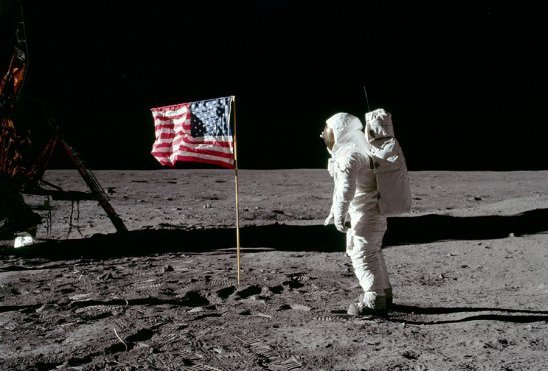
What people don’t know, however, is that when Armstrong and Aldrin blasted off from the lunar surface, the blast wave from the Lunar Module’s rocket knocked the flag over. As Chaikin also wrote, “Outside, a spray of gold foil and debris from the descent stage flew away in all directions. The flag toppled to the dust.”
Thus, for the last four decades this American flag, shown so proudly unfurled on the surface of the Moon, has actually been lying unceremoniously on the ground, in the lunar dust.
It might actually be possible to see this, though the photos at this time remain unclear and quite blurry.
» Read more
Worth reading: Nature has put together a special section of articles on the history of the space shuttle.
The space shuttle has undocked from the space station for the last time.
That’s so nice of them: Russia vows not to exploit its manned space flight monopoly.
Actually, this isn’t really news. Since the fall of the Soviet Union the Russians have always driven a hard bargain when they have sold tickets to get crew or cargo into space. However, once the contract has been signed they have also honored those contracts, to the letter. As the U.S. already has a signed contract to get its astronauts to ISS using Russian rockets and capsules, there won’t be any opportunities for Russian exploitation — until that contract expires.
In other words, the U.S. had better get some manned launch capability on line before too long. And on that note, see this article: NASA considers man-rating the Atlas V.
SpaceX has broken ground on its Falcon Heavy launch site.
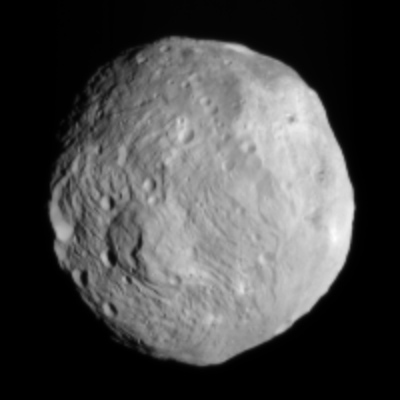
Another image of Vesta from Dawn has been released. This image was taken on July 9 from a distance of 26,000 miles away. It is definitely an improvement over the previous image, with more small details becoming visible. However, I once again wonder about the softness of the image. Look at the limb of the planet. It is soft against the black sky. This is not what one would expect from perfectly focused camera.
Dawn goes into orbit around Vesta next week. We sure learn then for sure if there is a problem with its camera, or whether I am merely being a bit too nervous.
And in a related note: Long, cramped road trips ahead for US astronauts.
The law is such an inconvenient thing: In a bipartisan effort, Texas lawmakers roast NASA administrator Charles Bolden for not meeting mandated Congressional deadlines for Congress’s personally designed rocket, the program-formerly-called-Constellation.
The heavy-lift rocket and capsule that Congress insists NASA build is a complete waste of money and nothing more than pork. It will never get built, mainly because Congress has given NASA less money and less time to build it than they did for Constellation under the Bush administration. Unfortunately, the reason they continue to require NASA to build it is to provide pork to their districts.
In a perfect world this funding would be cut now, especially considering the state of the federal debt.
» Read more
NASA awards a key piece of ISS management to Florida, not Houston.
The story reports that politics were not involved, but I am suspicious. Since all ISS management and operations come out of Houston, why send some of that management to Florida?
The second ARTEMIS space probe will enter lunar orbit on Sunday.
“With two spacecraft orbiting in opposite directions, we can acquire a full 3-D view of the structure of the magnetic fields near the moon and on the lunar surface,” said Vassilis Angelopoulos, principal investigator for the THEMIS and ARTEMIS missions and a professor of space physics at UCLA. “ARTEMIS will be doing totally new science, as well as reusing existing spacecraft to save a lot of taxpayer money.”
I’ve posted earlier about Dawn’s approach to Vesta. However, in looking at the images from Dawn, it dawned on me recently that they seems more fuzzy for what you’d normally expect from a space probe. I am now wondering if there is something fundamentally wrong with Dawn’s camera, causing its images to be slightly out of focus.