The dry and mountainous terrain west of Jezero Crater

The dry and mountainous terrain west of Jezero Crater
Click for original image.

Since my earlier update today about Perseverance and Ingenuity mentioned the very diverse and strange geology known to exist west of Jezero Crater and where the rover is eventually headed, I thought it worthwhile to post another cool image of that terrain.

The picture to the right, rotated, cropped, reduced and sharpened to post here, was taken on May 22, 2023 by the high resolution camera on Mars Reconnaissance Orbiter (MRO). Labeled a “terrain sample” image, the location was likely chosen by the camera team in order to fill a gap in the camera’s schedule so that they can maintain its proper temperature. Having a gap that put the spacecraft over this region to the west of Jezero was however a great opportunity to get another look at this rocky, mountainous, and very parched terrain, located in Mars’ very dry equatorial regions.
» Read more

0 comments

Perseverance snaps new close-up of Ingenuity

Overview map
Click for interactive map.

Ingenuity as seen by Perseverance on August 2, 2023
Ingenuity as seen by Perseverance on August 2, 2023.
Click for original image.

Cool image time! With Perseverance and Ingenuity in the past week getting close together for the first time in months, the Perseverance team naturally turned its high resolution mast cameras at the helicopter. The picture to the right, cropped, reduced, and sharpened to post here, was taken on August 2, 2023 by the rover’s left mast camera, showing Ingenuity only about two hundred feet away.

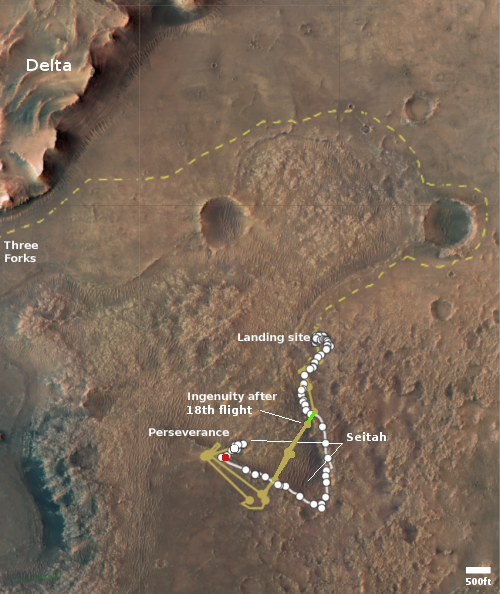
The blue dot on the overview map above shows Perseverance’s present location, with the green dot marking Ingenuity’s. The picture to the right is therefore looking almost due south. The red dotted line indicates the rover’s planned route, moving towards Neretva Vallis, the gap in the rim of Jezero Crater from which the delta had flowed, eons ago. The rover’s goal is to eventually enter that gap and explore the very diverse and strange geology known to exist outside the crater to the west.

We should also expect even better images of Ingenuity in the next week. Its 54th flight is scheduled for today, in which the engineering team wants to send the helicopter on a simple straight up and down hop of sixteen feet in order to better “localize” the helicopter. With Perseverance less than two hundred feet away, its cameras should be able to assemble a great movie of that flight.

1 comment

New software detects its first potentially dangerous asteroid

New software designed to detect asteroids, developed for use with the Rubin Observatory presently being built in Chile, has successfully discovered its first potentially hazardous asteroid (PHA) using data from another smaller operational ground-based telescope.

The discovered asteroid is 600 feet long, large enough to pose a real threat should it ever hit the Earth. Fortunately, the data says that though its orbit can take it as close as 140,000 miles there is no impact likely in the foreseeable future.

When the Rubin telescope begins its planned ten year survey of the entire night sky in 2025, this software is expected to almost triple the number of known potentially-hazardous-asteroids, from 2,350 to almost 6,000.

Funded primarily by the U.S. National Science Foundation and the U.S. Department of Energy, Rubin’s observations will dramatically increase the discovery rate of PHAs. Rubin will scan the sky unprecedentedly quickly with its 8.4-meter mirror and massive 3,200-megapixel camera, visiting spots on the sky twice per night rather than the four times needed by present telescopes. But with this novel observing “cadence,” researchers need a new type of discovery algorithm to reliably spot space rocks.

Thus, the development of this new software.

3 comments

China’s Long March 4C launches weather satellite; SpaceX launches communications satellite

Two launches this evening. First China used its Long March 4C rocket to put a weather satellite into orbit, lifting off from its Jiuquan spaceport in northwest China. No word on where the lower stages crashed within China.

SpaceX then used its Falcon 9 rocket to put an Intelsat commercial communications satellite into orbit, lifting off from Cape Canaveral. The first stage successfully completed its sixth flight, landing on a drone ship in the Atlantic. The two fairing halves completed their eighth and tenth flights respectively.

As of posting the satellites from both launches had not deployed.

The leaders in the 2023 launch race:

52 SpaceX
31 China
9 Russia
6 Rocket Lab
6 India

American private enterprise still leads China in successful launches 60 to 31, and the entire world combined 60 to 51, while SpaceX by itself leads the world (excluding American companies) 52 to 51.

0 comments

Voyager Space partners with Airbus to build its Starlab space station

Voyager Space, one of the three companies with a contract from NASA to develop a commercial private space station, has now signed a partnership agreement with the European aerospace company Airbus to work together to build its Starlab space station.

The companies announced Aug. 2 the creation of a joint venture, also called Starlab, that will be responsible for the development and operation of the station. The joint venture builds upon an agreement announced in January where Voyager selected Airbus to provide technical support for the proposed station.

“This transatlantic venture with footprints on both sides of the ocean aligns the interests of both ourselves and Voyager and our respective space agencies,” said Jean-Marc Nasr, head of space systems at Airbus, in a statement. “Together our teams are focused on creating an unmatched space destination both technologically and as a business operation.”

Though no specifics of the deal were released, Voyager will continue to retain 51% control. It appears that Voyager’s goal with this deal is to get its foot in the door of Europe. With ESA no longer considering doing any work on the space stations of either China or Russia, it needs a place to go after ISS is retired. By signing up Airbus as a partner Voyager makes Starlab the most likely go-to station for these European companies and governments.

Isn’t private enterprise and freedom wonderful? Without even trying Europe is going to get a space station of its own, and it will do it by hiring this private consortium of American and European companies.

Hat tip to Jay, BtB’s stringer.

0 comments

The first glacial evidence found on Mars back in 2007

Glaciers on Mars?
Click for original image.

Cool image time! The picture to the right, cropped, reduced, sharpened, and annotated to post here, was taken on January 3, 2023 by the high resolution camera on Mars Reconnaissance Orbiter (MRO). It shows the eastern wall of what the scientists call a graben, a large depression caused when the ground inside the depression suddenly shifted downward.

The elevation difference between the high and low points is about 3,500 feet. The streaks on the lower half of the cliff wall are slope streaks, a phenomenon unique to Mars that remains at this moment unexplained. Though the streaks resemble avalanches, they do not change the topography in any way, have no debris pile at their base, and appear instead to be a stain that appears at random times of the year that fades with time.

What is intriguing about this picture however is the wavelike floor on its western half. At first glance these waves suggest some form of dust dunes or lava flows, but neither conclusion appears correct. Instead, we are looking at what was one of the first discoveries on Mars of what scientists have determined to be glacial features.
» Read more

0 comments

Satellite startup Planet lays off 10% of its workforce, most located in San Francisco

According to a filing to the SEC yesterday, the smallsat startup Planet has laid off 10% of its workforce, 117 employees of which 85 are located in San Francisco, in order “to prioritize our attention on the highest ROI [return on investment] opportunities for our business and mission,” as expressed by the company’s CEO to his employees.

The company presently operates a constellation of more than 200 small satellites designed to provide high resolution imagery of the Earth. In late 2021 it went public through a merger with a SPAC (special purpose acquisition company), and has since seen its stock price drop from $11.35 to $3.75 yesterday.

The layoffs this week are likely simply the company recognizing that its main office in San Francisco had become bloated and it needed to economize. It is even possible the company is now considering a move from San Fran and California, though this is not mentioned in any of its announcements.

2 comments

NASA detects weak signal from Voyager 2

Though communications with Voyager 2 have not been re-established, JPL engineers using NASA’s Deep Space Network of antennas have detected a weak signal from Voyager 2 that indicates the spacecraft is still functioning.

Using multiple antennas, NASA’s Deep Space Network (DSN) was able to detect a carrier signal from Voyager 2. A carrier signal is what the spacecraft uses to send data back to Earth. The signal is too faint for data to be extracted, but the detection confirms that the spacecraft is still operating. The spacecraft also continues on its expected trajectory. Although the mission expects the spacecraft to point its antenna at Earth in mid-October, the team will attempt to command Voyager sooner, while its antenna is still pointed away from Earth. To do this, a DSN antenna will be used to “shout” the command to Voyager to turn its antenna. This intermediary attempt may not work, in which case the team will wait for the spacecraft to automatically reset its orientation in October.

The hope is that new commands to re-orient, sent by the strongest signal possible, might be heard by the spacecraft, causing it to obey now. If not, this weak signal from Voyager 2 still suggests that the October reset will occur as normal and engineers will be able to recover communications then.

2 comments

Northrop Grumman’s Antares rocket successfully places Cygnus freighter into orbit

Northrop Grumman’s Antares rocket tonight successfully launched a Cygnus freighter into orbit to ISS, flying for the last time with a first stage built in the Ukraine with engines from Russia.

Until Firefly can provide Northrop Grumman with a new American-made first stage, for the next three Cygnus cargo missions to ISS the company has purchased SpaceX’s Falcon 9 rocket.

This was Northrop Grumman’s first launch in 2023, so there is no change to the leader board in the 2023 launch race:

51 SpaceX
30 China
9 Russia
6 Rocket Lab
6 India

American private enterprise now leads China in successful launches 59 to 30, and the entire world combined 59 to 50, with SpaceX by itself still leading the entire world (excluding American companies) 51 to 50.

2 comments

The wind-scoured dusty and cratered dry tropics of Mars

The wind-scoured dusty and cratered dry tropics of Mars
Click for original image.

Cool image time! The picture to the right, cropped, reduced, and sharpened to post here, was taken on June 2, 2023 by the high resolution camera on Mars Reconnaissance Orbiter (MRO), and shows one small area in Martian equatorial regions where the main features are a dusty plain interspersed with craters, not entirely dissimilar to the Moon .

In the picture the northwest-to-southeast orientation of ridge-lines, plus the position of divots with their steep and deep end all on the northwest side, all suggest the prevailing winds here blow in the same direction, from the northwest to the southeast.

We are looking at a very ancient terrain. Many of these craters likely date from the early bombardment period of the solar system, just after the planets had formed but there was still a lot of objects around crashing into them.
» Read more

1 comment

Eruption on comet results in its tail splitting as it brightens by 100x

On July 20, 2023 the Comet 12P/Pons-Brooks suddenly erupted for the first time in almost seven decades, making it a hundred times brighter than normal while splitting its tail in two.

As of July 26, the comet’s coma had grown to around 143,000 miles (230,000 kilometers) across, or more than 7,000 times wider than its nucleus, which has an estimated diameter of around 18.6 miles (30 km), Richard Miles, an astronomer with the British Astronomical Association who studies cryovolcanic comets, told Live Science in an email.

But interestingly, an irregularity in the shape of the expanded coma makes the comet look as though it has sprouted horns. Other experts have also likened the deformed comet to the Millennium Falcon, one of the iconic spaceships from Star Wars, Spaceweather.com reported.

It is believed the tail’s shape is the result of the shape of the comet’s nucleus, which probably had a solid ridge acting as a barrier to material at that point.

The comet, which orbits the Sun every 71 years, will make its closest approach to Earth in the spring of 2024, when it will likely be visible to the naked eye.

3 comments

Chandrayaan-3 is now on its way to the Moon

Chandrayaan-3's mission profile

According to a tweet from India’s space agency, ISRO, engineers have successfully completed the trans-lunar-injection burn that has now sent its Chandrayaan-3 lunar lander/rover on its way to the Moon.

As shown in mission’s profile graphic to the right, the spacecraft spent the last two weeks in Earth orbit. repeatedly raising its orbit to reduce the amount of fuel necessary to send it to the Moon. It will now take about five days traveling to the Moon, entering its orbit on August 5th. It will then spend about two weeks lowering that orbit slowly, until it is in the proper orbit for the descent to the surface on August 23, 2023.

If all goes well, its Vikram lander will gently place the Pragyan rover in the high southern latitudes, where it will function for about two weeks, or during the daylight portion of one lunar day.

0 comments
1 301 302 303 304 305 1,353