More results from DART impact of Dimorphos

Didymos and Dimorphos as seen from Earth
Click for movie.

At a science conference this week scientists provided an update on the changes that occurred to the asteroid Dimorphos after it was impacted by the DART spacecraft in September, shortening its orbit around the larger asteroid Didymos by 33 minutes.

The image to the right is a screen capture from a short movie made from 30 images taken by the Magdalena Ridge Observatory in New Mexico, and part of a new image release of the asteroid pair.

It shows the motion of the Didymos system across the sky over the course of roughly 80 minutes, and features a long, linear tail stretching to the right from the asteroid system to the edge of the frame. The animation is roughly 32,000 kilometers across the field of view at the distance of Didymos.

According to the scientists, the impact displaced more than two million pounds of material from Dimorphos.

Observations before and after impact, reveal that Dimorphos and its larger parent asteroid, Didymos, have similar makeup and are composed of the same material โ€“ material that has been linked to ordinary chondrites, similar to the most common type of meteorite to impact the Earth. These measurements also took advantage of the ejecta from Dimorphos, which dominated the reflected light from the system in the days after impact. Even now, telescope images of the Didymos system show how solar radiation pressure has stretched the ejecta stream into a comet-like tail tens of thousands of miles in length.

Putting those pieces together, and assuming that Didymos and Dimorphos have the same densities, the team calculates that the momentum transferred when DART hit Dimorphos was roughly 3.6 times greater than if the asteroid had simply absorbed the spacecraft and produced no ejecta at all โ€“ indicating the ejecta contributed to moving the asteroid more than the spacecraft did.

This information is teaching us a great deal about these two particular asteroids, which could be used if for some reason their totally safe orbit got changed and they were going to impact Earth. However, NASA’s repeated effort to make believe this info would be useful for deflecting other asteroids is somewhat absurd. It is helpful, but each asteroid is unique. The data from DART is mostly helping astronomers get a better understanding of the geology of these specific asteroids, which will widen their understanding of asteroids in general. Planetary defense is really a very minor aspect of this work.

5 comments

Russian official: Soyuz leak possibly caused by micrometeorite hit

According to Sergei Krikalev, who heads Roscosmos’ manned program, the leak of coolant from the Soyuz capsule docked at ISS could have been caused by a micrometeorite hit.

Sergei Krikalev, a veteran cosmonaut who serves as the director of crewed space flight programs at Roscosmos, said a meteorite striking one of external radiators of the Soyuz MS-22 capsule could have caused the coolant to escape.

The malfunction could affect the performance of the capsule’s coolant system and the temperature in the equipment section of the capsule but doesn’t endanger the crew, Krikalev said in a statement.

Krikalev said Russian flight controllers were assessing the situation and following temperature indicators on the Soyuz. โ€œThere have been no other changes in parameters on the Soyuz spacecraft and the station, so there is no threat for the crew,โ€ he said.

The “equipment section of the capsule” is its service module, not its habitable orbital module or descent module.

Krikalev, the first Russian to fly on the space shuttle and occupy ISS, is a generally very reliable source. He is speculating, but not wildly but based on what is so far known. The upcoming inspection of the Soyuz using an ISS robot arm will soon tell us whether he is right or not. Krikalev also said that the inspection will tell them whether this capsule can be used to return its astronauts to Earth.

9 comments

China launches test satellite

The launch list changes immediately! China also completed a successful launched today, using its Long March 11 rocket to put an experimental satellite into orbit, designed to do “in-orbit verification of new space technologies.”

The rocket is solid-fueled, and designed to launch quickly as needed. No word on where its lower stages crashed inside China.

The updated leaders in the 2022 launch race:

60 China
57 SpaceX
21 Russia
9 Rocket Lab
8 ULA

The U.S. still leads China 81 to 60 in the national rankings, but trails the entire world combined 92 to 81.

0 comments

SpaceX launches oceanography satellite

SpaceX early this morning used its Falcon 9 rocket to successfully launch an oceanography satellite, dubbed SWOT, for both NASA and France’s space agency CNES.

The satellite it designed to measure the height of water on 90% of the Earth’s surface.

The first stage was making its sixth flight, and successfully returned to Earth, touching down on its landing pad at Vandenberg Space Force Base.

The leaders in the 2022 launch race:

59 China
57 SpaceX
21 Russia
9 Rocket Lab
8 ULA

The U.S. now leads China 81 to 59 in the national rankings, but trails the entire world combined 91 to 81.

These numbers however should change again later today, as SpaceX has another launch scheduled.

0 comments

December 15, 2022 Quick space links

Courtesy of Jay, BtB’s stringer. All the links today have to do with the Soyuz capsule that is leaking on ISS.


  • Details about the leaking coolant are described here and here.
  • The second link provides a description of the cooling system that is leaking. It appears the leaking material could be water, or “Isooctan LZ-TK-2”.


1 comment

Sunken butte on Mars

Collapsed butte in the Martian northern lowland plains
Click for full image.

Cool image time! The photo to the right, cropped, reduced, and sharpened to post here, was taken on November 1, 2022 by the high resolution camera on Mars Reconnaissance Orbiter (MRO). It shows what the scientists label a “layered butte.” Like the mesas in the American southwest, those layers, or terraces, mark the geological history of this place, where over time layer upon layer was placed down, and then eroded away except for this mesa.

What makes the mesa even more intriguing and strange, however, are surrounding concentric cracks and the moat at the mesa’s base. These features suggest that at some point the ground below the mesa collapsed so that the entire mesa dropped, as a unit.

What could cause this? The overview map below provides a clue, though certainly not an answer.
» Read more

0 comments

Perseverance records sound of dust devil

For the first time scientists have used the microphone on the Mars rover Perseverance to successfully record the sound of dust devil as it flowed overhead.

I have embedded a video of the recording below. The research paper can be read here.

Dust devils on Mars, while much less dense in its very thin atmosphere, are generally much larger than found on Earth.

The dust devil recently detected by Perseverance was 25 meters wide and 118 meters tall (82 feet by 387 feet), putting it squarely in the average zone in terms of size for Martian dust storms. But they can grow much bigger, too, as dust on Mars can be whipped up in huge global dust storms.

The data also picked up the sound of dust particles hitting the microphone, which will allow the scientists to measure the density of the devil.
» Read more

1 comment

China launches classified remote sensing satellite

Using its Long March 2D rocket, China last night successfully launched a classified remote sensing satellite into orbit.

The launch was from an interior spaceport. No word on where the first stage crash-landed.

The leaders in the 2022 launch race:

59 China
56 SpaceX
21 Russia
9 Rocket Lab
8 ULA

The U.S. still leads China 80 to 59 in the national rankings, but now trails the entire world combined 90 to 81.

Though SpaceX led China in successful launches for most of the year, China historically tends to do a lot of launches in the November-December time period. This is why it has surged ahead in the past month. SpaceX can still catch up, however, as it still has five launches planned for 2022. Either way, we will not know who comes out ahead until probably the end of the year.

That a private American company however has even a chance of beating out the entire world in annual launches is quite remarkable, whether or not SpaceX ends up ahead.

1 comment

Soyuz manned capsule docked to ISS is apparently leaking something

A spacewalk today was cancelled when it was suddenly noticed that some unknown substance was leaking from one of the Soyuz manned capsules docked to ISS.

During preparations for this eveningโ€™s planned spacewalk by Roscosmos cosmonauts Sergey Prokopyev and Dmitri Petelin, ground teams noticed significant leaking of an unknown substance from the aft portion of the Soyuz MS-22 spacecraft docked to the Rassvet module on the International Space Station. The spacewalk has been canceled, and ground teams in Moscow are evaluating the nature of the fluid and potential impacts to the integrity of the Soyuz spacecraft, which carried Prokopyev, Petelin, and NASA astronaut Frank Rubio into space after launching from the Baikonur Cosmodrome in Kazakhstan on Sept. 21.

The big question is whether this leak will impact the capsule’s function as a lifeboat or a return vehicle for the three astronauts it brought into space. If so, then an empty manned capsule needs to be launched, either by the Russians or SpaceX, though if the latter someone would have to pay the cost.

6 comments

Scientists publish papers describing largest Mars quake from May

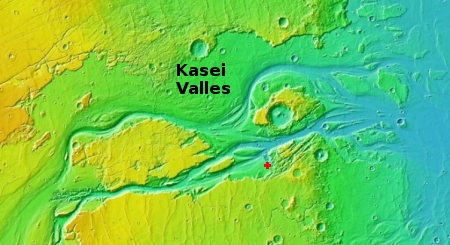
Location of May quake

Though news of the largest quake so far detected by InSight on Mars, magnitude 4.7, was released in May, this week the science team published two papers describing the quake itself and what they have learned from it. From the press release:

The waves from the record-breaking quake lasted about 10 hours โ€” quite a while, considering no previous Marsquakes exceeded an hour.

It was also curious because the epicenter was close to but outside the Cerberus Fossae region, which is the most seismically active region on the Red Planet. The epicenter did not appear to be obviously related to known geologic features, although a deep epicenter could be related to hidden features lower in the crust.

Marsquakes are often divided into two different types โ€” those with high-frequency waves characterized by rapid but shorter vibrations, and those of low-frequency, when the surface moves slowly but with larger amplitude. This recent seismic event is rare in that it exhibited characteristics of both high- and low-frequency quakes. Further research might reveal that previously recorded low- and high-frequency quakes are merely two aspects of the same thing, Kawamura said.

The green-dotted white patch on the map above marks the approximate location of this quake, east of where most of the previous larger quakes have been detected and under the Medusa Fossae Formation of volcanic ash. That no surface features appear to correspond to this quake, it is thought it was the result of a shift of underground features.

0 comments

The first launch of China’s Zhuque-2 rocket ends in failure

The first launch of China’s Zhuque-2 rocket, built by the pseudo-private company Landspace, ended in failure today when the upper stage had problems after separation of the first stage.

Apparent spectator footage posted on Chinese social media showed the rocket ascending into clear skies, trailed by white exhaust. While the first stage is understood to have performed well, separate apparent leaked footage suggests that issues affecting the rocketโ€™s second stage resulted in the failure of the mission.

Data suggest an expected burn of the stageโ€™s vernier thrusters, intended to carry the stage and payloads into orbit after a burn by the main engine, did not occur as planned.

If this launch had been successful, it would have made the Zhuque-2 rocket the first rocket to reach orbit using methane as a fuel, beating three different American companies, SpaceX, Blue Origin, and Relativity.

Relativity has been preparing for the first launch of its Terran-1 rocket since October, with a goal of launching before the end of the year. At the moment however no launch date is set, though the company’s CEO seems confident it will launch soon.

In addition, SpaceX has also been targeting the first orbital launch of its Starship/Superheavy rocket by the end of this year. As with Relativity, no launch date has been set.

The first launch of Blue Origin’s New Glenn rocket meanwhile is nowhere in sight, as yet. It was originally supposed to launch in 2020, but even now has four launches scheduled on its manifest for 2023. None however have been scheduled, and the first launch will likely slip to late in the year, if that soon.

0 comments
1 375 376 377 378 379 1,353