Alien world

Meridiani Planum
So what is it we are looking at in the image above? I have reduced the resolution slightly to fit it here, but you can see the full resolution image by clicking on the picture.

Is it a marble or granite kitchen counter? Nah, the surface is too rough.

Maybe it’s a modern abstract painting that we can find hanging in the Museum of Modern Art in New York. Nah, it has too much style and depth. Abstract art is much more shallow and empty of content.

Could it be a close-up of a just-opened container of berry-vanilla ice cream, the different flavors swirling and intertwined to enhance the eating experience? No, somehow it looks too gritty for ice cream.
» Read more

7 comments

Successful test flight of New Shepard

Capitalism in space: Blue Origin today successful flew its New Shepard suborbital spacecraft on its second test flight.

You can watch the video of the full flight here. Try not to cringe listening to the announcer, who I think sometimes overdoes it.

They were aiming for a maximum altitude of 350,000 feet, which would place the capsule more than 100 kilometers or 66 miles above the Earth, the generally accepted altitude for the start of space. The live stream showed an maximum altitude of about 347,000, but the article says that later recalculations estimated a top altitude of 351,000.

Either way, they have now successfully achieved a safe suborbital spaceflight twice with this spacecraft, and both times carried science payloads. Meanwhile, their direct competitor, Virgin Galactic, has come no where close, even after fourteen years of development.

7 comments

Blue Origin to test fly New Shepard tomorrow

Capitalism in space: Jeff Bezos announced yesterday that Blue Origin plans to test fly New Shepard tomorrow on its first flight for 2018.

“Launch preparations are underway for New Shepard’s 8th test flight, as we continue our progress toward human spaceflight. Currently targeting Sunday 4/29 with launch window opening up at 830am CDT. Livestream info to come. @BlueOrigin #GradatimFerociter,” Bezos said via Twitter.

I am glad to hear this. The lack of flights has been puzzling. That they are moving forward again is good news.

11 comments

Heat shield for 2020 Mars rover cracks during testing

The heat shield to be used during landing by the U.S.’s 2020 Mars rover cracked during recent testing.

The heat shield’s structural damage, located near the shield’s outer edge, happened during a weeklong test at the Denver facility of contractor Lockheed Martin Space, according to a NASA statement released Thursday (April 26). The test was intended to subject the heat shield to forces about 20 percent greater than those it will experience when it hits the Martian atmosphere for entry, descent and landing operations.

The Mars 2020 team found the fracture on April 12. Mission management at NASA’s Jet Propulsion Laboratory in Pasadena, California, will work with Lockheed Martin to lead an examination of the cause of the crack and to decide if any design changes should be made, NASA officials said in the statement.

They do not expect this issue to cause them to miss the 2020 launch window. However, it is astonishing that the heat shield should fail in this manner. First, to save development costs this rover was essentially a rebuild of Curiosity. The new heat shield should have been the same design, and thus should have already been proven capable of surviving this test. Second, Lockheed Martin has been making heat shields of all kinds for decades. This is not cutting edge technology.

Third, note that Lockheed Martin is building Orion, and it also experienced cracks in the capsule’s structure (not its heat shield) during manufacture and testing.

Overall, these facts suggest that some fundamental manufacturing error has occurred, and that there might also be a quality control problem at Lockheed Martin.

6 comments

The thin dense crust of Mercury

Using data gathered by the MESSENGER spacecraft while it was in orbit around Mercury, scientists now estimate that the planet’s crust is thinner than previously believed, 16 miles thick rather than 22 miles.

The crust is also as dense as aluminum. It is also the thinnest crust, relative to the planet’s core, of any rocky planet in the solar system.

Mercury’s core is believed to occupy 60 percent of the planet’s entire volume. For comparison, Earth’s core takes up roughly 15 percent of its volume. Why is Mercury’s core so large?

“Maybe it formed closer to a normal planet and maybe a lot of the crust and mantle got stripped away by giant impacts,” Sori said. “Another idea is that maybe, when you’re forming so close to the sun, the solar winds blow away a lot of the rock and you get a large core size very early on. There’s not an answer that everyone agrees to yet.”

There appears to be a great deal of uncertainty to these conclusions, and I would not be surprised if these conclusions change with the arrival of more data.

2 comments

Mars rover update: April 27, 2018

Summary: Curiosity’s exploration of Vera Rubin Ridge is extended, while an attempt by Opportunity to climb back up Perseverance Valley to reach an interesting rock outcrop fails.

For a list of past updates beginning in July 2016, see my February 8, 2018 update.

Curiosity

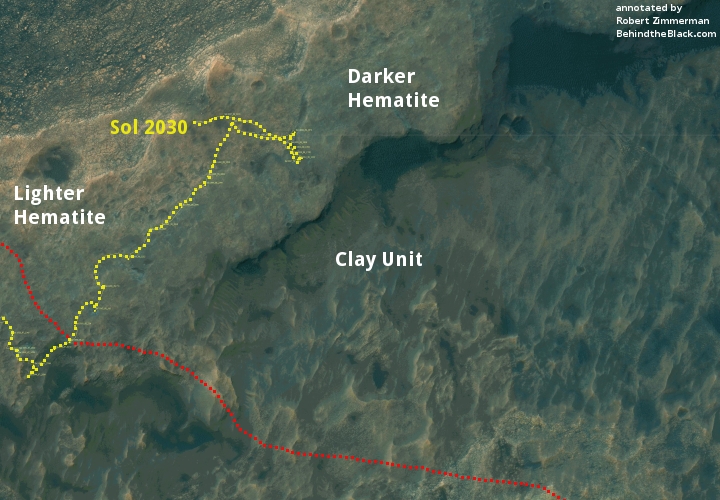
Curiosity's traverse map, Sol 2030

For the overall context of Curiosity’s travels, see Pinpointing Curiosity’s location in Gale Crater.

Since my March 21, 2018 update, it has become apparent that the Curiosity science team has decided to extend the rover’s research on Vera Rubin Ridge far beyond their original plans. They have continued their travels to the northeast well past the original nominal route off the ridge, as indicated by the dotted red line on the traverse map above. Along the way they stopped to inspect a wide variety of geology, and have now moved to the north and have actually begun descending off the ridge, but in a direction that takes the rover away from Mount Sharp and its original route. As noted in their April 25 update,
» Read more

1 comment

Big earthquake in South Korea linked to geothermal power plant

South Korea’s second largest earthquake has now been linked by two different studies to the injection of water deep below the surface at a new geothermal power plant.

Perched on South Korea’s southeast coast and far from grinding tectonic plates, Pohang is an unlikely spot for a big earthquake. Before the geothermal plant’s two wells were drilled, there had never been an earthquake there of any significance, says Kwanghee Kim, a seismologist at Pusan National University in Busan, South Korea, and lead author of one study. But while Kim was monitoring the aftermath of an unrelated earthquake in 2016, he began to detect rumbles from Pohang. That prompted his lab to deploy eight temporary seismic sensors at the site, which were finally in place on 10 November 2017. He expected any quakes to be small—after all, the largest previous quake tied to enhanced geothermal power, in Basel, Switzerland, was just 3.4 in magnitude.

It took only 5 days to be proved wrong. “The Pohang earthquake was larger than any predicted by existing theories,” Kim says. Although some initial measures placed the source of the quake several kilometers away from the plant, Kim’s network revealed that the earthquake, and several of its foreshocks, all began right below the 4-kilometer-deep well used to inject water into the subsurface to create the plant’s heating reservoir. Indeed, it appears likely that the well’s high-pressure water lubricated an unknown fault in the rock, causing it to slip and triggering the quake, Kim says.

A second paper, by European scientists who used regional seismic data, reinforces the South Korean team’s results, in particular its shallow depth. That study also points out that an earlier 3.1-magnitude earthquake also took place near the well bottom, increasing the odds of a common source. Satellite measures of shifts in the surface after the November 2017 quake support that idea, says Stefan Wiemer, the second study’s lead author and director of the Swiss Seismological Service in Zurich. It’s clear the locked fault was storing energy that was waiting to be released, Wiemer says. “If that fault would have gone next Tuesday or 50 years from now, we’ll never know.”

The article notes that scientists had previously concluded that injecting water underground for geothermal purposes was okay (since it reduced use of fossil fuels) while doing the same for fracking (to obtain and use fossil fuels) was bad.. The data here actually suggests just the reverse, since fracking has never produced an earthquake as large as the 5.5 magnitude Pohang quake.

3 comments

China aims to reuse vertically-landed first stages by 2020

One of China’s top space engineers said this week at a conference that they are aiming to reuse vertically-landed first stages by 2020 on a new Long March 8 rocket.

At an aerospace industry seminar on Tuesday, leading Chinese carrier rocket designer Long Lehao said that China is expected to realize vertical recycling – similar to the technology employed by US-based firm SpaceX – by 2020 at the earliest on its CZ-8 rockets. This will further lower the price tag of a launch and boost China’s chances of getting international commercial satellite launch orders, the CCTV report said.

Lan Tianyi, founder of Beijing-based Ultimate Blue Nebula Co, a space industry consultancy, said China will become the second rocket power to have this capacity, putting the country ahead of Russia and the EU. However, Lan said that while the aim of recycling rockets is to reduce costs for launch operators, whether this can be achieved remains to be seen.

The recycled rockets developed by SpaceX are reported to have helped the company reduce launch costs by as much as 30 percent, according to media reports.

“There is no way to verify SpaceX’s claim, as it is the only company that owns the technology, and China has to wait for the moment when it has successfully recycled a rocket to see whether the costs can be lowered,” Lan told the Global Times on Thursday.

Right now, the politics in China are extremely favorable for space development, with so many top posts occupied by former space managers. Thus, it seems reasonable to believe that the country is investing the cash necessary to develop rocket stages that can land vertically. If they do it, they will put themselves in a strong position for future space colonization, because such technology is essential for landing spacecraft on other worlds. Right now, only the U.S. has done this repeatedly and successfully.

1 comment

Short movie from Rosetta of Comet 67P/C-G

A search by a Twitter user of the Rosetta archive from its visit to Comet 67P/C-G has produced a very short movie of the comet’s surface.

The bright dots travelling from the top of the frame to the bottom, which look something like snow, are in fact background stars. They have that apparent motion as the spacecraft moves and the comet rotates. The more rapidly moving streaks are thought to be dust particles illuminated by the Sun. There also appear to be a few streaking cosmic rays.

Take a look. The twelve second movie gives a flavor of what it would be like to walk that comet’s surface.

4 comments

China’s Long March 11 rocket launches five Earth observation satellites

China’s Long March 11 rocket today launched five Earth observation satellites.

The rocket appears designed to compete with some of the smallsat rockets being developed by private companies in the U.S. and elsewhere.

The Long March-11 (Chang Zheng-11) is a small solid-fueled quick-reaction launch vehicle developed by the China Academy of Launch Vehicle Technology (CALT) with the goal to provide an easy to operate quick-reaction launch vehicle, that can remain in storage for long period and to provide a reliable launch on short notice.

LM-11 is a four stage solid-fueled launch vehicle equipped with a reaction control system on the fourth stage. The vehicle has a length of 20.8 meters, 2.0 meters in diameter and a liftoff mass of 58,000 kg. At launch it develops 120.000 kg/f, launching a 350 kg cargo into a 700 km SSO. The CZ-11 can use two types of fairing with 1.6 meters or 2.0 meters.

LM-11’s first launch took place on September 25, 2015, when successfully orbited the Pujiang-1 and the three Tianwang small sats from the Jiuquan Satellite Launch Center.

Update: I had initially left off Russia’s Rokot launch of a new European Earth observation satellite late yesterday. The standings below have therefore been updated.

The leaders in the 2018 launch standings:

12 China
8 SpaceX
5 Russia
4 ULA

Europe, India, and Japan are all tied at 3. The U.S. and China are now tied at 12 in the national standings.

0 comments

Trace Gas Orbiter releases its first image

Trace Gas Orbiter's first released image of Korolev Crater

Europe’s Trace Gas Orbiter has released its first image after reaching its planned science orbit.

The image is posted above, reduced in resolution to show here. It shows a portion of the rim of Korolev Crater, a rare large crater located in the vast northern plains of Mars. Because it is so far north, it has ice on the rim which looks almost like glacial flows in this image.

0 comments

Source of yellow water in Russian section of ISS identified

The yellow water found in Russian section of ISS earlier this week was caused by the ordinary crust deposits that formed on the inside of a water-heating unit, what the Russians have labeled a “samovar” and we would probably call a teapot.

Limescale crust inside a ‘samovar’ whose service life had expired was the cause for the appearance of yellow water admixtures in the Russian segment of the International Space Station (ISS), First Deputy CEO for Space Systems’ Flight Operation and Tests at Energia Rocket and Space Corporation Vladimir Solovyov told TASS on Tuesday. “A household cause is behind the emergence of the yellow admixtures in the water. Routine limescale crust had formed in the water-heating unit, which had reached the end of its service life. There is nothing terrible in that as we are regularly confronted with such things on Earth. The problem is solved quite easily, we will just promptly replace this unit, which cosmonauts normally call ‘samovar’ with a reserve one,” Solovyov explained.

Anyone who has used a teapot to boil water for years will eventually have to replace it because of the development of a crust on its inside surface. This is what has happened here. It appears the Russian article today was in response to panicked news reports earlier in the week about the appearance of the yellow water and the need for the Russians to use water from the American segment while they pinned down the cause, a procedure that is quite routine.

5 comments

Trump administration considering reinstating fees to purchase Landsat images

The Trump administration is considering reinstating the fee system to purchase Landsat images that existed prior to 2008.

Not surprisingly, the Nature article is completely hostile to this idea. The quote below gives a flavor.

Since the USGS made the data freely available, the rate at which users download it has jumped 100-fold. The images have enabled groundbreaking studies of changes in forests, surface water, and cities, among other topics. Searching Google Scholar for “Landsat” turns up nearly 100,000 papers published since 2008.

A USGS survey of Landsat users released in 2013 found that the free distribution of Landsat imagery generates more than US$2 billion of economic benefit annually — dwarfing the programme’s current annual budget of roughly $80 million. More than half of the nearly 13,500 survey respondents were academics, and the majority lived outside the United States. [emphasis mine]

Why should scientists, a majority of which are not even Americans, have a free ride?

8 comments

Russian lawmakers introduce legislation to ban rocket engine sales to U.S.

Link here. The article provides practically no information about the legislation or its chances of passing. Instead, it focuses on the past history behind ULA’s use of the Russian RD-180 rocket engine in its Atlas 5 rocket as well as the recent efforts to replace it.

Thus, I have no idea if this legislation signals a real threat to future ULA launches or not. Moreover, the article tries to make it sound that the U.S. is entirely reliant on this rocket engine, something that is simply not true.

Nonetheless, this story underscores again the need for ULA to find a different engine to power its rockets. They shouldn’t be dependent on a rocket engiine built by a foreign power that has political motives that sometimes conflict with those of the United States.

2 comments

India recalls communications satellite, postponing launch indefinitely

India’s space agency ISRO yesterday recalled its largest ever communications satellite, GSAT-11, from French Guiana, where it was being prepared for a May Ariane 5 launch, citing a need to check the satellite’s systems.

Though no specific reason was given for the recall, which will postpone the satellite’s launch indefinitely, it likely is related to the March failure in orbit of India’s GSAT-6A satellite.

ISRO lost communication contact with its GSAT-6A communication satellite soon after it was put into orbit on March 29.

ISRO suspects the failure of the power systems in the satellite for the loss of communication link. “The satellites are powered by solar panels that charge the onboard batteries. The batteries are fully charged when the satellite is loaded on to the rocket. Even if there is a problem with the solar panel, then the battery power should have kicked in. Here the entire power system of the satellite seems to have failed,” one space expert told IANS earlier.

According to experts, the power system could have failed due to some short circuiting or arcing resulting in what is known in the space terminology ‘loss of lock’ or loss of contact with the ground station.

The head of ISRO is a well-trained engineer who has worked in the trenches. I suspect he decided the problems with GSAT-6A demanded a more detailed systems check on GSAT-11 prior to launch. And even if it wasn’t his specific decision, the willingness to make such a decision I think indicates a great deal of maturity in the present culture at ISRO. It might be embarrassing to make such a recall, but it is far better to do so beforehand than after an unrecoverable failure in space. That they are willing to face this embarrassment to avoid a future failure is something laudable.

0 comments

Gaia releases 3D map of galaxy

The science team for the space telescope Gaia, designed to map the positions of billions of stars, have released the probe’s second catalog, producing a 3D map of 1.7 billion stars in the Milky Way

The new data release, which covers the period between 25 July 2014 and 23 May 2016, pins down the positions of nearly 1.7 billion stars, and with a much greater precision. For some of the brightest stars in the survey, the level of precision equates to Earth-bound observers being able to spot a Euro coin lying on the surface of the Moon.

With these accurate measurements it is possible to separate the parallax of stars – an apparent shift on the sky caused by Earth’s yearly orbit around the Sun – from their true movements through the Galaxy. The new catalogue lists the parallax and velocity across the sky, or proper motion, for more than 1.3 billion stars. From the most accurate parallax measurements, about ten per cent of the total, astronomers can directly estimate distances to individual stars.

The catalog provides much more information than this. For example:

As well as positions, the data include brightness information of all surveyed stars and colour measurements of nearly all, plus information on how the brightness and colour of half a million variable stars change over time. It also contains the velocities along the line of sight of a subset of seven million stars, the surface temperatures of about a hundred million and the effect of interstellar dust on 87 million.

Gaia also observes objects in our Solar System: the second data release comprises the positions of more than 14 000 known asteroids, which allows precise determination of their orbits. A much larger asteroid sample will be compiled in Gaia’s future releases.

Further afield, Gaia closed in on the positions of half a million distant quasars, bright galaxies powered by the activity of the supermassive black holes at their cores. These sources are used to define a reference frame for the celestial coordinates of all objects in the Gaia catalogue, something that is routinely done in radio waves but now for the first time is also available at optical wavelengths.

I guarantee that many theories about specific strange stars, such as the plethora of different types of variable stars, are going to change drastically with this new and precise information. At the article they describe just one example relating to white dwarf stars.

3 comments

Russia agrees to replace Angola’s first satellite, lost shortly after launch

Russia has agreed to replace Angola’s first satellite, lost shortly after launch, and have the replacement paid for by both insurance and Russia.

The minister confirmed that payment for the production of the second satellite would come from the insurance reimbursement for the lost AngoSat-1 satellite worth 121 million US dollars. The rest of the cost will be paid by the Russian side. The overall sum of the project amounts to 320 million US dollars.

The AngoSat-1 telecommunications satellite was launched by a Zenit-2SB carried rocket with a Fregat booster on December 26, 2017 from the Baikonur space center in Kazakhstan. Contact with the satellite was lost on the following day after the separation from the upper stage.

Essentially, this is another example of a Russian launch failure, as it appears the Russians have accepted blame for the failure.

0 comments

Blue Origin’s CEO gives an update on the company’s rockets

Link here. According to the CEO, Bob Smith, they are making good progress on developing their BE-4 rocket engine, and also expect to test fly New Shepard again in a few weeks.

In both cases, he admits that development has taken longer than expected. For example, in discussing New Shepard, he said the following:

Smith said Blue Origin is still planning to start flying people on its New Shepard suborbital spaceship by the end of the year, after further uncrewed tests. “We would have loved to have flown more, earlier, but the design incorporation didn’t go as quickly as we’d like it to,” Smith said.

I have no idea what he means by “design incorporation.” The bottom line however is that they have had issues that slowed things down.

The article provides a lot more details. Overall, while he says nothing that contradicts earlier reports, he provides a good summary of the company’s status.

3 comments

Zooming in on a Martian surprise

Global map of Mars

Let’s take a journey. Above is a global map of Mars, showing its largest and well known geological features. While far smaller than Earth, its lack of oceans means that Mars’ actual dry surface has about the same square footage as the continents of Earth. It is a vast place. Getting a close look at every spot is going to take many decades of work, and probably won’t be finished until humans are actually walking its surface.

Let’s pick a spot, zoom in and find out what’s there.
» Read more

5 comments

China’s mysterious SJ-17 satellite

The extensive maneuvers in space of China’s SJ-17 satellite, launched in December 2016 on the maiden flight of China’s Long March 5 rocket, have satellite trackers and defense officials intrigued and concerned.

Now China, as far as we know, hasn’t done anything nefarious with this satellite. But it has approached to within “a couple of hundred meters” to an apparently dead Chinese communications satellite recently parked in the so-called graveyard orbit. That is incredibly close by space standards. (Also, that comsat may or may not actually be a dead satellite.) And, as space geeks can tell from the above chart, it has executed “proximity operations” with at least four Chinese satellites.

What does all this mean? Are the Chinese testing space war maneuvers to allow them to get close an enemy satellite to move it or disable it? Since the maneuvers to service a satellite — giving it new fuel or trying tor repair it, for example — are virtually indistinguishable from an offensive maneuver, we don’t know. We do know that Strategic Command’s Gen. John Hyten has made it clear China and Russia are building weapons that include satellites, lasers and other ground-to-space weapons. Russia has deployed three Kosmos satellites that appear designed to approach other nations satellites and destroy them. China has launched Shiyan satellites, reportedly able to use a grappling arm to move satellites.

SJ-17 could be testing anti-satellite capabilities, where either it approaches close enough to a target so that when it explodes it takes the target with it, or it grabs that satellite to take it over. Or it could be testing robot orbital maneuvering for the purpose of future satellite servicing missions.

In either case, China is demonstrating that its future satellites will have very sophisticated maneuvering systems, capable of doing any number of things in orbit.

0 comments
1 504 505 506 507 508 820