Russia’s next ISS module, Nauka, delayed again

Russia is apparently going to have to delay the launch of its next ISS module, Nauka, into 2019.

Nauka was initially built in the 1990s as a back-up module for one of Russia’s first ISS first modules, Zarya. It has undergone numerous concept changes, and even more numerous delays, including the most recent and worst, where it was discovered that they had to scrub clean the module’s fueling system because they had become contaminated.

0 comments

Falcon Heavy launch tomorrow

Capitalism in space: Several stories today about tomorrow’s long-awaited Falcon Heavy launch, with a launch window opening at 1:30 pm (eastern).

First, the FAA has approved SpaceX’s launch license. This is an example of the absolute irrelevance of government. There was no way this launch license was going to be denied, which means that the FAA’s only purpose here was to simply make work for some bureaucrats.

Second, this story by Bill Harwood provides a nice summary of the context of the launch, including SpaceX’s success at shaking up the launch history in the past decade. The money quote, however, comes when Harwood quotes John Logsdon, founder and now retired director of the Space Policy Institute at George Washington University. For years Logsdon has been the media’s go-to expert on the policy of space, and has consistently expressed unbounded faith and love for NASA projects like SLS. His perspective has always been that of the 1960s, when the space race then established the concept that in order to succeed in space you needed to have a government space program. The idea of a chaotic, competitive effort by private companies has always been inconceivable to him and most liberal policy experts. Thus, when asked about the purpose behind Falcon Heavy as well as Musk’s even bigger proposed rocket, the Big Falcon Rocket (BFR), Logsdon was totally baffled.

“I don’t understand what they’re doing,” Logsdon said. “Elon’s out talking about they’re not going to pursue the Falcon line of rockets, he’s going to put all his efforts into the BFR. So, what is the future of Heavy?”

…Logsdon said he believes it is “good for the country to have two alternative heavy lift vehicles, at least for a little while, to see which one works better.” But he also believes the SLS enjoys enough solid congressional support to “sustain it for some few more years, anyway.”

What Logsdon, being an academic his whole life, has never understood is the concept of profit and efficiency. Unlike the government projects like SLS that Logsdon tends to favor, Falcon Heavy is designed to provide customers a cheap way to get large payloads into orbit. That ability is going to soon provide SpaceX plenty of business, and will make SLS look like a complete waste of money. Furthermore, the BFR is Musk’s declaration that, as the head of a cutting edge private company, he is not going to stand still, but will keep pushing the envelope to provide his customers even better products in the future.

Finally, this CNN article, while typically shallow and not very knowledgeable, does provide one piece of important information, about the launchpad being used.

Because of a special walkway that has been constructed for it, Pad 39A is the only site that can host flights of SpaceX’s new spacecraft, Crew Dragon. That’s the spacecraft the company is developing to help NASA ferry astronauts to and from the International Space Station. Crew Dragon has already faced delays. And destroying the launch pad could mean pushing deadlines back even further, according to U.S. Government Accountability Office Director Cristina Chaplain.

A launch failure on the launchpad would therefore significantly impact the schedule for SpaceX’s private manned capsule. This also explains why Musk has said he would consider this launch a success if the Falcon Heavy simply cleared the launch tower.

7 comments

Japan’s newest rocket puts tiny satellite in orbit

Japan today successfully launched a cubesat into orbit using a redesigned suborbital rocket flying its second test flight.

Standing just 31 feet (9.5 meters) tall and spanning around 20 inches (52 centimeters) in diameter, the SS-520-5 rocket was modest by launcher standards. With Saturday’s successful flight, the solid-fueled booster became the smallest rocket to ever put an object in orbit around Earth. A student-built shoebox-sized CubeSat named TRICOM 1R — weighing in at about 10 pounds (3 kilograms) — was mounted on top of the SS-520-5 rocket for liftoff from the Uchinoura Space Center in Japan’s Kagoshima prefecture.

This rocket, built by Japan’s space agency JAXA, is only a test vehicle. There are no plans to offer it as a commercial product, the agency hopes it will serve as a model that private companies can use to build their own. This approach might work, but it reminds me too much of many past and similar NASA projects, which once completed then vanished, with no real world utilization.

The 2018 launch standings:

6 China
2 SpaceX
2 ULA
2 Japan

I have dropped listing the countries that so far only have one launch.

0 comments

Update on the recovery of long lost IMAGE spacecraft

Link here. Not much additional information, other than the engineers have determined that the spacecraft has definitely done a reboot and appears to be operational.

The puzzle is that when the satellite went dark around 2005, it was using its backup equipment, dubbed Side B, because of issues with Side A. Now however it appears to be using its primary equipment, Side A. Engineers at the moment do not understand why.

I should add that I previously thought IMAGE was designed to study the Sun. That was wrong. It was designed to study the Earth’s magnetosphere, and how that interacts with the solar wind and solar magnetic storms.

0 comments

Longest Russian spacewalk replaces ISS antenna, though issues remain

On the longest Russian spacewalk ever, two Russian astronauts today replaced an antenna on ISS, though it appears the installation had issues that might require an additional spacewalk.

NASA’s Mission Control reported that the antenna was still working. Nevertheless, Russian space officials were convening a special team to see whether further action would be necessary. The antenna is used for communications with Russia’s Mission Control outside Moscow.

The trouble arose toward the end of the more than 8 hour spacewalk — the longest ever by Russians and the fifth longest overall — after Commander Alexander Misurkin and Anton Shkaplerov successfully replaced an electronics box to upgrade the antenna. The pair watched in dismay as the antenna got hung up on the Russian side of the complex and could not be extended properly. The antenna — a long boom with a 4-foot dish at the end — had been folded up before the repair work.

Misurkin and Shkaplerov pushed, as flight controllers tried repeatedly, via remote commanding, to rotate the antenna into the right position. Finally, someone shouted in Russian, “It’s moving. It’s in place.” NASA Mission Control said from Houston that the antenna wound up in a position 180 degrees farther than anticipated.

In checking other reports about this spacewalk, it remains unclear whether the antenna will work in the present configuration. I should also note that while the AP report above calls this a “critical” piece of equipment, the antenna that was replaced has sat unused on ISS since for about 17 years because it was meant to work with Russian geosynchronous communications satellites that were never launched.

1 comment

Russia considering $100 million tourist spacewalks

Roscosmos is considering offering future space tourists the chance to do their own spacewalk for $100 million price tag.

“We are discussing the possibility of sending tourists on spacewalks,” Vladimir Solntsev, the head of Russian space company Energia, told Russian tabloid Komsomolskaya Pravda. “Market analysts have confirmed this: wealthy people are ready to pay money for this,” Solntsev told the paper.

He said the cost of such a trip could be around $100m (€80m), “possibly less for the first tourist”. The tourists will be able to “go out on a spacewalk and make a film, (or) a video clip”.

The article also reiterates Russia’s plan to put tourist accommodations in its next ISS module.

While the original news source for this story, Pravda, is generally not very trustworthy, I tend to believe this. It is definitely doable, and would give the Russians another way to make money, faced with the reality that they will soon be losing NASA as a customer for flying its astronauts to ISS. It also demonstrates that Russia recognizes that it will not be able to charge tourists the $75-$90 million or so per ticket it has been charging NASA. NASA was over a barrel, and thus the Russians could jack up the price. Tourists however will have the option of walking away, and thus the price per ticket will have to come down. For Russia to get the same money, they will need to offer more.

7 comments

Air Force issues bid requests for five future launches

Capitalism in space: The Air Force has issued a new request for bids on five future satellite launches, with SpaceX and ULA to compete for each.

The Air Force on Wednesday released a final request for proposals for Evolved Expendable Launch Vehicle (EELV) launch services for two National Reconnaissance Office payloads, the fifth Space-Based Infrared System geosynchronous Earth orbit satellite, an Air Force Space Command mission dubbed AFSPC-44 and a secret surveillance mission code-named SilentBarker.

Proposals are due April 16 and contracts are expected to be awarded in late 2018.

…The existence of SilentBarker surfaced last year during a House Armed Services Committee strategic forces subcommittee hearing when Gen. John Raymond, commander of Air Force Space Command, explained that the Air Force and the NRO were developing a “space situational awareness architecture” to help improve the protection of satellites from enemy attacks. SilentBarker is the name of the program.

Why do I have the sneaking suspicion that SilentBarker and Zuma have something to do with each other?

0 comments

A SpaceX expansion at Boca Chica spaceport?

SpaceX’s request to the Texas government for an additional $5 million commitment might be because the company wants to expand on its original plans for its Boca Chica spaceport, and needs additional infrastructure work from the local authorities.

State Rep. René Oliveira, D-Brownsville, said SpaceX asked legislators to set aside funds to support space-related companies and operations in the state, though the money would not be specifically earmarked for SpaceX or the Boca Chica project. The company also has a rocket development facility in McGregor.

Oliveira, who helped assemble a coalition of key legislators to secure the $5 million in development aid, said some of the money might be used to support rocket operations beyond what SpaceX previously has said it wants to do at Boca Chica. “About a year ago, SpaceX came to me with their concept of a new, larger, expanded plan for Boca Chica Beach,” Oliveira said. “The concept went well beyond conducting launches, and would require new commitments for construction, investment and jobs to support the new operations.”

This could simply be a lobbying technique by Oliveira to get more money. Or it could be because SpaceX has actually decided to expand its plans for Boca Chica, which has the advantage over Florida in that the company would have no scheduling conflicts as the spaceport would be theirs entirely.

4 comments

SpaceX successfully launches Luxembourg’s first government satellite

Capitalism in space: SpaceX today successfully launched Luxembourg’s first government satellite, GovSat 1.

The launch used a previously flown first stage, which was intentionally not recovered on this flight. They did however land it in the ocean, probably to simply practice the entire routine.

The 2018 launch standings:

5 China
2 SpaceX
2 ULA
1 Rocket Lab
1 Europe
1 India
1 Japan

This launch puts the U.S. and China in a tie for the lead. I must also note that the world’s aerospace industry completed 13 launches in the first month of 2018. If this pace is maintained, we shall see about 150 launches in 2018, the most since before 1980, and possible the most in a single year ever. (I need to check the records for the 1970s, as it is possible but very unlikely this number was topped during that time.)

7 comments

Fractures in the floor of Occator Crater

Fractures in floor of Occator Crater

Cool image time! The Dawn science team has released an image of Ceres, cropped to post here in the right, that shows a spiderweb of fractures radiating out from a single point in the floor of Occator Crater.

These fractures have been interpreted as evidence that material came up from below and formed a dome shape, as if a piston was pushing Occator’s floor from beneath the surface. This may be due to the upwelling of material coming from Ceres’ deep interior. An alternative hypothesis is that the deformation is due to volume changes inside a reservoir of icy magma in the shallow subsurface that is in the process of freezing, similar to the change in volume that a bottle of water experiences when put in a freezer.

In the image sunlight is coming from the right. This fractured area can be seen in this earlier simulated oblique image of Occator Crater, in the southwest corner of the crater floor, well away from the crater’s more well known bright areas.

1 comment

Private Chinese company developing vertical take-off and landing rocket

Capitalism in space? A private Chinese company, Linkspace, is developing a small rocket with the ability to vertically land, much like SpaceX’s Falcon 9.

Chinese private space company Linkspace has taken a step in its development of a reusable orbital rocket with a successful vertical takeoff, vertical landing (VTVL) test. VTVL has allowed US company SpaceX to launch, land and reuse its Falcon 9 rocket first stages, and will next week attempt the same with the new Falcon Heavy launch vehicle.

The breakthrough by Linkspace will be used for its own, much smaller rockets which will aim to provide low-cost access to space for clients looking to launch small satellites. The NewLine-1 rocket, with a reusable first stage, will be capable of carrying 200 kg of micro and nanosats to Sun-synchronous orbit up to an altitude of 500 kilometres. Linkspace is aiming for the maiden flight to take place in 2020

I have embedded below the fold a PR video from the company that shows a few seconds of this test.

The article also provides the status of another Chinese private smallsat rocket company, OneSpace, as well as an overview of the government’s policy in connection with these private operations.

OneSpace received support from the State Administration for Science, Technology and Industry for National Defence (SASTIND), which oversees China’s space activities, and has raised 500 million yuan (US$77.6m) through finance rounds since its establishment in summer 2015, according to Tencent Technology.

This follows a government decision in 2014 to allow the diversification of sources of income for space companies in an effort to boost innovation. This was backed up in a 2016 Space ‘White Paper’, which underlined commercial space activities and funding for the first time in a government document.

» Read more

10 comments

Curiosity takes a panorama that shows its entire journey so far

Cool image time! The Curiosity science team has released a panorama taken in October 2017 that looks north across the floor of Gale Crater and shows the rover’s entire journey since it landed in 2012.

Rather than post the image here, I have posted below the fold a video produced by the science team that pans across the entire panorama, and then shows where Curiosity has traveled in that panorama. Look close, and you will realize how truly little of Mars we have so far explored.
» Read more

1 comment

The landing site of NASA’s next Mars lander

InSight's landing site on Mars

InSight, NASA’s next Mars lander scheduled to launch later this year (two years late), is aiming for a landing site in a region called Elysium Planitia, a flat plain north of the equator.

InSight’s scientific success and safe landing depends on landing in a relatively flat area, with an elevation low enough to have sufficient atmosphere above the site for a safe landing. It also depends on landing in an area where rocks are few in number. Elysium Planitia has just the right surface for the instruments to be able to probe the deep interior, and its proximity to the equator ensures that the solar-powered lander is exposed to plenty of sunlight.

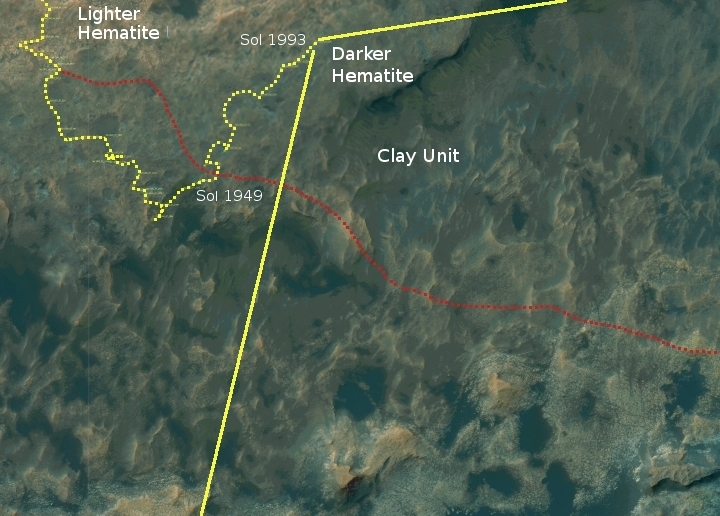
The target area is centered at 4.5 N latitude and 135.9 East longitude. If you zoom in on that latitude and longitude at the archive of Mars Reconnaissance Orbiter (MRO) high resolution images, you get the red blob on the right, which shows how many images they have taken of this area in preparation for InSight’s mission. The X indicates the location of lat/long above.

Below the fold is a reduced version of the MRO image for the center of this target area. The black spots near the center are thought to be a recent crater impact site. In general, this image shows an area with more features than the region around it. Most of the landing area of Elysium Planitia is a featureless flat plain with scattered small craters. Since InSight is not a rover, where it lands will be where it does its research, so there was no reason to pick a site with lots of interesting surface features. Moreover, since InSight is focused not on studying the surface but the interior geology of Mars, it matters little what the surface looks like anyway. One instrument will be a seismograph, while another will insert a thermometer about sixteen feet into the ground to measure the interior temperature.
» Read more

1 comment

Problem with new ISS robot arm hand

Update: Software patch fixes robot arm latching mechanism. (Hat tip reader jburn.)

Less that a week after astronauts did a spacewalk to install a new latching end effector on the end of one of the station’s robot arms NASA has decided to do another spacewalk to put the old “hand” back on.

Hints of an issue cropped up during the previous spacewalk when two of the six Expedition 54 astronauts—NASA’s Mark Vande Hei and Scott Tingle—replaced the end effector, called LEE-B, but ground teams were unable to communicate with the mechanism. “The spacewalking crew demated and remated the connectors and ground teams were able to power up the arm to an operational state on its secondary communications sting leaving the arm operational but without a redundant communications string,” a NASA statement reads.

After several days of troubleshooting, NASA and the Canadian Space Agency—which built the 57.7-foot (17.6-meter) long Canadarm2—said the decision was made to use the upcoming spacewalk to re-install the old LEE-B to restore the redundant capability with the arm. The space agency said if Canada and its robotics specialists find a way to solve the issue, the Jan. 29 spacewalk could be delayed.

2 comments

SpaceX sets February 6 for first Falcon Heavy launch attempt

Capitalism in space: SpaceX has now scheduled February 6 as the date for its first attempt to launch its Falcon Heavy rocket.

I was amused by this tidbit from the article:

While a launch date has been set, the company still faces a regulatory obstacle ahead of the launch. The Federal Aviation Administration’s Office of Commercial Space Transportation has not yet issued a launch license for the Falcon Heavy, a requirement for a commercial launch such as this. Such licenses are often issued days ahead of a launch.

I dare the FAA to deny this launch a license. I just dare them.

9 comments

Bad times fall on Russian Proton rocket

Link here. The key quote is this:

All this means that after 53 years in service, the venerable Proton rocket might set an anti-record in 2018 by flying only a couple of missions. And, for the first time since its entrance onto the world market at the end of the Cold War, it may not bring any money to its cash-strapped developer.

This story confirms much of what I have been reporting about Proton and the loss of its customer base in the past three years.

0 comments
1 509 510 511 512 513 816