Falcon Heavy static fire now set for January 19
SpaceX has now scheduled its next attempt complete a static fire test of its Falcon Heavy rocket for Friday, January 19, with a window beginning at 3:30 pm.
Capitalism in space: Virgin Orbit has signed another launch contract, this time to launch nanosats for a company that provides services to the airline industry.
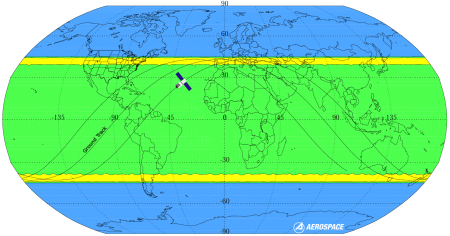
The flight, which is bound for a low-inclination orbit, is scheduled to occur in early 2019. GomSpace will use the launch to further build out a constellation of small satellites that will use Automatic Dependent Surveillance-Broadcast (ADS-B) and Automatic Identification System (AIS) signal monitoring to track civilian aircraft and ocean-going vessels. This satellite constellation will provide continuous monitoring between 37 degrees North and 37 degrees South, helping provide global situational awareness for air-traffic controllers and shipping companies, and aiding in the identification and location of wayward or missing planes and ships.
The satellites slated for flight on LauncherOne are based closely on the flight-proven hardware used in the successful GOMX-1 and GOMX-3 missions, and will be designed, manufactured, and commissioned by GomSpace. The constellation will be operated by GomSpace’s Mauritius-based customer, Aerial & Maritime Ltd., once in orbit.
This appears to be the fifth launch contract that Virgin Orbit has signed, all with different companies. The recent stories have all suggested commercial launches will begin in 2019. I wonder, considering the company has yet to test fly LauncherOne, its rocket, even once.
There could be many reasons the company is getting so many contracts at this time. They could be offering great deals, with no commitment. They could be farther along in testing than the public knows. They could be fooling the satellite companies (though I doubt this because of the number of companies now signed on). Their other partners, some quite large and powerful, might be exercising clout to get these small smallsat companies to announce a launch contract in order to improve Virgin Orbit’s footprint in the market.
Regardless, we shall find out soon. To start commercial operations by early 2019 they must do some initial flight tests of LauncherOne this year. Time is running out for them to meet this schedule.
Summary: Both rovers have moved little in the past month, Opportunity because it is in a good science location and because it must save energy during the winter and Curiosity because it is in a geological location so good the scientists appear to almost be going ga-ga over it.
For the overall context of Curiosity’s travels, see Pinpointing Curiosityโs location in Gale Crater.
In the month since my December 18 update, Curiosity has continued to head south rather than east as originally planned (as indicated by the dotted yellow line in the traverse map to the right). Moreover, the rover has not moved very much, because the science team has decided that there is just too much significant geology in this area on Vera Rubin Ridge, also part of a geological unit they have dubbed the Hematite Unit.
Right now the rover is located at an area they call “Region e,” one of the three patches I have also indicated on the image to the right. From the second update below:
This location is a slight depression with exposed fractured bedrock that appears more “blue” from orbit than the surrounding region. In addition, the orbital evidence and observations from the ground suggest that this location is similar to “Region 10” that we visited just last week, which was shown to have some pretty spectacular small-scale features that were of particular interest to many on the science team. As a result, the team was very excited to reach “Region e” and begin our scientific investigation!
The last few updates on the Curiosity mission update page indicate the excitement the geologists have for this site:
» Read more
It appears that the first static fire test of the Falcon Heavy has been delayed again from today to later in the week.
There is no word on why the delay, but all indications suggest that they are going through the process step-by-step with great care. As they find things that need addressing they are addressing them, and that only when all issues are resolved will they go forward.
Last week there was a big NASA story about the discovery of eight locations on Mars where the evidence strongly suggests that these spots have cliff faces with exposed layers of water ice.
The press release however did not provide an overview about where those eight locations were. Only two locations were given, one for a scarp in Milankoviฤ Crater in the northern hemisphere, and one in an area called Promethei Terra, located in the remote cratered highlands in the southern high-mid-latitudes.
After much digging (and some assistance from John Batchelor) I was finally able to obtain the latitudes and longitudes of all 8 locations. All but the scarp in Milankoviฤ Crater crater (shown by the white dot north of Olympus Mons) are located in the white rectangular box shown to the south and east of Hellas Basin, the area with Mars’ lowest elevation. This part of Mars is not well imaged with the high resolution camera on Mars Reconnaissance Orbiter (indicated by the fewer number of red squares in the image), mostly because it appears relatively boring from a distance. Nothing appears to be there for hundreds and hundreds of miles except craters, sand, and sand dunes..
The discovery of these scarps in this area however changes the picture. It suggests that cratered highlands that surround Hellas Basin, including those close to the planet’s equator, could contain similar buried layers of ice. More research is necessary to pin down more locations, especially those closer to the equator where conditions might be more hospitable for a colony.
Moreover, educated readers of Behind the Black have previously noted that because of Hellas Basin’s low elevation the air pressure there is thicker, and therefore the location has some advantages as a potential colony location. These ice scarps raise the value of Hellas Basin considerably, as they suggest that such layers could easily be exposed as you descend into Hellas Basin. If such layers are exposed on the northern flanks of the basin, they would be at latitudes of around 25 to 30 degrees south, a much more friendly latitude for settlement.
Link here. The article has a lot of good information not only about the test but about the launchpad and how it will be used in the future.
One take-away that I came off with however came from the picture of the Falcon Heavy on the launchpad. It made me realize how far apart the two side stages sit from the core stages, as the rocket is now reconfigured. My impression of most strap-ons today is that they are placed very close to the core, and they generally have aerodynamic cones that slope away from the core, so that the air is directed away from the space between the stages. Falcon Heavy however has all that space, and the side strap-ons have rounded cones.
I wonder if this is one of the rocket’s most worrisome unknowns, as it travels through Max Q, the period shortly after launch when the stresses created from its speed and the atmosphere are the highest. As designed, a lot of atmosphere will travel between the stages. While this isn’t entirely unique (the shuttle had a somewhat comparable gaps between its various parts), I do wonder.
SpaceX yesterday re-scheduled the Falcon Heavy launchpad static fire engine test to Monday, with a window opening at 4 pm Eastern and lasting until 10 pm.
Comments at the link suggest that the software for the rocket’s hold down clamps required review. This theory however is unconfirmed.
Update: The test has now slipped to Tuesday.
Cool movie time! Using Juno images, a citizen scientist has created a short movie showing two complete rotations of Jupiter’s south polar regions. I have embedded the movie below the fold. It is definitely worth watching. As he notes,
Due to Jupiter’s low axial tilt we never see more than roughly one half of the area around the poles in sunlight at any given time. However, it is interesting to see what Jupiter’s polar regions would look like if things were different and a big area around the poles was illuminated. This rotation movie shows what Jupiter’s south polar region would look like near the time of southern summer solstice if Jupiter’s axial tilt was much greater than it is, i.e. comparable to Saturn’s axial tilt.
He also notes the puzzling fact that, though Jupiter and Saturn are both gas giants, unlike Saturn Jupiter does not have a vortex at its poles. In fact, he points out how none of Jupiter’s storms are centered at the pole. Why one gas giant should have such pole-centered vortexes while another does not is a big mystery that illustrates how very little we know about planetary formation and evolution.
The two rotations also do not show any changes in the storms, not because they aren’t changing but because the images used were taken over too short a time span to show this.
» Read more
The competition heats up: China today completed its third launch in as many days, placing a remote sensing satellite into orbit.
It was also reported today that one of the strap-on boosters from the previous launch fell and exploded in a Chinese village, where towns-people were able to take videos of it burning on the ground.
The launch standings:
3 China
1 SpaceX
1 ULA
1 India
Capitalism in space: Virgin Galactic’s Unity suborbital spaceship completed 7th glide test today.
I must admit that I am only reporting this because I feel obligated to. This was their first flight in five months, and they have still not done a powered flight. I cannot get excited about Virgin Galactic and SpaceshipTwo until I actually see them reach space, something they have still not accomplished after fourteen years of development.
Capitalism in space: Rocket Lab has announced that it will attempt the second test launch of its Electron rocket during a nine day launch window beginning on January 20.
Bad weather and technical issues prevented this launch in December. Meanwhile, Japan is also planning a test launch in January of its only smallsat rocket, the SS-520. The Japanese entry is a demo mission designed and built by that country’s space agency, while Rocket Lab is entirely private. Both however provide more evidence that 2018 will be a booming year (no pun intended) for rockets.
The competition heats up: In what looks like the beginning of what might be the most active launch year in almost three decades, India and ULA today each successfully completed their first launches of 2018.
ULA’s Delta 4 rocket launched a U.S. reconnaissance satellite, while India’s PSLV rocket placed in orbit 31 satellites, 30 of which were smallsats. For India, this was their first launch since an August PSLV launch failed when the rocket fairing did not release.
Update: I just discovered that China launched its second rocket yesterday, placing it in a tie with U.S. for most launches and ahead of everyone else.
2 China
1 SpaceX
1 ULA
1 India
Scientists have discovered eight locations on Mars where underground ice appears to be exposed on cliff faces
The scarps directly expose bright glimpses into vast underground ice previously detected with spectrometers on NASA’s Mars Odyssey orbiter, with ground-penetrating radar instruments on MRO and on the European Space Agency’s Mars Express orbiter, and with observations of fresh impact craters that uncover subsurface ice. NASA sent the Phoenix lander to Mars in response to the Odyssey findings; in 2008, the Phoenix mission confirmed and analyzed the buried water ice at 68 degrees north latitude, about one-third of the way to the pole from the northernmost of the eight scarp sites.
The important thing about this discovery is that, though we have known for several years that water ice exists underground in the Martian mid-latitudes, this is the first time we have identified specific places there it is exposed and accessible.
Unfortunately, the press release does not provide the specific eight locations, except for the one image, which is located in the southern hemisphere in a region called Promethei Terra, far from areas that have been studied much more extensively. I will do some digging to see if I can identify the other seven locations.
An evening pause: Hat tip John Harman. This video has been around for awhile, but I hadn’t ever actually watched it until now. What it shows is very cool, but sad in so many ways. As a government project the whole Soviet space shuttle program was generally a dead end waste of resources (as was our own shuttle). Yet, it was possibly one of Soviet Russia’s greatest technological achievements — which they have allowed to rot away in these abandoned hangers, rather than opening them up for their citizens to see and admire and learn from.
Astronomers and programmers have created a 3D fly-through of the Orion Nebula, using imagery and data from the Hubble and Spitzer space telescopes.
I have embedded the video below the fold. At one point it really resembles what one sees out of an airplane window when there is a thick cloud cover below.
» Read more
NASA has funded a cubesat-based ultra-violet telescope to launch in 2021.
SPARCS is a CubeSat built of six cubical units, each about four inches on a side. These are joined to make a spacecraft two units wide by three long in what is termed a 6U spacecraft. Solar power panels extend like wings from one end. “In size and shape, SPARCS most resembles a family-size box of Cheerios,” Shkolnik said.
The spacecraft will contain three major systems โ the telescope, the camera, and the operational and science software. Along with Shkolnik, SESE astronomers Paul Scowen, Daniel Jacobs, and Judd Bowman will oversee the development of the telescope and camera, plus the software and the systems engineering to pull it all together. The telescope uses a mirror system with coatings optimized for ultraviolet light. Together with the camera, the system can measure very small changes in the brightness of M dwarf stars to carry out the primary science of the mission.
As I have noted numerous times recently, the space industry is splitting between large manned projects and tiny unmanned ones. While certain unmanned probes will always have to be larger, the ability to build and launch the same capabilities at a smaller size is lowering cost and allowing more probes to be launched.
In reviewing Lunar Reconnaissance Orbiter data scientists think they have discovered several skylight entrances into a lava tube that is located near the Moon’s north pole.
The new pits were identified on the northeastern floor of Philolaus Crater, a large, 43 mile (70 km)-diameter impact crater located at 72.1oN, 32.4oW, about 340 miles (550 km) from the North Pole of the Moon, on the lunar near side. The pits appear as small rimless depressions, typically 50 to 100 feet across (15 to 30 meters), with completely shadowed interiors. The pits are located along sections of winding channels, known on the Moon as โsinuous rilles,โ that crisscross the floor of Philolaus Crater. Lunar sinuous rilles are generally thought to be collapsed, or partially collapsed, lava tubes, underground tunnels that were once streams of flowing lava.
โThe highest resolution images available for Philolaus Crater do not allow the pits to be identified as lava tube skylights with 100 percent certainty, but we are looking at good candidates considering simultaneously their size, shape, lighting conditions and geologic settingโ says Pascal Lee, planetary scientist at the SETI Institute and the Mars Institute who made the new finding at NASAโs Ames Research Center in Silicon Valley.
…Prior to this discovery, over 200 pits had been found on the Moon by other researchers, with many identified as likely skylights leading to underground lava tubes associated with similar sinuous rilles. However, todayโs announcement represents the first published report of possible lava tube skylights in the Moonโs polar regions.
The floor of the crater as a lot of rilles, and a close look at that crater floor reveals to me a lot of possible sky light entrances, more than indicated by the images at the llink. (Go here, click on projections and pick “Orthographic (North Pole).” Then zoom in on the crater indicated by the yellow X in my image on the right above.)
The key here is that caves or lava tubes provide a good place to cheaply and quickly establish a lunar colony. While it is suspected that water might survive in permanently shadowed regions near the poles, up until now no one had found any good underground locations there. If this suspected skylight entrances prove true, this crater then becomes prime real estate on the Moon.
The first launch dates for SpaceX’s manned Dragon capsule have apparently been rescheduled, with the new dates August 2018 for the first unmanned demo flight and December 2018 for the first manned flight.
This is a four month delay from the previous announced dates of April and August.
Hat tip to reader Kirk Hilliard.
Capitalism in space: Planet has signed a deal with the Russian government entity that bundles smallsat secondary payloads to launch a dozen cubesats on a Soyuz rocket presently scheduled to launch later this year.
This agreement provides further evidence that the cubesat commercial industry is here to stay. There are a lot of these contracts right now (India is scheduled to launch 30 tomorrow). The need for more small rockets to launch such satellites appears almost overwhelming, and thus a good financial choice.
The new colonial movement: The head of China’s space agency has now been promoted to a political post as acting governor of the Fujian province in China.
The significance here is that this is not the first time a space agency manager in China has moved into an important political role. Three previous space administrators have already become governors of different Chinese provinces (the equivalent of states here in the U.S.) As was noted in an article I linked to in May, the managers of China’s space agency now dominate its entire government. This not only bodes well for its space program (giving it great political clout), but it also bodes well for China’s political system, as they appear to be appointing their political people based not just on power, but on administrative skills and talent.
This process is also interesting historically. For almost two thousand years China’s government was managed under the bureaucratic philosophies of Confucius, whereby administrators had to pass a difficult intellectual test to become certified. They then moved up the ranks.
It seems that these cultural roots are deep and on-going. China appears now to be replacing that test (which with time became hidebound and disconnected with the changing times, especially when the European powers arrived in the 1800s) with actual management experience in major industries. If you want to get promoted into higher positions of power in China, you need to demonstrate that you can manage a company or a space program effectively.