Spacewalkers successfully replace failed unit on ISS

In a a short spacewalk just under three hours two astronauts today successfully replaced the failed MDM data relay unit on the outside of ISS.

Some additional details about this unit:

The MDM that failed and an identical unit are part of the tier 2 command architecture and relay commands to a variety of critical station systems, including the stationโ€™s guidance, navigation and control system, the labโ€™s stabilizing gyros, the environmental control system, the stationโ€™s cooling system and others.

Both tier 2 computers were installed during spacewalks March 30 and March 24 respectively, replacing two older units with models featuring upgraded data processing cards. It is not yet known whether the problem with MDM-1 involved the upgraded components or some other circuitry or software

I suspect this upgraded but failed unit is going to be looked at very carefully.

7 comments

The face of Ceres

The face of Ceres

Cool image time! The image on the right, reduced in resolution to show here, was taken by Dawn on April 29, 2017, when the spacecraft had been positioned between the Sun and the dwarf planet at a moment when its entire surface was lit. They have enhanced the colors to bring out the contrasts.

Images combining these different color filter perspectives reveal fine details of Ceres’ surface. For example, they emphasize the distinct compositions and textures of the material ejected from craters. The brightest region on Ceres, called Cerealia Facula, is highlighted in Occator Crater in the center of this image. Vinalia Faculae, the set of secondary bright spots in the same crater, are located to the right of Cerealia Facula.

One of the darkest regions on Ceres is next to Occator, and represents ejected material from the impact that formed the crater. The ejected material forms a large arc that extends over several hundred kilometers, below the center of Ceres in this image. That material’s distribution is partly determined by Ceres’ rotation.

Be sure to take a close look at the full image. It isn’t super high resolution, but it reveals a lot of interesting details

0 comments

Emergency spacewalk on ISS to replace electronics relay box

Astronauts will perform an emergency spacewalk on May 23 to replace the failed MDM electronics relay box that failed on Saturday.

So, they have a spare on board, which is good. The article does note, however, that the unit that failed had only been installed less than two months ago, on March 30. This is not good. These units should last longer than two months, especially considering how critical they appear to be.

5 comments

Rocket Lab launch delayed

Capitalism in space: Rocket Lab has delayed its first test launch of its Electron rocket because of predicted high winds.

The company has not yet said if they have rescheduled for Tuesday.

This article gives a very detailed overview of the rocket, its engines, and the history of its launch site. It also notes that if successful, the launch will be first orbital flight ever from a commercial company from its own commercial launch site.

3 comments

Primary data relay electronics unit on ISS truss fails

ISS managers are meeting to make a plan to deal with the failure on Saturday of the #1 data relay electronics box on the S0 truss of the station.

The unit, called an MDM, has an identical backup in place so no station operations have so far been effected. However, that backup had failed back in 2014 and required a spacewalk to replace it, so it is not clear to me as yet whether the station has any additional spares available to replace the newly failed unit. If so, it will still require a spacewalk to make the switch.

If there is no spare, they will likely have to ship one up on the next cargo flight, as the MDM is essential for operating the solar panels and radiators as well as the robot arms.

5 comments

The first 3 of a 200 nanosat constellation delivered for launch

Capitalism in space: Sky and Space Global (SAS) has delivered the first three nanosats — of a planned 200 nanosat constellation — to India for launch.

The first three nanosats are to be launched by India on its PSLV rocket, but SAS has contracted Virgin Orbit to use its LauncherOne to put the next 197 up. They had made this first announcement last summer, saying the first three would launch in the second quarter of 2017. It appears that they are holding to that schedule.

They also said that LauncherOne would begin launching the other 197 satellites in 2018. For this I remain far more skeptical, since the track record at Virgin in getting its spacecraft off the ground on schedule has not been good.

0 comments

Rocket Lab gets another contract

Capitalism in space: With its first test launch set for Monday, Rocket Lab today earned a new launch contract, this time from Spaceflight, a company that acts as a charter company putting together launches for smallsat companies.

Spaceflight buys a launch from a rocket company, and then sells slots to smallsat companies that cannot afford to buy the whole launch. This way Spaceflight can tailor each launch to the needs of the different smallsats. Though they have previously purchased launches from India’s PSLV, Russia’s Dnepr, and SpaceX’s Falcon 9, Rocket Lab’s Electron fits this model more perfectly, because — as a small rocket designed for smallsats, it doesn’t require a lot of smallsats to fill its payload. Thus, they can offer the smallsats on board access to orbits not normally available. This will make it relatively easy to find customers for the launch.

5 comments

SpaceX launches commercial satellite

Capitalism in space: SpaceX today successfully launched a commercial communications satellite, only two weeks after its previous launch.

They hope to launch again in two weeks, and then two weeks after that, and then two weeks after that, again. In fact, they presently have four launches listed for June. If they succeed, they will be well on the way to clearing their launch backlog.

9 comments

Mars rover update: May 15, 2017

This update could also be entitled, “Up and down into Martian gullies,” as that is what both rovers, Curiosity and Opportunity, are presently focused on doing.

Curiosity

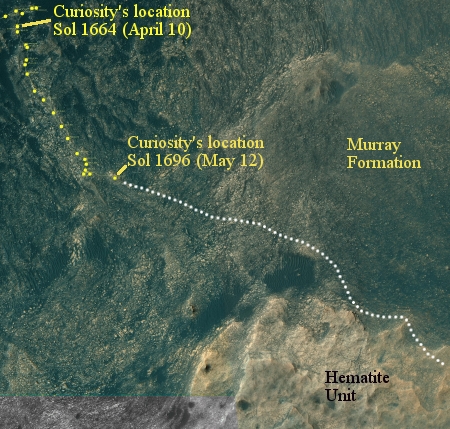
Curiosity's position, Sol 1696 (May 12, 2017)

For the overall context of Curiosity’s travels, see Pinpointing Curiosityโ€™s location in Gale Crater.

In the past month, since my previous April 21, 2017 update, Curiosity has been working its way up the dry wash, frequently stopping to inspect the rocky surface terrain within. As they note,

As we climb up Mount Sharp, recently over slopes of 4-6 degrees, we have seen more varied outcrop structures and chemistries than the rest of the Murray formation, and such changes catch the collective eye of the team.

Only in the last week have they shifted to the east, as planned. Their near term goal is the lighter, yellowish layer of rock, dubbed the Hematite Unit, that sits higher up the slope of Mount Sharp. As they have been traveling on the Murray Formation now for more than a year, since March, 2016, I am certain the science team is even more eager to get to this different layer of geology to find out what it is made of and why it is there.

You can get an overall view of the geology Curiosity is traversing from this October 3, 2016 press release. Below is a version of the traverse map shown at that site that I posted as part of my October 6, 2016 rover update, updated to show Curiosity’s present location. It is apparent that Curiosity is finally moving out of the foothills below Mount Sharp and beginning its climb up the mountain’s actual slopes.
» Read more

5 comments

Engine test of Blue Origin BE-4 engine goes bad

Capitalism n space: Blue Origin today revealed that an engine test of its BE-4 rocket engine, intended for sale to ULA as well as the basis for their own New Glenn rocket, went wrong.

In a rare update, the Blue Origin space venture founded by Amazon billionaire Jeff Bezos reported that it lost a set of powerpack test hardware for its BE-4 rocket engine over the weekend, but added that such a setback is โ€œnot unusualโ€ during development. โ€œThatโ€™s why we always set up our development programs to be hardware-rich,โ€ the company tweeted today. โ€œBack into testing soon.โ€

The announcement was via a tweet, and they have released no additional details.

10 comments

Rocket Lab sets May 21 for first test launch of its Electron rocket

Capitalism in space: Rocket Lab today announced that it has scheduled the first test flight of its Electron rocket for May 21.

The company is setting expectations for a test launch that may suffer delays and could end in failure. โ€œDuring this first launch attempt it is possible we will scrub multiple attempts as we wait until we are ready and conditions are favorable,โ€ Beck said in the statement.

The launch, as the companyโ€™s name for it emphasizes [“It’s a test], is a test flight, with no satellite payload on board. The launch is the first of three such test flights Rocket Lab plans before beginning commercial launches later this year.

Rocket Lab plans to carry out the launch largely out of public view. The company said a press kit about the mission that there will be no public viewing sites in the vicinity of its New Zealand launch site for this mission. There are also no plans to webcast the launch, although the company said it will provide video footage โ€œfollowing a successful launch.โ€

Although Rocket Lab is launching from New Zealand, the company is headquartered in the United States, and thus will require a launch license from the U.S. Federal Aviation Administration for this and future Electron missions. As of May 14, the FAA had not published a launch license for this flight. [emphasis mine]

I have highlighted the last paragraph above because it is to me the most interesting part of this entire story. What happens if Rocket Lab never gets its U.S. launch license and launches anyway? They are launching on foreign soil. It really is none of the FAA’s business, even if the company is based in the U.S. Will they fine them? Call them names?

I suspect that one reason they have made the announcement first, before getting their license, is to pressure the FAA bureaucrats to get off their duffs and get moving. In the past both Virgin Galactic and SpaceX have done the same thing, and got their licenses very quickly thereafter.

1 comment

The press begins to turn against SLS

This report by Eric Berger of Ars Technica, describing the press teleconference today where NASA announced that they would not fly humans on the first SLS flight in 2019, reveals a significant political change.

In the past, most mainstream reporters would routinely accept NASA’s announcements about SLS. If the agency said it was great, their stories would wax poetic about how great it was. If NASA said its greatness was causing a delay, their stories would laud NASA had how well it was doing dealing with SLS’s greatness, even though that greatness was forcing another delay. Never, and I mean never, would NASA or these reporters ever talk about the project’s overall and ungodly cost.

This press conference was apparently quite different. The press had lots of questions about SLS and its endless delays. They had lots of questions about its costs. And most significant, they had lots of questions for NASA about why the agency is having so much trouble building this rocket, when two private companies, SpaceX and Blue Origin, are building something comparable for a tenth the money in about half the time.

During the teleconference, Ars asked Gerstenmaier to step back and take a big-picture look at the SLS rocket. Even with all of the fundingโ€”about $10 billion through next yearโ€”how was the agency likely to miss the original deadline by as much as three years, if not more?

“I donโ€™t know,” Gerstenmaier replied. “I donโ€™t knowโ€”I would just say itโ€™s really kind of the complexity of what weโ€™re trying to go do, and to build these systems. We werenโ€™t pushing state-of-the-art technology, like main engines sitting underneath the rocket or new solid rocket boosters. But we were pushing a lot of new manufacturing, and I think that new manufacturing has caused some of the delays weโ€™ve seen. No one welds the way that weโ€™re welding material at the thicknesses weโ€™re welding.”

…Later, the NASA officials were asked about private companies such as SpaceX and Blue Origin, which are also building heavy-lift rockets but at a very limited cost to taxpayers. What would they have to say about just buying those vehicles off the shelf, at significantly lower cost than an SLS launch, and preserving NASA’s funds to execute in-space missions?

Gerstnmaier’s explanations for SLS’s delays and costs, that it is a very complex and advanced piece of rocket engineering, is total bunk. This was supposed to be an upgraded Saturn 5, but it will only be able to lift about 70% of the payload. It is using the actual shuttle engines, and upgraded shuttle solid rocket boosters. While new engineering was required to refit these for SLS, none of that should have been so hard or expensive.

The key here is that members of the press are finally aware of this, and are asking the right questions. With Falcon Heavy about to launched multiple times before SLS even launches once, the continuation of this boondoggle is becoming increasingly difficult to justify.


29 comments

NASA nixes plan to fly humans on first SLS flight

Common sense prevails! In a joint decision with the White House, NASA announced today that they will not fly humans on the first test flight of SLS, now scheduled for sometime in 2019.

Bill Gerstenmaier, NASA associate administrator for human exploration and operations, said that the study turned up fewer technical issues with putting a crew on EM-1 than he originally expected. โ€œWhat I was surprised by was that I thought there would be a whole lot of really negative work that would actually maybe make this not very attractive to us,โ€ he said. โ€œBut when [acting NASA administration Robert Lightfoot] and I look at this overall, it does add some more risk to us, because itโ€™s the first crew on the vehicle,โ€ he said. The work to add crew to EM-1 would have cost NASA an additional $600โ€“900 million, and delay the launch likely to the first or second quarter of 2020.

โ€œThe culmination of changes in all three of those areas said that overall, probably the best plan we have is actually the plan weโ€™re on right now,โ€ Gerstenmaier said. โ€œWhen we looked at the overall integrated activity, even though it was feasible, it just didnโ€™t seem warranted in this environment.โ€

The announcement also included an admission by Gerstenmaier that the first manned SLS flight, now set for 2021, will likely be delayed.

1 comment

Propellers by the dozens

Propellers

Cool image time! The latest image releases from Cassini, taken during its recent close fly-by campaign of the rings of Saturn, focus on the propeller features produced in the rings by larger ring objects. The image on the right, reduced to show here, reveals dozens of propellers of all shapes and sizes.

The original discovery of propellers in this region in Saturn’s rings … was made using several images taken from very close to the rings during Cassini’s 2004 arrival at Saturn. Those discovery images were of low resolution and were difficult to interpret, and there were few clues as to how the small propellers seen in those images were related to the larger propellers Cassini observed later in the mission….

This image, for the first time, shows swarms of propellers of a wide range of sizes, putting the ones Cassini observed in its Saturn arrival images in context. Scientists will use this information to derive a โ€œparticle size distributionโ€ for propeller moons, which is an important clue to their origins.

The parallel pattern of rings in the center of the image is a series of density waves in the ring structure, caused by an interaction with one of Saturn’s larger nearby moons.

They have also released the best view we can now expect of a propeller by Cassini.

This is the third and final propeller to be targeted for a close flyby observation during Cassini’s ring-grazing orbits (the period from Nov. 2016 to April 2017 when Cassini’s orbit passed just outside the main rings). …Because propellers are seen in the outermost parts of the main rings, the ring-grazing orbits provided Cassini’s best opportunity to see them up close.

Cassini is now diving between the rings and the planet, so the propellers are farther away.

0 comments

Air Force agreement with ULA expires

The 2005 agreement between the Air Force and ULA that established the ULA launch monopoly that was only broken by SpaceX in the past two years has apparently expired.

David Hardy, associate deputy under secretary of the Air Force for space, and the deputy director, principal Defence Department space advisor staff, said on 9 May that he was the compliance officer for the agreement and that the Pentagon no longer has oversight duties now that the agreement has expired. He told Jane’s these oversight duties included compliance requirements to what communications and relationships the two parent companies, Lockheed Martin and Boeing, could have with ULA, their joint venture.

It is very unclear how this will effect ULA. Will it continue to get the $800 million subsidy, as outlined by the agreement? It even appears from the article that the partnership between Boeing and Lockheed Martin might be dead.

0 comments
1 546 547 548 549 550 820