ISRO successfully tests thrusters to be used on its manned Gaganyaan capsule

India’s space agency ISRO last week successfully completed two tests of the attitude control thrusters that will be used on its manned Gaganyaan capsule.

In a statement issued on Wednesday, ISRO said that the short-duration tests, lasting 30 seconds and 100 seconds respectively, were aimed at validating the test article configuration. The space agency stated that the overall performance of the propulsion system during the hot tests had been normal and aligned with pre-test predictions.

It was also noted that during the 100-second test, the simultaneous operation of all Reaction Control System (RCS) thrusters in various modes—both steady state and pulsed—along with all Liquid Apogee Motor (LAM) engines had been successfully demonstrated.

The first unmanned test flight of Gaganyaan is presently targeting a launch in the last quarter of 2025, with two more unmanned test flights in 2026. The manned mission of one to three days would follow in 2027.

0 comments

Canadian rocket startup hopes to fly first suborbital launch from its proposed Newfoundland spaceport in August

Nordspace's proposed spaceport
Nordspace’s proposed spaceport. Click for original.

Though details remain slim, the Canadian rocket startup Nordspace now says it is targeting an August launch of its hopes to fly first suborbital launch from its proposed spaceport in August.

NordSpace’s Taiga rocket isn’t going to reach orbit when it launches in August, but it’s a big step toward the company’s ultimate goal. Taiga is a small, liquid-fueled, hypersonic launch vehicle capable of carrying just over 110 pounds (50 kilograms) above the Karman Line. This summer’s shakedown cruise will be a low-altitude demonstration of Taiga’s capabilities.

The map to the right indicates the location of the spaceport, near the town of St. Lawrence on the southern coast of the island of Newfoundland.

Whether this launch occurs is very uncertain. For example, a previous report in January 2025 about this launch site suggested that government approvals were still required. It is not known if those approvals have been obtained.

Nordspace is the second company in Canada to propose offering a combined spaceport/rocket service. The other, Maritime Launch Services, first appeared almost a decade ago, but has never gotten off the ground. Nordspace first announced its plans in July 2024, so achieving a first test launch in 2025 will clearly place it ahead of Maritime.

7 comments

SpaceX gets launch contract from Globalstar

As it appears right now to be the only American rocket company capable of taking on new launch contracts, SpaceX today was awarded a new launch contract from Globalstar to launch its third generation set of satellites.

The press release is not clear about the number of satellites or launches involved, but either way the deal signals SpaceX’s continuing dominance. For larger satellites it has no real competitors. Not only are its launch prices the cheapest, none of its competitors are capable of adding new customers to their launch manifests. In fact, those competitors, ULA, Arianespace, and Blue Origin, are having trouble simply getting their rockets off the ground on a regular basis.

This situation however is likely to change by two years, assuming the new rockets being developed by Rocket Lab, Stoke Space, and Relativity finally begin flying.

0 comments

Spanish high altitude balloon company to fly tourist flights from South Korea

The Spanish high altitude balloon startup Zero-2-Infinity has now established an office in South Korea with the intention of flying tourist flights from there for a ticket price of about $60k per flight.

Zero 2 Infinity plans to begin its Korean operations with a project called “Byul” — the Korean word for star — which offers a symbolic farewell for pet lovers. The initiative will invite volunteers to send the ashes of their deceased furry companions into the stratosphere, carried in star-shaped, biodegradable capsules. The company aims to begin collecting participants this September, with the first near-space release scheduled for December in Korea.

Byul will apparently be a smaller balloon with no human passengers. The company claims it has already test flown a larger helium balloon with humans aboard to an altitude of 6 miles, and again unmanned to 20 miles. If so it has done so with no publicity at all. This announcement today appears more a push to raise the $70 million the company says it needs to develop this manned balloon capsule.

3 comments

SpaceX launches 28 Starlink satellites

After an unusual pause of launches of several days (likely due to the July 4th weekend), SpaceX last night successfully launched by placing another 28 Starlink satellites into orbit, its Falcon 9 rocket lifting off from Cape Canaveral in Florida.

The first stage completed its 22nd flight, landing on a drone ship in the Atlantic.

The leaders in the 2025 launch race:

85 SpaceX
36 China
10 Rocket Lab
8 Russia

SpaceX now leads the rest of the world in successful launches, 85 to 63.

0 comments

Returning to Mars’ glacier country

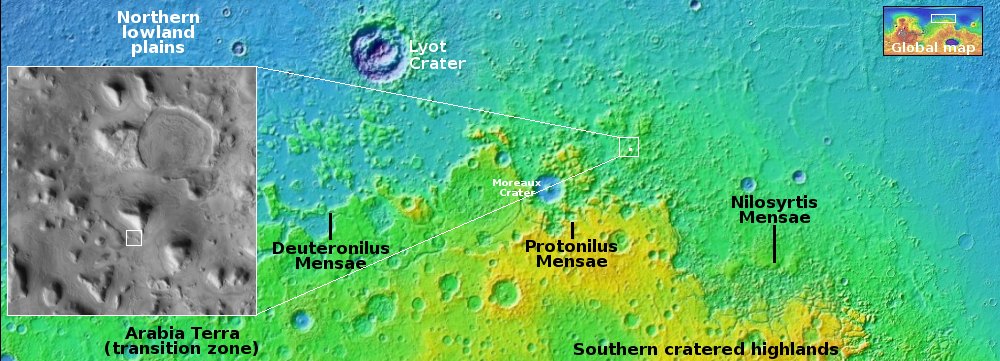
Overview map

Returning to Mars' glacier country
Click for original image.

Today’s cool image illustrates again why I rail against those who still claim Mars is dry. The picture to the right, cropped, reduced, and sharpened to post here, was taken on June 2, 2025 by the high resolution camera on Mars Reconnaissance Orbiter (MRO).

The picture was labeled simply as a “terrain sample” by the MRO camera team, which almost always signifies that it was taken not as part of any specific science research project or by request by a scientist, but to fill a gap in the camera’s schedule in order to maintain its proper temperature. When such a gap-filler picture is required, the team tries to pick interesting features in that time frame, but don’t always succeed.

In this case, that time frame placed MRO over the northern mid-latitudes and a region I label “glacier country” because practically every picture taken in this region shows glacial features. This picture is no exception. The white dot in the overview map above marks the location, in the Protonilus Mensae area of the 2,000-mile-long strip of glaciers. The arrow in the picture itself shows the downward grade of the glacial flow. The small 2,000-foot-wide crater appears as if the impact occurred on soft ice, and the stippled terrain surrounding it appears to resemble the feature geologists have labeled “brain terrain”, a surface feature unique to Mars and associated with near surface ice, though its exact formation process is not yet understood.

Nor have I cherry-picked this image to prove my point. Its glacial-like features are very typical for this region of Mars. Note for example the inset with the larger crater to the northeast. It appears almost buried by this glacial material, which has poured through the gap in its southwest quadrant to fill it. A close look at all the low lying terrain shows similar glacial-like flows.

Mars is surely not a paradise. It is bone-chillingly cold almost all the time. Its atmosphere is so thin and lacking in oxygen you would quickly suffocate if you tried to breath it. But the data continues to suggest that the red planet has ample supplies of near-surface ice outside of its dry tropics. All future colonists will need to do is dig a bit and process the water out.

1 comment

ESA picks five rocket startups for future launch contracts

European Space Agency

Capitalism in space: The European Space Agency (ESA) today announced that it has chosen five rocket startups — out of twelve that applied to its “European Launcher Challenge” — now approved to bid on future ESA launch contracts.

The startups are Isar Aerospace and Rocket Factory Augsburg from Germany, PLD Space from Spain, MaiaSpace from France, and Orbex from Great Britain. Though none have successfully completed a first launch. all five showed the most advancement. Isar has had one attempted launch failure, while Rocket Factory lost its rocket during a static fire test just before launch. PLD meanwhile has achieved a short suborbital test, while Orbex has said it was ready to launch three years ago but was blocked by red tape in the United Kingdom.

MaiaSpace is technically the least advanced, but it is also a subdivision wholly owned by ArianeGroup, a partnership of Europe’s largest aerospace companies, Airbus and Safran. It was also established in partnership with France’s space agency CNES. Thus, it has well-established connections within Europe’s aerospace industry that makes it favored.

The goal of this ESA program is to shift from the government model it has used for decades, where ESA builds and owns the rockets, to develop a competitive rocket industry of independent companies that market their rockets to ESA for contracts. ESA has seen the success in the U.S. when NASA shifted to this capitalism model in the past decade, and wishes to emulate this.

Whether it remains uncertain. ESA is still mired by bureaucratic government thinking, as illustrated by the next phrase in this challenge:

The next phase of the proposal will see ESA open dialogue between the preselected companies and their respective Member States. This process will help formalise the proposal ahead of the agency’s Ministerial-Level Council meeting (CM25), which will take place toward the end of the year. At CM25, Member States are expected to formally commit funding to the initiative. Following the meeting, ESA will issue a Phase 2 call for proposals, which will be restricted to the preselected candidate companies. European Launcher Challenge contracts will then be awarded after a final evaluation period.

The ESA’s very nature seems to impose odious bureaucratic rules on its member nations that could hinder these private companies. For example, these rules now block any other independent rocket startups from bidding on contracts. Like the bootleggers during Prohibitioin, the ESA has essentially divided competition up by territory and given it to these favored companies. No one else is allowed in.

0 comments

Two Russian satellites are maneuvering toward an American military satellite

Two Russian “inspector” satellites, launched together in 2022 but now separated, appear to be maneuvering toward an American military satellite and are about to position themselves to within 30 and 50 miles respectively every four days.

[O]n June 26, 2025, a new object was apparently ejected from the main satellite at a separation speed of just around 10 kilometers per hour, according to an estimate by Jonathan McDowell.

By the end of June 2025, Object C (Full ID — 2022-089C), as the newly released satellite was identified in the US Space Force catalogue, was around 140 kilometers from its Kosmos-2558 “mother vehicle,” according to observations by Marco Langbroek. It was tracked in a 545 by 451-kilometer orbit, with an inclination 97.24 degrees toward the Equator. On July 3, 2025, at around 18:42 UTC, Object C made a sudden orbit-lowering maneuver descending to an altitude of around 435 kilometers, while Kosmos-2558 remained in its original orbit.

According to Nico Janssen, the newly formed orbit would put Object C within 81 kilometers from USA-326, on July 5, 2025, at around 00:54:20 UTC. In the meantime, Kosmos-2558 would pass at a minimum distance of nearly 49 kilometers from USA-326 on the same day, at around 09:40:50, Janssen predicted on the Seesat-L Internet message board on July 4, 2025.

Russia’s anti-satellite technology is based on tests several decades ago whereby it brought a killer satellite close to a target satellite and destroyed both by blowing up the killer satellite. These maneuvers now are not likely aimed at such a test, destroying the American classified military satellite. Instead, Russia likely wants to obtain close-up photography and data collection about it. The maneuvers however do prove once again that Russia’s anti-satellite technology is viable.

4 comments

ULA finally begins stacking Vulcan for next launch

After months of delay following the nozzle failure on the rocket’s second launch, ULA has now finally begun preparing a new Vulcan rocket for its third launch, carrying a number of a classified NSSL national security payloads.

Based on statements by ULA’s CEO, Tory Bruno, the company is finally about to begin the aggressive 2025 launch schedule he had promised last year.

During a media roundtable on the sidelines of the 40th Space Symposium in early April, Bruno said they planned to launch around 11 to 13 times by the end of the year. He said that would be a roughly 50-50 split between Atlas and Vulcan rockets.

The next two Vulcan launches are planned to be two NSSL Phase 2 missions: USSF-106 and USSF-87. The Vulcan rockets for both have been at the Cape since last year, but the status of the payloads hasn’t been publicly discussed given their ties to national security.

Bruno said following those two NSSL missions, ULA will launch the first Kuiper Vulcan mission and then bounce back and forth between Atlas and Vulcan flights through the end of the year.

If this schedule turns out to be true, it will be good news not only for ULA but for Amazon, as it indicates the possibility of ULA launching more than 500 Kuiper satellites before the end of the year. That will make a significant dent in its requirement to place 1,600 satellites in orbit by July 2026. At the moment only 54 are in space.

4 comments

Mars is not dry!

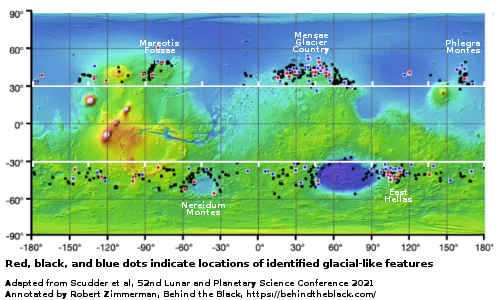
Global map of glaciers found on Mars

I once again feel compelled to rant against the shallow ignorance of too many people in both the journalism field as well as academia about the most recent data we now have of Mars. Two articles today once again show this ignorance, assuming blandly that Mars is a dry planet with little water on it anywhere, when orbital data over the past decade has unequivocally shown that — except for its equatorial regions — the planet is covered with a LOT of near-surface ice.

The headlines make this ignorance quite clear:

In both cases, the articles assume that the data obtained from rovers and landers in the dry Martian tropics applies to the entire planet. It does not. This evidence of a dry planet carries a bias that comes from the decision by the planetary community as well as NASA to send every rover to that dry equatorial region. Only one lander, Phoenix, has ever been successfully dropped far from the Martian equator, and it was purposely sent to a very high latitude, where it proved there was ice present just below the surface.

Orbital data in the past decade from both Mars Reconnaissance Orbiter and Mars Express has clearly shown that there is a lot of near surface ice on Mars, as shown by the map above. In the mid-latitudes the terrain is dominated by glaciers, as this is the region where the vast ice sheets in the high latitudes begin to fade away.

Only the equatorial region, indicated by the white lines on the map, is dry and barren. And yet, even here, orbital data has detected evidence that suggests underground ice still exists.

It seems to me that journalists and academic PR departments should know these facts, and include them in any reports about the dry nature of Mars’ equatorial regions.

13 comments

European capsule startup wins $15 million grant

A Luxembourg-based startup aimed at building orbiting recoverable capsules for cargo as well as in-space manufacturing has won a $14.7 million grant from the European Innovation Council as part of its European Innovation Council Accelerator program to encourage development in Europe’s private commercial space sector.

The company, Space Cargo Unlimited, will use the money to develop what it calls its “BentoBox in-orbit testing and manufacturing platform.” It is also partnering with well-established European company Thales-Alenia, with the BentoBox development based on previous work done for the European Space Agency’s (ESA) Space Rider demonstrator project.

The overall nature of this grant and work illustrates Europe’s aggressive shift in the past two years from the government model, where ESA designed and owned everything, to the capitalism model, where the government is merely the customer, buying what it needs from the private sector. The government-built Space Rider, which was intended to be a re-usable space plane similar to the X-37B, has never flown. Now, its technology is being repurposed by private European companies for their own spacecraft with the intention of making profits. And this Bentobox project is a prime example.

The inaugural flight of the BentoBox platform as a standalone system using the ATMOS inflatable heatshield is expected in the fourth quarter of 2025. As of a late 2024 update, Space Cargo Unlimited had already secured bookings for 80% of the inaugural flight, and 50% and 40% of the second and third flights, respectively.

Note too that Space Cargo is a European competitor with Varda in the U.S. It appears Europe wants some of this business for itself.

2 comments

China launches technology test satellite

China today successfully launched a technology test satellite, its Long March 4C rocket lifting off from its Xichang spaceport in southwest China.

As is usual for China’s state-run press, little information about the satellite was released. The most information any article provided was this:

The satellite, designed and built by the Innovation Academy for Microsatellites under the Chinese Academy of Sciences in Shanghai, will measure and survey space environmental elements and test new technologies.

Nor did that state-run press provide any information about where the rocket’s lower stages, using very toxic hypergolic fuels, crashed inside China.

The leaders in the 2025 launch race:

84 SpaceX
36 China
10 Rocket Lab
7 Russia

SpaceX still leads the rest of the world in successful launches, 84 to 62.

4 comments

Sunspot update: Sunspot activity rebounds somewhat in June

As I have done since I started this website fifteen years ago, I post at the start of every month an update of the Sun’s ongoing sunspot activity, using the update that NOAA posts each month to its own graph of sunspot activity but annotated by me with extra information to illustrate the larger scientific context.

Below is that graph, showing that in June sunspot activity rebounded upward somewhat from the shocking drop in activity that occurred in May.

» Read more

0 comments

Another interstellar object identified entering the solar system

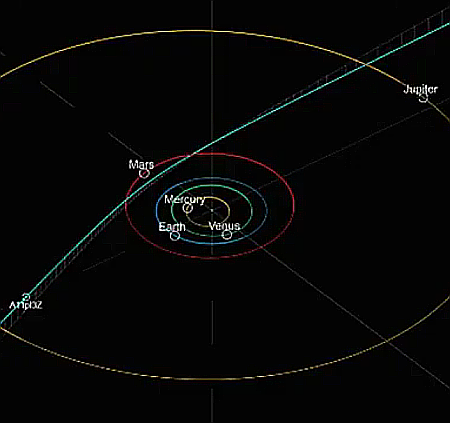
A11pl3Z's path through the solar system

Astronomers think they have identified another interstellar object that is now entering the solar system.

The dim space rock is currently at about magnitude 18.8. Our new visitor, A11pl3Z, will get its closest to the sun – at about 2 astronomical units (AU), or twice as far as Earth is from the sun – in October. As it reaches perihelion – its closest point to the sun – it should be moving at about 68 km/s relative to the sun, or at about 152,000 miles per hour.

The object’s calculated path through the solar system, shown by the blue line in the graphic to the right, as well as the object’s high speed, are why the astronomers think it is interstellar in origin. Both facts suggest it is coming from beyond the Oort cloud.

This is the third such object discovered, after Oumuamua (whose nature remains somewhat unknown), followed by Comet 21/Borisov.

UPDATE: The object has now been renamed 3I/Atlas. The “3I” indicates it is the third interstellar object discovered, and “Atlas” refers to the discovering telescope survey.

12 comments

Methane climate satellite fails

Fifteen months into a five year mission it appears the methane climate satellite MethaneSat has apparently failed prematurely.

From the press release by the environmental activist organization Environmental Defense Fund that operated the satellite:

On Friday, June 20, the MethaneSAT mission operations lost contact with MethaneSAT. After pursuing all options to restore communications, we learned this morning that the satellite has lost power, and that it is likely not recoverable.

The satellite was unusual in that it was developed and built by this activist organization, not a government or academic institution. Its failure is especially unfortunate at this time, because this non-governmental approach to science research is exactly what the science community needs to pursue faced as it is with major cuts in federal funding.

9 comments

SpaceX yesterday completed two launches

SpaceX yesterday successfully completed two launches from Florida. First, it placed a European Union weather and climate research satellite, Sentinel-4, its Falcon 9 rocket lifting off from the Kennedy Space Center. The first stage completed its ninth flight, landing on a drone ship in the Atlantic.

Next, it continued its unrelenting pace of launching Starlink satellites, its Falcon 9 rocket lifting off with 27 from Cape Canaveral. The first stage completed its 29th flight, landing on a drone ship in the Atlantic.

That flight makes this particular first stage the third most traveled launch vehicle, with only the space shuttles Discover (39 flights) and Atlantis (33 flights) ahead of it.

The leaders in the 2025 launch race:

84 SpaceX
35 China
10 Rocket Lab
7 Russia

SpaceX now leads the rest of the world in successful launches, 84 to 61.

0 comments

Webb detects unexpected “little red dots” in the early universe

The uncertainty of science: Using the Webb Space Telescope astronomers have begun to compile a small catalog of what they call “little red dots” [LRDs], objects in the very early universe that are very small, too small to be galaxies and are thus a mystery.

A team of astronomers recently compiled one of the largest samples of LRDs to date, nearly all of which existed during the first 1.5 billion years after the big bang. They found that a large fraction of the LRDs in their sample showed signs of containing growing supermassive black holes.

“We’re confounded by this new population of objects that Webb has found. We don’t see analogs of them at lower redshifts, which is why we haven’t seen them prior to Webb,” said Dale Kocevski of Colby College in Waterville, Maine, and lead author of the study. “There’s a substantial amount of work being done to try to determine the nature of these little red dots and whether their light is dominated by accreting black holes.”

The present most popular theory to explain the dots, based on the available data, is that the dots are newly formed black holes, their red light caused by material falling into the hole at millions of miles per hour. That theory has of course problems. For example, it doesn’t explain why we don’t see these dots in more recent times. Nor does it explain why the dots are dim in X-rays, a radiation expected from accreting black holes.

As always, the press release claims that this discovery does not “break” the present cosmological theories for the formation of the universe, but at the same time, it does illustrate our overall lack of knowledge about that early universe. We really don’t know very much, which means any theories we have are likely wrong simply due to our present ignorance.

3 comments

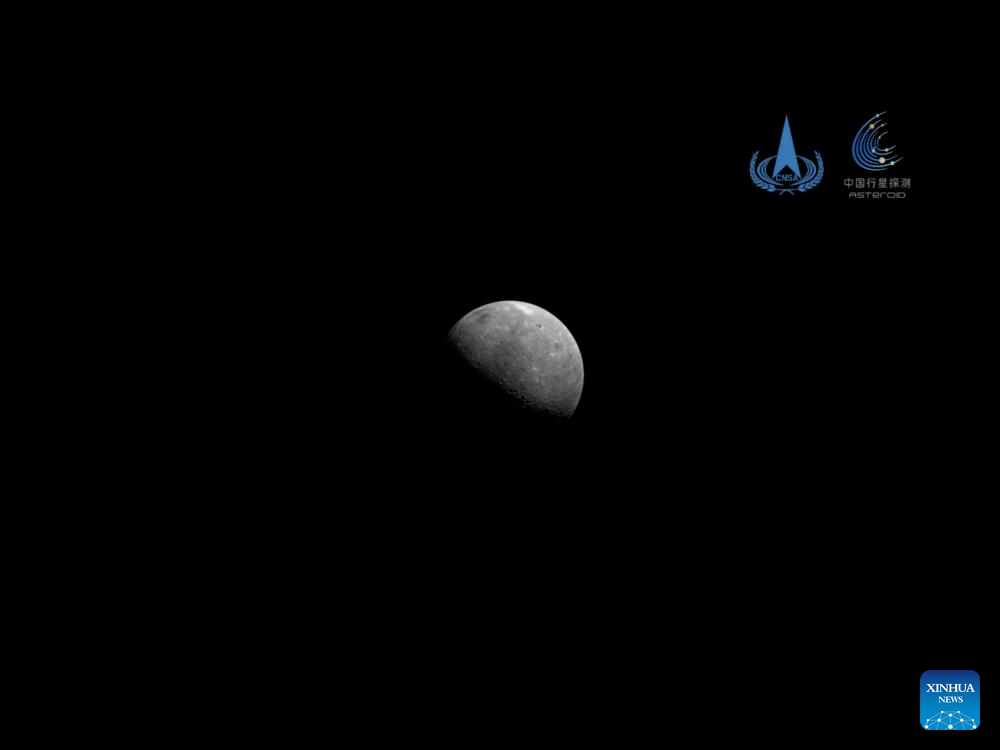
China releases images of Earth and Moon, taken by its Tianwen-2 asteroid probe

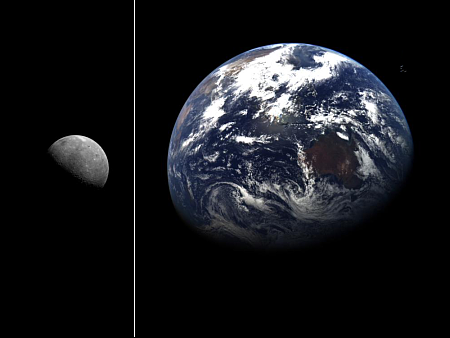
Tianwen-2 images of the Earth and the Moon
For original images go here and here.

According to a report today in China’s state-run press, its Tianwen-2 asteroid sample return spacecraft is operating normally, and has successfully taken pictures of both the Earth and the Moon to test its instrumentation.

Those images are to the right, cropped, reduced, and sharpened to post here.

The CNSA [China National Space Administration] said that the narrow-field-of-view navigation sensor equipped on the probe recently captured the images of Earth and the moon, demonstrating good functional performance.

The images released include a photograph of Earth obtained by Tianwen-2 when it was approximately 590,000 kilometers away from the planet, as well as a new photograph of the moon captured when it was about the same distance from the moon. After the images were transmitted back to the ground, they were processed and produced by scientific researchers.

The Tianwen-2 probe has currently been in orbit for over 33 days, at a distance from Earth exceeding 12 million kilometers, and it is in good working condition, the CNSA said.

The probe will take about a year to reach asteroid Kamo’oalewa, where it will fly in formation studying it for another year, during which time it will attempt to grab samples by two methods. One method is a copy of the touch-and-go technique used by OSIRIS-REx on Bennu. The second method, dubbed “anchor and attach,” is untried, and involves using four robot arms, each with their own drill.

3 comments

Speculation on future New Glenn launch schedule

According to anonymous sources at Blue Origin, the company has now delayed the second launch of its New Glenn rocket to September, ten months after its first launch in January 2025, and hopes to quickly follow with three more launches by the middle of 2026.

The September launch will launch NASA’s two smallsat Escapade Mars orbiters.

After Escapade, Blue Origin has several missions tentatively plotted out. However, sources cautioned that the manifest could be moved around due to the readiness of subsequent New Glenn vehicles and their payloads. Based upon information received by Ars, the launch manifest could look something like this:

  • New Glenn 2: ESCAPADE (fall 2025)
  • New Glenn 3: Firefly’s Elytra orbital transfer vehicle (end of 2025, early 2026)
  • New Glenn 4: Blue Moon MK1 lander (first half of 2026)
  • New Glenn 5: First batch of 49 Amazon Project Kuiper satellites (mid-2026)

Whether this schedule will occur as speculated is unknown. Blue Origin’s long term track record — slow and timid — suggests it is very unlikely. And even if it does fly as planned, it suggests strongly that Amazon is not going to meet its FCC license requirement to have 1,600 Kuiper satellites in orbit by July 2026. So far Amazon has only placed 54 operational Kuiper satellites into orbit, on two Atlas-5 launches. It has contracts to launch these satellites 46 times on ULA rockets (8 on Atlas-5 and 36 on Vulcan), 27 times on Blue Origin’s New Glenn, 18 times on ArianeGroup’s Ariane-6, and 3 times on SpaceX’s Falcon-9.

Except for the Falcon 9, none of the other rockets have begun flying with any frequency. Vulcan has only launched twice, New Glenn once, and Ariane-6 twice. All three have been extremely slow to ramp up operations, with months passing between each launch. To meet Amazon’s FCC license requirements, they will have to achieve between 35 to 60 launches in the next twelve months, a pace of three to six launches per month. At this point none of these companies appear capable of even coming close to doing this.

Nor does Amazon have the option to switch these launches to the Falcon 9. SpaceX would certainly accept the business, but the manifest for the Falcon 9 is presently very full. It is doubtful it could do more than double or triple its commitment to Amazon.

5 comments

NASA still hoping to save its Lunar Trailblazer mission

Though the odds of success are very dim, NASA has decided to give engineers another few weeks to try to activate its Lunar Trailblazer orbiter, that stopped communicating with Earth the day after it was launched in late February.

NASA has extended recovery efforts of its Lunar Trailblazer spacecraft from mid-June to early July. Updated modeling of the spacecraft’s trajectory by the mission team indicates lighting conditions will continue to be favorable and may provide enough sunlight for the spacecraft’s solar panels to recharge its batteries to an operational state and turn on its radio.

…Should enough sunlight reach Lunar Trailblazer’s solar panels, the batteries may charge to a level that allows the spacecraft’s radio system to boot up. But as Lunar Trailblazer travels farther away, it will soon be too distant to recover because its telecommunications signals to Earth will be too weak for the mission to receive telemetry and command.

The mission team has determined that if they can regain command of the spacecraft, the propulsion system isn’t frozen, and the instruments remain operable, the spacecraft may be able to achieve an elliptical lunar orbit and complete its lunar science objectives.

As I said, the chance of success are not good.

1 comment
1 65 66 67 68 69 822