Germany commits almost a million dollars to build off-shore launch platform

The Germany government has now allocated $897,000 to a private consortium of four companies to help finance its promised but delayed an off-shore launch platform.

The North Sea launch platform is being developed by the German Offshore Spaceport Alliance (GOSA), a joint venture formed in December 2020 by Tractebel DOC Offshore, MediaMobil, OHB, and Harren Shipping Services. The platform will be constructed on the 170-metre-long Combi Dock I vessel and will accommodate launchers with a mass of between 36 and 52 tonnes. A 2020 feasibility study stated that the development and operation of the North Sea launch platform would cost between €22 and €30 million over six years.

The consortium had first announced the project in 2023, with the first launch of several suborbital test rockets in 2024. Since then little has been heard of this project, with those launches never occurring.

If built as promised, this platform would accommodate rockets as large as the Falcon Heavy. Its goal, besides offering the platform to all rocket companies, is apparently to give German rocket startups the option of a German spaceport so they don’t have to depend on other countries.

5 comments

Rocket Lab launches 5 Kinéis satellites for its constellation for the internet of things

Rocket Lab today successfully launched five more internet of things satellites for the French company Kinéis, bringing its planned 25 satellite constellation to 20 satellites.

Rocket Lab has the contract to launch the entire constellation, and this was the fourth of five launches in that deal.

The 2025 launch race:

17 SpaceX
6 China
1 Blue Origin
1 India
1 Japan
1 Russia
1 Rocket Lab

1 comment

New calculations raise odds from 1.2% to 2.3% that asteroid will impact Earth in ’32

New calculations have increased the chances that the recently discovered asteroid 2024 YR4 will hit the Earth in 2032 from 1.2% to 2.3%.

Ongoing observations from ground-based telescopes involved with the International Asteroid Warning Network will continue while the asteroid is still visible through April, after which it will be too faint to observe until around June 2028.

NASA’s James Webb Space Telescope will also observe the asteroid in March 2025 to better assess the asteroid’s size. Currently the asteroid is estimated to be 130-300 feet across.

There remains great uncertainty in these numbers. We will really not know for certain if the asteroid will hit us until its orbit is studied for the next few years. Moreover, its size and make-up is also not known precisely yet. It could be as large as 320 feet, or as small as 130 feet. If the larger size, it poses a much greater risk, though that risk shrinks again if it is a rubble-pile asteroid that will simply break apart upon hitting the atmosphere.

This is not something to take lightly. Though the asteroid is not a world-destroyer, it does have the ability to cause significant damage, depending on where it hits. As its arrival is not for eight years, there is even time to quickly put together an unmanned mission to study it. (In the past I would never said this, but the domination of private enterprise in our present competitive space industry makes many things possible that were impossible when NASA and the government ran everything.)

21 comments

More indications balloon company Space Perspective is about to go bankrupt

New details reported yesterday strongly suggest that the high altitude balloon company Space Perspective has been unable to find new investors and is on the verge of shutting.

In a February 5 email to stakeholders, Interim CEO Michael Savage provided the latest updates, shedding light on failed funding efforts, the company’s dire financial situation, and attempts to restructure its debt. The email also acknowledged the gravity of the challenges ahead, hinting at the possible closure of operations.

Savage’s email outlined efforts to secure funding, including meetings with investors Fortuna and Broadlight, both of whom ultimately declined to proceed. Savage explained that while there was initial interest, the company’s mounting debt and financial instability deterred further investment. “Both [investors] have expressed interest, but despite the current circumstances and since Nov./Dec. 2024, they feel that their LPs would not stomach the numbers,” Savage wrote.

The company has previously announced it was shifting operations out of the Cape Canaveral area to a location 90 miles north where costs were less as it searched for new investors. This new report suggests this move and the search have not worked and the company will soon go out of business.

0 comments

ULA swapping Vulcan for Atlas-5 for first 2025 launch

ULA has decided to destack the Vulcan rocket it had planned as its first launch in 2025 (launching a military payload) and is now replacing it with one of its remaining Atlas-5 rockets to put the first batch of satellites for Amazon’s Kuiper internet constellation.

It appears the military is not ready to certify this launch after the second Vulcan launch in October 2024 experienced a problem with one of its strap-on boosters. The payload got to its proper orbit, but the loss of that booster’s nozzle appears to be an issue the military remains concerned about.

Rather than wait, ULA decided to switch to the Kuiper launch. The company wants to complete up to 20 launches in 2025, many of which are for Amazon using its last ten or so Atlas-5 rockets. When it can start commercial launches of Vulcan remains somewhat uncertain. The military has indicated it will make a final decision of certification in the spring, and has also said that first operational flight will follow soon after.

4 comments

Arthur Clarke in 1964 predicts the future in 2000

An evening pause: Something to ponder over the weekend. The video only includes two short clips from this 1964 BBC show, and thus picks two that have ended up to be largely right. And though Clarke’s predictions were not all right, he hit the mark an incredibly high number of times.

Hat tip John Jossy.

5 comments

The weird landscape in Mars’ glacial country

Overview map
Glacier country in the northern mid-latitudes of Mars

The weird landscape in Mars' glacier country

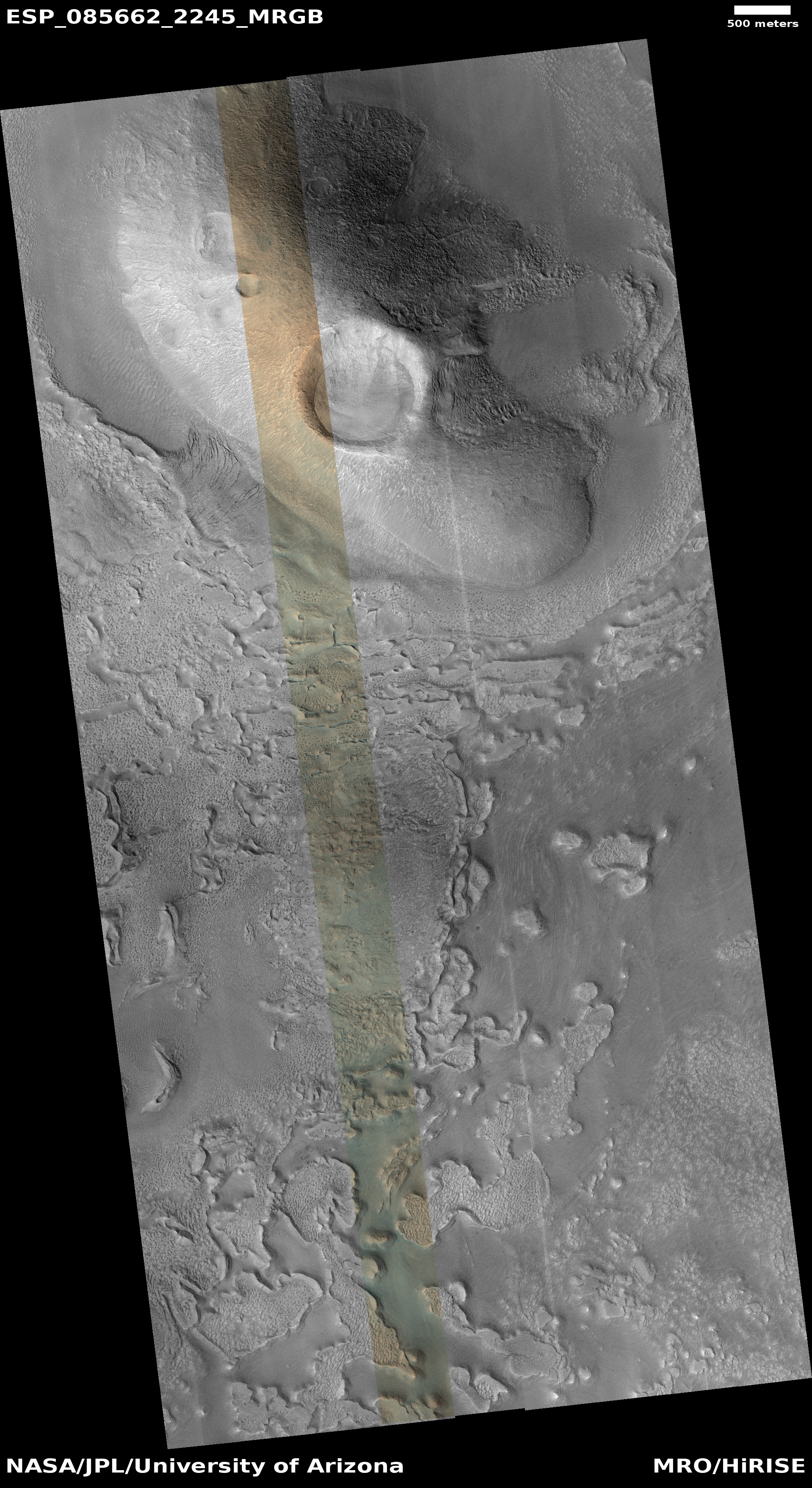
Cool image time! The picture to the right, rotated, cropped, reduced, and sharpened to post here, was taken on November 4, 2024 by the high resolution camera on Mars Reconnaissance Orbiter (MRO).

The science team labels the features in the lowland below the mesas “ribbed terrain.” To me it looks like peeling paint. What it is however is glacial material, a lot of it. The white dot on the overview map above marks the location, in the middle of the 2,000-mile-long mid-latitude strip in the northern hemisphere I label glacier country, because practically every high resolution image of this region shows glacial features like those on the right.

The mesa with the crater on top gives a clue on the geological history. This is chaos terrain, a region of random mesas cross-crossed with canyons and wide low plains, as shown in the inset. The entire surface was probably once at the same height as the top of that mesa with the crater. Over time glacial ice eroded away along fault lines. As that sublimation process continued, the fault lines widened to became canyons, then the flat plains, with the isolated mesas remaining between.

The “peeling paint” terrain is likely a layer of ice that is in the process of sublimating away.

0 comments

SpaceX to use older Dragon capsule for next manned launch because of issues with new capsule

Ars Technica today reported that because of continuing battery issues with the new Dragon manned capsule, SpaceX now plans to use the older Endurance Dragon capsule for the next manned launch to ISS and prevent further delays in bringing home the two Starliner astronauts.

NASA now believes the vehicle will not be ready for its debut launch until late April. Therefore, according to sources at the agency, NASA has decided to swap vehicles for Crew-10. The space agency has asked SpaceX to bring forward the C210 vehicle, which returned to Earth last March after completing the Crew-7 mission.

Known as Endurance, the spacecraft was next due to fly the private Axiom-4 mission to the space station later this spring. Sources said SpaceX is now working toward a no-earlier-than March 12 launch date for Crew-10 on Endurance. If this flight occurs on time—and the date is not certain, as it depends on other missions on SpaceX’s Falcon 9 manifest—the Crew-9 astronauts, including Wilmore and Williams, could fly home on March 19. They would have spent 286 days in space. Although not a record for a NASA human spaceflight, this would be far longer than their original mission, which was expected to last eight to 30 days.

The new capsule will then be used for Axiom’s fourth commercial flight to ISS, AX-4, presently scheduled for later in the spring.

4 comments

Astrobotic’s Griffin lunar lander gets commercial rover to replace NASA’s VIPER rover

Astrobotic’s commercial Griffin lunar lander has signed a deal with the space rover startup Venturi Astrolab to fly its FLEX Lunar Innovation Platform (FLIP) in place of NASA’s cancelled VIPER rover.

Last year NASA announced that it would be cancelling the VIPER lander that was set to travel aboard Astrobotic’s Griffin-1 lander, just months after the company’s first attempt at a moonshot failed. Now, the company has secured a contract to transport a rover developed by California-based aerospace firm Venturi Astrolab. That rover, the FLEX Lunar Innovation Platform, or FLIP for short, will be deployed to the Nobile region of the lunar south pole. The mission is scheduled for the end of the year and NASA’s contract with Astrobotic has been modified for the mission to serve as large lander demonstration flight.

This deal has significant ramifications outside of Astrobotic’s effort to make money hauling payloads to the Moon. Astrolab is one of three companies with NASA design contracts to develop a manned lunar rover for its later Artemis manned missions. By flying this smaller version now and successfully operating it on the Moon Astrolab puts itself in a better position to win the larger final rover contract from NASA, beating out Intuitive Machines and Lunar Outpost.

Astrolab was clearly aiming for the VIPER slot when it unveiled FLIP in October 2024. As I predicted then:

FLIP was clearly designed to match the fit of NASA’s now canceled VIPER rover that was to be launched on Astrobotic’s Griffin lander. Griffin is still being prepped for its lunar mission to be launched in 2025, but no longer has that prime payload. It is very obvious that Astrolab is vying to make FLIP that prime payload.

Note however how private enterprise moves. NASA can’t get it done but the competition to win contracts and make profits has these private companies scrambling to make things happen, quickly and cheaply.

1 comment

German startup Atmos gets FAA approval to launch its orbital research capsule

The German startup Atmos Space Cargo has now gotten its FAA launch license for testing the re-entry capability of its first orbiting research capsule, dubbed Phoenix.

That payload review was the final regulatory step needed for the mission, Sebastian Klaus, chief executive and co-founder of Atmos, said in an interview. The company doesn’t need a separate FAA reentry license because the spacecraft is planned to reenter over international waters, he said, and there are no licensing requirements by Germany, where the company is based.

Phoenix is fully assembled and has completed environmental testing, although the company is continuing to update software for the vehicle. “Physically and from a testing point of view, the spacecraft is ready for launch,” he said.

The capsule will be deployed immediately after the Falcon 9’s upper stage completes its de-orbit burn, so that it can then test that re-entry capability using an “inflatable decelerator”, likely a larger heat shield that can be used to protect a larger capsule.

This mission will be the first in a series of flights to test that inflatable system. If successful, the capsule will then be made available for orbital manufacturing for return to Earth, similar to the American startup Varda and its capsule.

2 comments

Martian hardened dunes untouched by dust devils

Hardened dunes and dust devils
Click for original image.

Cool image time! The picture to the right, cropped to post here, was taken on September 26, 2024 by the high resolution camera on Mars Reconnaissance Orbiter (MRO).

I picked this image out of the MRO archive because of the many dust devil tracts that cut across the entire image, traveling in all directions with no apparent pattern. I also picked it because those tracks also cut across the many parallel small ridges that appear to be ancient ripple dunes that have since hardened into rock. What makes this landscape puzzling is how those dust devil tracks leave no evidence on those ridges. It is as if the ancient ripple dunes were laid down after the very recent dust devil tracks, even though that is chronologically entirely backwards.

Apparently, the dust devil tracks form because the devil only disturbs the dust that coats the flat low ground between the ridges. The ridges themselves are hard, and thus the devils, produced in Mars’ extremely thin atmosphere, can leave no mark.
» Read more

0 comments

Sunspot update: Sunspot activity continued its decline in January

Another month has passed, meaning it is time for another update on the Sun’s sunspot cycle, based on NOAA’s monthly graph tracking that activity but annotated by me with additional information.

In January the decline in sunspot activity on the hemisphere facing Earth since August 2024 continued, with the number of sunspots dropping to a level not seen since May 2023, when the Sun’s was ramping up from solar minimum to solar maximum.
» Read more

5 comments

Rocket Lab wins another multi-launch contract

Rocket Lab today announced it has won a four-launch contract with a Japanese company, the Institute for Q-shu Pioneers of Space, Inc. (iQPS), to launch its Earth-imaging satellites.

The multi-launch contract, signed in July 2024 [but apparently not publicly announced till now], includes three dedicated missions for launch in 2025 from Rocket Lab Launch Complex 1 in New Zealand, with a fourth launch scheduled for 2026. Each mission will carry a single satellite to form part of iQPS’ planned constellation of 36 synthetic aperture radar (SAR) satellites that are capable of collecting images through cloud and at night with a high resolution of less than a meter.

Rocket Lab previously completed one launch for iQPS in 2023, signing the contract and launching within four months.

Though the company has not yet announced officially the number of launches it hopes to fly in 2025, it appears the number will exceed the 14 orbital launches it completed in 2024. Before adding the three 2025 iQPS launches above, Rocket Lab had 18 Electron launches listed for 2025 at the rocketlaunch.live website, as well as the first launch of the company’s new Neutron rocket. Altogether that adds up to a total of 22 launches.

0 comments

ISRO considering doing more docking tests with Spadex satellites

India’s space agency ISRO has delayed the undocking of its two Spadex satellites as it considers a plan to do more docking tests.

The original plan was to have the chase satellite complete only one docking with the target vehicle, after which the two satellites would separate and spend the next two years doing different work. That plan is being reconsidered.

[Isro chairman V.] Narayanan said in Sriharikota that they have to think of the money involved in such projects and utilise it to the maximum. “Now we are in the process of reviewing when to do the undocking, the power connections and when to totally separate them again and dock again. All these processes are going on. We do not want to undock and leave it,” the Isro chairman said.

“We have loaded five kg of propellant on both the satellites. The propellant is needed for docking and undocking exercises. Currently we have 60 to 70 per cent of the propellant (as of January 29) remaining in the spacecraft. There are going to be a lot of experiments in the docking, undocking, power connection exercises and it is not a one time exercise,” he said.

Sources at ISRO also suggest there may be issues with the docking that still need analysis.

0 comments

SpaceX launches two high resolution Earth imaging reconnaissance satellites

SpaceX tonight successfully launched Maxar’s last two of six high resolution Earth imaging reconnaissance satellites of its Worldview constellation, its Falcon 9 rocket lifting off from the Kennedy Space Center in Florida.

SpaceX placed the entire Worldview constellation in orbit over three launches. The first stage on today’s launch completed its fourth flight, landing back at Cape Canaveral, while the rocket’s two fairing halves completed their 21st and 23rd flights respectively.

This was also SpaceX’s second launch today.

The 2025 launch race:

16 SpaceX
6 China
1 Blue Origin
1 India
1 Japan

0 comments

Gullies on crater wall

Gullies on Mars
Click for full image.

Cool image time! The picture to the right, cropped, reduced, and sharpened to post here, was taken on August 8, 2024 by the high resolution camera on Mars Reconnaissance Orbiter (MRO).

The picture’s research focus is the gullies, which the scientists’ describe as “perched pole-facing gullies on ancient crater wall.” Perched means the start and end of each gully is on that crater wall, linked neither to the top or bottom of the wall itself. That the gully starts below the top means whatever caused it came from within the wall itself, not from the plateau above. That it ends before the crater floor means the process that cut the gully out was not powerful enough to reach the bottom.

That the gullies are on the interior north wall of this unnamed 25-mile-wide crater means they get less sunlight year round, something that must play a part in causing the gullies.
» Read more

0 comments

NASA calls for the private sector to launch VIPER to the Moon

As a follow-up of its August request for suggestions on how to save its cancelled VIPER rover mission to the Moon, NASA has now issued a request for actual proposals from the private sector for flying the mission, due on March 3, 2025.

The Announcement for Partnership Proposal contains proposal instructions and evaluation criteria for a new Lunar Volatiles Science Partnership. Responses are due Monday, March 3. After evaluating submissions, any selections by the agency will require respondents to submit a second, more detailed, proposal. NASA is expected to make a decision on the VIPER mission this summer.

…As part of an agreement, NASA would contribute the existing VIPER rover as-is. Potential partners would need to arrange for the integration and successful landing of the rover on the Moon, conduct a science/exploration campaign, and disseminate VIPER-generated science data. The partner may not disassemble the rover and use its instruments or parts separately from the VIPER mission. NASA’s selection approach will favor proposals that enable data from the mission’s science instruments to be shared openly with anyone who wishes to use it.

Expect a number of companies to tout their proposals in press releases in the coming weeks.

3 comments

Boeing writes off another half billion dollars due to Starliner

In filing an annual report to the SEC, Boeing revealed that has written off another half billion dollars due to Starliner delays and technical problems, bringing the total the company has lost on the capsule to more than two billion.

In the company’s 10-K annual filing with the U.S. Securities and Exchange Commission Feb. 3, Boeing said it took $523 million in charges on Starliner in 2024. The company blamed the losses on “schedule delays and higher testing and certification costs as well as higher costs for post certification missions.”

Both Boeing and NASA remain utterly silent on the future of Starliner. It remains uncertified for operational manned flights, which means Boeing continues to earn nothing from it. Will it have to fly another manned mission on its own dime to get that certification? Or will NASA instead pay it to fly a cargo mission to ISS, as rumors have suggested, to prove the capsule is ready for manned flights?

No one knows. Nor do we know if Boeing will either sell off its space division or cancel Starliner entirely and thus free itself of the problem.

1 comment
1 90 91 92 93 94 822