The People’s Climate March leaves New York a mess

“Their love for the Earth is so real, they couldn’t even use a trash can.”

The images of the trash left scattered on the streets of New York is striking, especially when compared to the very clean remains after the 2010 Tea Party march in DC, and provide more evidence that the loud cries of “Save the Earth” by these demonstrators were quite shallow and insincere.

Nonetheless, this apparent hypocrisy to me is less significant than the actual agenda of these fascists as stated by them, before, during, and after the march. They want to imprison their opponents and than impose their will by force on everyone else. It is far more important to note this fact than the fact that these demonstrators are sloppy hypocrites.

1 comment

“They want to start taking โ€” now.”

The two stories linked below, describing what it was like at Sunday’s People’s Climate March in New York, confirm for me what I had surmised from earlier reports prior to the march, that the march was a leftwing get-together with its central goal to use the climate as an excuse to impose leftist and communist redistributionist policies on the free citizens of America.

My headline is a quote from the second article. The full quote:

Put it all together โ€” all the justice demanders, the tax Wall Streeters, and the spirit of Occupy symbolized by the angry pacifist โ€” and the People’s Climate March was one long, loud, loosely organized demand that vast sums of money be taken from the wealthy and given to the clients of the coalitions and alliances and networks and task forces that make up today’s environmental justice movement. They’ve had enough of debating climate models. They want to start taking โ€” now.

Lord help us, in that we have already tragically allowed many of these people to wield significant amounts of power, and they are using that power to impose their agenda on us all.

4 comments

Antarctic sea ice extent largest on record

The uncertainty of science: Even as global warming protesters gather in New York to push their political agenda and fear-monger the threat of global warming, the Antarctic ice cap has set a record for its greatest extent ever measured.

No one really has a convincing explanation for why the south pole ice cap is so large even as the north pole ice cap remains relatively small (though recovering from the record lows from earlier in this century).

7 comments

Global warming advocates finally admit their focus is politics, not science

In writing a propaganda piece selling a global warming protest planned for Sunday in New York, this so-called journalist noted that if the crowd exceeds 100,000 “then the ‘People’s Climate March’ will likely mark the moment when global warming transitions from being a science and policy issue into a full-fledged social movement.

The writer goes on to rave about the diversity of the expected protesters, even while noting the following:

The People’s Climate March is backed by an unprecedented coalition of 45 major labor groups, including heavy hitters such as the Service Employees International Union (SEIU) โ€” a group that Henn said “doesnโ€™t mess around” โ€” along with prominent grassroots environmental organizations like 350.org as well as religious organizations.

In other words, it is a union/leftist coalition and isn’t diverse at all.

Regardless, after reading that first quote highlighted above, words fail me. This is an outright admission that this movement has no interest in the data and in fact doesn’t want anyone else to have interest in the data either. They want to impose a political agenda on society, and are using a made-up scientific crisis to do it. Worse, a whole generation of climate scientists have abandoned the pursuit of science in order to help them.

5 comments

Ocean surface wind speeds declining

The uncertainty of science: Data now shows that surface wind speeds over the oceans have declined in the past three years, and that August 2014 has the lowest average since 1989.

The author of the article says that these low wind speeds might explain why ocean surface temperatures have recently been high, He also admits he really has no idea. And are these variations because of global warming? No one has the slightest idea. To claim otherwise is to be an advocate not a scientist. As far as we know with the available data, these variations could simply be result of natural cycles.

0 comments

Neil deGrasse Tyson under attack for fabricating quotes

A series of recent articles have attacked Neil deGrasse Tyson for fabricating quotes and other facts in this lectures and presentations. This article provides a good summary.

The article also notes how Tyson’s behavior is quite typical for too many modern scientists, especially those who have been touting human-caused global warming these past two decades.

In related news, climate scientist Judith Curry gave a talk at the National Press Club this week in which she outlined very cogently the real scientific debate and how politics is distorting that process. Unlike Tyson, Curry does not mince words about the data, and considers the fabrication of information to be a terrible thing for scientists to do.

And then there’s this: The Lonesomest Mann in Town.

11 comments

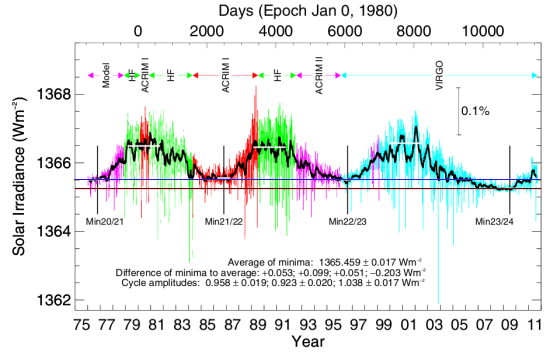
The solar maximum lingers on

On Monday NOAA posted its monthly update of the solar cycle, showing the sunspot activity for the Sun in August. As I do every month, I am posting it here, below the fold, with annotations to give it context.

The sunspot activity of the Sun in August hovered at the same levels seen in July. Though the month had seen periods of little activity, these were interspersed with many violent flaring sunspots, including one that only yesterday unleashed a powerful X-class flare that is expected to send a coronal mass ejection directly at the Earth and should impact the Earth’s magnetic field on September 12. Expect spectacular auroras!
» Read more

6 comments

Greenhouse gases up; Temperature stable

The uncertainty of science: Even as the Earth’s climate temperature has remained essentially unchanged for the past two decades, the rate of increase in greenhouse gases in 2013 hit its highest number in thirty years.

This Nature article is interesting in two ways. First, it actually breaks with the tradition of the past two decades and notes the gigantic uncertainties that exist in climate science.

The question remains, however, of why the rise in global mean temperatures near the surface has apparently slowed, after a series of exceptionally warm years in the 1990s.

To have mentioned an inconvenient fact like this, casting doubt on the theory of human-caused global warming, has been forbidden for decades in major journals like Nature. That the article does mention it shows that the inconvenient facts have become too obvious to ignore.

The second way the article is interesting is its repeated attempt to make believe that new theories, based on this very incomplete and contradictory data set, can explain the mystery.

Scientists have suggested a number of possible explanations for the global warming pause. According to the latest hypothesis, regularly occurring changes in circulation patterns in the Atlantic and Southern Ocean may have caused an increased volume of relatively warm water to sink to the depth of the ocean, thus reducing the amount of ocean heat escaping to the atmosphere.

The sad fact is that there are now dozens of theories to explain the long pause in global warming, none of which are convincing. The uncertainties continue to rule!

Similarly, the article also makes this naive statement:

Atmospheric methane, the second most important long-lived greenhouse gas, also reached a new high of about 1,824 parts per billion last year, mostly due to increased emissions from cattle breeding, rice farming, fossil fuel mining, landfills and biomass burning. [emphasis mine]

The certainty expressed here about the sources of methane increase in the atmosphere is misplaced. We don’t really know all the sources of the increase in methane in the atmosphere. Recent data instead suggests it could have many natural sources having nothing to do with human activities.

The bottom line remains: The knowledge we have of the Earth’s atmosphere and climate remains very incomplete and preliminary. Any theories about its nature and operation must be taken with a very large measure of skepticism. Any particular theory might be right, but it is just as likely that future research will very easily prove it wrong.

It would be nice if the journalists at Nature would take this advice.

5 comments

Natural methane plumes found on the sea floor

The uncertainty of science: Scientists have discovered hundreds of natural methane sea-floor seeps that had not been predicted by theory.

The bubble streams showed up on sonar scans of the sea floor taken between September 2011 and August 2013 during oceanographic expeditions ranging from Cape Hatteras in North Carolina to Georges Bank off Cape Cod. Altogether, researchers analysed data covering a 94,000-square-kilometre arc (an area about the size of Indiana or Hungary) that includes the edge of the continental shelf and the steep slope just seaward of it, says co-author Adam Skarke, a geologist at Mississippi State University in Starkville. Within a distance of about 950 kilometres, the team found about 570 bubble plumes โ€” an astounding number considering that scientists had previously reported only a handful in the region, he notes.

The article’s first two paragraphs breathlessly attempt to link these plumes to human-caused global warming, noting that there is theory that a warming ocean could produce such methane seeps. Worse, the article adds, once this methane is released it will accentuate warming, as methane is a very powerful greenhouse gas.

The article’s last paragraph, however, finally tells us the real story. Hard data gathered by remote robot vehicles that have actually visited these kinds of plumes instead suggests that the plumes have been there for more than a thousand years and thus could have nothing to do with human-caused global warming. In fact, their natural existence is a significant problem for most climate theories, as they now have to account for this additional greenhouse gas, naturally produced.

0 comments

Cooking the climate numbers in Australia

A comparison of the raw climate data with the adjusted numbers released by Australia’s Bureau of Meteorology shows that the adjustments have routinely turned the trends from cooling to warming.

This is the same finding that Steven Goddard and others in the U.S. found when they did the same comparison of NASA and NOAA numbers. In every case the adjustments either cooled the past or warmed the present in order to accentuate the appearance of a warming trend, sometimes in complete contradiction of numbers that had been accepted by scientists for decades.

So, does this mean the climate isn’t warming? No. What it means is we haven’t the slightest idea what’s happening, since the data has now been corrupted so badly that it is almost meaningless.

5 comments

Scientists baffled by unknown source of CFCs

The uncertainty of science: Scientists have found that, despite their complete ban since 2007, one type of ozone-depleting CFCs are still being pumped into the atmosphere from some unknown source.

Carbon tetrachloride (CCl4), which was once used in applications such as dry cleaning and as a fire-extinguishing agent, was regulated in 1987 under the Montreal Protocol along with other chlorofluorocarbons that destroy ozone and contribute to the ozone hole over Antarctica. Parties to the Montreal Protocol reported zero new CCl4 emissions between 2007-2012.

However, the new research shows worldwide emissions of CCl4 average 39 kilotons (about 43,000 U.S. tons) per year, approximately 30 percent of peak emissions prior to the international treaty going into effect. โ€œWe are not supposed to be seeing this at all,โ€ said Qing Liang, an atmospheric scientist at NASAโ€™s Goddard Space Flight Center in Greenbelt, Maryland, and lead author of the study published online in the Aug. 18 issue of Geophysical Research Letters, a journal of the American Geophysical Union. โ€œIt is now apparent there are either unidentified industrial leakages, large emissions from contaminated sites, or unknown CCl4 sources.โ€

That there seems to be an unknown source of CFCs suggests strongly that the entire theory of CFCs destroying the ozone layer is faulty. If CFCs were being produced naturally in the past then the ozone layer should not exist based on this theory. That it does exist says the CFCs are not harmful to it and were banned unnecessarily.

8 comments
1 39 40 41 42 43 82