
Florida divers find new treasure, including emerald ring worth $500,000, from Spanish wreck
Florida divers salvaging a 1622 Spanish wreck, have found more treasure, including an emerald ring worth $500,000.
Florida divers salvaging a 1622 Spanish wreck, have found more treasure, including an emerald ring worth $500,000.
Robot exploration in the Great Pyramid at Giza.
The robot explorer that took the images is named Djedi, after the magician whom Pharaoh Khufu consulted when planning the layout of the Great Pyramid. It was designed and built by engineers at the University of Leeds, in collaboration with Scoutek UK and Dassault Systemes, France.
We arrived at Space View Park in Titusville at around 9 pm, bringing with us camp chairs, a softside cooler with food, cameras, tripods, and light jackets. I also brought a light fleece sleeping bag for additional warmth. Even though it was still twelve hours before launch, the entire shoreline was occupied by a line of people either sitting or lying on blankets or pads. Back from the water and under the trees there were more than a dozen small tents set up.
We found a spot where the line was only one deep and set up our chairs. In front of us were a group of Floridians who had never seen a launch up close, though they told us how they had often watched shuttle launches from their front door. As one of them said, “There won’t be many more chances to see this, so we decided we better come down.”
Also set up in the park under a tarp was a electronic setup with television feeds and speakers linked to NASA TV, run by the Space Walk of Fame Foundation, a volunteer organization that maintains Space View Park and the monuments to space that are on display there.

Looking east out across the Indian River was Merritt Island, with the launchpad lit up like a Christmas tree eleven miles distant. To the right was the VAB.
» Read more
Exploring London’s abandoned Mail Rail subway system.
An evening pause: Caving in Druid Cave, Cheat Canyon, West Virginia. The caver is David Riggs. The videographer is caver Aaron Bird. The caver who arrives at the end with the ATV is caver Brian Masney. All are world class cavers, with whom I’ve had the honor of caving.
The video is nicely done, and gives an excellent and accurate feel for modern cave exploration and techniques. Watch especially how the rigging allows David to climb past the waterfall while on rope and hardly get wet.
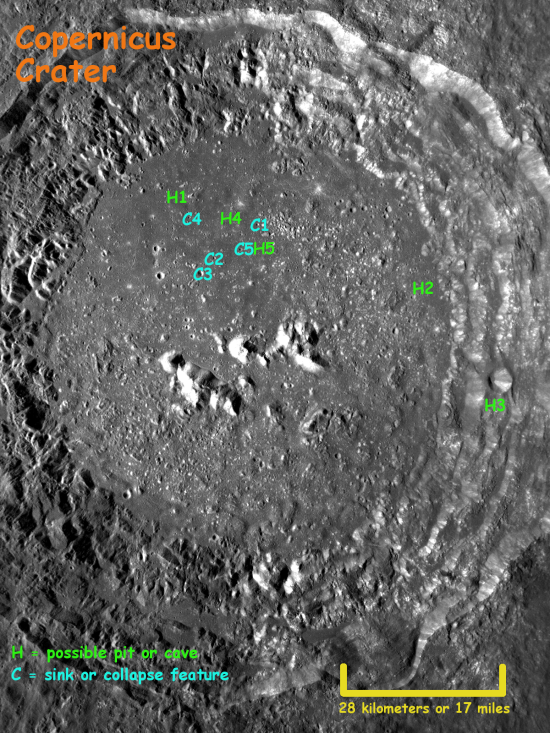
The Lunar Reconnaissance Orbiter website recently announced a new way to tour the Moon. The website, called QuickMap, allows a user with any home computer to zoom into any spot on the lunar surface and see the high resolution images being taken by Lunar Reconnaissance Orbiter.
Using QuickMap, I spent a few hours this past weekend strolling about on the northern half of the floor of the crater Copernicus. It is in this area, annotated in the image on the right, that NASA engineer James Fincannon has already located a slew of collapse features and possible caves, the images of which I have posted previously on behindtheblack. (Click on the image or here to see a larger version of this updated index map.)
(You also can go sightseeing there if you wish. Go to QuickMap and zoom in on 10.1 latitude and -20.1 longitude to get to the floor of Copernicus. Or pick your own spot on the lunar surface and do some of your own exploring!)
What I found in the northern half of Copernicus’s floor was a plethora of possible caves and collapse features. Literally, the crater floor is littered with what appear to be pits, fissures, rills, and sinks. More significantly, sometimes the cave entrances line up with long straight collapse features, suggesting strongly the existence of extensive underground passages beyond the initial entrance pits.
» Read more
Shackleton’s Antarctica, in color in 1915.
How hibernating bears could help man get to Mars.
A new report says that government spending on space will flatten worldwide over the next five years. Some key quotes from the news story however suggest all is not going downhill:
A total of 692 satellites will be launched by governments in the coming decade, up 43% from the previous decade. This is a direct reflection of the increasing number of new space-capable countries across the globe. Civil agencies will launch roughly 75% of these satellites, a significant increase compared to the last decade during which they accounted for 67% of all government satellites launched.
Also, while certain areas will show a decline (the U.S. manned program) others appear robust.
Access to space (launch capability) investments reached $4.6 billion in 2010, and should be sustained in the coming years as more governments see independent access to space as a top priority of their space programs.
In both of the above examples, the areas where space activity will increase is because of the arrival of new space-faring nations (India, Japan, China to name only the most obvious), what I have been calling the new colonial movement. I also believe that as these new countries begin to show their stuff in space, their success will further fuel the competition, and the older space-faring nations will come back to life in order to stay in the game.
Which exoplanet should we go to first?
Today is the 25th anniversary of the Challenger accident. There are innumerable links from many sources talking about the event, too many for me to list here. You can find most at this link on Jeff Foust’s website, spacetoday.net.
Though I think it is very important for us to remember and honor these events, I have become somewhat disenchanted with the modern American obsession with memorials and anniversaries. Rather than build a memorial, I’d much rather we focused entirely on building new spaceships, new space stations, and new lunar bases, while flying multi-year missions on ISS, all in preparation for exploring and colonizing the solar system.
If we actually made the solar system a place for humans to live in and explore, we would build a far better memorial to those who have sacrificed their lives for the sake of exploration. And I think these heroes would be far more pleased by that memorial than by a stone statue or emotional op-ed that describes their courage.