Underground exploring today

No posting today, as I am leaving home at 6:30 am with several cavers for a day trip to a cave in the Chiricahua Mountains in southeast Arizona. The drive one way is about three and a half hours, so doing this as a day trip will likely break what I like to call Zimmerman’s law: “The cave time must exceed the drive time.”

However, when I first visited Tucson last winter and mentioned I might move here, the local cavers asked if I’d be interested in being the cartographer of this particular cave and help them get a project started to survey it. Three previous attempts to survey it were never completed, so no good map exists. And since I have recently completed two significant cave maps of two important West Virginia caves (see monographs 3 and 4 on this page) and am without a map project at the moment, how could I say no? Tomorrow’s trip is my first visit to the cave in preparation for getting the survey project off the ground in January.

Anyway, I will be back late, and will return to the computer on Saturday. For everyone, have a Merry Christmas weekend!

2 comments

New cave discoveries in the western Caucasus of Russia

From an email sent out by Ukrainian caver Alexander Klimchouk, received today:

Pavel Rud’ko of Krasnoyarsk (Rissia, Siberia) has reported the success of the recent expedition of Krasnoyarsk cavers to the Sarma Cave, Arabika Massif, Western Caucasus. The cave, previously explored by cavers from Krasnoyarsk and Irkutsk to -1570 m, has now been made almost 200 m deeper, to reach depth of -1760m and become the second deepest cave in the world.

The expedition led by Pavel Rud’ko has been carried out between September 1st – October 7th, 2011. The main branch has been pushed to -1760 m after breaking through a narrow meander at the old bottom. Many side and ascending passages in other parts of the cave have been also explored. The expedition performed systematic temperature measurements, and speleobiological and microbiological sampling.

With its new depth figure, Sarma surpassed the Illjuzia-Mezhonnogo-Snezhnaya system (-1753 m), located in the nearby Bzybsky Massif, and became the second deepest cave in the world, following Krubera Cave (-2191 m) located in the same massif. Thus, the western Caucasus now hosts three deepest caves in the worlds, two of them in Arabika Massif and one in Bzybsky Massif.

Some details of geology, hydrogeology and cave locations of Arabika can be found here. [pdf]

0 comments

The Painted Desert of Mars

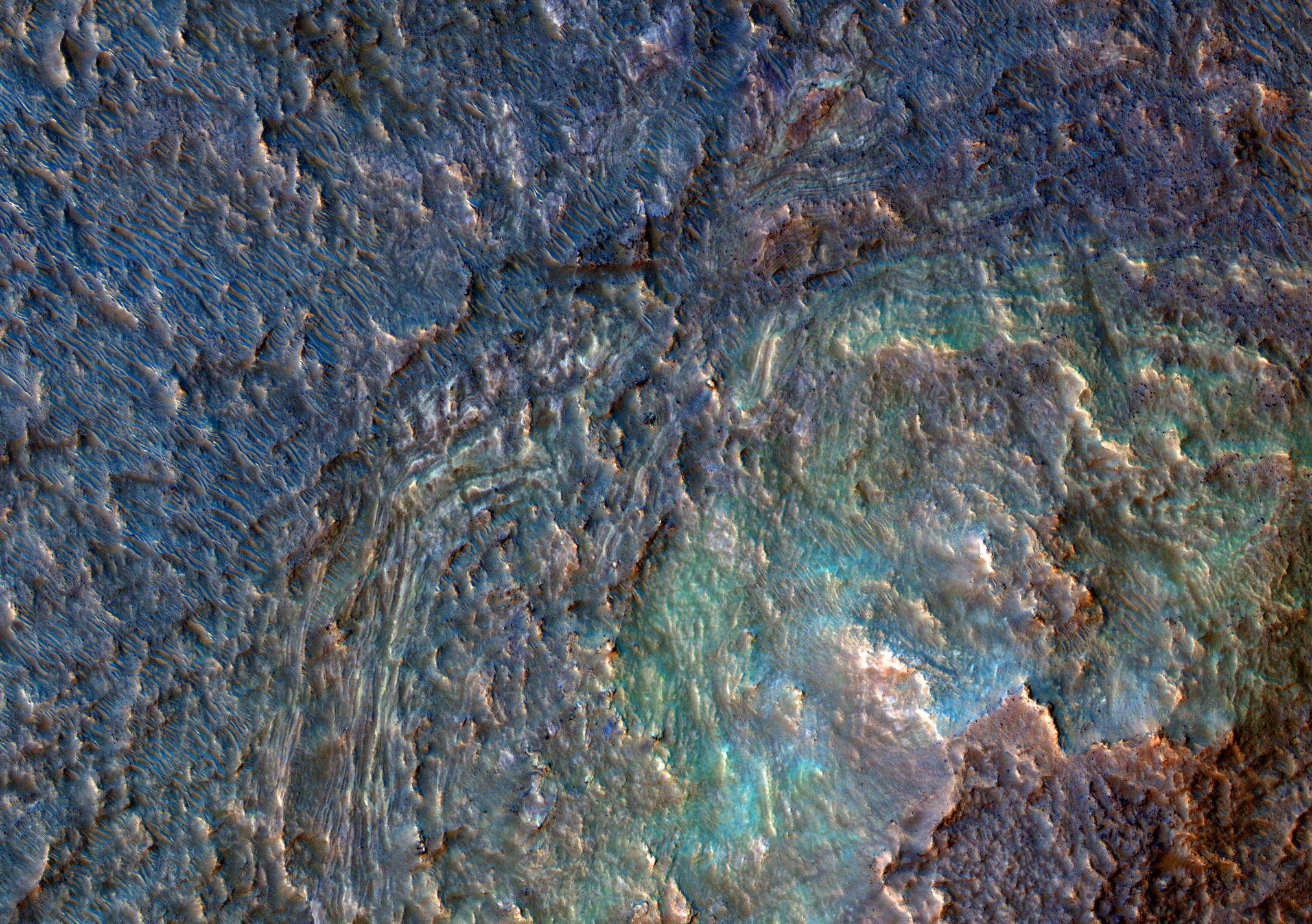
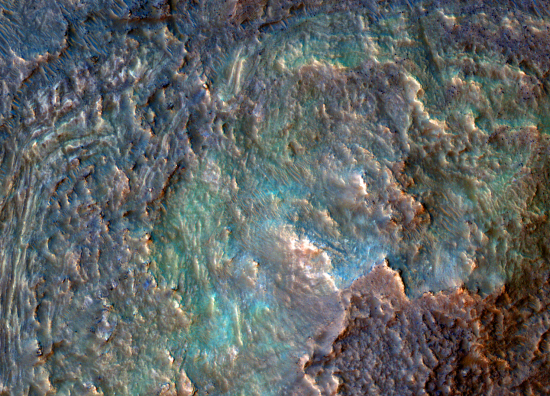
Mars Reconnaissance Orbiter released this picture yesterday of what the Orbiter’s scientists have labeled “The crazy floor of Hellas Basin.” Below you can see a cropped image of only one part of the large higher resolution image. The NASA caption says that the wild colors probably “indicate that diverse minerals are present,” meaning that any settlers of the red planet will probably take a close look at this location with the reasonable hope of finding the resources they need to colonize a planet.

To me, these colors also indicate that this place on Mars would probably one of its most popular tourist spots. As I look at the image my eye instinctively wants to trace out the best trail route along the ridges and down into the gullies in order to give hikers the best view of this colorful terrain.

Hellas Basin

0 comments

A flag in the dust

Bumped: I posted this essay last July 20th on the anniversary of the Apollo 11 landing on the moon. I think it is worth rereading again, even as the shuttle is about to return to Earth for the last time.

Today, July 20th, is the anniversary of the Apollo 11 landing on the Moon, the first time ever that a human being arrived on another planet. Americans love to celebrate this event, as it symbolizes one of the finest moments in our history, when we set out to achieve something truly great and noble and succeeded far better than we could have imagined. Not only did we get to the Moon as promised, over the next three and a half years we sent another five missions, each with increasingly sophisticated equipment, each sent to explore some increasingly alien terrain. Forty-plus years later, no one has come close to matching this achievement, a fact that emphasizes how difficult it was for the United States to accomplish it.

There is one small but very important detail about the Apollo 11 mission, however, that most Americans are unaware of. In mounting the American flag, the astronauts found the lunar surface much harder than expected. They had a great deal of trouble getting the flagpole into the ground. As Andrew Chaikin wrote in his book, A Man on the Moon, “For a moment it seemed the flag would fall over in front of a worldwide audience, but at last the men managed to steady it.” Then Armstrong took what has become one of the world’s iconic images, that of Buzz Aldrin standing on the lunar surface saluting the flag of the United States of America.
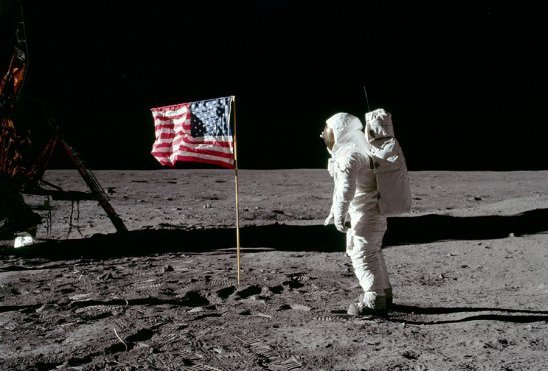
Aldrin saluting the flag

What people don’t know, however, is that when Armstrong and Aldrin blasted off from the lunar surface, the blast wave from the Lunar Module’s rocket knocked the flag over. As Chaikin also wrote, “Outside, a spray of gold foil and debris from the descent stage flew away in all directions. The flag toppled to the dust.”

Thus, for the last four decades this American flag, shown so proudly unfurled on the surface of the Moon, has actually been lying unceremoniously on the ground, in the lunar dust.

It might actually be possible to see this, though the photos at this time remain unclear and quite blurry.
» Read more

4 comments
1 84 85 86 87 88 89