
Advertising Could Pay for a Mission to Mars, Scientist Says
Let advertisers pay for a mission to Mars.
Let advertisers pay for a mission to Mars.
The competition moves forward: Russia allocates $3.8 billion for its space programs in 2011.
The new colonial movement: China to explore Mars with Russia this year.
A 10-man team of explorers and scientists today completed the first there-and-back crossing of the continent of Antarctica using wheeled vehicles. From the expedition blog:
We quickly took ourselves to the mess tent for some hot coffee and something which we had been craving for a while – Coca Cola. The feeling among the team was satisfaction and elation at what we had achieved and relief that the belt drive had held out! The first Expedition ever to travel coast to coast and back again, with the privilege of visiting the South Pole twice. We joked in the mess tent before deciding that we were not going to sleep and headed over to the Mechanic Area and back to the vehicles.
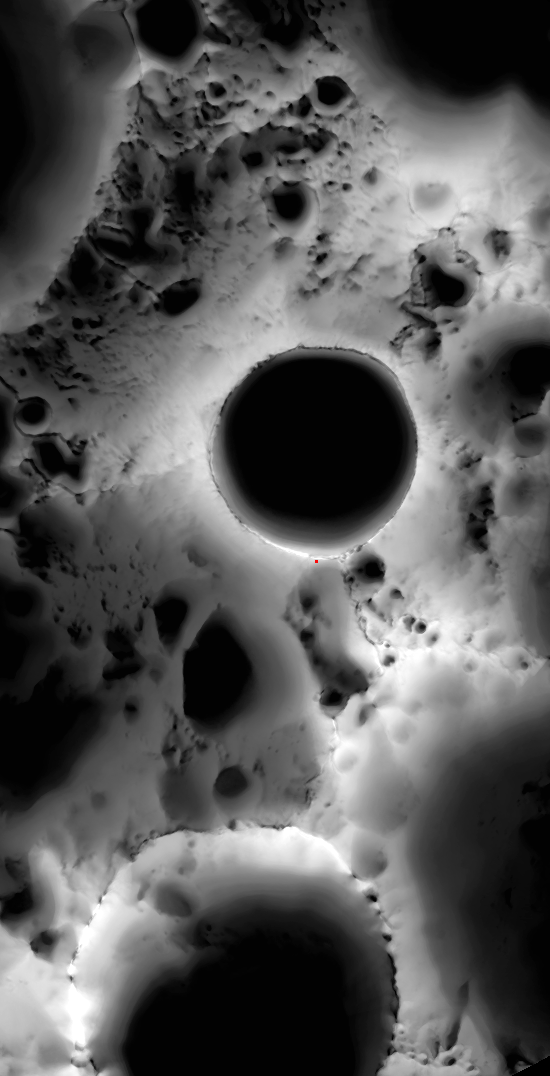
The image below was produced by Lunar Reconnaissance Orbiter by assembling data from numerous images over six months. The levels of brightness and darkness indicate the percentage of time in which an area is sunlight. The red dot just below the rim of Shackleton shows the approximate location of the south pole.
As you can see, the rim of Shackleton Crater nearest the south pole is illuminated by the sun most of the time, while the nearby crater floor never gets sunlight. This data confirms what Japanese scientists found using their lunar probe, Kaguya. The south pole has the ideal combination of locations with nearly continuous bright sunlight (to provide power) and nearly continuous darkness (where explorers will likely find significant amounts of frozen water), making this is an excellent location to build that first lunar base. And from the image you can see that the Shackleton Crater rim is not the only spot near the south pole with these conditions.
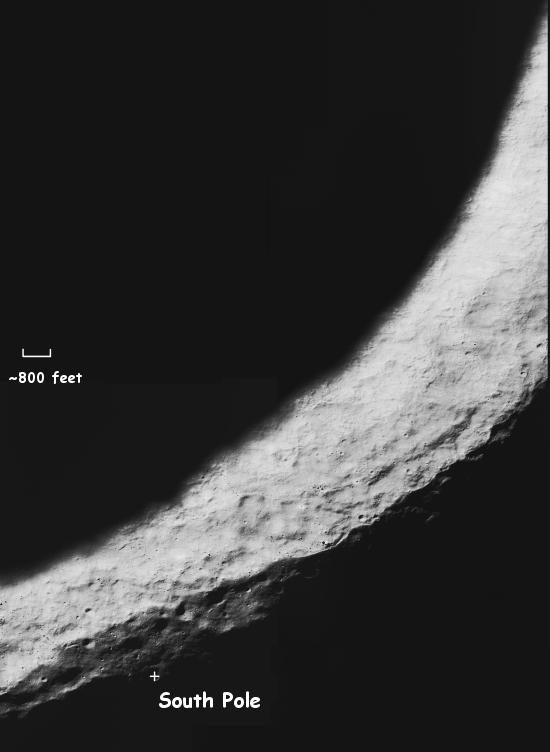
Also, if you look at the close-up image of Shackleton’s rim that I posted here, you will see that there is plenty of room to land and set up residence.
The laws covering the exploration of space are not helping.
Updated and bumped: John’s obituary can now be read here.
John Wilcox, the man most responsible for finding the connection between Kentucky’s Mammoth Cave and the Flint Ridge Cave system and thereby producing the world’s longest cave system, died today after a three week long illness. To quote Roger Brucker, co-author of The Longest Cave, Wilcox “was known for his systematic approach to exploration and laser-like focus on detailed mapping.” R.I.P.
On August 18, 2010, the Mars rover Opportunity took this panorama image of the Martian terrain. Up close, patches of bedrock can be seen where the sand had blown clear. In the far distance the rim of Endeavour Crater, the rover’s long term destination, pokes up over the horizon.
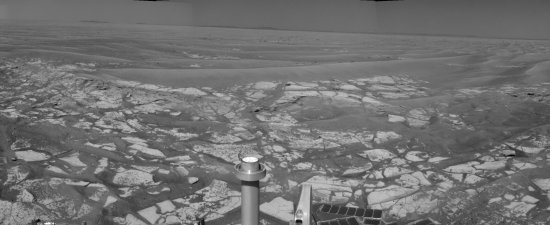
Update: A press notice from JPL today notes that Opportunity has now traveled about half of the 11.8 mile distance to Endeavour Crater. As it took two years to go this far, the journey still has two years to go, assuming the rover survives that long.
Though this only confirms what the Russians learned on Mir, scientists have determined that long periods in weightlessness cause a significant loss in muscle strength. More research like this — to both study the problem as well as possibly solve it — is exactly what we need to do on ISS. Key quote:
Damage caused to the tissue is such that it is equivalent to a 30- to 50-year-old crew member’s muscles deteriorating to that of an 80-year-old. Despite in-flight exercise, the report warns that the destructive effects of extended weightlessness to skeletal muscle poses a significant safety risk for future manned missions to Mars and further afield.
Using data from the Japanese lunar orbiter Kaguya, scientists have identified several locations near the Moon’s south pole that are in daylight from 86 to 94 percent of the time. Key quote from abstract:
The place receiving the most illumination (86% of the year) is located close to the rim of Shackleton crater at 88.74°S 124.5°E. However two other areas, less than 10 km apart from each other, are collectively lit for 94% of the year. We found that sites exist near the south pole that are continuously lit for several months during summer. We were also able to map the locations and durations of eclipse periods for these areas. Finally we analyzed the seasonal variations in lighting conditions, from summer to winter, for key areas near the south pole. We conclude that areas exist near the south pole that have illumination conditions that make them ideal candidates as future outpost sites. [emphasis mine]
Below is a composite close-up image of the rim of Shackleten crator that I assembled using this Lunar Reconnaissance image. The key quote from the full caption :
The full [Narrow Angle Camera] mosaic reveals a shelf on the southeast flank of the crater that is more than two kilometers across and perfectly suitable for a future landing. The extreme Sun angle gives the surface an exaggerated rough appearance, but if you look closely at this scale any area that is between the small craters might make a good landing site.
At an aerospace industry conference last week SpaceX outlined the company’s plans for building its own heavy-lift rocket, as well as their long range exploration goals. Key quote from rocket development facility director Tom Markusic: “Mars is the ultimate goal of SpaceX.”