Neil deGrasse Tyson under attack for fabricating quotes

A series of recent articles have attacked Neil deGrasse Tyson for fabricating quotes and other facts in this lectures and presentations. This article provides a good summary.

The article also notes how Tyson’s behavior is quite typical for too many modern scientists, especially those who have been touting human-caused global warming these past two decades.

In related news, climate scientist Judith Curry gave a talk at the National Press Club this week in which she outlined very cogently the real scientific debate and how politics is distorting that process. Unlike Tyson, Curry does not mince words about the data, and considers the fabrication of information to be a terrible thing for scientists to do.

And then there’s this: The Lonesomest Mann in Town.

11 comments

More fraud in academia

A simple background check on a West Virginia academic who was touted as a “genius” has discovered that his entire resume was a fraud.

[Anoop] Shankar isn’t a Ph.D. He didn’t graduate from the Harvard of India. He didn’t write dozens of the scholarly publications on his resume, and as for the Royal College of Physicians, they’ve never heard of him. He does have a master’s degree in epidemiology from the University of North Carolina and an Indian medical degree, but at least two of his green card references—attesting to “world class creativity,” “genius insight,” and “a new avenue for treating hypertension”—were a forgery.

Worse, when the investigation threatened his bright future he used two students to try to destroy the career of an investigator by faking a sexual attack.

And even worse yet, the academic community remains unwilling to deal with this fraud aggressively.

Although Shankar was forced out of WVU in December of 2012, the university has yet to address the case publicly, allowing Shankar and his work to continue unchallenged. In the last year alone, he’s published at least three papers, including one in the prestigious Journal of the American Medical Association. He also landed a new job on the backs of taxpayers: associate professor of family medicine at Virginia Commonwealth University, a large public university in Richmond.

So far, the investigation has only focused on the man’s faked resume. No one has taken a close look at his medical research, though the article does describe one example where Shankar was actually teaching his students to manipulate data unethically to get the results they wanted.

As the article notes, “How many more are there out there?” As I’ve documented repeatedly in the climate field, academia no longer seems interested in cleaning house and maintaining honest standards. This story only reinforces this fact.

1 comment

Sixty science papers retracted

The uncertainty of peer review: An internal investigation has caused the retraction of sixty peer-reviewed scientific papers that were published by a single journal, the Journal of Vibration and Control (JVC).

The network of JVC papers that emerged was incestuous, with the same small group of authors reviewing each other’s work and appearing together as co-authors. By the end of the year, the investigators had a list of 130 e-mail addresses associated with 60 papers, with one scientist as co-author on all of them: Chen-Yuan Chen of NPUE, who goes by “Peter.” When SAGE sent an e-mail to all 130 e-mail addresses requesting that the authors confirm their identity, none responded. “The authors were contacted again by SAGE in May 2014 to inform them that their papers would be retracted in the July 2014 issue,” says Sherman, but again none responded. According to SAGE’s official statement, Chen resigned from NPUE in February. Neither Chen nor officials at NPUE responded to e-mails from ScienceInsider

How was it possible for a scientist to become the sole reviewer on dozens of his own papers? The answer appears to be that Chen was allowed to nominate his own reviewers, who were not vetted by JVC,

Chen apparently created fake gmail accounts for both real and non-existing scientists and then chose these scientists both as his co-authors as well as his peer-reviewers.

0 comments

The sad and dishonest state of economic research

A survey of professional academic economists finds that a large percentage are quite willing to cheat or fake data to get the results they want.

From the paper’s abstract:

This study reports the results of a survey of professional, mostly academic economists about their research norms and scientific misbehavior. Behavior such as data fabrication or plagiarism are (almost) unanimously rejected and admitted by less than 4% of participants. Research practices that are often considered “questionable,” e.g., strategic behavior while analyzing results or in the publication process, are rejected by at least 60%. Despite their low justifiability, these behaviors are widespread. Ninety-four percent report having engaged in at least one unaccepted research practice. [emphasis mine]

That less than 4% engage in “data fabrication or plagiarism” might seem low, but it is a terrible statistic. Worse, the other results make me think that the many of the 96% who said they didn’t do this were lying. 40% admit to doing what they agree are “questionable” research practices, while 94% admit to committing “at least one unaccepted research practice.”

In other words, almost none of these academic economists can be trusted in the slightest. As the paper notes, “these behaviors are widespread.”

5 comments

A scientist whistleblower has found that publicly questioning bad science papers vs privately notifying the publisher significantly increases the chances of getting them retracted.

Surprise, surprise! A scientist whistleblower has found that publicly questioning bad science papers vs privately notifying the publisher significantly increases the chances of getting them retracted.

[Paul] Brookes ran the blog Science Fraud from July 2012 to January 2013, before closing it down in response to threats of legal action. For the PeerJ study, Brookes compared the outcomes of two sets of papers — 274 whose alleged data problems he chronicled on his blog, and 223 that he was e-mailed about but did not post before he shut the site down. Those private e-mails, he says, were also copied to the relevant journals, funding agencies and authors’ research institutions, so authorities would also have had the opportunity to review the allegations.

Of the 274 papers Brookes blogged about, 16 were retracted and 47 corrected by December 2013, he reports, meaning that action was taken in 23% of the cases. But of the 223 unpublicized papers, only two were retracted and five corrected — a rate of 3%.

As always, the more freedom and openness we have, the better. The only people who suffer in such a situation are the incompetent and dishonest ones.

0 comments

A close review of the sources cited in the four studies that claimed a 97% scientific consensus supporting global warming has found that claim to be false.

More global warming fraud: A close review of the sources cited in the studies that claimed a 97% scientific consensus supporting global warming has found that claim to be false.

Instead of a 97% consensus, the review found that only 1 to 3% supported global warming. Quite a difference, eh?

The review’s press release nicely summarizes the incompetence or downright dishonesty of three of these consensus studies:

The Oreskes (2004) study claimed 75% consensus and a “remarkable lack of disagreement” by the other 25% of the abstracts she reviewed. Peiser (2005) re-ran her survey and found major discrepancies. Only 1.2% or 13 scientists out of 1,117 agreed with the Intergovernmental Panel on Climate Change (IPCC) view that human activity is the main cause of global warming since 1950. Peiser found that 34 scientists rejected or doubted the alleged ‘consensus’ position outright and 44 claimed natural factors as more influential. At least 470 papers expressed no position on Anthropogenic (human-caused) Global Warming (AGW) whatsoever.

Doran & Zimmerman (2009) only assessed 79 scientists out of 3,146 respondents. Many scientists sent them emails protesting the survey design.

The recent Cook et al (2013) began with the broadest possible ‘consensus’ definition – rendering the idea of ‘consensus’ meaningless. Only 0.54% (or 64 scientists) explicitly agreed. Though Cook’s graphics on The Consensus Project website focus on fossil fuels, his study used the 1996 Houghton declaration which includes other human factors like agriculture and land-use change. Some 7983 scientists or 67% of the ~12,000 papers in the Cook study had no position on climate change. Many scientists publicly denounced Cook for wrongly assessing their work as supporting AGW when it does not.

Based on my experience talking to climate scientists as well as reading innumerable papers, I have always thought that the 97% consensus claim was weak or fishy. Now we not only have proof, we have evidence that the claim was based on lies.

1 comment

Five years of hate and falsified news at NBC.

Five years of hate and falsified news at NBC.

This article is important because it documents the repeated times NBC has been caught deliberately faking news stories by dishonestly editing material. Worse, it also shows that, despite being caught at it, the network has refused to stop. If anything, it appears they have doubled down on their dishonesty in the last two years.

This says nothing good about NBC. It also tells us something far more terrible about its audience.

1 comment

Nearly two thirds of the fraud and waste lost by the federal government in 2013 was paid by HHS, the agency running Obamacare.

Nearly two thirds of the fraud and waste lost by the federal government in 2013 was spent by HHS, the agency running Obamacare.

The total amount lost by either fraud, waste, or error equaled $106 billion, slightly down from 2012’s $108 billion figure. Of that, about $65 billion occurred in Health and Human Services.

But hey, what’s a few billion dollars here and there. It’s not like the federal government has a debt problem, does it?

0 comments

In its minority small business program, supposedly designed to help minorities, the federal government has instead given millions to firms owned by fictitious people.

In its minority small business program, supposedly designed to help minorities, the federal government has instead given millions to firms owned by fictitious people.

This article illustrates how deep and extensive the corruption is in Washington DC. Things have gotten so bad that we hardly notice a story like this, even though it involves a level of fraud and illegality involving millions of dollars that has become almost routine within the small business and minority set-aside programs of the federal government.

The programs were designed, with noble good intentions, to encourage new businesses run by minorities or women. Instead, a minority or woman sets up a fake company and then subcontracts the work out to others (even though such subcontracting is forbidden). No one in the federal government notices or cares, and the fraud escalates, until in examples like the one at the link, it becomes so egregious that someone in government feels obligated to prosecute. And even then, it appears that the woman charged is only obligated to return some cash and a car. It does not look like she will serve any prison time.

Just imagine how much other fraud and corruption continues to go on in other federal feel-good programs that no one has bothered to stop or notice. The possibilities are numbing.

1 comment

More fraud in climate science

Fraudalent data

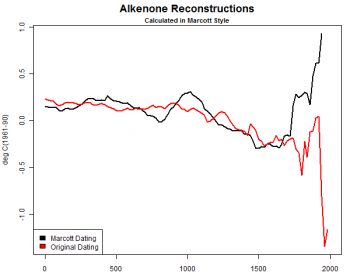
Steve McIntyre, the man who had demonstrated that Michael Mann’s hockey stick graph was a fraud, has now demonstrated that the work of a group of climate scientists attempting to resurrect it is even more fraudulent. It seems that in order to recreate the illusion of warming in the past four hundred years, the scientists, led by geologist Shaun Marcott, changed the dates on a series of ocean cores in order to get the results they wanted.

McIntyre found that Marcott and his colleagues used previously published ocean core data, but have altered the dates represented by the cores, in some cases by as much as 1,000 years.

Most significantly, the scientists made no explanation for changing these dates. It is as if they wanted to hide this decline, y’know?

The chart on the right, by McIntyre, illustrates the fraud. The black line shows the temperature numbers of the ocean cores used by Marcott. The red line shows the temperature numbers, as originally published in the scientific literature, for these ocean cores.

The discrepancy here is so egregious that it screams at you. More important, as John Hinderaker says,
» Read more

28 comments

A new study has found that scientific misconduct and fraud is on the rise.

A new study has found that scientific misconduct and fraud is on the rise.

A review of retractions in medical and biological peer-reviewed journals finds the percentage of studies withdrawn because of fraud or suspected fraud has jumped substantially since the mid-1970s. In 1976, there were fewer than 10 fraud retractions for every 1 million studies published, compared with 96 retractions per million in 2007.

The study’s authors suggest that the high pressure of big science might be a cause, combined with an overall decline in our culture itself. I wonder if the influence of government money, granted not because of good science but in the service of a political agenda, might also be a contributing factor.

0 comments

James Hansen’s Goddard Institute of Space Studies has once again been caught changing its past climate temperature data without explanation.

James Hansen’s Goddard Institute of Space Studies has once again been caught changing its past climate temperature data without explanation.

Surprise of surprise, the change had the effect of making the long-term temperature record support conclusions of faster warming. The biggest changes were mostly pre-1963 temperatures; they were generally adjusted down. That would make the warming trend steeper, since post-1963 temperatures were adjusted slightly upward, on average. Generally, the older the data, the more adjustment.

Hat tip to reader jwing who alerted me to this story. As I commented to him, this “also is old news, to my mind, even though this is a new discovery of corruption. This kind of fraud has now been on-going for the past decade, with no signs of any effort to fix it. Worse, the climate science field even denies that it has a problem. Thus, I don’t trust anything they tell me. I check everything twice, and then have doubts besides. Which is why I remain entirely skeptical of any claims these climate scientists make.”

And in this case, the climate scientist in question is James Hansen.

9 comments

Hundreds of peer-reviewed papers in the field of anaesthesiology are about to be retracted because their data was fabricated.

Hundreds of peer-reviewed papers in the field of anesthesiology are about to be retracted because their data was fabricated.

After more than a decade of suspicion about the work of anesthesiologist Yoshitaka Fujii, formerly of Toho University in Tokyo, investigations by journals and universities have concluded that he fabricated data on an epic scale. At least half of the roughly 200 papers he authored on responses to drugs after surgery are in line for retraction in the coming months.

Like many cases of fraud, this one has raised questions about how the misconduct went undetected for so long. But the scope and duration of Fujii’s deception have shaken multiple journals and the entire field of anesthesiology, which has seen other high-profile frauds in the past few years.

Fujii’s work was published in many different journals, where it appears none of his referees ever checked his data. Worse, this is not the first such case in this field.
» Read more

2 comments

Another psychologist has resigned amid questions over the validity of his research.

Another psychologist has resigned amid questions over the validity of his research.

This and other recent cases (here, here, here, here, here, here) are more evidence that the peer review process in some fields is badly broken, that the reviewers are too often not doing the reviewing they are supposed to, and in some cases might very well be participating in scientific fraud themselves.

4 comments

The pork of Obamacare

The Patient Centered Outcomes Research Institute (PCORI), created by Obamacare, announced its first round of grants today, part of a funding program of fifty “pilot projects” totaling $30 million.

It didn’t take much research for me to conclude that, while some of this work might be useful, most of it sounds like bureaucratic claptrap. For example, consider the description Nature gives for these three grants:
» Read more

4 comments

NBC has been caught again, for the third time this year, of selectively editing news footage to create a false scenario.

NBC has been caught again, for the third time this year, of selectively editing news footage to create a false scenario.

In all three cases the false scenario aided Democratic leftwing politics.

I mention this story only to emphasis how completely unreliable NBC is as a source of news information. Sadly, none of the other media networks are much better.

0 comments

Spending money on silliness at the NSF and NIH

Your tax dollars at work: Spending money on silliness at the NSF and NIH.

Coburn’s report identified a number of projects that will make most Americans—scientists and nonscientists alike—shake their heads. They include studies of: how to ride a bike; when dogs became man’s best friend; whether political views are genetically predetermined; whether parents choose trendy baby names; and when the best time is to buy a ticket to a sold-out sporting event. And it noted that “only politicians appear to benefit from other NSF studies, such as research on what motivates individuals to make political donations, how politicians can benefit from Internet town halls…and how politicians use the Internet.”

Read the whole thing, as it gives a scientist’s perspective of this waste, which is sometimes not as obvious as the examples above.

0 comments
1 2 3 4