
World’s second-tallest skyscraper completed in Shanghai
Link here. The skyscraper is over 2,000 feet high and has 128 floors.
Link here. The skyscraper is over 2,000 feet high and has 128 floors.
The competition heats up: The Russian government has apparently given the go-ahead to the development of a Falcon 9-like modular rocket, original dubbed Soyuz 5 but now called Fenix (Phoenix).
The images at the link show it to be similar in concept to Falcon 9, with its first stage used as a component to produce multiple configurations. With one first stage it would resemble Falcon 9. In its Falcon Heavy configuration it would use three first stages strapped together. Moreover, the article notes that development would begin as expendable, but shift towards re-usability during operation, like Falcon 9. And it does appear that reducing cost is its main driver, since it will involve the development of only one engine and the reuse of it in every stage, like Falcon 9,
If all goes as outlined in the plan (don’t bet on it), the rocket would be operational by 2025, which is the one difference with Falcon 9. SpaceX got its rocket designed and launched in about five years. The Russian governmental system is going to take ten years to do the same..
The article is a detailed explanation of the rocket mentioned by Deputy Prime Minister Dmitri Rogozin during his confusing television briefing on December 30. The irony here is that, while this rocket might be able to compete with the Falcon 9 of 2016, when it becomes operational in 2025 who knows what will be considered competitive.
The competition cools down? Bigelow Aerospace has laid off somewhere between 30 and 50 employees out of approximately 150 total employees.
In a Jan. 6 statement provided to SpaceNews, Bigelow Aerospace President Robert Bigelow said that the company determined that many areas of the company were “overstaffed” and decided to lay off employees to reduce the company’s expenses. “In December of 2015, we analyzed the amount of staff that we employed throughout all of our departments at Bigelow Aerospace, and discovered that numerous departments were overstaffed,” Bigelow said in the statement. “Regrettably, we had to make the choice that, beginning with the New Year, we need to follow standard business protocols, which sensibly requires an attempt to achieve balance in how much staff is necessary.”
The lay-offs do not necessarily indicate the company is failing, only that it is adjusting its payroll to the specific conditions of the moment. They have completed construction of their inflatable module for ISS and now only await its launch. Time to save money until they win their next contract.
The competition heats up: With its January 17 launch from Vandenberg, SpaceX will attempt to land the first stage on a barge in the Pacific.
This will also be the first attempt from the California launch site. If successful, it will give SpaceX greater flexibility on future first stage recoveries, as some launches won’t have the fuel to get the stage back to land but could bring it down on a barge at sea.
The competition heats up: The schedule and launch plans for Boeing’s manned Starliner spacecraft are now becoming solidified.
For Boeing, Starliner will first launch on an uncrewed test flight to the Station via the “Boe-OFT” mission in April or May, 2017 – on a 30 day mission, ending with a parachute-assisted return. Should all go to plan, the second mission will involve a crew on a mission designated “Boe-CFT”, launching sometime between July and September, 2017, on a 14-day mission to the ISS.
The article also outlines the launch procedures Boeing intends to follow, some determined by the company and some by NASA’s complex safety rules. One interesting tidbit about Starliner revealed here that I was unaware of previously is that the capsule is made of separate top and bottom units that are only fitted together late in the launch process, allowing for easier access.
David French notes that if Marco Rubio is now considered a RINO establishment candidate whom conservatives must oppose it demonstrates beyond doubt that the tea party has won the debate.
It seems that [Rubio’s] now the “establishment” candidate mainly because a number of establishment figures and donors have defected to him after their preferred candidate — perhaps Bush, Christie, or Kasich — failed to gain traction. But if the standard for establishment status is simply whether establishment figures have chosen to support you after their first-choice candidate fails, then every single GOP contender is either establishment or establishment-in-waiting. After all, if Rubio falters, mass numbers of establishment politicians and donors will rush to back Cruz over Trump. And if Cruz falters, those same people will presumably back Trump over Hillary.
Here’s the reality: In the battle — launched in 2010 — between the tea party and traditional GOP powers, the tea party largely won. The contest between Rubio, Cruz, and Trump is a fight between Tea Party 1.0, Tea Party 2.0, and classic American populism. And each one of these candidates would need traditional Republican or “establishment” support in the general election.
He’s right. The political debate is now being fought entirely on tea party terms, with those terms forcing the candidates consistently rightward on every issue. Not only is this a good thing, it suggests a major shift by the American public itself. Our so-called “intellectual elites” might still be liberal, standing there with their fingers in their ears and eyes closed chanting “La-la-la-la-la-la-la-LA!!” so they won’t get triggered by new ideas, but the public has heard what tea party advocates have said and has found those positions worth supporting.
This suggests to me that we might even be seeing a shift in the voting patterns of the low-information television voter, the kind of voter who only comes out during Presidential elections and routinely supports the Democratic candidate being pushed by the mainstream networks. If so, the Democratic Party is in very deep trouble, as they continue to behave as if their low-information voting block remains solid and under their control.
Despite agreements by Russia, Canada, and Japan to extend their ISS partnership with the U.S. through 2024, both France and Germany of the European Space Agency (ESA) are having second thoughts and might pull out in 2020 instead.
In separate statements Jan. 4 and Jan. 5, the heads of the French and German space agencies said a detailed study is under way to assess the future operating cost of the station, and whether the cost can be justified given the pressure on near-term budgets.
Pascale Ehrenfreund, chairman of the board of the German Aerospace Center, DLR, which is Germany’s space agency, said DLR would make no promises until after a full review of ISS’s value. “In view of the high cost involved and the resulting implications on budgets of [European Space Agency] member states, we have to evaluate very carefully costs and benefits of a continued participation in the ISS,” Ehrenfreund said in a Jan. 5 statement in response to SpaceNews inquiries. “It’s only based on this evaluation that we will be able to take a definite position.”
Germany has been Europe’s ISS champion — its biggest paymaster and most vocal booster — for more than 20 years and at times has had to strong-arm France into boosting its support under threat of reduced German backing of Europe’s Ariane rocket program, a French priority.
Eventually, all the partners running ISS with the U.S. are going to come to this decision, which means the U.S. government should begin thinking about what it does at that time. I say, when that time comes the government will privatize the station, giving it to the private companies best able to make a profit from it. And by 2024 the U.S. is likely to have a number of companies quite capable of doing so, from SpaceX to Blue Origin to Bigelow.
There also will be no reason to destroy the station at that time. Being modular, much of it is relatively new, and what is old could be replaced with relatively simplicity. This is a national asset that should not be abandoned nonchalantly.
An evening pause: Not only is the flying amazing, including some stunts under structures (which is usually forbidden in most cities), the music, a piece called Celestial by Audio Network, is great too!
Hat tip from both Edward Thelen’s, father and son.
The competition heats up: With 17, Florida had more rocket launches in 2015 than it has had in more than a dozen years.
Russia once again had the most launches in the year, with 29 (including 3 failures). Overall, launches worldwide were down, from 92 in 2014 to 87 in 2015. However, the uptick in the U.S., spurred I think by SpaceX, suggests that the U.S. numbers will continue to rise, and in in a few years the U.S.will take the lead.
Note also that when the shuttle was retired many thought that — with the loss of that government operation — it would be the end of the Florida launch business. Competition and private enterprise have instead shown that a dependence on government is not the only way to do things, and is in fact not the best way to do things.
This link provides a very detailed but thorough summary of the political positions that Donald Trump has taken in the past year during his presidential campaign. Take a look, as it does a nice job of listing his stance on almost all the important issues that appear to concern Americans at this time. His conclusion is telling:
Except for immigration, foreign policy, and energy, all of Trump’s contemporary positions are more identifiable with liberal positions, which is not surprising, considering he has spent most of his life as a liberal Democrat. Now, if you’re a conservative and immigration is your number-one issue, you can still justify a vote for Donald Trump. But Ted Cruz is almost as good – promising to build a wall, oppose amnesty, and enforce the law – and he’s much better on just about every other issue.
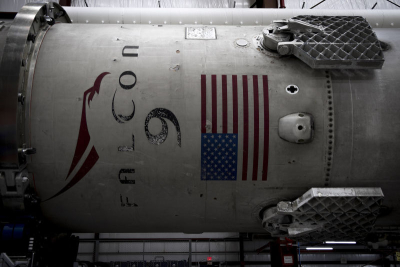
The competition heats up: In an Instagram post, Elon Musk has revealed that the Falcon 9 first stage that successfully landed vertically after launch is in its hanger and is essentially undamaged.
Elon Musk: “Falcon 9 back in the hangar at Cape Canaveral. No damage found, ready to fire again.”
Musk’s post included a higher resolution version of the picture on the right, showing a close-up of the stage near its top. This image reveals that, despite some minor paint damage and dirt, this section of the stage does appear whole and ready to go. Even the landing fins are folded and appear undamaged.
Musk’s post also suggests that the stage is ready for its first post-launch test firing, which underlines how unique this opportunity is. No one has ever had a functioning first stage available for testing after it had been launched and returned to Earth. Past assumptions (an important word) have always said that the stress of launch would damage it enough that it wouldn’t be cost effect to reuse it. SpaceX’s engineers now will have an opportunity to find out if that assumption was true or false. I strongly suspect they will find that this assumption was false, that it was used as a bugaboo by the small-minded to discourage just this kind of effort by SpaceX.
This article notes that Musk has previously said it costs $60 million to build the first stage, but only $200K to refuel it. Since SpaceX says it charges about $70 million per launch, that first stage is most of SpaceX’s cost for each launch. If the stage can reused later, the cost of later launches will thus plummet incredibly. Assume they can only reuse the stage once. Amortized over only two launches the cost is still cut by almost half. More importantly, the ability to reuse will be an incentive for them to build the stage right the first time, so that it can be reused multiple times.
I repeat: The importance of this breakthrough has not yet sunk in. It is going to change the entire aerospace industry and everything we do in space.
Update: I have corrected the post above, which originally incorrectly stated that the picture showed the stage near its base.
The competition heats up: Japan’s legislature is considering bills that would allow for the private launching of Japanese rockets.
Draft bills for the Space Activities Act and Satellite Remote Sensing Act, to be submitted to the regular Diet session from Jan. 4, will require the government to scrutinize launch plans before granting case-by-case permission. Under the Basic Plan on Space Policy set in early 2015, the government aims to expand the size of the space industry to around ¥5 trillion over the next decade. The government would also oblige companies to pay compensation in the event of accidents. Victims would receive government compensation if private operators are unable to cover all the damages, according to the drafts.
Currently, the only entity that has a space program is the state-sponsored Japan Aerospace Exploration Agency.
The proposed laws will probably not work very well, as they they seem to maintain the government’s strong control over everything.