Dwayne O’Brien – We Remember

An evening pause: To the men who flew the planes.

And all who’ve coursed through hostile skies,
Know that freedom requires a sacrifice,
To those who paid the highest price,
We remember.

With a place of honor so deserved,
For what flesh and blood and steel have earned,
That may the glory be reserved,
For the colors they so bravely served.

Keep them flying, keep them flying,
So that all who see them will know,
That our freedom was won by the blood that flowed,
And we remember.

Hat tip Chris Whiting.

2 comments

Salomé’s Dance

An evening pause: Music by Charles Barber. This comes from the 1913 silent film, Salomé, based on an Oscar Wilde play. Rarely seen, the movie represents a very early attempt to do something “edgy”. It succeeds about as well as modern “edgy” films, showing us a very shallow representation of human existence. But the visuals give us a glimpse into that early film world, when sets and costume were usually the only way to show something strange and striking.

Hat tip Judd Clark.

8 comments

Real Space – Every Space Station Size Comparison

An evening pause: Some quick visual space station history. Note how almost all the non-U.S. stations are essentially assembled using revisions of the same early Soviet-era modules. Note too how the future private stations are all very different from each other. The contrast illustrates the difference between what you get when governments control everything, and when competition and freedom rule.

Hat tip Edward Thelen.

3 comments

Apollo astronaut Tom Stafford passes away at 93

Apollo 10 astronaut Tom Stafford, who also flew two Gemini missions as well as the Apollo-Soyuz mission, passed away yesterday at the age of 93.

Stafford’s first flight was on Gemini 6, which achieved the first rendezvous in space when it maneuvered close to Gemini 7 during its two week mission. He then flew on Gemini 9, which was to attempt the first docking but was stymied when the shroud on the Agena target vehicle failed to release, blocking the docking port. The crew could only rendezvous again.

Stafford then commanded Apollo 10, the dress rehearsal for the lunar landing, flying his lunar module to within about ten miles of the Moon’s surface. His final mission was Apollo-Soyuz, the first joint mission between the United States and the Soviet Union.

Of the 24 Apollo astronauts that flew to the Moon, only seven still live. A truly great generation of Americans, possibly the greatest generation of all, is slowly leaving us.

3 comments

Voidwalkeraudio – Desire

An evening pause: The visuals come from the 1927 German film by Fritz Lang, Metropolis, and cover the scene dubbed “Maria’s Dance.” You can see the full movie here, as well as many other places on line.

Hat tip Judd Clark, who adds, “To understand what’s going on here, one needs to see the whole movie, preferably the latest restored version, and to really understand, one needs to read Lang’s wife Thea Von Harbou’s book “Metropolis”.

8 comments

Simon Sinek – How great leaders inspire action

An evening pause: Though I do not think his hypothesis goes far enough, this short TED talk posits some intriguing ideas about leadership. And it seems somehow appropriate today on the Ides of March, which also makes me wonder what Julius Caesar (and other successful leaders, both good and evil) would think of these ideas.

Hat tip Doug Johnson.

2 comments

Abraham Lincoln – an annual tribute to celebrate his birthday

An evening pause: The memory of this man and what he stood for and accomplished must not be forgotten, which is why I try to celebrate his memory each year with a tribute on his birthday. As I wrote in 2021,

[T]hough he freed the slaves, I think Lincoln’s most enduring contribution to American history, a contribution that now has sadly been lost, was his limitless good will for everyone, even to those who hated him and wished to kill him. Had he not been assassinated, American history might have been far better because Lincoln would have had the clout to ease the worst elements of Reconstruction, while forcing through reforms in the former southern slave states.

Those reforms did not happen until the civil rights movement of the 1960s, and are now being abandoned in the 2020s by black supremacists in the academic community who are imposing new racist Jim Crow laws nationwide, designed to favor blacks and other minorities.

Listen to the words of the first song, which was a Lincoln campaign song. He stood for freedom for all, and put his life on the line for that principle. From the pictures you can see the evolution of this kind-hearted but determined man from youth to mid-age, with all the troubles of the Civil War reflected in his face and mouth.

11 comments

Computer problem on Voyager-1 remains unsolved

Engineers remain baffled over a computer issue that has prevented the receipt of any data since November 2023 from Voyager-1, floating some 15 billion miles away just outside the solar system in interstellar space.

In November, the data packages transmitted by Voyager 1 manifested a repeating pattern of ones and zeros as if it were stuck, according to NASA. Dodd said engineers at JPL have spent the better part of three months trying to diagnose the cause of the problem. She said the engineering team is “99.9 percent sure” the problem originated in the FDS [Flight Data Subsystem], which appears to be having trouble “frame syncing” data.

So far, the ground team believes the most likely explanation for the problem is a bit of corrupted memory in the FDS. However, because of the computer hangup, engineers lack detailed data from Voyager 1 that might lead them to the root of the issue. “It’s likely somewhere in the FDS memory,” Dodd said. “A bit got flipped or corrupted. But without the telemetry, we can’t see where that FDS memory corruption is.”

Since November the only signal received from Voyager-1 is a carrier signal that simply tells engineers the spacecraft is alive. Though the effort continues to try to fix the spacecraft, the odds of bringing it back to life are becoming slim, especially because its power supply will run out in 2026 at the very latest. Even if they manage to fix the issue now, the spacecraft has only a short time left regardless.

Considering the computers on this spacecraft, as well as its twin Voyager-2, have been operating continuously for almost a half century since their launch in 1977, their failure now is nothing to be ashamed of. The engineers that built both did well, to put it mildly.

As for Voyager-1’s future, even dead it will fly on into interstellar space, eventually getting within 1.5 light years of a star in the constellation Camelopardalis.

2 comments

The future of astronomy, as seen by PBS News in 1991

An evening pause: Today is the 75th anniversary of the moment astonomers took the lens cap off the Hale Telescope at Palomar, what astronomers call “first light.” In honor of this anniversary, tonight’s evening pause is a somewhat well-done news piece produced by PBS in 1991, describing the state of ground-based astronomy at that time, which was actually another key moment in the history of astronomy. After decades of no advancement following the Hale telescope, the field was about to burst out with a whole new set of telescopes exceeding it significantly, based on new technologies. We today have become accustomed to those new telescopes, but in 1991 they were still incomplete or on the drawing board.

This was also after the launch of Hubble but before it was fixed, so this moment was also a somewhat dark time for astronomy in general. Watching this news piece gives you a sense of history, as seen by those living at that time. It also lets you see some good examples of the standard tropes of reporters as well as some astronomers. They always say this new telescope (whatever and whenever it is) is going to allow us to discover the entire history of the universe, even though it never can, and never will.

Hat tip Mike Nelson.

15 comments

Ray Manzarek – the creation of “Riders on the Storm”

An evening pause: The pianist from the Doors describes how this song was created. If you want to hear it as performed, go here, which notes, “This was the last song recorded by the members of The Doors, according to Manzarek, as well as Morrison’s last recorded song to be released.”

Hat tip Doug Johnson

2 comments

Dave Brubeck Quartet – Golden Brown

An evening pause: This video is not what it seems. The sax player, Lawrence Mason, has created a cover of this Dave Brubeck song by editing and playing over the Dave Brubeck quartet playing another song in 1965. As he notes on the youtube page, he did it as a tribute to “Paul Desmond (saxophonist with the Dave Brubeck quartet – the anniversary of his death is at the end of this month) [May 2020].”

Hat tip Alton Blevins.

0 comments

Secretariat – Triple Crown Races

An evening pause: If you have never seen the Triple Crown victories by Secretariat in 1973, you need to watch this video. It will take your breath away. In the first two races jockey Ron Turcotte appears to let the pack take the lead at the start because he knows Secretariat can’t stand being behind. In the last, it is as if the horse wanted to prove to everyone that there was no horse now or ever that was faster. From the youtube webpage:

Secretariat (March 30, 1970 – October 4, 1989), also known as Big Red, was a champion American Thoroughbred racehorse who is the ninth winner of the American Triple Crown, setting and still holding the fastest time record in all three races. He is widely regarded as one of the greatest racehorses of all time. He became the first Triple Crown winner in 25 years and his record-breaking victory in the Belmont Stakes, which he won by 31 lengths, is widely regarded as one of the greatest races in history.

9 comments

Proposed removal of William Penn statue proves the Democrats really are anti-American

The William Penn statue in Welcome Park
The William Penn statue in the center of
Welcome Park. Note the panels on the wall
behind, describing the achievements of his life.
The park service was also planning to “rehabilitate”
this as well.

Though the Biden administration and the National Park Service immediately backed down from its proposal to remove the statue of William Penn from the Pennsylvania park dedicated in 1982 to honor his memory, the very proposal proved without doubt how much the Democrats who dominate our government truly hate America, its founding, and everything it stands for.

First, let’s review the proposal that has now been dumped. According to the National Park Service press release issued on January 5th,

The proposed rehabilitation of Welcome Park includes expanded interpretation of the Native American history of Philadelphia and was developed in consultation with representatives of the indigenous nations of the Haudenosaunee, the Delaware Nation, Delaware Tribe of Indians, the Shawnee Tribe, and the Eastern Shawnee Tribe of Oklahoma. The reimagined Welcome Park maintains certain aspects of the original design such as the street grid, the rivers and the east wall while adding a new planted buffer on three sides, and a ceremonial gathering space with circular benches. The Penn statue and Slate Roof house model will be removed and not reinstalled. [emphasis mine]

In other words, a park built at the site of William Penn’s pioneer home and designed expressly to honor his achievements as the founder of Pennsylvania as a religious haven for all people was to be redesigned instead as a memorial to the primitive stone-age Indian tribes that once lived there, focusing instead on how Penn and the Quakers oppressed them by coming to America. And to rub salt in the wound, this change was to be done in connection with the 250th anniversary of the signing of the Declaration of Independence in 2026.

As I said, the Democrats who dominate our federal bureaucracy as well as academia are our enemies. They truly intend to wipe any positive mention of America from every history book or place, and replace it with Marxist icons and false anti-American propaganda.

Very quickly there was an uproar against this plan. » Read more

11 comments

John Batchelor highlights Genesis: The Story of Apollo 8

At 11 pm (Eastern) during the third hour of John Batchelor’s show tonight and tomorrow he will air a long two hour interview with me discussing my book Genesis: The Story of Apollo 8. After many years he finally decided his listeners deserved a full discussion of what is to many the most historically important Apollo mission to the Moon. It might not have landed on the Moon but what the astronauts accomplished and said changed the nation, and will likely be remembered forever.

Tune in if you are interested. Even better, consider reading the book. In fact, the best thing of all would be to give the book to any high school students in your family. They will learn more about American history and the Cold War by reading it than they get nowadays from their entire public school education.

I will also embed the podcasts here when they become available.

4 comments

Repost: The real meaning of the Apollo 8 Earthrise image

I wrote this essay in 2018, to celebrate the fiftieth anniversary of the Apollo 8 mission to the Moon. I think it worth reposting again, especially because stories about Apollo 8 still refuse to show the Earthrise image as Bill Anders took it.
———————————————

Earthrise, as seen by a space-farer

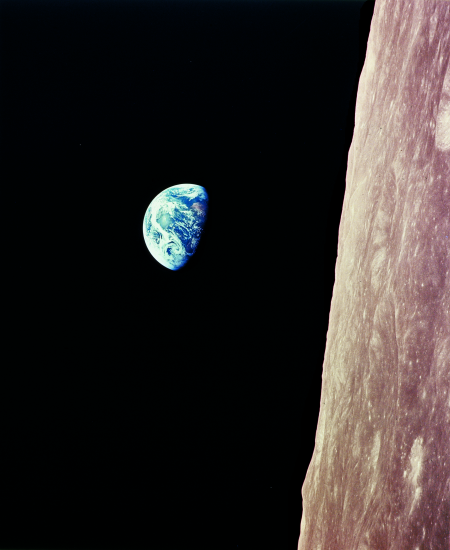
Today is the fiftieth anniversary of the moment when the three astronauts on Apollo 8 witnessed their first Earthrise while in orbit around the Moon, and Bill Anders snapped the picture of that Earthrise that has been been called “the most influential environmental picture ever taken.”

The last few days have seen numerous articles celebrating this iconic image. While all have captured in varying degrees the significance and influence of that picture on human society on Earth, all have failed to depict this image as Bill Anders, the photographer, took it. He did not frame the shot, in his mind, with the horizon on the bottom of the frame, as it has been depicted repeatedly in practically every article about this image, since the day it was published back in 1968.

Instead, Anders saw himself as an spaceman in a capsule orbiting the waist of the Moon. He also saw the Earth as merely another space object, now appearing from behind the waist of that Moon. As a result, he framed the shot with the horizon to the right, with the Earth moving from right to left as it moved out from behind the Moon, as shown on the right.

His perspective was that of a spacefarer, an explorer of the universe that sees the planets around him as objects within that universe in which he floats.

When we here are on Earth frame the image with the horizon on the bottom, we immediately reveal our limited planet-bound perspective. We automatically see ourselves on a planet’s surface, watching another planet rise above the distant horizon line.

This difference in perspective is to me the real meaning of this picture. On one hand we see the perspective of the past. On the other we see the perspective the future, for as long humanity can remain alive.

I prefer the future perspective, which is why I framed this image on the cover of Genesis: the Story of Apollo 8 the way Bill Anders took it. I prefer to align myself with that space-faring future.

And it was that space-faring future that spoke when they read from Genesis that evening. They had made the first human leap to another world, and they wished to describe and capture the majesty of that leap to the world. They succeeded beyond their wildest dreams.

Yet, they were also still mostly Earth-bound in mind, which is why Frank Borman’s concluding words during that Christmas eve telecast were so heartfelt. He was a spaceman in a delicate vehicle talking to his home of Earth, 240,000 miles away. “And from the crew of Apollo 8, we close with good night, good luck, a Merry Christmas, and God bless all of you — all of you on the good Earth.” They longed deeply to return, a wish that at that moment, in that vehicle, was quite reasonable.

Someday that desire to return to Earth will be gone. People will live and work and grow up in space, and see the Earth as Bill Anders saw it in his photograph fifty years ago.

And it is for that time that I long. It will be a future of majesty we can only imagine.

Merry Christmas to all, all of us still pinned down here on “the good Earth.”

12 comments
1 5 6 7 8 9 55