India picks its first astronauts; confirms new lunar rover

The new colonial movement: The head of India’s space agency ISRO yesterday confirmed that their plans to build and land a rover on the Moon in 2020, while also announcing that they have chosen the first four astronauts to train for their first manned mission in 2022.

He also confirmed that the land acquisition for a second launch site is proceeding.

The astronauts, whose identity has not been revealed, will be trained by Russia.

0 comments

India aims for about a dozen launches in 2020

The new colonial movement: India’s space agency ISRO is targeting about about a dozen launches in 2020, including the first unmanned test flight of its manned capsule Gaganyaan, the first flight of its smallsat SSLV rocket, and the first test flights of a reusable rocket, the first stage landing vertically and the second stage returning like a space shuttle.

Of these I estimate about seven are orbital flights.

Based on the last few years, this prediction by ISRO is likely high. They tend to over-predict what they will accomplish each year. This isn’t necessarily bad, as it forces them to accelerate their work rather than allowing it to drag on endlessly.

0 comments

India confirms details of Vikram’s crash on Moon

India’s government has finally officially admitted that its Vikram lunar lander crashed in September.

In a written answer to a question posed to the Department of Space in Lok Sabha, Minister of State in the Prime Minister’s Office (PMO) Jitendra Singh said the “reduction in velocity” of the Vikram lander during the final phase of its descent on the moon’s surface “was more than the designed value”. As a result, Vikram “hard-landed” on the moon “within 500 metres of the designated landing site”, he said.

…“The first phase of descent was performed nominally from an altitude of 30 km to 7.4 km above the moon surface. The velocity was reduced from 1,683 m/s to 146 m/s. During the second phase of descent, the reduction in velocity was more than the designed value. Due to this deviation, the initial conditions at the start of the fine braking phase (final phase below 7.4 km altitude) were beyond the designed parameters. As a result, Vikram hard-landed within 500 m of the designated landing site,” the minister said in a written answer in the Lok Sabha.

Except for the detail that they think Vikram landed within 500 meters of its planned landing site, this answer really doesn’t tell us much new. It was very obvious during the landing that the spacecraft was traveling too fast as it began its final braking phase, and that it then descended much too fast thereafter.

In fact, the couched language and the unwillingness so far of ISRO, India’s space agency, to provide a detailed report on the failure does not reflect well on them. This kind of cutting edge engineering requires a hard kind of intellectual honesty. They have so far not shown that kind of honesty in their response to this failure.

5 comments

India targets Nov 2020 for new lunar lander mission

The new colonial movement: Sources inside India’s space agency ISRO yesterday revealed that they are now working to build and fly another lunar lander/rover, dubbed Chandrayaan-3, with a target launch date of November 2020, only one year from now.

Isro has formed multiple committees — an overall panel and three sub-committees — and held at least four high-level meetings since October. The new mission will include only a lander and rover, as the Chandrayaan-2 orbiter is functioning well. On Tuesday, the overview committee met with the agenda of reviewing the configuration of Chandrayaan-3. It also looked into the recommendations of various sub-committees on propulsion, sensors, overall engineering, navigation and guidance.

The Chandrayaan-2 orbiter had provided the propulsion capabilities to get the Vikram lander (with rover) to lunar orbit earlier this year, only to have the lander fail shortly before touchdown. To do this new mission without an orbiter will require adding a propulsion unit to the rover/lander. They are also looking at strengthening the lander’s legs to better resist a high velocity landing.

Kudos to ISRO for moving so quickly. There is no reason a replacement lander/rover should take years to build. They already know what to do, they need only do it again, with upgrades designed to avoid the failure in September.

0 comments

First images from Chandrayaan-2

One of Chandrayaan-2's first hi-res images
Click for the full image.

India has released the first image from the high resolution camera on its Chandrayaan-2 lunar orbiter.

The image on the right, cropped to post here, is from that image and shows objects as small as 10 inches across, which is better than the 20 inch resolution obtained by the U.S.’s Lunar Reconnaissance Orbiter (LRO). Depending on orbit, they should therefore eventually be able to image their crashed Vikram lander with more detail. It also means they can supplement and improve on data from LRO, a significant achievement for India.

Additionally they report that all instruments on board are functioning normally.

0 comments

LRO fails to spot Vikram on Moon

Despite successfully taking high resolution images of the area on the Moon where it is thought India’s Vikram crash-landed two weeks ago, the Lunar Reconnaissance Orbiter (LRO) science team has been unable to identify it in those images.

LRO’s Lunar Reconnaissance Orbiter Camera instrument, or LROC, imaged the intended south pole touchdown site for the lander, which is called Vikram, as planned yesterday (Sept. 17), Aviation Week’s Mark Carreau reported. But “long shadows in the area may be obscuring the silent lunar explorer,” Carreau wrote.

“It was near dusk as the region prepares to transition from a two-week lunar day to an equally long lunar night, so shadows covered much of the region, and Vikram may not be in the LROC’s field of view,” Carreau wrote, citing a NASA statement.

This means that they will simply have to try again during a later orbit. Eventually the lighting conditions will be right, and LRO will photograph Vikram.

0 comments

LRO to image Vikram landing site next week

The Lunar Reconnaissance Orbiter (LRO) science team plans to take high resolution images of the Vikram landing site when the orbiter flies over that site on September 17, thus allowing them to release before and after images.

Noah Petro, LRO’s project scientist at NASA’s Goddard Space Flight Center, said that the orbiter is due to fly over the Vikram landing site Tuesday, Sept. 17. “Per NASA policy, all LRO data are publicly available,” Petro wrote in an email. “NASA will share any before and after flyover imagery of the area around the targeted Chandrayaan 2 Vikram lander landing site to support analysis by the Indian Space Research Organization.”

Officials with India’s space agency ISRO have said they have photographed Vikram with their orbiter, Chandrayaan-2, but they have not released these images as yet. Their have also been reports from India stating that their images suggest the lander is still in one piece, but these reports are not confirmed.

LRO’s images should clarify the situation. The images should also help tell us what exactly happened after Indian engineers lost contact with Vikram shortly before landing.

1 comment

Chandrayaan-2 locates Vikram

According to K. Sivan, the head of ISRO, India’s space agency, their Chandrayaan-2 orbiter has captured a thermal image of Vikram on the lunar surface, pinpointing the lander’s location.

They have not released the image. According to reports today, they do not yet know the lander’s condition, and have not regained communications. Reports late yesterday had quoted K.Sivan as saying “It must have been a hard-landing.” That quote is not in today’s reports.

In watching the landing and the subsequent reports out of India, it appears that India is having trouble dealing with this failure. To give the worst example, I watched a television anchor fantasize, twenty minutes after contact had been lost, that the lander must merely be hovering above the surface looking for a nice place to land. Most of the reports are not as bad, but all seem to want to minimize the failure, to an extreme extent.

Their grief is understandable, because their hopes were so high. At the same time, you can’t succeed in this kind of challenging endeavor without an uncompromising intellectual honesty, which means you admit failure as quickly as possible, look hard at the failure to figure out why it happened, and then fix the problem. If India can get to that place it will be a sign that they are maturing as a nation. At the moment it appears they are not quite there.

4 comments

Vikram fails to land on Moon

Vikram, India’s first attempt to soft land on the Moon, apparently has failed, with something apparently going wrong in the very last seconds before landing.

As I write this they have not officially announced anything, but the live feed shows a room of very unhappy people.

It is possible the lander made it and has not yet sent back word, but such a confirmation should not take this long.

India’s prime minister, Narendra Modi, was given a very short briefing by K. Sivan, head of ISRO, and then apparently left without comment. This I found an interesting contrast to the actions of Israel’s prime minister Benjamin Netanyahu when its lunar lander Beresheet failed in landing earlier this year. Netanyahu came out to comfort the workers in mission control, congratulating them for getting as far as they had. Modi apparently simply left. UPDATE: Modi has reappeared to talk to the children who had won a contest to see the landing as well as people in mission control. After making a public statement he has now left.

They are now confirming that communications was lost at 2.1 kilometers altitude, which was just before landing. They are analyzing the data right now to figure out what went wrong.

11 comments

Watch Vikram landing on Moon

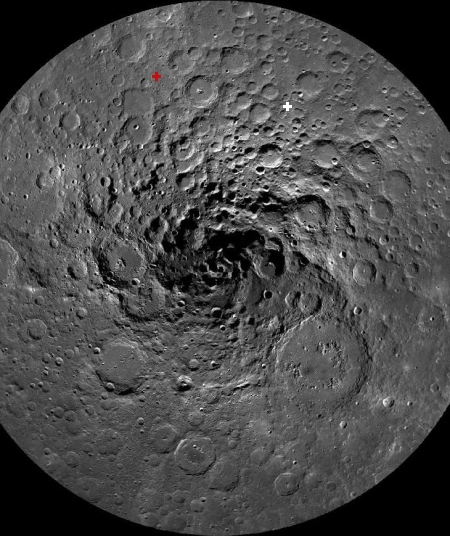
Vikram's primary landing site

The new colonial movement: I have embedded below the live stream of India’s attempt today to land its Vikram lander on the Moon, broadcast by one of their national television networks.

The landing window is from 4:30 to 5:30 pm Eastern. This live stream is set to begin about 3 pm Eastern.

If you want to watch ISRO’s official live stream you can access it here.

Some interesting details: Vikram is named after Vikram A. Sarabhai, who many consider the founder of India’s space program. The lunar rover that will roll off of Vikram once landing is achieved is dubbed Pragyan, which means “wisdom” in Sanskrit. Both are designed to operate on the Moon for one lunar day.

The landing site will be about 375 miles from the south pole.

That spot is a highland that rises between two craters dubbed Manzinus C and Simpelius N. On a grid of the moon’s surface, it would fall at 70.9 degrees south latitude and 22.7 degrees east longitude.

The white cross on the image to the right is where I think this site is. The secondary landing site is indicated by the red cross.

1 comment

Vikram makes second and last lunar orbital change

The new colonial movement: India’s Vikram lunar lander today made its second and last orbital change, preparing itself for landing on the Moon on September 7.

The orbit of Vikram Lander is 35 km x 101 km. Chandrayaan-2 Orbiter continues to orbit the Moon in an orbit of 96 km x 125 km and both the Orbiter and Lander are healthy.

With this maneuver the required orbit for the Vikram Lander to commence it descent towards the surface of the Moon is achieved. The Lander is scheduled to powered descent between 0100 – 0200 hrs IST on September 07, 2019, which is then followed by touch down of Lander between 0130 – 0230 hrs IST

They plan to roll the rover Pragyan off of Vikram about two hours after landing.

This article provides a nice overview of the mission.

0 comments

Vikram completes first de-orbit burn

The new colonial movement: India’s Vikram lunar lander has successfully completed its first de-orbit engine burn, lasting 4 seconds, adjusting its orbit slightly in preparation for landing on the Moon on September 7.

They will do a second burn tomorrow, further adjusting the orbit.

Note that the update says that this burn was by Chandrayaan-2, but this must be a mistake. The Vikram lander separated from the Chandrayaan-2 orbiter yesterday, and it is Vikram that is doing the orbital changes and will land on the Moon.

0 comments

Vikram has successfully separated from Chandrayaan-2

The new colonial movement: India’s lunar lander, Vikram, has successfully separated from Chandrayaan-2, and is functioning nominally in lunar orbit.

The update describing this is the second update at the link, with the first detailing the arrangements for the press to cover the landing on September 7.

The lander carries the rover, dubbed Pragyan, which will roll off Vikram only a few hours after landing.

2 comments

Chandrayaan-2 now in proper lunar orbit for release of lander/rover

India’s Chandrayaan-2 spacecraft today completed its fifth engine burn in lunar orbit, placing it in the correct orbit for releasing its lander/rover.

The next operation is the separation of Vikram Lander from Chandrayaan-2 Orbiter, which is scheduled on September 02, 2019, between 1245 – 1345 hrs (IST). Following this, there will be two deorbit maneuvers of Vikram Lander to prepare for its landing in the south polar region of the moon.

The landing itself is scheduled for September 7.

0 comments

More images from Chandrayaan-2

Moon image from Chandrayaan-2
Click for full image.

The Chandrayaan-2 engineering team has released more lunar images from Chandrayaan-2, this time from its higher resolution Terrain Mapping Camera 2.

One example is to the right, reduced to post here. It was taken from about 2,700 miles altitude, and shows a section of the northern hemisphere on the Moon’s heavily cratered far side. There are other images at the link.

The goal of these images is to demonstrate that the camera and spacecraft pointing systems are working. It appears they have done so successfully.

0 comments

ISRO releases Chandrayaan-2’s first Moon image from lunar orbit

The Moon as seen by Chandrayaan-2

India’s space agency ISRO has released the first image taken by Chandrayaan-2 after entering orbit around the Moon.

That image is to the right, reduced to post here. It was taken from about 1,600 miles elevation, and shows mostly the far side of the Moon. The dark mare in the upper right is the Sea of Moscow, which is the only large mare on the far side.

This image once again proves the camera and the spacecraft’s ability to point it accurately are both functioning.

0 comments

Chandrayaan-2 successfully enters lunar orbit

The head of ISRO today announced that, after completed a 29 minute engine burn, India’s Chandrayaan-2 orbiter/lander/rover has successfully entered the correct orbit around the Moon.

In his briefing, Dr. Sivan announced that “The LOI maneuver was performed successfully today morning using the onboard propulsion system for a firing duration of about 29 minutes. This maneuver precisely injected Chandrayaan-2 into an orbit around the Moon.” He emphasised the unique requirement of 90 degree orbital inclination of Chandrayaan-2 and said that it was achieved by the precise execution of both the Trans Lunar Injection (performed on August 14, 2019) and today’s LOI maneuver.

“The satellite is currently located in a lunar orbit with a distance of about 114 km at perilune (nearest point to the Moon) and 18,072 km at apolune (farthest point to the Moon)”, he added.

Over the next four lunar orbits they will execute four more engine burns to lower the spacecraft to the orbit needed to send the lander/rover to the surface on September 7 in the south polar region of the Moon between the craters Manzinus C and Simpelius N at about 71 degrees latitude.

4 comments
1 8 9 10 11 12 16