
Terran Orbital wins contract to build cubesat to go to Apophis with ESA’s Ramses probe
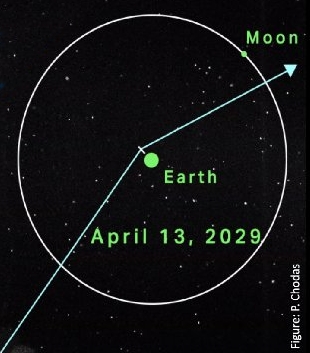
Apophis' path past the Earth in 2029
A cartoon (not to scale) showing Apophis’s
path in 2029.

The satellite company Terran Orbital, owned by Lockheed Martin, has won a contract from the European Space Agency (ESA) to build a cubesat to fly with its Ramses probe that will launch in 2028 and rendezvous with the potentially dangerous asteroid Apophis when it makes its very close fly-by of the Earth on April 13, 2029.

The CubeSat is named after Italian scientist Paolo Farinella and is backed by the Italian Space Agency. After successfully completing the Critical Design Review in January 2026, Tyvak International [a subsidiary of Terran Orbital] will begin the implementation phase, with launch currently planned for 2028.

…Operating aboard the RAMSES spacecraft, developed by OHB Italia, the Farinella CubeSat will be one of two spacecraft deployed to explore the asteroid’s subsurface using low-frequency radar. The satellite will also carry Horus, an optical instrument that acts as both a science imager and navigation camera, and Vista, a dust detector previously flown on the Milani CubeSat from ESA’s Hera mission.

Apophis is estimated to be about 1,200 feet across. When it does its fly-by in ’29 it will get within 20,000 miles of the Earth, dipping within the orbits used by geosynchronous satellites. It will then pass within 60,000 miles of the Moon. At its closest it will for a short time be visible to the naked eye.

Apophis’ orbit means that it has the potential in the next century or so to impact the Earth. This particular fly-by is significant because the Earth/Moon’s gravity will change the asteroid’s path in an unpredictable manner that could either increase or decrease that impact possibility on future fly-bys. And we won’t know until after the fly-by is complete.
1 comment

SpaceX completes first launch in 2026

The beat goes on! SpaceX tonight successfully placed an Italian Earth observation satellite into orbit, its Falcon 9 lifting off from Vandenberg Space Force Base.

The satellite’s data will be used by Italy for both military and civil purposes. The rocket’s first stage completed its 21st flight, landing back at Vandenberg. The two fairings completed their 2nd and 23rd flights respectively.

At this moment, SpaceX has the only launch in 2026.

2 comments

Italian rocket company Avio wins two launch contracts valued at $117 million total

Last week the Italian rocket company Avio announced that it has signed launch contracts for its Vega-C rocket with two different unnamed satellite customers, the value of the contracts equaling $117 million total.

The satellites to be launched will be used for Earth observation, environmental monitoring and resource management purposes for civil and scientific applications, providing high-resolution imagery as well as best-in-class geolocation accuracy. The passengers will feature a mass ranging from more than 400 to more than 1,000 kilograms and will be deployed into a ~500 km Sun-synchronous orbit.

These contracts totally secure over EUR 100 million for launch services to be scheduled between 2028 and 2031.

Though the customers remain unnamed, the Avio release indicated that one was from Europe and the other was non-European. That latter contract deal could be linked to Avio’s announcement at about the same time that it is spending $500 million to build a rocket facility in Virginia. If the non-European customer was American and its satellites were for the Pentagon, having a U.S.-based facility made that contract award far more likely.

1 comment

Kenya to build its own spaceport

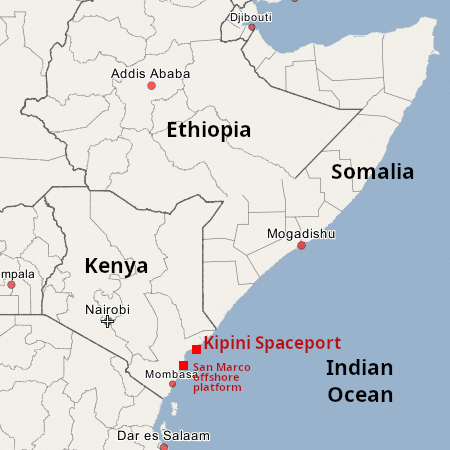
Kenya spaceports
Kenya spaceports

The Kenyan government has now initiated a project to establish a second commercial spaceport on the country’s coast, located near the town of Kipini.

As stated in the document made public on December 16, 2025, the government is looking to recruit a skilled transaction advisor who is capable of analyzing the technical, financial, legal, environmental, and social feasibility of the construction of the spaceport based on a PPP model. The strategy utilizes Kenya’s location on the equator, which provides some benefits in satellite launches, among them lower fuel consumption, lower launch costs, and easier satellite placement in low-inclined orbits around the earth’s equatorial region.

…Under the plan, the transaction advisor will prepare a detailed feasibility study in line with the PPP Act, 2021. The study will include concept designs, launch vehicle options, infrastructure requirements, lifecycle cost estimates, and a phased implementation plan for the facility.

As shown on the map to the right, this new facility would be to the north of the San Marco offshore platform that had been used for eight launches by Italy from the ’60s to the ’80s and that the Italian rocket company Avio is now planning to re-open.

The Kenyan government apparently wants to build its own a launch site that it can offer to others to use.

5 comments

Avio wins U.S. launch contract for its Vega-C rocket

Capitalism in space: In what I think is a first, the Italian rocket company Avio has won a Vega-C launch contract without any participation from the European Space Agency’s (ESA) commercial division Arianespace.

The contract is also with an American company, SpaceLaunch, to put an “institutional Earth observation satellite” in orbit in 2027.

The significance of the deal is that Avio is now successfully marketing and selling its Vega-C rocket, without the middleman Arianespace taking a cut. As part of the shift of ESA and Europe to the capitalism model, whereby it no longer runs things but acts merely as a customer, it also freed Avio from the clutches of Arianespace. Previously, Avio built the rocket for that government agency, which then marketed and sold it to satellite companies. Avio had no control over profit or price. In fact, it didn’t really own its own rocket.

This absurd situation is now ending. There are still a handful of Vega-C launches that were contracted for under Arianespace, but after these Avio will be completely in charge. This deal, announced yesterday, is the beginning of that process.

2 comments

Italy to fly experiments on first Starship flights to Mars

According to a tweet by SpaceX’s president and chief operating officer Gywnne Shotwell today, the Italian Space Agency (ASI) has signed an agreement to fly experiments on first Starship flights to Mars that will carrying customer payloads. She quoted a tweet by ASI’s president, Teodoro Valente:

ASI_Spazio and SpaceX have signed a first-of-its-kind agreement to carry Italian experiments on the first Starship flights to Mars with customers. The payloads will gather scientific data during the missions. Italy continues to lead in space exploration!

Little other information has yet been released, but expect more details in the coming days.

UPDATE: ASI’s press release on August 8th added this detail:

The payloads will include a plant growth experiment, a weather monitoring station and a radiation sensor. The goal is to collect scientific data in the approximately six-month interplanetary flight phase from Earth to Mars and then on the Martian surface.

Hat tip to reader Gary.

2 comments

Italy awards Italian company contract to design constellation of radio telescopes orbiting the Moon

Capitalism in space: The Italian Space Agency has awarded the Italian company Blue Skies Space a contract to design a constellation of radio telescopes orbiting the Moon and designed to map the universe’s earliest radio emissions.

The project, named RadioLuna, aims to uncover whether a fleet of small satellites in a lunar orbit could detect faint radio signals from the universe’s earliest days—signals that are nearly impossible to pick up on Earth due to man-made radio interference. These signals, in the FM radio range, come from a time before the first stars formed, when the universe was mostly hydrogen gas. By listening from the far side of the Moon, free from Earth’s radio noise, scientists could use the satellites to uncover a missing piece of the puzzle in our understanding of the cosmic “dark ages.”

The study will establish the viability of operating simple and cost-effective CubeSats equipped with commercial off-the-shelf (COTS) components orbiting the Moon and will be led by Blue Skies Space Italia S.r.l., a subsidiary of UK-based Blue Skies Space Ltd. Project partner OHB Italia will be responsible for the definition of a viable platform in a Moon orbit.

The contract is another example of Italy (and Europe) shifting to private enterprise in space. Rather than design this project in-house, its space agency is contracting it out to private companies.

0 comments

British rocket start-up Orbex wins two-launch contract from Italian orbital tug company D-Orbit

The British rocket start-up Orbex, which hopes to complete its first test orbital launch of its Prime rocket this year, after years of regulatory delays, has gotten a two-launch contract from the Italian orbital tug company D-Orbit.

The contract appears to be part of Europe’s effort to have its European payloads launch on European rockets. Previously D-Orbit tugs have mostly been launched by SpaceX because the only available European rockets, Ariane-6 and Vega-C, have either not been operational or available. Moreover, all these rockets are too big for D-Orbit’s tugs, which thus have to fly as secondary payloads.

Orbex’s Prime rocket is small, and so the tugs can be launched as the primary payload. The rocket however is not yet operational, unlike for example Rocket Lab’s small Electron rocket. The decision to go with Orbex’s untested rocket suggests Europe is forcing D-Orbit to sign with a European rocket company.

2 comments

Italy’s military negotiating with SpaceX to use its Starlink constellation for communications

In what would be a five year deal costing $1.56 billion, Italy’s military is presently negotiating with SpaceX to use its Starlink constellation for communications, rather than wait for the European Space Agency’s (ESA) IRIS2 constellation, which is years from launch and likely to experience delays, as do all of ESA’s projects.

By negotiating a five-year deal with SpaceX, Italy may be aiming to bridge the gap until Europe’s IRIS2 system becomes operational. With the ongoing war in Eastern Europe, the country’s Armed Forces likely view secure military communications as an urgent priority. However, critics may argue that the €1.5 billion price tag represents 14.15% of the total IRIS2 budget for just five years of service. For context, Italy is the third-largest contributor to the European Union, with its €18.6 billion contribution in 2023 accounting for roughly 10% of the EU’s total budget.

This story illustrates the good business sense of Elon Musk. He moved to get Starlink in orbit ahead of anyone else, and now is reaping the cash awards because he can provide services while others cannot.

0 comments

Italian government awards former Ukrainian startup a $1.14 million development loan

A former Ukrainian startup, Kurs Orbital, has won a $1.14 million loan from Italy’s National Agency for Investment Attraction and Business Development (Invitalia) in order to build and sell its module providing rendezvous and docking capabilities for satellites.

Kurs Orbital was founded in 2021 by the former director of Ukraine’s space agency, Volodymyr Usov. After Russia invaded Ukraine in 2022, the company relocated to Turin, Italy. The company is currently developing its ARCap system, a rendezvous and proximity operations module that can be integrated with a wide range of vehicles, including satellites, orbital transfer vehicles, and even cargo or crew spacecraft. Possible applications for the technology include satellite life extension missions, in-orbit servicing, and space debris removal.

On 30 December, the company announced that it had secured a €1.1 million soft loan from Italy’s National Agency for Investment Attraction and Business Development (Invitalia). A soft loan provides the borrower with more favourable terms than traditional lenders typically offer. The loan was awarded through the agency’s Smart&Start programme, which focuses on supporting the growth of innovative startups by providing financing of between €100,000 and €1.5 million.

The Kurs rendezvous and docking system was first developed in the Ukraine for the Soviet-era space stations. When the Soviet Union broke up it continued to sell them to Roscosmos, but over time the Putin government increasingly worked to block these deals as it tried (and generally failed) to develop the capabilities within Russia. The Ukrainian companies then began marketing their products, with some success, in the west. Following Russia’s 2022 invasion of the Ukraine those companies have either died, or done what Kurs Orbital did, move to the west.

While this story might resemble the actions of the Chinese government as described in my previous post, there is one very fundamental difference. In Italy the law protects the property rights of this company. The Italian government might provide it loans and assistance, like the Chinese, but it does not have the power or right to take it over, at its whim, as the Chinese communists can.

The story also illustrates the foolishness of Russia’s power-hungry policies. It not only has wasted its youth and industry on a useless war, it has driven away companies and technology that formerly gave it capabilities it now lacks.

0 comments

Europe’s Vega-C rocket returns to flight after being grounded for more than two years

Europe’s Vega-C rocket, built by the Italian company Avio but presently still managed by the European Space Agency’s commercial arm Arianespace, today successfully completed its first launch in two years, lifting off from French Guiana carrying a European Earth observation satellite. As of posting the satellite had not yet been deployed.

The rocket was first grounded when its upper stage failed during a December 2022 launch. The investigation pinpointed the problem as the design of the stage’s engine nozzle. However, the first redesign also failed, requiring a second redesign.

This was the eighth launch worldwide in the past 48 hours, the most ever accomplished in such a short time. All told, five nations completed launches (United States 3, China 2, India 1, Russia 1, Europe 1) from eight different spaceports, with all three American launches completed by SpaceX.

Because this was only the third launch by Europe this year, the leader board for the 2024 launch race remains unchanged:

127 SpaceX
59 China
16 Russia
13 Rocket Lab

American private enterprise still leads the rest of the world combined in successful launches 146 to 90, while SpaceX by itself leads the entire world, including American companies, 127 to 109.

1 comment

Italy to resume use of its San Marco spaceport off the coast of Kenya

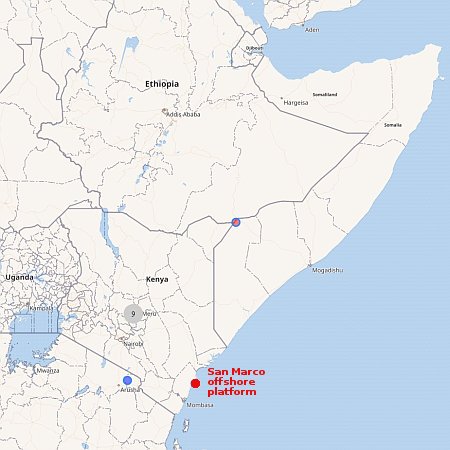
Italy's offshore San Marco spaceport
Click for full map.

Italy has now decided to re-open its long unused San Marco spaceport facility off the coast of Kenya, resuming launches from its off-shore launch platform.

During its active life beginning in 1967 a total of eight launches occurred from this site, with the last flight occurring in 1988.

In late 2023, the Minister of Enterprise and Made in Italy, Adolfo Urso, first proposed reopening the facility for rocket launches. While unsubstantiated by other sources, local publication MalindiKenya.net reported at the time that the move would be used to create an “ideal launch base for the Italian Vega launcher, thus avoiding paying France for the use of the French Guiana base.”

In October 2024, during a presentation just before the 75th International Astronautical Congress kicked off, Minister Urso explained that the country had decided to move ahead with its plans to once again launch rockets from the Luigi Broglio Space Center.

The present plans will have the site managed by the Kenya Space Agency, established in 2017, with Italy providing the rockets and satellites, all of which are expected to be smallsats. It appears that the rocket company Avio, which builds the Vega-C rocket, might be aiming to use this site as an commercial launchpad, thus allowing it to bypass the French-run French Guiana spaceport. Located close to the equator and on the coast, this site would offer satellite companies a very wide range of orbits.

2 comments

Italian rocket company Avio outlines its future rocket plans

Link here. The plans include steady upgrades to its Vega-C rocket, including replacing the upper stage engine presently provided by a Ukrainian company with an engine built by Avio itself.

The bigger development will be a more powerful rocket, the Vega-E, to replace the Vega-C in 2027.

This version of the rocket will retain the first and second stages of the Vega C+ rocket and substitute the third and fourth stages for a single liquid fuel stage powered by the company’s new M10 methalox rocket engine.

The company is also hoping to begin test flights in 2026 of a Grasshopper-type small-scale demonstration rocket leading to the development of a reusable two-stage rocket that would eventually replace Vega-E.

3 comments

D-Orbit newest orbital tug deploys four smallsats

The Italian orbital tug company D-Orbit has now successfully deployed four smallsats from its newest tug, having been launched on August 16, 2024 on a SpaceX Falcon 9 rocket.

The tug still has one more satellite to deploy, after which it will remain in orbit as it also carries four additional customer “hosted” payloads that are using the tug itself as their service module.

This is D-Orbit’s second demo mission, the first flying in 2023. It also appears be completely successful, which puts this company in an excellent position to garner future contracts from many small satellite companies. It is also a partner in a $256 million Italian project to test in-orbit robotic satellite repair.

0 comments

ESA approves taking the Vega-C rocket away from Arianespace

The council that runs the European Space Agency (ESA) today approved a resolution that shifted ownership of the Vega-C rocket away from government-run Arianespace and giving it back to its builder, the Italian aerospace company Avio.

Arianespace and Avio have agreed that Arianespace will remain the launch service provider and operator for Vega and Vega-C launch services until Vega flight 29 (VV29), scheduled for the fourth quarter of 2025. For Vega-C launches following VV29, the customers who have already contracted with Arianespace will be offered the possibility to transfer their contracts to Avio as the new launch service provider and sole operator of Vega.

Arianespace will primarily focus with ArianeGroup on the Ariane 6 exploitation to best meet the customer needs.

The council also agreed with France’s plan to allow independent commercial rocket startups to launch from French Guiana. Control of that spaceport has also been taken from Arianespace and returned to its owner, the French space agency CNES.

Essentially, this decision ties Arianespace’s future to Ariane-6, which is likely to disappear once its present manifest of launches, mostly for Amazon’s Kuiper constellation, gets launched.

4 comments

Italy approves new space law

Italy’s Council of Ministers yesterday approved language for a new space law and five year space economic plan, designed to regulate the commercial space operations inside Italy as well by Italian companies operating in foreign lands.

In addition to mandating authorization for national and foreign operators who intend to conduct space activities from Italian soil, the law will also regulate the activities of national operators intending to conduct business from foreign territories. One element of regulatory compliance outlined within the law addresses the management of space incidents. Operators will be required to secure insurance coverage of up to €100 million per incident. There are, however, provisions allowing for the potential for lower caps in cases of reduced risk.

More details about the law can be found here. It gives regulatory authority to Italy’s space agency ASI, while also establishing a five-year government program (funding not disclosed) to stimulate the space sector.

The released details are insufficient to find out the real consequences of this law. If written correctly, the regulations could actually make it easier for the private sector to prosper. If not, it could instead squelch new startups as well as existing companies.

0 comments

Three European nations sign deal with Arianegroup for use of Ariane-6

In a separate deal outside of the European Space Agency, Germany, France, and Italy have signed a deal with the private rocket company Arianegroup to use its still unlaunched Ariane-6, assuming the company can reduce costs.

The agreement will provide €340 million ($365 million) of financing a year for Arianespace’s Ariane 6 rocket in exchange for a commitment to an 11% cut in costs. The rocket will also be awarded at least four missions from public institutions a year, while the lighter Vega C launcher will get at least three.

Essentially the deal is intended to keep Ariane-6 afloat, as its high cost has made it difficult to attract customers. At the same time, the contract demands those costs be reduced, and adds pressure to that demand by noting that future and additional launches will be awarded on a purely competitive bidding process. It appears these three countries will open bidding not only to the new rocket startups being developed in Europe, but American rocket companies as well.

2 comments

Italy’s biggest bank will invest in SpaceX

Italy’s largest bank, Intesa Sanpaolo, announced today that is joining in SpaceX as a private investment partner.

No details of the investment deal were released, but it likely adds a significant amount to the almost $11 billion in investment capital SpaceX has already gotten from the private sector, most of which is being used to develop Starship, Superheavy, and Starlink.

Very clearly, the investment community sees value and large future profits from SpaceX and Elon Musk, and wants to support it. Contrast this with the attitude of the Biden administration and the left, which apparently prefers to squelch this progress for the sake of power.

5 comments

Italy awards $256 million contract for testing in-orbit robotic satellite servicing

The new colonial movement: The Italian Space Agency yesterday issued a $256 million contract to a partnership of several private European companies — most of which are Italian — to fly a mission testing a variety of in-orbit robotic satellite servicing capabilities.

Thales Alenia Space, a joint venture between Thales of France and Leonardo of Italy, said the group is contracted to design, develop, and qualify a spacecraft capable of performing a range of autonomous robotic operations on satellites in low Earth orbit.

The company did not disclose details about these satellites or specifics about the mission, but said the servicer would have a dexterous robotic arm and test capabilities that include refueling, component repair or replacement, orbital transfer, and atmospheric reentry. The servicer will be launched with a target satellite, Thales Alenia Space spokesperson Cinzia Marcanio said, and both will be fitted with an interface for a refueling mission.

The partnership also includes the Italian companies Telespazio, Avio, and D-Orbit.

The significance of this deal is that Italy has gone outside the European Space Agency (ESA) to do it. For decades all European projects would be developed and flown through ESA. Italy appears to be have finally realized that it does not need that partnership, that in fact that partnership acts to hinder its own companies by requiring any mission to use companies from other nations. This deal instead keeps almost everything inside Italy.

We have seen a similar pattern in both Germany and the United Kingdom. The former has been working to encourage private German rocket companies, independent of ESA. The latter is doing the same in the UK, while also encouraging private British spaceports to launch those rockets.

These efforts strongly suggest that ESA’s monumental failure with the Ariane-6 — which is years late and will cost too much to fly — has been causing its member nations to rethink that partnership, and increasingly go it alone. ESA failed to provide them a competitive alternative for getting their payloads into orbit. They are now looking for ways to do it themselves.

3 comments
1 2 3