Juno flies past the Jupiter moon Thebe

Jupiter's moon Thebes
Click for original image.

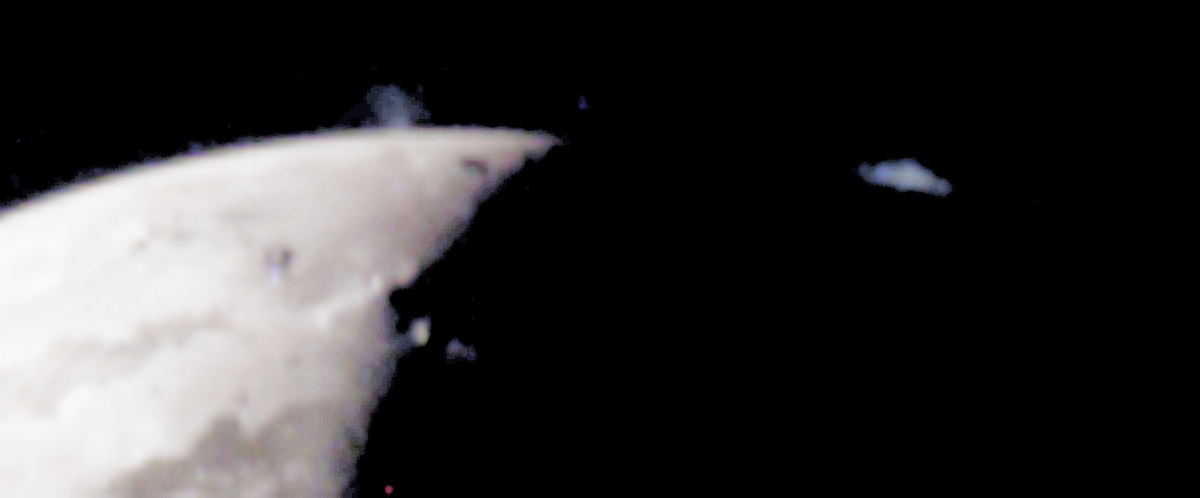
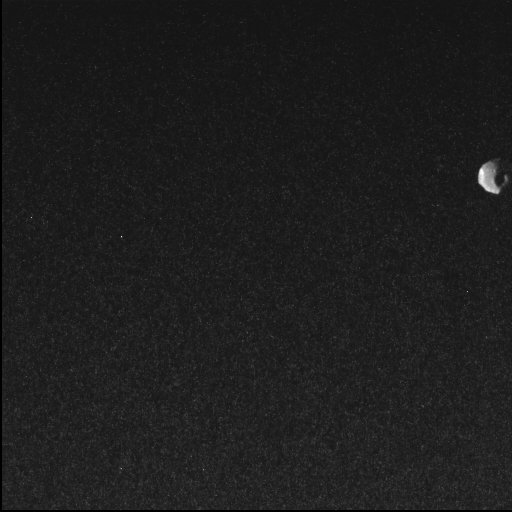
Though the Jupiter orbiter Juno is in its final orbits as it is running out of fuel, on May 1, 2026 it did a close fly-by of the 50 by 72 mile-wide Jupiter moon Thebe, getting within 3,100 miles.

The picture to the right, cropped and expanded to post here, is the best image released from that fly-by. It is very comparable to a photo taken by the Galileo orbiter on January 4, 2000. Both show the very large crater, dubbed Zethus.

The picture was taken by Juno’s Stellar Reference Unit (SRU) camera, designed not to do science but to “image star fields for navigation.” Thus, the picture is somewhat fuzzy, and was pointed poorly so the moon is on the far right, almost off camera.

It is very unclear how much longer Juno will function. It has apparently survived attempts by the Trump administration to zero out its operating budget, but there have been indications that its fuel supply is low.

8 comments

Juno data suggests lightning on Jupiter is a hundred to a million times more powerful than lightning on Earth

The uncertainty of science: Using data from the orbiter Juno as it passed multiple times above a storm on Jupiter, scientists now believe lightning bolts on Jupiter could be a hundred to a million times more powerful than lightning bolts on Earth.

Juno made 12 passes over isolated storms during that period, and was close enough on four of them to measure microwave static from lightning. The flashes averaged three per second during these passes; on one flyover, Juno detected 206 separate pulses of microwave radiation. Of a total of 613 pulses measured, Wong calculated that the power ranged from about that of a lightning bolt on Earth to 100 or more times the power of an Earth bolt. Because he compared Earth lightning emissions at one radio wavelength to Jupiter lightning emissions at a different wavelength, there’s some uncertainty in the comparison, Wong cautioned. Based on one study of lightning radio emissions on Earth, Jupiter’s bolts could have been a million times more powerful than those on Earth.

Lots of uncertainty and assumptions in these conclusions, but they are not only not surprising, they fit earlier data collected before Juno.

9 comments

The auroras of Jupiter and Ganymede

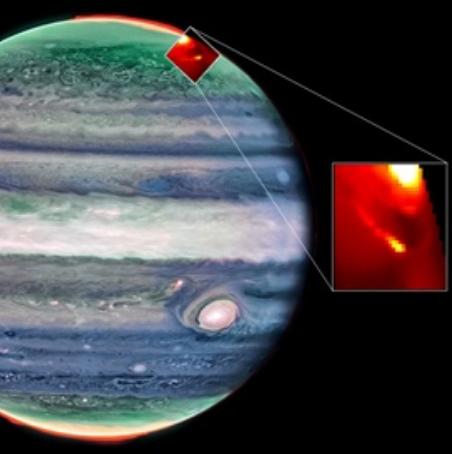
According to two different university press releases in the past month, new details have been discovered about the auroras found on Jupiter as well as its largest moon, Ganymede, caused by the interaction of Jupiter’s powerful magnetic field not only with Ganymede’s weak one but with the motion of all four Galilean moons as they orbit the gas giant.

The first study used data from Juno when it made a close fly-by of Ganymede in 2021. It not only showed how the aurora was caused by interaction between the magnetic fields of Jupiter and Ganymede, it found that Ganymede’s auroras were similar to those on Earth.

Similar structures, known as ‘beads’, have been observed in the auroras of Earth and Jupiter, where they are linked to sub-storms and dawn storms, large-scale rearrangements of the magnetosphere that release enormous amounts of energy and produce intense auroral activity,” explains Alessandro Moirano, post-doctoral researcher at LPAP.

Ganymede interacts with Jupiter’s space environment in a similar way to how Earth interacts with the solar wind; therefore, the discovery of auroral patches on Ganymede similar to those on Earth suggests that the fundamental physical process(es) could be generally induced in the coupling between any celestial body, its magnetosphere, and external forces.
The aurora's on Jupiter
The auroral footprints of Io and Europa
on Jupiter

The second study, released yesterday, used the Webb Space Telescope to a get a more detailed look at Jupiter’s auroras, caused as the four Galilean moons — Io, Europa, Ganymede, and Callisto — travel through Jupiter’s powerful magnetic field, causing energetic particles to following Jupiter’s magnetic field lines down to its poles, there creating the auroras.

Webb’s data found that the auroral footprints on Jupiter caused by each moon were different from Jupiter’s own aurora.

However, the footprints created by Io and Europa, did not have the characteristics expected from Jupiter’s main aurora, which contains a lot of hot material. Instead, in one snapshot, they discovered a cold spot within Io’s auroral footprint that registered temperatures much lower than expected, with extraordinarily high densities.

As the data was limited to a single 22-hour window, the results are very uncertain. More observations are planned, covering a longer time period, to see if this phenomenon can be captured again.

All of these results are very tantalizing, but to really get a handle on what is going on will require continuous observations over years, from many spacecraft devoted exclusively to Jupiter. And that isn’t going to happen for quite some time.

0 comments

Dumb science: Researchers claim Jupiter is 0.0028% thinner than previously measured

Stupidity on display: According to researchers using data from the Jupiter orbiter Juno, Jupiter is a tiny bit thinner at the equator and flatter at the poles than previously measured.

Leading an international team from Italy, the United States, France and Switzerland, Weizmann Institute of Science researchers [Israel] have produced more precise measurements of Jupiter’s size and shape than ever before, using new data from NASA’s Juno spacecraft.

The peer-reviewed research, published today in Nature Astronomy, shows that the radius of Jupiter is about four kilometers (2.5 miles) thinner at its equator and 12 kilometers (7.5 miles) flatter at the poles than believed in earlier assessments. The scientists determined the planet has a radius of 71,484 kilometers (44,418 miles). Earlier data measured it at 71,492 kilometers (44,423 miles).

The absurdity of this research is galling. The revision they claim is tiny, a mere 0.0028% difference at the equator, and 0.0084% at the poles. These numbers are insignificant. Moreover, Jupiter is a gas giant. It has no precisely known surface. Instead, it has an atmosphere that gradually thins as you go up. To claim any precise diameter is absurd, especially because seasonally and over time that atmosphere will expand and shrink.

And of course, at least two mainstream news outlets, Scientific American and The Times of Israel (linked above), report this story without any skepticism, as if this is a Earth-shaking discovery. All that tells me is that when it comes to science, both are incompetent sources of information.

7 comments

Scientists produce new estimate of the thickness of Europa’s icy crust

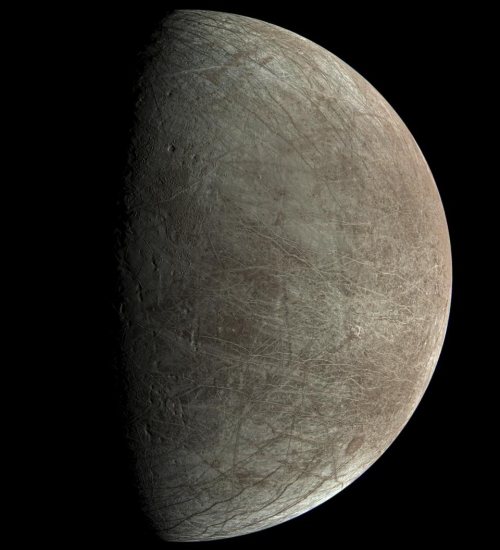
Europa in true color
Europa in true color, taken by Juno during that
September 2022 fly-by
. Click for full image.

Using data produced by Juno during a 2022 close-fly of Jupiter’s moon Europa, scientists have made a new estimate of the thickness of Europa’s icy crust, approximately 18 miles thick with a 6-mile margin of error.

In other words, their estimate could be as small as 12 miles thick, or as large as 24 miles thick.

You can read their paper here. From their abstract:

For the idealized case of pure water ice, the data are consistent with the existence of a thermally conductive ice shell with a thickness of 29 ± 10 km [18 ± 6 miles] and with the presence of cracks, pores or other scatterers extending to depths of hundreds of metres below the surface with a characteristic size smaller than a few centimetres in radius. An ice-shell salinity of 15 mg kg−1, as indicated by models based on terrestrial marine ice, would reduce our estimate of the thickness of the ice shell by about 5 km, substantially less than our 10 km uncertainty. The low volume fraction, small size and shallow depth of the scatterers indicate that the fracture interfaces observed at Europa’s surface are alone unlikely to be capable of carrying nutrients between the surface and the ocean. [emphasi mine]

The highlighted sentence is the important one. If this new estimate is right, than the unidentified reddish material that appears to leak out of the long ridgelike cracks on Europa’s surface, clearly visible in the picture to the right, are not coming from any underground ocean. The distances are too large.

Other estimates have suggested that ice crust could be as thin as 2 miles, but like this research the uncertainties are very large.

Meanwhile, the Juno mission is still alive, though essentially winding down operations. The mission was expected to officially end at the end of September 2025, when its budget ran out, but the just passed budget included enough money to keep it going, albeit at a relatively low level. According to the orbiter’s webpage, it will continue to orbit Jupiter, its orbit degrading naturally until it falls into Jupiter to burn up. As it does so data will continue to be collected, though at a much lower rate.

7 comments

The Juno mission at Jupiter is almost certainly over

An article yesterday at Space.com speculated that the Juno mission to Jupiter is likely over, but added that we cannot yet be sure because the government shutdown has prevented NASA from making any definitive announcement.

NASA’s management had previously extended the orbiter’s mission several times, with the last extension going until the end of the 2025 fiscal year, that ended on September 30, 2025. No new budget has yet been approved, and the proposed Trump budget had included no money for extending the mission farther.

Due to the government shutdown, NASA is currently unable to say whether Juno is still operating or already powered down. At the time of publication, responses from agency officials state that “NASA is currently closed due to a lapse in government funding … Please reach back out after an appropriation or continuing resolution is approved.”

Under shutdown rules, only missions that fall under “excepted activities” — those required to protect life, property, or national security — can continue operations or communications. NASA’s continuity plans also specify that carryover funding may only be applied to “presidential priorities,” which limits what science programs can proceed during a lapse.

Juno does not fall into those protected categories, and was also zeroed-out on the President’s fiscal year 2026 budget request — making the mission, presumably, not a priority. So, until normal government operations resume, the spacecraft’s future is uncertain.

I think Juno’s future at this point is not uncertain in the least. While other active missions that the Trump proposed shutting down might get revived, Juno is unlikely to be one of them. I suspect the science team has put it in hibernation, and is already beginning to move on to other projects and work. They are being coy about this in the faint hope Congress will save Juno, but this should not be a priority. At this point I think NASA would be wiser to spend its resources elsewhere.

2 comments

House committee support for threatened NASA missions is actually quite questionable

According to a House appropriations committee spending bill that it approved this week, it appears on the surface that it is canceling the proposed 24% cut by Trump to NASA’s budget as well as endorsing continued funding for some threatened missions. A close look however suggests this congressional support for NASA is somewhat superficial, and might actually be ephemeral.

The key is the language of the bill. From the link above:

The bill was largely unchanged from what the CJS [commerce, justice and science] subcommittee approved July 14. It includes $24.838 billion for NASA, nearly the same as the $24.875 billion the agency received in fiscal 2024 and 2025, and far above the $18.8 billion the administration proposed for fiscal 2026 in May.

Members adopted a manager’s amendment, a package of noncontroversial changes and corrections, on a voice vote. That amendment also made additions to the report accompanying the bill. The report includes language expressing support for several NASA missions targeted for cancellation, including the Chandra X-ray Observatory, the Juno mission at Jupiter and the New Horizons mission in the Kuiper Belt.

The report does not specify funding levels for those missions, but the “continues support” language signals to NASA that it should fund continue operations within the agency’s science budget. [emphasis mine]

It is the vagueness of this language that suggests the support is ephemeral. The courts recently have consistently ruled that if Congress doesn’t specifically mandate spending on a project, the White House is free to move money around as it sees fit. By not expressly outlining funding for Chandra, Juno, and New Horizons, these congressmen are playing a shell game, whereby to their constituents they can point to this vote and claim they wholeheartedly supported NASA and these missions. At the same time, they also appear to be allowing Trump the freedom to go ahead and shut the missions down, as his budget has already proposed.

None of this is yet real. The bill still must be passed by the full House, as well as the Senate. It then has to be signed by Trump. A lot of changes would happen in that process.

Either way, it appears that within the House at least, there is some movement to at least make some budget cuts possible. The sad thing is that the House is not actually cutting the budget, even as it is allowing Trump a way to cut these relatively inexpensive on-going missions. Considering the debt, it would have been much better had the committee actually trimmed NASA’s budget, even a little, while at the same time allocating specific funds to keep these very cost-effective missions alive.

6 comments

Juno detects the aurora of the moon Callisto in Jupiter’s atmosphere

Though previous observations had detected auroras on Jupiter produced by three of its four Galilean moons — Io, Europa, and Ganymede — scientists had until now been unable to detect a similar aurora produced by the fourth, Callisto.

The Jupiter orbiter Juno finally accomplished this observation for the first time.

[T]o image Callisto’s footprint, the main auroral oval needs to move aside while the polar region is being imaged. And to bring to bear Juno’s arsenal of instruments studying fields and particles, the spacecraft’s trajectory must carry it across the magnetic field line linking Callisto and Jupiter.

These two events serendipitously occurred during Juno’s 22nd orbit of the giant planet, in September 2019, revealing Callisto’s auroral footprint and providing a sample of the particle population, electromagnetic waves, and magnetic fields associated with the interaction.

The research paper describing this detection has just been published.

These secondary auroras are caused by Jupiter’s powerful magnetic field.

The Juno mission itself is about to end. NASA did not approve a mission extension, and next month the science team will send the spacecraft into Jupiter’s atmosphere, where it will burn up. We will then have to wait five years for Europa Clipper to arrive in Jupiter orbit, followed a year later by Europe’s Juice orbiter.

While the propaganda press is condemning this decision, there is some logic to it. Juno has mostly completed its work. While new knowledge can certainly be gained if it remained operations for three more years, the amount of knowledge will be relatively small. And NASA does face a budget crunch. Better to spend its money on other things that can produce more bang to the buck.

3 comments

Sending Juno to fly past interstellar comet 3I/Atlas?

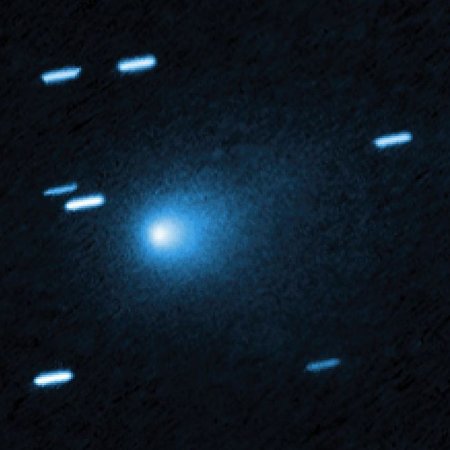
3I/Atlas as seen by Hubble on July 21, 2025
Hubble’s most recent image of comet 3I/Atlas.
Click for original image.

It’s all clickbait! In what appears to be an example of silliness, a scientist, Avi Loeb of Harvard, has proposed repurposing the Jupiter orbiter Juno by using its remaining fuel and its main engine (unused since 2016 because it is feared it will explode if ignited) to send the spacecraft on a path allowing it to fly past the interstellar comet 3I/Atlas that is presently zipping through out solar system.

Not surprisingly, a politician, congresswoman Anna Paulina Luna (R-Florida), immediately latched onto this idea to garner her own publicity.

Loeb believes Juno, which is scheduled to plunge into Jupiter’s atmosphere at the end of its mission in Sept. 2025, could be repurposed. He suggests using its remaining fuel to redirect it toward 3I/ATLAS when the object passes within about 34 million miles of Jupiter in March 2026.

Florida Congresswoman Anna Paulina Luna has backed the proposal in a letter [pdf] to interim NASA Administrator Sean Duffy, urging the agency to explore extending Juno’s mission. “It is recommended that NASA conduct a study to assess how much fuel is left in Juno’s engine, and I support an extension of the Juno mission at least until mid-March 2026 at a cost of about $15M per 6 months from the current expiration date of mid-September 2025,” Luna wrote.

The problem with this idea is that it isn’t realistic. Juno really doesn’t have sufficient fuel, and as I mentioned, its main engine is suspect, so suspect that the science team decided in 2016 to never use it again, thus leaving Juno in a higher than planned orbit that required twice as much time at Jupiter to get the same work done.

There is also one more reason to doubt Loeb’s proposal. He has also proposed that 3I/Atlas is an alien probe, ignoring or dismissing the images and data that make if very clear that it is nothing more than a comet, albeit interstellar in origin. It appears therefore that he might very well represent the quality of scientists that Harvard is hiring these days.

22 comments

Juno enters and then recovers from safe mode

During its most recent close fly-by of Jupiter on April 4, 2025 — its 71st — the orbiter Juno went into safe mode two different times, causing its science instruments to shut down.

The mission operations team has reestablished high-rate data transmission with Juno, and the spacecraft is currently conducting flight software diagnostics.The team will work in the ensuing days to transmit the engineering and science data collected before and after the safe-mode events to Earth.

Juno first entered safe mode at 5:17 a.m. EDT, about an hour before its 71st close passage of Jupiter — called perijove. It went into safe mode again 45 minutes after perijove. During both safe-mode events, the spacecraft performed exactly as designed, rebooting its computer, turning off nonessential functions, and pointing its antenna toward Earth for communication.

Since arrival in its present Jupiter orbit in 2016 Juno has operated almost perfectly, having experienced only two other safe mode events, once in 2016 and a second in 2022. The two recent events on this most recent fly-by suggest however that the harsh environment surrounding Jupiter might be beginning to impact the spacecraft.

1 comment

Juno data proves volcanism on Io involves numerous lava lakes

The lava lakes of Io
A global map of Io’s lava lakes. Click for original figure.

Based on data and imagery produced by the Jupiter orbiter Juno as it made a series of fly-bys of the moon Io from 2022 to 2024, scientists have now mapped at least 40 lava lakes amid the numerous volcanoes on the planet. The map above, figure 2 of the paper, shows their location and approximate relative size across Io’s surface. From the paper’s abstract:

Recent observations from the Juno spacecraft have revealed at least 40 lava lakes on Io, one of Jupiter’s moons, using the JIRAM (Jovian InfraRed Auroral Mapper) imager. Most of the large depressions on Io, known as paterae, show signs of heat, indicating that lava lakes are common. The lava lakes vary in size from 10 to 100 km in diameter and have a thin crust, about 5–10 m thick, that appears to be a few years old. The heat observed mainly comes from the larger crust, not the small exposed lava, so it is hard to measure the total heat output from just the thermal data. Additionally, eight of these lava lakes are new discoveries and were not previously known as active hotspots.

One aspect of these lakes found repeatedly in this new data is that their lava appears to rise and fall as a unit, as if the lake’s floor bed acts like a huge piston pushing the whole lake up and down from below, rather than lava entering in or draining out from a central vent. This conclusion appears to settle the debate between these models for explaining why the lava almost never rises high enough to pour out from the lake. Instead, the lakes themselves appear to be stable features, not volcanic calderas from which lava flows to build a mountain.

0 comments

Juno detects the largest volcanic event on Io yet

Changes on Io since April 2024
Changes on Io since April 2024. Click for original image.

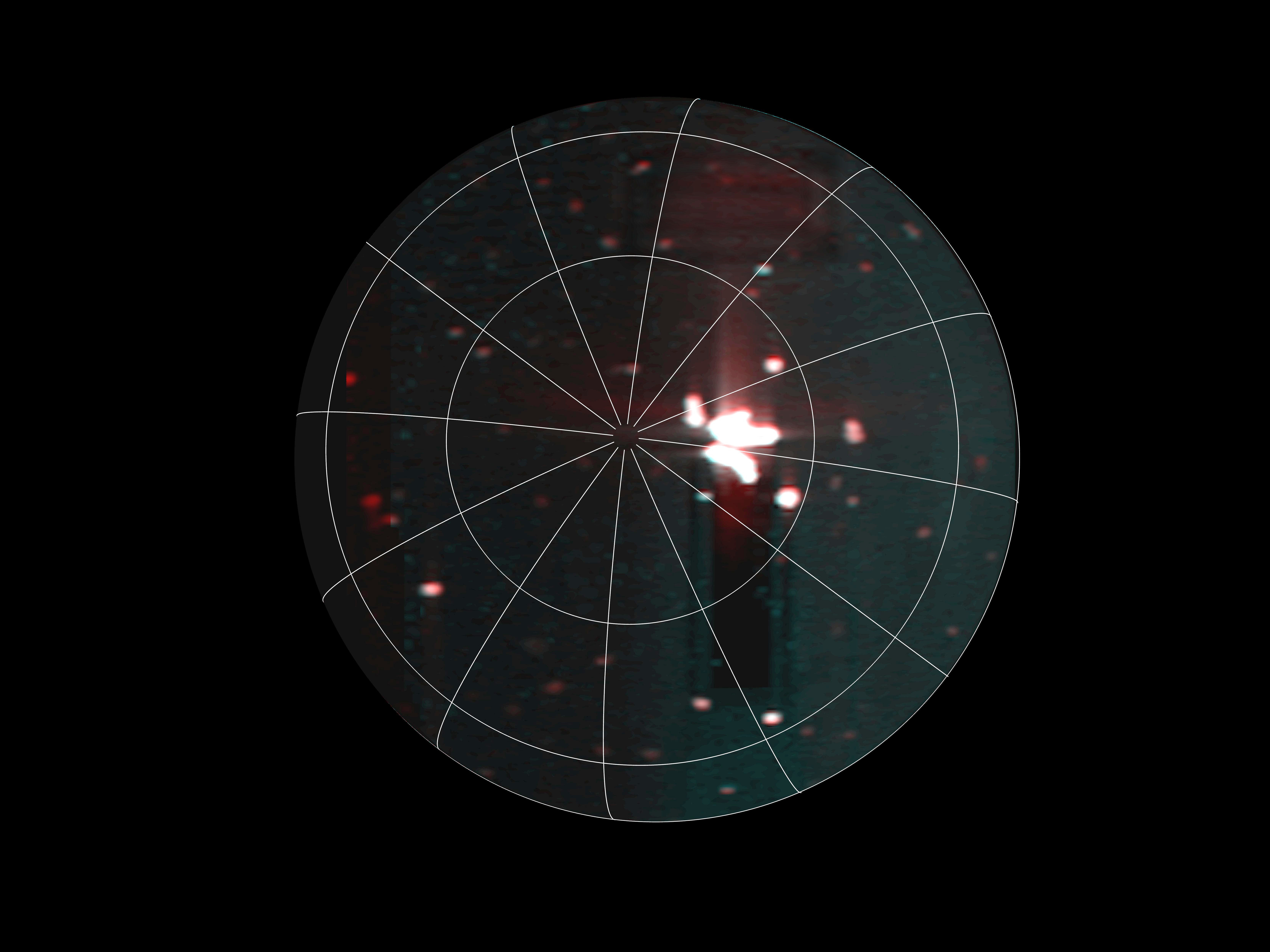
Infrared detection of volcanic hot spot
Infrared detection of volcanic hot spot.
Click for original image.

Using Juno’s Italian JIRAM infrared instrument image as well as its optical camera, scientists have detected what appears to be the largest volcanic event yet measured on the Jupiter moon Io, covering an area larger than Lake Superior,

Scientists with NASA’s Juno mission have discovered a volcanic hot spot in the southern hemisphere of Jupiter’s moon Io. The hot spot is not only larger than Earth’s Lake Superior, but it also belches out eruptions six times the total energy of all the world’s power plants.

…The JIRAM science team estimates the as-yet-unnamed feature spans 40,000 square miles (100,000 square kilometers). The previous record holder was Io’s Loki Patera, a lava lake of about 7,700 square miles (20,000 square kilometers). The total power value of the new hot spot’s radiance measured well above 80 trillion watts.

The pictures above were taken by Juno’s optical camera during the last three close flyby’s, looking down at the south pole, with the red arrows indicating the change to the pole’s right during each pass. The infrared image to the right shows a similar view during the fly-by, and shows that same hot spot as the bright area to the pole’s right.

Juno will do another fly-by of Io in March, though from a greater distance. Scientists plan to use both instruments to see how this hot spot has changed again since the end of December.

0 comments

Juno spots changes on Io’s surface in just a two-month span

Before and after images by Juno of volcanic ring on Io
Click for original image.

New photos taken just two months apart by Juno of a region dubbed Nusk Patera on the Jupiter moon Io showed the appearance of a distinct ring that had hardly been there before.

The pictures, taken during two recent fly-bys of the moon, are above, and show the change. From the caption:

A red ring formed around Nusku Patera in the two months between the spacecraft’s 58th flyby on Feb. 3, 2024, and its 60th on April 9, 2024. The ring obscures some nearby features like Creidne Patera. This ring, 683 miles (1,100 kilometers) wide is likely from a Pele-type plume rich in sulfur. Similar transient red rings were observed by NASA’s Galileo mission around Grian Patera and Surt and were associated with intense but short-lived thermal “outburst” eruptions.

In other words, sulfur from eruption from the central vent/caldera was flung into the sky enough that when it eventually settled back down it landed in a ring about 340 miles away from the center.

Other data from Juno, also released this week here and here, detected fresh lava flows at another volcanic region of Io dubbed, Zal Patera.

0 comments

Io’s volcanoes get their lava from separate magma chambers, not a global underground ocean of magma

Io's interior as presently theorized
Click for original animation.

Using data collected from Juno’s multiple fly-bys of the Jupiter moon Io, scientists now hypothesize that the moon does not have a global underground ocean of magma, feeding its many volcanoes, but that instead each volcano is fed its lava from a separate magma chamber.

The graphic to the right illustrates the present conclusion. You can read the paper here [pdf]. From the press release:

The Juno team compared Doppler data from their two flybys with observations from the agency’s previous missions to the Jovian system and from ground telescopes. They found tidal deformation consistent with Io not having a shallow global magma ocean.

“Juno’s discovery that tidal forces do not always create global magma oceans does more than prompt us to rethink what we know about Io’s interior,” said lead author Ryan Park, a Juno co-investigator and supervisor of the Solar System Dynamics Group at JPL. “It has implications for our understanding of other moons, such as Enceladus and Europa, and even exoplanets and super-Earths. Our new findings provide an opportunity to rethink what we know about planetary formation and evolution.” [emphasis mine]

The highlighted words indicate the significance of this data. It possibly suggests that the underground oceans of water that have been theorized for these other moons — where life could possibly exist — might be mistaken. Instead, they might have smaller pockets of water, similar to Io’s many magma chambers.

Everything here however is uncertain, including these new conclusions about Io. We just don’t have enough data from any of these moons to make any definitive conclusions.

0 comments

A map of Io’s hot spots based on Juno data

The hot spots on Io
Click for original image.

The uncertainty of science: Using the JIRAM infrared camera on the Jupiter orbiter Juno, scientists have now created a global map of volcanic activity, showing where it appears the hottest and greatest activity is located.

That data is illustrated by the graphic to the right, taken from figure 1 of the paper. The top row shows the coverage of the planet, with Io’s southern hemisphere getting the fewest observations. The bottom row shows the observed regions with the greatest heat. This quote from the abstract is most revealing:

Using JIRAM, we have mapped where volcanoes are producing the most power and compared that to where we expect higher heat flow from the interior models. Our map doesn’t agree with any of these models very well. JIRAM observed more volcanic activity at the poles than we expected to see based on previous observations. However, since the south pole was only observed twice, it’s possible that these observations don’t represent the average volcanic activity of the south pole. Very bright volcanoes that may have been continuously active for decades were also imaged during these Juno fly-bys, some of which are nearer the poles than the equator.

The conflict between the data and the theories could very well be explained simply by the short term nature of these observations. The models could very well be right, over centuries. For example, the new volcano discovered by Juno is near the equator, suggesting with time those models will turn out to be correct.

Or not. A lot more observations will have to be made of Io before any model of its volcanic activity can be considered trustworthy.

0 comments

Juno discovers new volcano on Io

New volcano on Io
Click for original image.

By comparing images taken twenty-seven years apart by the the Jupiter orbiters Galileo and Juno, scientists have discovered that during that time a new volcano appeared on the volcano-strewn Jupiter moon Io.

The two pictures to the right show the surface change on Io during those 27 years.

Analysis of the first close-up images of Io in over 25 years, captured by the JunoCam instrument on NASA’s Juno mission, reveal the emergence of a fresh volcano with multiple lava flows and volcanic deposits covering an area about 180 kilometres by 180 kilometres. The findings have been presented at the Europlanet Science Congress (EPSC) in Berlin this week.

The new volcano is located just south of Io’s equator. Although Io is covered with active volcanoes, images taken during NASA’s Galileo mission in 1997 did not see a volcano is in this particular region – just a featureless surface.

If anything, it has been somewhat surprising how little change the new Juno images have found on Io’s surface, considering its intensely active volcanic geology, with volcano plumes from eruptions captured in images repeatedly. Some volcanoes have shown change, but new features such as this new volcano have not previously been identified.

At the same time, the amount of high resolution imagery of the planet’s surface has been somewhat limited. Galileo sent back far fewer pictures than planned because its main antenna never deployed, and Juno had only a handful of close fly-bys. It will take a mission dedicated to studying Io to better map its violent surface.

1 comment

Juno infrared data confirms existence of at least eleven lava lakes on Io

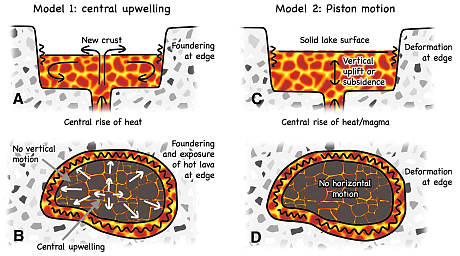
Cartoon describing Io's lava lakes
Click for original image.

Using infrared data from the Jupiter orbiter Juno, obtained during a close fly-by in May 2023 of the moon Io, scientists have identified what appear to be at least eleven active lava lakes, all filled with liquid magma under a surface crust and having a stable perimeter that apparently does not overflow the rim.

You can read the research paper here. The graphic to the right is figure 6 from the paper, describing two models for explaining why the lava in these lakes never rises high enough to pour out.

Unlike the April fly-by, which got as close as 10,777 miles and produced some amazing imagery, the May fly-by only got within 22,000 miles, but its course allowed Juno’s infrared instruments to collect good global data for six hours.

The JIRAM data reveal a common set of thermal characteristics for at least ten patera, with bright “thermal rings” around the perimeter of their floors. Loki, Surt, Fuchi, Amaterasu, Mulungu, Chors, and Dazhbog paterae, two unnamed paterae (here referred to as UP1 and UP2), and two other potential additional paterae (not discussed further because the spatial resolution is poor), all show the same pattern of surface temperatures.

That data suggested that each patera was a hot lava lake, with a stable rim in which little magma ever overflowed. As the scientists conclude in their paper, “Present findings highlight Io’s abundant lava reserves, resembling lava lakes on Earth in some ways, yet distinctly different from any other phenomena observed in the Solar System.” The scientists also note that no missions are being planned right now to get a better look at Io.

0 comments

Juno looks down at Jupiter

Jupiter as seen by Juno on May 12, 2024
Click for original image.

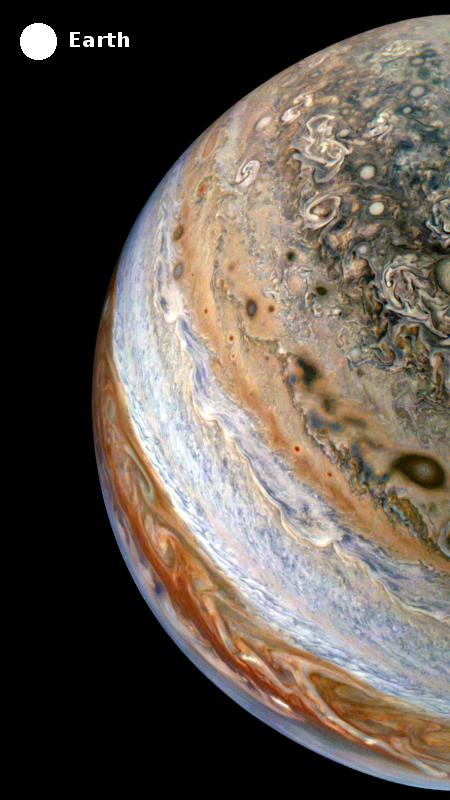
Cool image time! The picture to the right, rotated, reduced, and annotated to post here, was taken on May 12, 2024 by the camera on the Jupiter orbiter Juno during its most recent close-fly of the gas giant, its sixty-first since it arrived in 2016. The picture was snapped when Juno was about 34,674 miles away from Jupiter as it flew over the northern hemisphere.

Citizen scientist Thomas Thomopoulos then took that raw image and enhanced and enlarged it to bring out the storm details. You can see the distinct bands that cut across Jupiter’s equatorial and mid-latitudes. The reddish band is where the Great Red Spot is located, though that spot is not seen in this picture.

As we move north those bands slowly transition into the chaotic storms of the polar regions, which also circle the pole but do not form bands.

For scale I have added a circle that approximates the Earth’s size in comparison to Jupiter. You will notice that some of those polar storms are as big if not bigger than the Earth itself. To think we presently have any real understanding of the processes that create Jupiter’s climate and weather systems is to be arrogant beyond belief.

Fortunately, the scientists who study Jupiter are not that arrogant, though they often can’t admit it and are forced to sound otherwise when ignorant journalists and NASA managers demand more answers from them then are possible. The scientists understand that what makes pictures like this intriguing is not what it tells us but the amount of ignorance it reveals. To get funding for future research however sometimes requires they sound more knowledgeable than they are.

10 comments

Io on Juno’s 60th close fly-by of Jupiter

Volcano Plumes on Io
Click for original image.

Io as seen by Juno
Click for original image.

The photos above and to the right were both taken by Juno during its 60th close fly-by of Jupiter on April 9, 2024. The image above, cropped slightly to post here, was processed by citizen scientist Gerald Eichstädt, who states the following:

The stretched and enlarged crop is derived from a reprojected Io image with a margin of 100 km greater than Io’s nominal radius. Two plumes are obvious. The plume on the night siide is visible in several frames of the PJ60 Io sequence.

That Juno captures plumes like this on every close fly-by tells us the extent of activity that is on-going on the moon. Basically, eruptions are continuous and never ending.

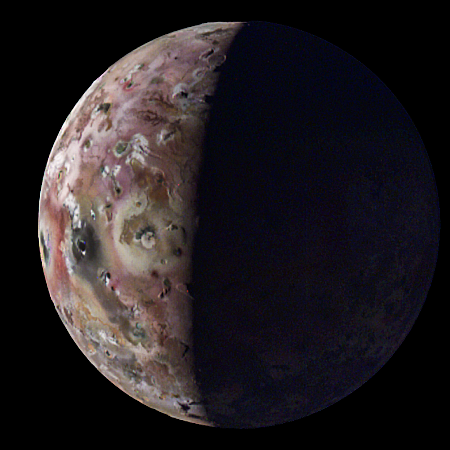
The image to the right, reduced and sharpened to post here, was processed by Eichstädt and enhanced by citizen scientist Thomas Thomopoulos. It gives us a global view of Io’s many volcanoes and flood lava plains.

During that 60th fly-by Juno’s closest approach to Io was 10,778 miles. Though close, this is not as close as the approach of 930 miles during the 57th and 58th fly-bys. Nor will future fly-bys be as close again. This is essentially Juno’s last close look at the volcano world.

2 comments

Scientists: Europa produces oxygen on its surface, but less than expected

Graphic of Europa
Click for original image.

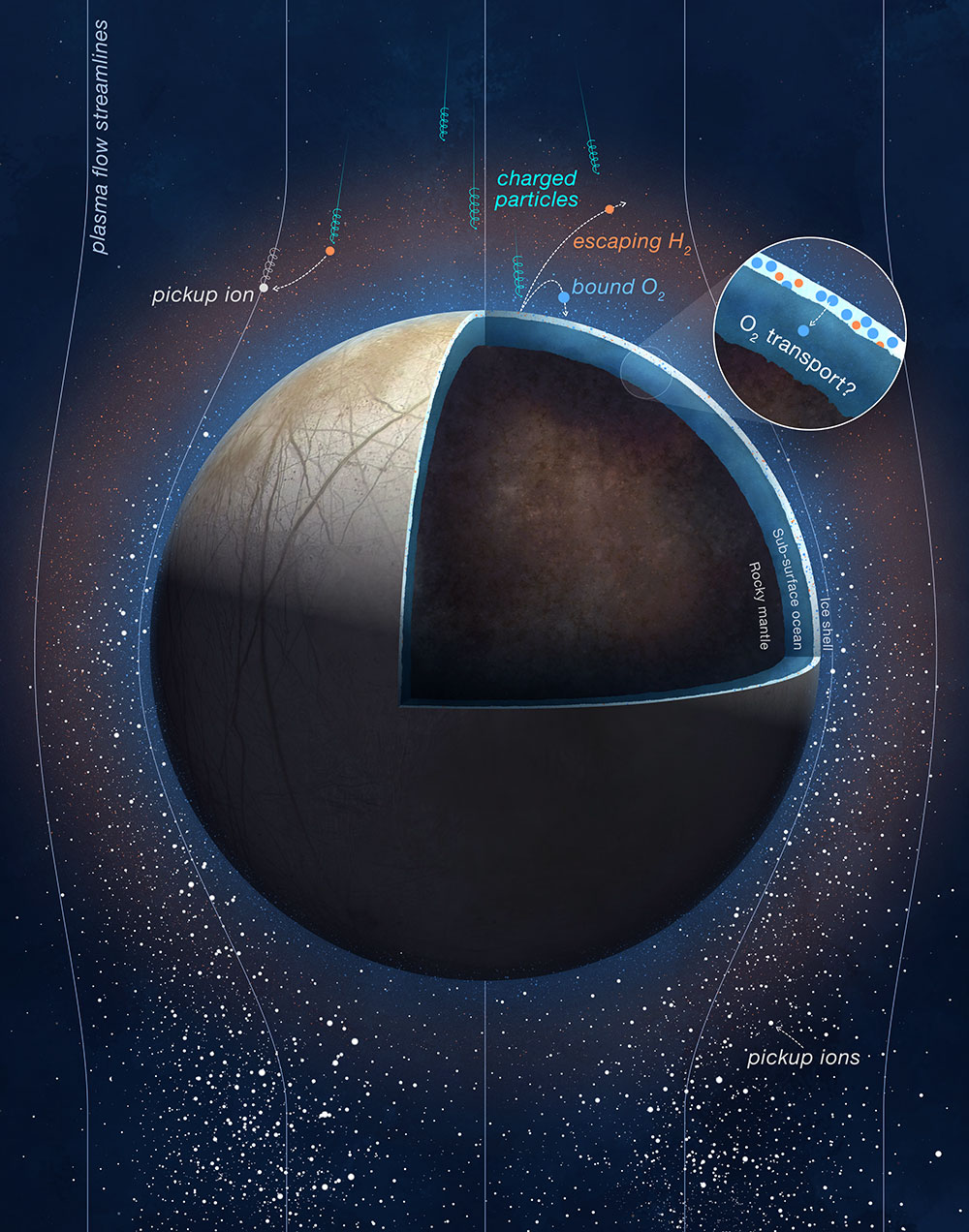
The uncertainty of science: Scientists using data from a 2022 flyby of the Jupiter moon Europa by the orbiter Juno have determined that the moon produces about 1,000 tons of oxygen every 24 hours on its surface, a large amount but less than most predictions based on previous indirect observations.

The paper’s authors estimate the amount of oxygen produced to be around 26 pounds every second (12 kilograms per second). Previous estimates range from a few pounds to over 2,000 pounds per second (over 1,000 kilograms per second). Scientists believe that some of the oxygen produced in this manner could work its way into the moon’s subsurface ocean as a possible source of metabolic energy.

You can read the paper here. The graphic shows the basic process, as presently theorized. What remains unknown is how or even if that oxygen is transported downward to the theorized underground ocean of liquid water. That the amount created is on the very low end of previous estimates suggests that there will be less free oxygen to support life in that ocean than expected.

2 comments
1 2 3 9