The volcanic world of Io, as seen by Juno in all its fly-bys
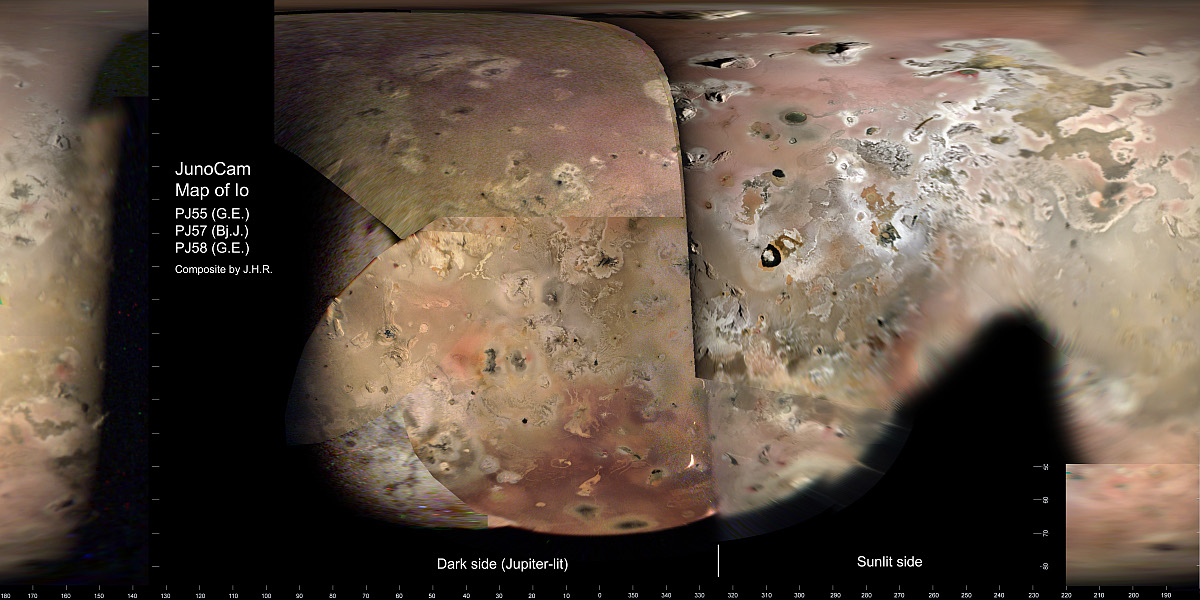
Map of Io
Click for full resolution image.

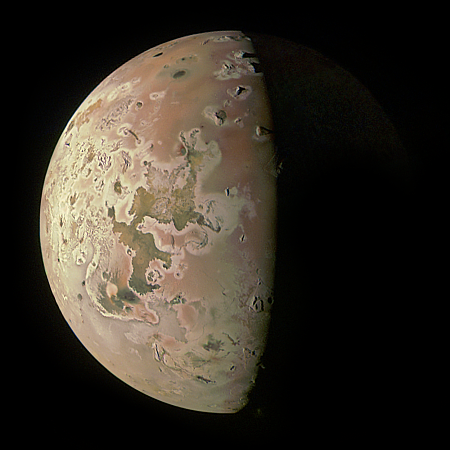
The mosaic of images above, reduced and sharpened to post here, was compiled by citizen scientists Gerald Eichstädt, Jason Perry, and John Rogers from images taken of the Jupiter moon Io during the three close fly-bys by the orbiter Juno that occurred during its 55th, 57th, and 58th orbits. From the caption:

Global map of Io by JunoCam, combining maps from PJ55, PJ57 and PJ58. Both the sunlit side and the Jupiter-lit-dark side are included. PJ55 map by Gerald Eichstädt; PJ57 map by Jason Perry; PJ58 map by Gerald Eichstädt and John Rogers. Some scaling and shifting was performed in order to align the maps with each other and with the USGS Voyager/Galileo map. Colours were adjusted for better compatability. –John Rogers.

A labeled version, showing the names of many volcanoes but only of the areas photographed during the most recent 58th orbit fly-by on February 3, 2024, can be seen here.

As Juno’s later fly-bys will be progressively farther away, we will no longer get better views of Io until another spacecraft arrives in a Jupiter orbit capable to returning to Io, possibly decades from now. Though Europa Clipper will arrive in Jupiter orbit April 2030, that orbit is designed to repeatedly fly close past Europa, and will likely never get close to Io.

Thus, this map provides a baseline for determing any changes that occur on Io in the coming years.
0 comments

Juno completes its closest approach of the Jupiter moon Io

Io on February 3, 2024
Click for full image.

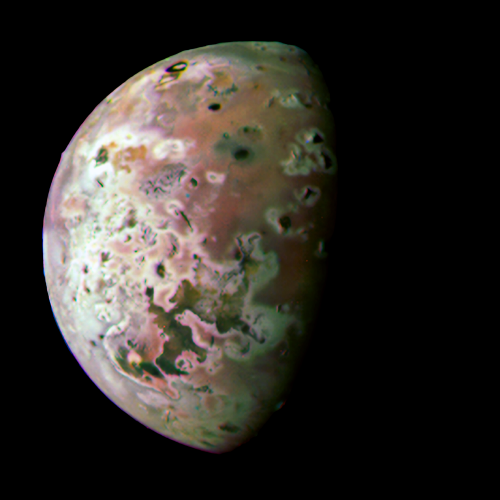
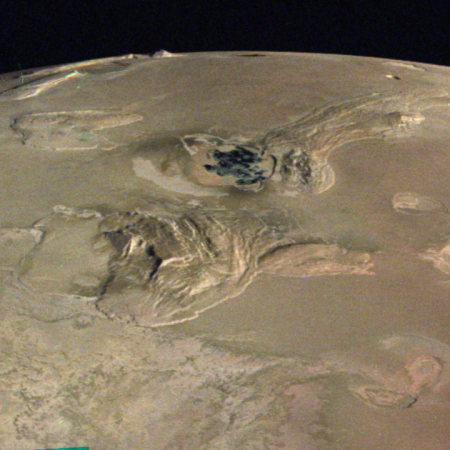
The Jupiter orbiter Juno successfully completed its 58th close fly-by of the gas giant, during which it also made its closest approach to the volcanic moon Io, zipping past at a distance of 932 miles. The image of Io to the right, cropped and reduced to post here, was taken at that closest Io approach, and shows a mountain on the horizon as well as a large shield volcano in the center (the dark splotch), with a major lava flow to the south. The picture was processed by citizen scientist Brian Swift.

Another image, processed by Björn Jónsson, shows the differences at one volcano dubbed Loki between the December 30, 2023 and the February 3, 2024 flybys. It appears that the brightness of the apron of lava that surrounds the volcano changes significantly depending on the lighting and the angle of view. In December it was almost black. In February it was greyish silver, almost shiny.

Another image, processed by Andrea Luck, captured faint eruption plumes on Io’s edge, caused by an ongoing eruption just beyond the horizon.

Juno still has four more flybys of Io coming up, but none will be as close as the February 3rd approach.

0 comments

The Surt volcano on Io

The Surt volcano on Io in close-up
Click for original image.

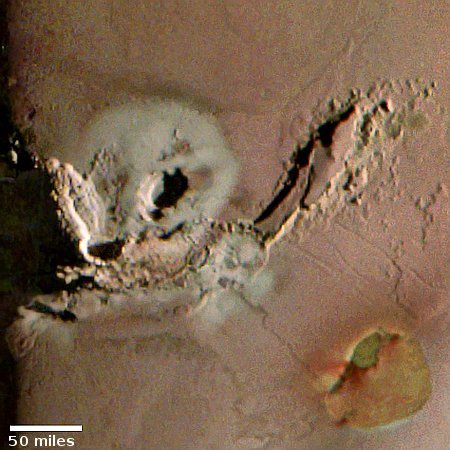
Cool image time! The picture to the right, rotated, reduced, and sharpened to post here, was taken by Juno during its 57th close-fly of Jupiter on December 30, 2023. It shows of one of the many volcanoes that cover and continually recoat the surface of the Jupiter moon Io.

The picture was initially processed by citizen scientist Gerald Eichstädt. Thomas Thomopoulos then zoomed in and added additional enhancements to this particular area. (I thank Thomas for his additional help in making this post happen.)

The location is an active volcano named Surt, which has been observed to erupt several times since the 1970s, with its February 2001 eruption the most powerful yet observed on Io, though the pictures by the Jupiter orbiter Galileo taken before and after revealed few significant surface changes.

The picture itself shows a region where major changes have definitely occurred. The large arc of mountains across the photo’s center suggests the remaining half of a large caldera, its northern half now either buried or destroyed. The deep obvious hole inside that crescent appears to be the main vent from which the recent eruptions have spewed, as indicated by the light-colored apron surrounding it.

In the southwest section of that large mountain arc is a distinct ridgeline with a small circular curve in its middle that suggests a former volcanic cone, its northern half now gone.

To put it mildly, Io appears a very alien place, shaped entirely and continuously by endlessly volcanic eruptions that spread lava across its entire surface repeatedly.

2 comments

First Juno images of Io from December 30th fly-by

Io as seen by Juno on December 30, 2023
For original global image go here. For original of inset go here.

The first raw Juno images taken of the Jupiter moon Io during its close fly-by on December 30, 2023, the closest in more than twenty years, have been released by the science team and citizen scientists have begun processing them.

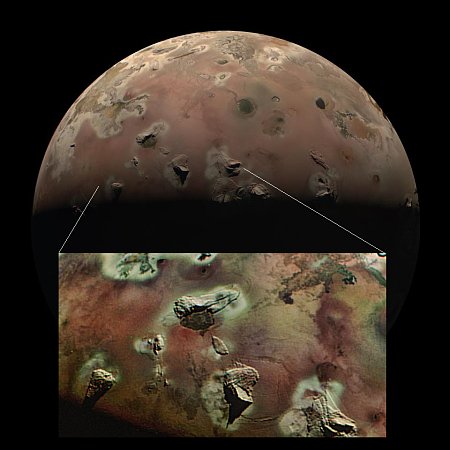
The global picture to the right, rotated and reduced to post here, was processed by Kevin Gill. The inset of the volcanic mountains near the terminator was processed by Thomas Thomopoulos. As he notes, to obtain better detail he enhanced the colors and image and then zoomed in.

In the inset, note the northeast flows coming off the two mountains near the center. With the lower mountain, this flow appears to lie on top of a larger flow that extended out almost to the mountain to the right.

Io is a planet of continuous volcanic activity. For example, when the global image above was taken, the plume of a volcano eruption was visible on the right horizon, as shown in this version, its exposure adjusted by Ted Stryk. Catching such eruptions on Io is not unusual, considering its continuous volcanic activity generated by the tidal forces the planet undergoes from its orbit around Jupiter. In fact, the very first plume was imaged in 1979 by Voyager 1 during its short fly-by, and proved a hypothesis of such activity that scientists had only published one week earlier.

2 comments

Juno’s closest image of Europa suggests recent surface activity

Juno's best image of Europa
Click for original image.

Analysis by scientists of the closest image of Europa taken during Juno’s close-fly on September 29, 2022 suggests that a particular strange feature, dubbed the “platypus” due to its shape, might be very young and indicate recent surface activity that could be related to underground liquid water.

That picture, reduced and sharpened to post here, is to the right. It is figure 2 of the paper. The description of this photo from the abstract:

Intricate networks of cross-cutting ridges and lineated bands surround an intriguing 37 km (east-west) by 67 km (north-south) chaos feature with a concentric fracture system, depressed matrix margins, and low-albedo materials potentially associated with brine infiltration. The morphology and local relief of the chaos feature are consistent with formation in the collapse of ice overlying a salt-rich lens of subsurface water. Low-albedo deposits, similar to features previously associated with hypothesized cryovolcanic plume activity, flank nearby ridges. The SRU’s high-resolution view of many types of features in a single image allows us to explore their regional context and greatly improve the geologic mapping of this part of Europa’s surface. The image reveals several relatively youthful features in a potentially dynamic region, providing baselines for candidate locations that future missions can investigate for present day surface activity.

SRU is Juno’s Stellar Reference Unit camera, designed to take pictures using only the low light of Jupiter reflected onto nighttime surfaces of Jupiter’s moons. It took this photo when Juno was only 256 miles above the surface.

This feature will obviously become a prime target for Europa Clipper when it arrives into orbit around Jupiter in April 2030. From this vantage point — safer than continuous exposure to Jupiter’s magnetosphere while in orbit around Europa — the spacecraft will do 44 close-flys of the moon.

0 comments

Scientists detect salts and carbon-based molecules on Ganymede

Ganymede as seen by Juno
A close-up image taken during the June 7, 2021
Juno fly-by of Ganymede Click for original image.

Using data obtained during a close fly-by of Ganymede by Juno in June 2021, scientists have detected evidence of salts and organic carbon-based molecules.

On June 7, 2021, Juno flew over Ganymede at a minimum altitude of 650 miles (1,046 kilometers). Shortly after the time of closest approach, the JIRAM instrument acquired infrared images and infrared spectra (essentially the chemical fingerprints of materials, based on how they reflect light) of the moon’s surface. Built by the Italian Space Agency, Agenzia Spaziale Italiana, JIRAM was designed to capture the infrared light (invisible to the naked eye) that emerges from deep inside Jupiter, probing the weather layer down to 30 to 45 miles (50 to 70 kilometers) below the gas giant’s cloud tops. But the instrument has also been used to offer insights into the terrain of moons Io, Europa, Ganymede, and Callisto (known collectively as the Galilean moons for their discoverer, Galileo).

The JIRAM data of Ganymede obtained during the flyby achieved an unprecedented spatial resolution for infrared spectroscopy – better than 0.62 miles (1 kilometer) per pixel. With it, Juno scientists were able to detect and analyze the unique spectral features of non-water-ice materials, including hydrated sodium chloride, ammonium chloride, sodium bicarbonate, and possibly aliphatic aldehydes.

The data indicated that the salts and organics were most concentrated in Ganymede’s equatorial regions, which are less impacted by Jupiter’s strong magnetic field. The scientists think these materials originally came from the brine of an underground ocean that somehow reached the surface, though this hypothesis remains unconfirmed.

0 comments

More Io images by Juno, enhanced by citizen scientists

Io in natural and enhance colors
Click here for original of top image,
here for bottom.

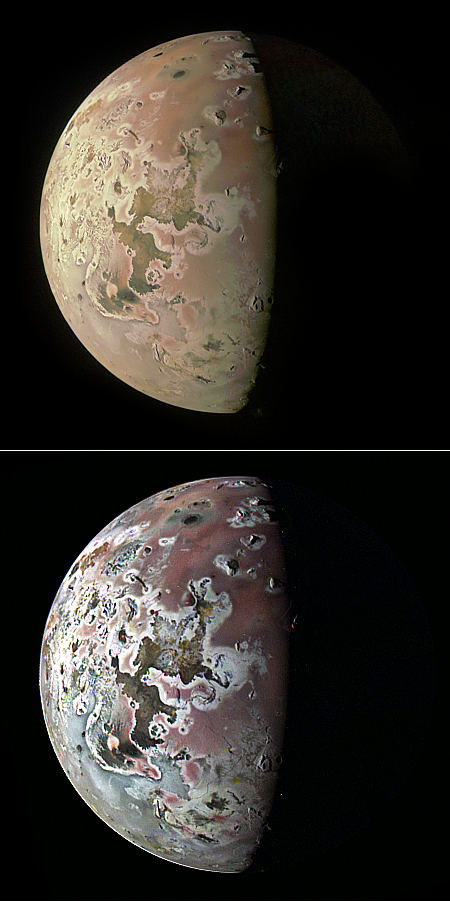
Since Juno completed its 55th close swing past Jupiter on October 15, 2023, including the closest fly by of its volcano-covered moon Io since the 1990s, citizen scientists have been grabbing the spacecraft’s raw images of the moon and enhancing them to bring out the details.

Immediately after the fly-by I posted on October 17, 2023 the top image to the right, processed by Ted Stryk. This version attempted to capture the view of Juno is natural color. As I noted then, “The dark patches are lava flows, with the dimensions of mountains along the terminator line between night and day clearly distinguishable.”

The bottom picture to the right was first processed by citizen scientist Gerald Eichstädt, who like Stryk attempted to capture Io’s natural colors. Thomas Thomopoulos then took Eichstädt’s image and enhanced the colors as well as reduced the brightness, in order to bring out the details as much as possible.

I have rotated, cropped, and reduced this bottom image further to post it here.

In comparing this image with earlier pictures of Io, taken by both Juno and Galileo in the 1990s, there is evidence that some of the lava flows visible now have changed significantly in the intevening time. This is not a surprise, as volcanic eruptions take place on Io so frequently that it has not unusual to capture one in the rare times close up images are possible, going back to the discovery of volcanic activity by Voyager-1 in 1979.

It will take a bit of time for scientists, both professional and amateur, to pick out the specific changes. That work will be further aided by Juno’s next fly-by on December 30, 2023, where it will dip to less than 1,000 miles of the surface.

3 comments

New Io images from Juno

Io as seen on October 15, 2023 by Juno
Click for original image.

The Jupiter orbiter Juno completed its 55th close pass of the gas giant on October 15, 2023, which also included a close pass of the Jupiter moon Io. The science team has now released the first images of Io from that fly-by, and several citizen scientists have released their processed versions.

The picture to the right, cropped, reduced, and sharpened to post here, was processed by Ted Stryk. It is the best view seen of this volcano-covered world since the Galileo orbiter in the 1990s. The dark patches are lava flows, with the dimensions of mountains along the terminator line between night and day clearly distinguishable.

An even closer look will occur during Juno’s 57th Jupiter orbit on December 30, 2023, when it will get within 1000 miles of Io’s surface, crossing the mid- to high latitudes of the planet’s western hemisphere.

5 comments

Juno gets new close-up images of Jupiter’s moon Io

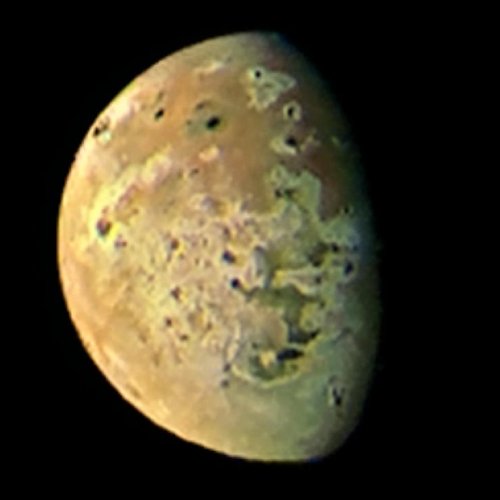
Io as seen by Juno in July 2023
Click for original image.

During its July close fly-by of Jupiter the orbiter Juno also flew past the moon Io, getting within 14,000 miles. The picture to the right, cropped and reduced to post here, was one of the images taken during that fly-by and subsequently processed and color enhanced by citizen scientist Thomas Thomopoulos.

The picture was taken at about the spacecraft’s closest point. It shows the splotched and volcanic surface of Io, which because it orbits close to Jupiter tidal forces cause it to have an intensely active volcanic surface. All the black features are either volcanoes or lava flows. This set of all of Juno’s Io images taken during the fly-by, enhanced by citizen scientist Gerald Eichstädt, also shows a volcanic plume in the shadowed portion of the planet, just beyond the terminator, which Eichstädt believes is a mountain dubbed Tohil Mons.

Even closer flybys are scheduled for December ’23 and February ’24, both getting within 1,000 miles of the surface.

2 comments

Juno’s next fly-by of Io coming on July 30

Io as seen by Juno
An image of Io from the March fly-by

The Juno science team is gearing up for the spacecraft’s next fly-by of the Jupiter moon Io, scheduled for July 30, 2023.

When NASA’s Juno mission flies by Jupiter’s fiery moon Io on Sunday, July 30, the spacecraft will be making its closest approach yet, coming within 13,700 miles (22,000 kilometers) of it. Data collected by the Italian-built JIRAM (Jovian InfraRed Auroral Mapper) and other science instruments is expected to provide a wealth of information on the hundreds of erupting volcanoes pouring out molten lava and sulfurous gases all over the volcano-festooned moon.

The image to the right was taken from 33,000 miles during the March fly-by, almost three times farther away. The dark spots are volcanoes, and some showed significant change from earlier images.

0 comments

Lightning on Jupiter

Lightning on Jupiter
Click for original image.

Cool image time! The picture to the right, cropped and reduced to post here, was taken on December 30, 2020 by Juno during its 31st close fly-by of Jupiter, and was enhanced and processed by citizen-scientist Kevin Gill.

In this view of a vortex near Jupiter’s north pole, NASA’s Juno mission observed the glow from a bolt of lightning. On Earth, lightning bolts originate from water clouds, and happen most frequently near the equator, while on Jupiter lightning likely also occurs in clouds containing an ammonia-water solution, and can be seen most often near the poles.

Juno was about 20,000 miles above Jupiter’s clouds when it took this picture, located at about 78 degrees north latitude.

4 comments

The grooved surface of Ganymede

The grooves of Ganymede
Click for original image.

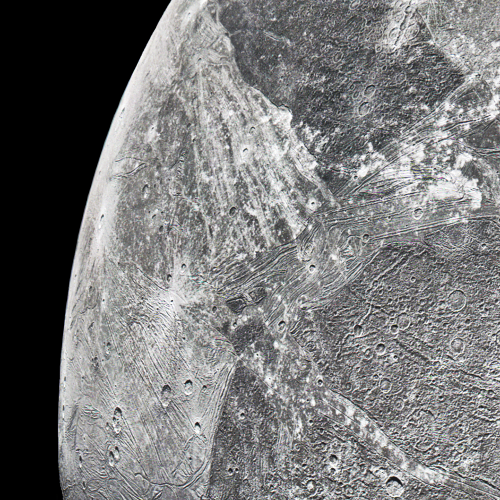
Cool image time! The picture to the right, reduced to post here, was taken on June 7, 2021 when the Jupiter orbiter Juno did a close flyby of the moon Ganymede, taking four pictures.

Citizen scientists Gerald Eichstädt and Thomas Thomopoulos have now reprocessed parts of those images to bring out the details more clearly (the other new versions available here, and here).

I have chosen to highlight the picture to the right however because it so clearly shows the puzzling grooves that cover much of Ganymede’s surface. While these parallel grooves in many ways mimic the grooves often seen on top of valley glaciers on Earth and Mars, on Ganymede they do not follow any valley floor. Instead, they form patches of parallel grooves that travel in completely different directions, depending on the patch. At the moment their origin is not understood.

These grooves are one of the mysteries that Europe’s Juice probe will attempt to solve when it arrives in orbit around Jupiter in 2031.

1 comment

Jupiter’s clouds in 3D

Jupiter's clouds in 3D
Click for original image.

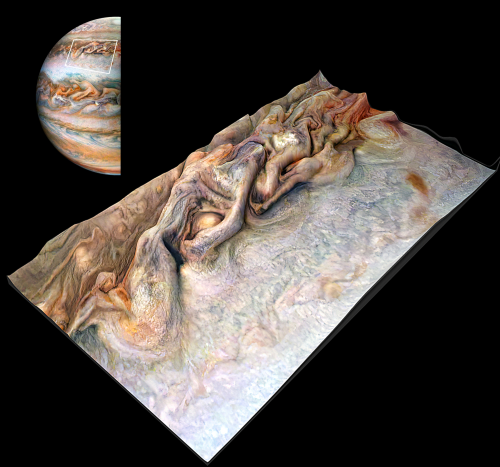
Another cool image! The picture to the right, cropped and reduced to post here, was created by a team of citizen scientists from a raw Juno image during its 40th close fly-by of Jupiter. From the caption:

Visual interpretation of relief (exaggerated) on Jupiter based on depth estimation from a single image

2D process: Enhanced RGB, enlargement and crop of image taken on 2022-02-25 02:21 UT – perijove 40 – Junocam

Process on 3d image : not based on a DTM, but a visual interpretation of the surface by depth estimation from a single image

The white box on the global image on the upper left marks the approximate area coverd by the oblique 3D picture. Though the vertical relief is greatly exaggerated as well as simulated from a flat image, it provides us a nice sense of the turbulent nature of Jupiter’s more active bands. The larger structures in the colored band appear to act like giant waves in a river rapids. And for reasons not yet understood, the more active areas of that upper atmosphere is divided into bands determined by latitude.

2 comments

Juno captures close-up images of Jupiter’s moon Io

Io as seen by Juno

On March 1, 2023 the Jupiter orbiter Juno passed within 33,000 miles of the gas giant’s moon Io, getting its first close-up images.

Several citizen scientists have processed those images. The photo to the right, cropped and reduced to post here, was created by Andrew R Brown. This particular picture was one of five taken by Juno during the fly-by. Jason Perry processed all five here, with this caption:

Most of the dark spots seen across Io’s surface are the result of volcanic eruptions. These include East Girru, a dark spot that was not seen the last time Io was seen at this resolution during the New Horizons encounter with Jupiter in February 2007. East Girru was undergoing a major eruption at the time but hadn’t had time to produce a new lava flow before the end of the week-long encounter. This small flow field, measuring 3,200 square kilometers (1,390 square miles) in size, may have also been reactivated during an eruption in October 2021, as seen by Juno JIRAM.

Another apparent surface change is at Chors Patera, which has undergone a significant reddening since Galileo last observed it in October 2001. Reddish materials on Io are indicative of the presence of short-chain sulfur and are often associated with high-temperature, silicate volcanism. Additional dark spots near the terminator, the boundary between Io’s day and night sides, are the shadows of tall mountains. The dark spot at middle right in the upper right image may be due a mountain 5500 meters (18,000 feet) tall.

The smallest object resolved in this image is about 22 miles across.

3 comments

Juno’s camera experiences temperature problem

Because of an unexpected rise in its temperature, Juno’s camera was unable to take its full schedule of planned images during its January 22, 2023 close approach of Jupiter.

The JunoCam imager aboard NASA’s Juno spacecraft did not acquire all planned images during the orbiter’s most recent flyby of Jupiter on Jan. 22. Data received from the spacecraft indicates that the camera experienced an issue similar to one that occurred on its previous close pass of the gas giant last month, when the team saw an anomalous temperature rise after the camera was powered on in preparation for the flyby.

However, on this new occasion the issue persisted for a longer period of time (23 hours compared to 36 minutes during the December close pass), leaving the first 214 JunoCam images planned for the flyby unusable. As with the previous occurrence, once the anomaly that caused the temperature rise cleared, the camera returned to normal operation and the remaining 44 images were of good quality and usable.

Engineers are analyzing the issue to try to determine its cause, as well as a fix. The camera at this moment appears to be operating properly, with the next close fly-by occurring on March 1, 2023.

1 comment

Animation of Jupiter’s clouds

Cool video time! Using a photo taken by Juno during its 2018 fly-by of Jupiter, citizen scientist Thomas Thomopoulos has created a short animation showing the flow of Jupiter’s clouds. He also added some 3D relief by assigning elevation to the image’s greyscale, with lighter regions assigned higher altitudes.

I have embedded the animation below. Run it at the slowest speed for the best effect. It is quite spectacular, though it is also important to note that it is not reality. Thomopoulos is simply giving us a hint of the natural evolution of the cloud structures, both in elevation and in time.

You can see another equally impressive animation by Thomopoulos here of several of Jupiter’s polar storms, using AI technology to smooth out the loop.
» Read more

0 comments

Racing above the clouds of Jupiter

Racing above the clouds of Jupiter
Click for full image.

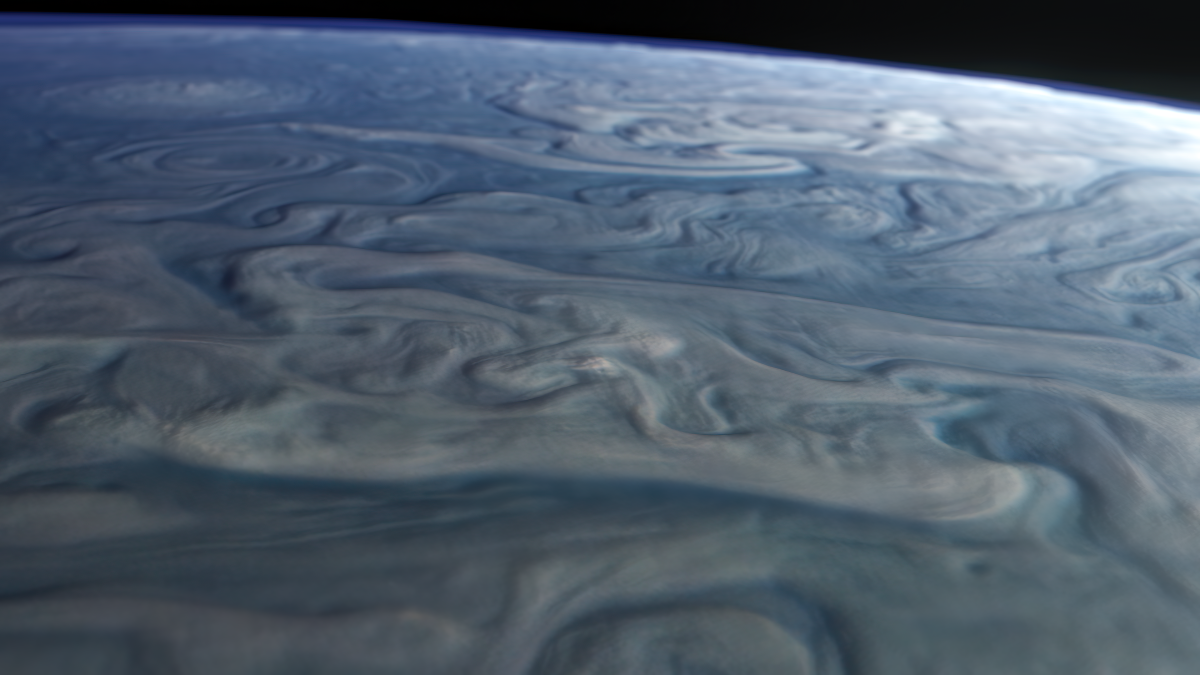
Cool image time! The photo above, reduced in size to post here, was created from a raw Juno image by citizen scientist Kevin Gill. From his caption:

A low perspective over Jupiter’s North Polar Storms. Used imagery from the Juno spacecraft’s recent Perijove 47 to render a simulated view as if the viewer were only a few thousand kilometers above the clouds. Applied simulated altimetry, shadowing, and upper atmospheric transparency depth in Blender and Photoshop to render this.

To get some perspective on how large Jupiter is, the planet’s curve is about comparable to the same curve seen by astronauts of the Earth at a height of about 300 to 400 kilometers. In this image however we are about ten times higher.

3 comments

A new hotspot map of Io, based on Juno data

Hot spot map of Io
Click for original figure.

Scientists have compiled a new map of the many volcanic hotspots on the Jupiter moon Io, based on data obtained by Juno, including 23 spots previously undetected. From the paper’s abstract:

We mapped the hot spot distribution on Io’s surface by analyzing the images acquired by the JIRAM instrument onboard the Juno spacecraft. We identified 242 hot spots, including 23 not present in other catalogs. A large number of the new hot spots identified are in the polar regions, specifically in the northern hemisphere. The comparison between our work and the most recent and updated catalog reveals that JIRAM detected 82% of the most powerful hot spots previously identified and half of the intermediate-power hot spots, thus showing that these are still active. JIRAM detected 16 out of the 34 faint hot spots previously reported.

The map above is taken from figure 2 of the paper. The data, when compared to other earlier data, confirms that many of these hot spots are long-lived, and have been erupting now for decades.

1 comment

Largest volcanic eruption in years detected on Io

Using instruments on a ground-based telescope, one scientist based at the Planetary Science Institute (PSI) in Arizona has detected the largest volcanic eruption in years on the Jupiter moon Io.

PSI Senior Scientist [Jeff] Morgenthaler has been using IoIO, located near Benson, Arizona to monitor volcanic activity on Io, since 2017. The observations show some sort of outburst nearly every year, but the largest yet was seen in the fall of 2022. Io is the innermost of Jupiter’s four large moons and is the most volcanic body in the Solar System thanks to the tidal stresses it feels from Jupiter and two of its other large satellites, Europa and Ganymede.

IoIO uses a coronagraphic technique which dims the light coming from Jupiter to enable imaging of faint gases near the very bright planet. A brightening of two of these gases, sodium and ionized sulfur, began between July and September 2022 and lasted until December 2022. The ionized sulfur, which forms a donut-like structure that encircles Jupiter and is called the Io plasma torus, was curiously not nearly as bright in this outburst as previously seen. “This could be telling us something about the composition of the volcanic activity that produced the outburst or it could be telling us that the torus is more efficient at ridding itself of material when more material is thrown into it,” Morgenthaler said.

The material released by this eruption could impact Juno during future close approaches of Jupiter.

0 comments

Using reflected light from Jupiter to photograph Ganymede’s night side

Ganymede as seen in the reflected light of Jupiter
Click for full image.

During Juno’s June 7, 2021 close fly-by of Ganymede, scientists used its instruments to obtain the first good image of a part of this Jupiter moon. What made the achievement especially amazing was that the area photographed was only lit by the reflected light from Jupiter, the equivalent of its “earthshine.” From the paper’s abstract:

On 7 June 2021, the Juno spacecraft flew within about 1,000 km of the surface of Jupiter’s largest moon, Ganymede. The Mission used their sensitive navigation camera to photograph the moon’s dark side where it was lit only by scattered sunlight from Jupiter. This new imaging approach revealed multiple surface features, including a patchwork of different surface textures (such as grooved terrain), several craters, and ejecta deposits. These features had not been visible in images collected by previous spacecraft.

The picture to the right is from figure 2 of the paper, cropped and reduced to post here. It shows a region on Ganymede that in the earlier images had shown few details because the lighting was poor and thus features were not easily discerned (as can be seen by the inset in the lower right). In the new picture, the only light was reflected from Jupiter, and its low angle brings out the surface topography.

0 comments
1 2 3 4 9