Juno to remain in 53-day orbit

The scientists and engineers running the Juno mission to Jupiter have decided to keep the spacecraft in its 53-day orbit for the rest of its mission rather than fire its engines to lower the orbit to its planned 14 days duration.

The original Juno flight plan envisioned the spacecraft looping around Jupiter twice in 53-day orbits, then reducing its orbital period to 14 days for the remainder of the mission. However, two helium check valves that are part of the plumbing for the spacecraft’s main engine did not operate as expected when the propulsion system was pressurized in October. Telemetry from the spacecraft indicated that it took several minutes for the valves to open, while it took only a few seconds during past main engine firings. “During a thorough review, we looked at multiple scenarios that would place Juno in a shorter-period orbit, but there was concern that another main engine burn could result in a less-than-desirable orbit,” said Rick Nybakken, Juno project manager at NASA’s Jet Propulsion Laboratory in Pasadena, California. “The bottom line is a burn represented a risk to completion of Juno’s science objectives.”

There are both pros and cons for using this longer orbit, detailed at the link, with.the most important being that doing nothing avoids losing the mission entirely.
26 comments

At Jupiter reality imitates art

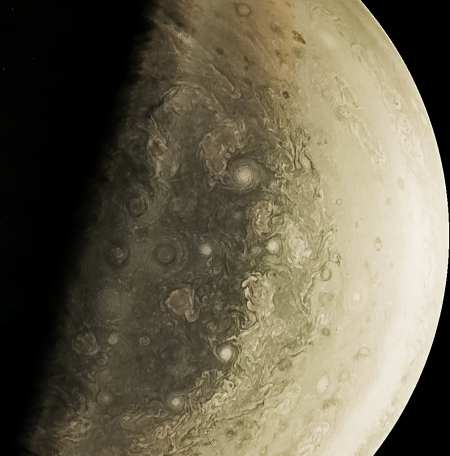
Jupiter's south pole, fourth flyby

NASA this week released images taken by Juno during its fourth close fly-by of Jupiter on February 2. The image highlighted by that press release focused on a wide lightly processed view of the south pole, different from the image above. As the release states,

Prior to the Feb. 2 flyby, the public was invited to vote for their favorite points of interest in the Jovian atmosphere for JunoCam to image. The point of interest captured here was titled “Jovian Antarctica” by a member of the public, in reference to Earth’s Antarctica.

The image above, cropped and reduced here, was more heavily processed by another member of the public, and shows more clearly the mad, chaotic storms at the south pole.

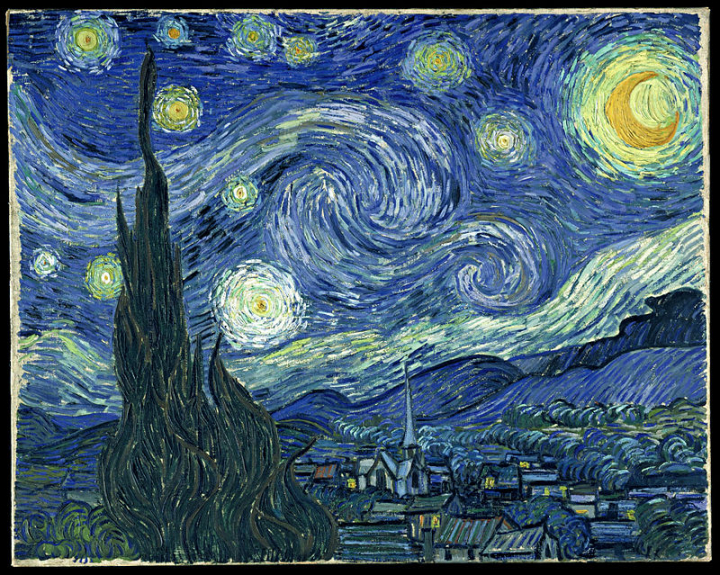
What instantly struck me when I saw this however was how much it reminded me of this piece of art, painted in 1889 in France by a man who was slowly going insane.

The Starry Night

Vincent Van Gogh never saw the storms on Jupiter, but his imagination conceived their existence in paint. Juno has now imaged them in reality.

5 comments

Juno’s next Jupiter fly-by today

Juno is set to make its fourth close fly-by of Jupiter today, dipping to within 2,670 miles of the gas giants cloud tops.

The Juno science team continues to analyze returns from previous flybys. Revelations include that Jupiter’s magnetic fields and aurora are bigger and more powerful than originally thought and that the belts and zones that give the gas giant’s cloud top its distinctive look extend deep into the planet’s interior. Peer-reviewed papers with more in-depth science results from Juno’s first three flybys are expected to be published within the next few months. Also, JunoCam, the first interplanetary outreach camera, is now being guided with the assistance from the public — people can participate by voting for what features on Jupiter should be imaged during each flyby.

0 comments

Jupiter’s Little Red Spot

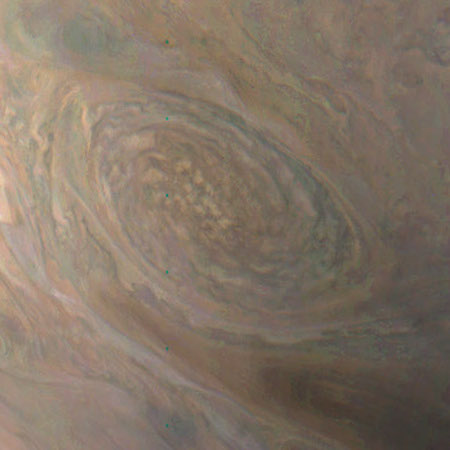
Little Red Spot

Cool image time! The image on the right, cropped to show here, is focused in on Jupiter’s Little Red Spot, a storm that formed by the merger of three smaller storms about a decade ago. The cropped image comes from a wider view of Jupiter from Juno that is quite amazing.

Note that the Little Red Spot, while only a third the size the more well known Giant Red Spot, is still about the size of the Earth.

This storm is the third largest anticyclonic reddish oval on the planet, which Earth-based observers have tracked for the last 23 years. An anticyclone is a weather phenomenon with large-scale circulation of winds around a central region of high atmospheric pressure. They rotate clockwise in the northern hemisphere, and counterclockwise in the southern hemisphere. The Little Red Spot shows very little color, just a pale brown smudge in the center. The color is very similar to the surroundings, making it difficult to see as it blends in with the clouds nearby. Citizen scientists Gerald Eichstaedt and John Rogers processed the image and drafted the caption.

0 comments

The raging storms of Jupiter’s south pole

Cool image time! Below the fold I have embedded an animation that was assembled from 30 Juno images taken during its third orbital close approach of Jupiter. It is at first a little hard to watch, which is why I have not made it visible on the main page, but it is worth watching because it gives a real sense of how powerful and violent the storms are in the polar regions of the gas giant planet. Keep your eye especially glued to the storms near the center of the image. In a very short time that it took Juno to zip past Jupiter, less than a day, these storms rotated about one third. Remember too that each storm would probably cover at least half of the Earth’s surface.

We desperately need a fleet of weather satellites orbiting Jupiter to give us a continuous view of these storms. The knowledge gained about atmospheric weather patterns would be priceless.

» Read more

2 comments

Juno completes third Jupiter flyby

On December 11 Juno successfully completed its third close flyby of Jupiter.

They have released one quite spectacular image taken during the close approach. Expect more to follow soon.

Though they continue to say that they are still considering firing the spacecraft’s main engine to lower and shorten the orbit, I am getting the impression that they are increasingly leaning to leaving things as they are. While this longer orbit will produce larger gaps in their data of the gas giant’s atmosphere (53 days between close approaches versus 14 days), it will also allow them to tract changes over a much longer time period. Considering the risk of a catastrophic failure should they fire the questionable engine, this choice seems quite reasonable.

15 comments

Juno’s upcoming December 11 Jupiter flyby

The Juno science team prepares for the next close flyby of Jupiter on December 11.

At the time of closest approach (called perijove), Juno will be about 2,580 miles (4,150 kilometers) above the gas giant’s roiling cloud tops and traveling at a speed of about 129,000 mph (57.8 kilometers per second) relative to the planet. Seven of Juno’s eight science instruments will be energized and collecting data during the flyby. “This will be the first time we are planning to operate the full Juno capability to investigate Jupiter’s interior structure via its gravity field,” said Scott Bolton, principal investigator of Juno from the Southwest Research Institute in San Antonio. “We are looking forward to what Jupiter’s gravity may reveal about the gas giant’s past and its future.”

Mission managers have decided not to collect data with the Jovian Infrared Auroral Mapper (JIRAM) instrument during the December flyby, to allow the team to complete an update to the spacecraft software that processes JIRAM’s science data. A software patch allowing JIRAM’s operation is expected to be available prior to the next perijove pass (PJ4) on Feb. 2, 2017.

It increasingly appears they do not want to risk firing the spacecraft’s main engine to shorten the 53 day orbit to 14 days because of a fear that the burn could fail catastrophically. This means that Juno’s mission will be extended significantly because it will take longer to gather data with such a long orbit.

0 comments

Jupiter’s chaotic storms

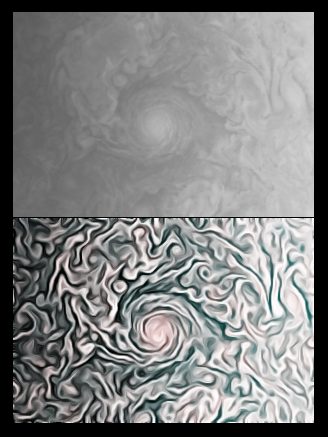
Jupiter's storms, as seen by Juno after processing

Cool image time! The image on the right shows what anyone can do if they want to play with images that have been taken by the Juno spacecraft. On top is the raw Juno image of a storm on Jupiter. On the bottom is that same storm after significant processing by an ordinary citizen. A larger version can be seen here.

While the Juno science team’s policy of making all their raw images available to the public is routine for a NASA mission, they are doing something a bit different by allowing the public to play with the images and then upload them on a Juno website for everyone to see. While some of the subsequent images have been a little silly, the image on the right illustrates how this policy can help scientists (and the public) better study the atmosphere on Jupiter. The processing has brought out all the storm’s swirls and twirls, and shown clearly how chaotic the storms are in Jupiter’s high latitudes.

The scientists don’t have the resources or the time to do this kind of processing on every image, or even every piece of every image. Allowing the public to do it will increase the variety of results and make it more likely for everyone to gain some understanding of what is going on in the gas giant’s atmosphere. Or not, but then that’s okay, as a realization that we don’t understand something is the first step towards wisdom and real knowledge.

3 comments

Juno successfully completes engine burn with smaller thrusters

Having successfully left safe mode, engineers had Juno do a 31 minute engine burn on Tuesday to adjust its orbit using its smaller thrusters.

The burn, which lasted just over 31 minutes, changed Juno’s orbital velocity by about 5.8 mph (2.6 meters per second) and consumed about 8 pounds (3.6 kilograms) of propellant. Juno will perform its next science flyby of Jupiter on Dec. 11, with time of closest approach to the gas giant occurring at 9:03 a.m. PDT (12:03 p.m. EDT). The complete suite of Juno’s science instruments, as well as the JunoCam imager, will be collecting data during the upcoming flyby.

That they will definitely collect data during the December 11 flyby means that they are going to delay again the main engine burn that will reduce the spacecraft’s orbit to 14 days, its official science orbit. This also means that they are still uncomfortable firing that main engine. It is also not clear from the press release whether this burn was planned, or was added to compensate for the main engine issues.

The vagueness makes me think that Juno has some serious issues that they haven’t yet told us about.

0 comments

The storms of Jupiter’s south pole

storms on Jupiter

Cool image time! Even though Juno has been unable to gather any additional data since its first close approach of Jupiter in August because of technical problems, the science team has set up its website to allow the public to download the images produced so far, process those images, and then upload them to the site for the world to see.

The image to the right, reduced in resolution to show here, is one example of the many different processed images produced by interested members of the general public. It highlights the seemingly incoherent storms that are raging at Jupiter’s south pole.

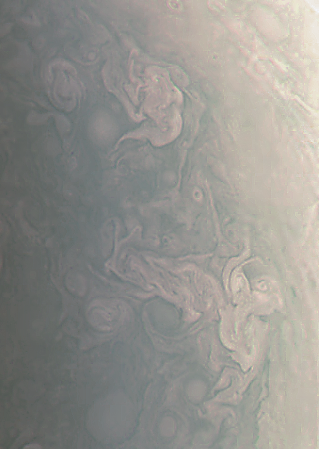
close-up of storms

To the left is a cropped section of the full resolution image. It shows the complex transition zone between the darker polar regions and the brighter band that surrounds it. This chaotic atmospheric behavior is something that no climate scientist has ever seen before. It will take decades of research to untangle and even begin to understand what is happening.

1 comment

Juno enters safe mode prior to Jupiter close approach

Because Juno entered safe mode prior to its close approach of Jupiter today, no science data was gathered.

NASA’s Juno spacecraft entered safe mode Tuesday, Oct. 18 at about 10:47 p.m. PDT (Oct. 19 at 1:47 a.m. EDT). Early indications are a software performance monitor induced a reboot of the spacecraft’s onboard computer. The spacecraft acted as expected during the transition into safe mode, restarted successfully and is healthy. High-rate data has been restored, and the spacecraft is conducting flight software diagnostics. All instruments are off, and the planned science data collection for today’s close flyby of Jupiter (perijove 2), did not occur. “At the time safe mode was entered, the spacecraft was more than 13 hours from its closest approach to Jupiter,” said Rick Nybakken, Juno project manager from NASA’s Jet Propulsion Laboratory in Pasadena, Calif. “We were still quite a ways from the planet’s more intense radiation belts and magnetic fields. The spacecraft is healthy and we are working our standard recovery procedure.”

This problem, combined with the thruster valve problem that prevented engineers from putting the spacecraft into its proper 14-day science orbit today, is significantly delaying science operations. They will not be able to adjust the orbit again until its next close approach December 11 (assuming the thruster problem has been solved by then), and until then it will also not be able to do much science.

0 comments

Problems with Juno’s main engine

Valve problems detected during Juno’s orbital insert around Jupiter has caused engineers to delay the October 19 engine burn that would have lowered the probe’s orbit around Jupiter.

Mission managers for NASA’s Juno mission to Jupiter have decided to postpone the upcoming burn of its main rocket motor originally scheduled for Oct. 19. This burn, called the period reduction maneuver (PRM), was to reduce Juno’s orbital period around Jupiter from 53.4 to 14 days. The decision was made in order to further study the performance of a set of valves that are part of the spacecraft’s fuel pressurization system. The period reduction maneuver was the final scheduled burn of Juno’s main engine. “Telemetry indicates that two helium check valves that play an important role in the firing of the spacecraft’s main engine did not operate as expected during a command sequence that was initiated yesterday,” said Rick Nybakken, Juno project manager at NASA’s Jet Propulsion Laboratory in Pasadena, California. “The valves should have opened in a few seconds, but it took several minutes. We need to better understand this issue before moving forward with a burn of the main engine.”

Because of this, they will instead use this next close approach to Jupiter to do pure science, something that they would not have done during the engine burn. Though this is a good example of turning lemons into lemonade, it will not be a good thing if Juno can never reduce its orbit to 14 days. A 53 day orbit will mean that they can only do good research every two months, and will seriously limit what they can learn over the long run.

1 comment

First science results from Juno

Storms at Jupiter's pole

The Juno science team today released the mission’s first science results gathered during its first close fly-by of Jupiter.

I have cropped on the right one of their full images to focus in on two of the strangely shaped storms Juno imaged during its pass. This image is of the northern pole. They also have some fascinating images of the south pole storms as well. Unlike the equatorial regions, which on gas giants have what appear to be parallel coherent bands of weather, the poles appear very chaotic, with the storms forming shapes that have not been seen in any other atmosphere in the solar system. They also found a hexagon-shaped weather feature in the pole.

The first link above also included data from the spacecraft’s other instruments, showing the gas giant’s complex atmosphere in a variety of other wavelengths.

5 comments

Juno’s closest Jupiter fly-by

Jupiter by Juno

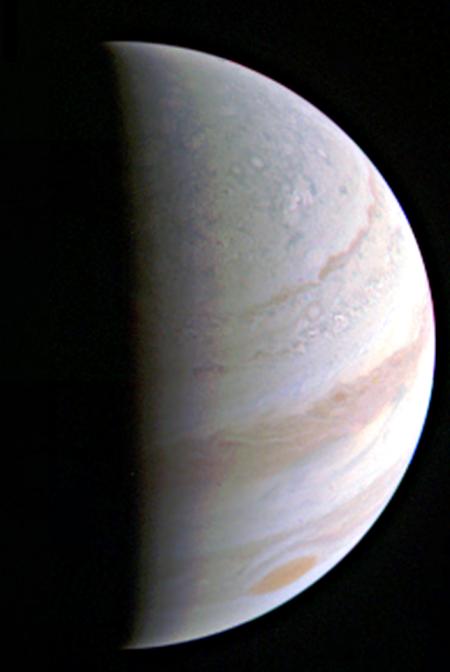
Juno today successfully completed its first and closest fly-by of Jupiter during its primary mission, zipping only 2,600 miles above the gas giant’s cloud tops.

We are getting some intriguing early data returns as we speak,” said Scott Bolton, principal investigator of Juno from the Southwest Research Institute in San Antonio. “It will take days for all the science data collected during the flyby to be downlinked and even more to begin to comprehend what Juno and Jupiter are trying to tell us.”

While results from the spacecraft’s suite of instruments will be released down the road, a handful of images from Juno’s visible light imager — JunoCam — are expected to be released the next couple of weeks. Those images will include the highest-resolution views of the Jovian atmosphere and the first glimpse of Jupiter’s north and south poles. “We are in an orbit nobody has ever been in before, and these images give us a whole new perspective on this gas-giant world,” said Bolton.

The image to the right, cropped and reduced in resolution to show here, was taken today when the spacecraft was still 437,000 miles away.

1 comment

Io’s atmosphere freezes and reinflates daily

New data from the ground-based Gemini telescope suggests that Io’s sulfur dioxide atmosphere freezes and then reinflates each time the moon flies through Jupiter’s shadow.

A study led by SwRI’s Constantine Tsang concluded that Io’s thin atmosphere, which consists primarily of sulfur dioxide (SO2) gas emitted from volcanoes, collapses as the SO2 freezes onto the surface as ice when Io is shaded by Jupiter. When the moon moves out of eclipse and ice warms, the atmosphere reforms through sublimation, where ice converts directly to gas.

The data is somewhat uncertain, however, as it based on only two observations.

7 comments

Juno swings back towards Jupiter

Juno has now passed the farther point from Jupiter in its first orbit and has started dropping back down to the gas giant.

Juno arrived at Jupiter on July 4, firing its main rocket engine as planned for 35 minutes. The flawless maneuver allowed Jupiter’s gravity to capture the solar powered spacecraft into the first of two 53.4-day-long orbits, referred to as capture orbits. Following the capture orbits, Juno will fire its engine once more to shorten its orbital period to 14 days and begin its science mission.

But before that happens, on Aug. 27, Juno must finish its first lap around Jupiter, with a finish line that represents the mission’s closest pass over the gas giant. During the encounter, Juno will skim past Jupiter at a mere 2,600 miles (4,200 kilometers) above the cloud tops.

2 comments

Great Red Spot hottest spot on Jupiter

Jupiter’s Great Red Spot, a giant storm that has been raging for at least three centuries, turns out to be the hottest spot on Jupiter.

They suspect that the spot is heated from below, but really understand much else, or even that.

Juno is specifically designed to study the weather patterns of Jupiter, so we will get some of these answers, plus a lot more questions, in the coming years as the spacecraft gathers its data.

15 comments

The first Juno picture of Jupiter from orbit

Juno's first picture in orbit

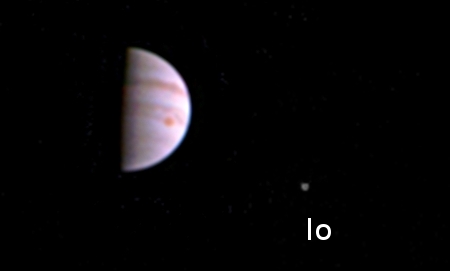
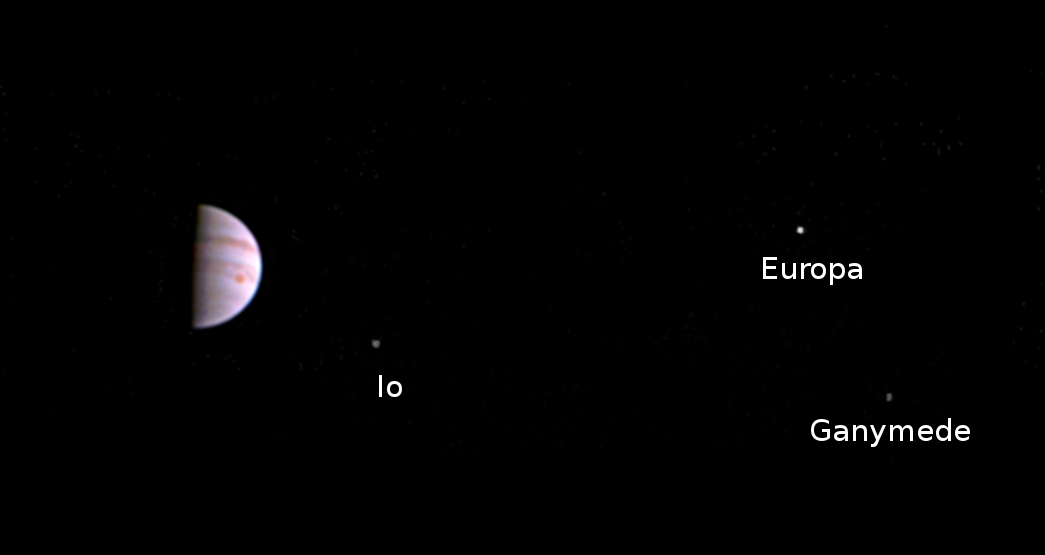
The Juno science team have released the first image since the spacecraft entered orbit around Jupiter. I have posted a cropped version on the right, showing only the moon Io. The full image shows Europa and Ganymede as well.

The image was taken from almost 3 million miles away, which accounts for its fuzziness. Expect much better pictures when the spacecraft dips down close in late August.

5 comments
1 8 9 10 11 12 13