First Juno movie of Jupiter’s changing weather

Gerald Eichstädt at the Juno image site has produced the first attempt to assemble a movie of Juno images of the same area on Jupiter in order to show its changing weather.

JunoCam has been seeing this scene about six times from very different perspectives between about 2017-09-01T22:03 and about 2017-09-01T22:19, hence a over a little more than 15 minutes.

This animation is a first attempt to reproject the six images to a similar common perspective in order to reveal some dynamical information.

An movie covering only 15 minutes won’t show much change, but it is a start. He also notes that in making the different images match up he likely introduced some artifacts that are not real.

0 comments

Juno finds mystery in Jupiter’s aurora

The uncertainty of science: Scientists analyzing the data sent back by Juno have found that the system for generating Jupiter’s aurora does not appear to be same as the process that creates auroras on Earth.

The science here is a bit complicated. Suffice it to say that Jupiter’s aurora seems produced by a much more complex process, which actually should not have surprised anyone, considering how much larger Jupiter is and more powerful its magnetic field.

2 comments

First images released from Juno’s seventh close fly-by of Jupiter

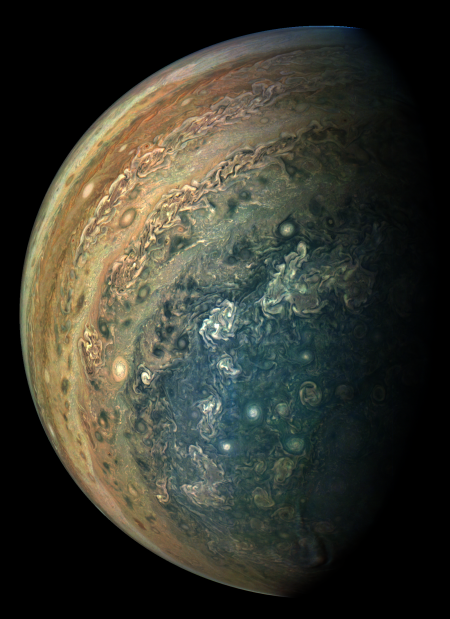
Jupiter's South pole, August 2017

Cool image time! The raw images taken during Juno’s seventh close fly-by of Jupiter have been released. The image on the right, reduced in resolution to post here, was reprocessed by Gerald Eichstädt and shows the gas giant’s south polar region.

It is worthwhile comparing this with previous south pole images, as well as other images from this fly-by reprocessed by Eichstadt. I want to know whether anyone can identify specific storms and show how they have changed over time. Unfortunately, Juno’s orbit is large, and so it only drops in close every 53 days, allowing for these storms to change a great deal, and thus making it more difficult to link images of the same changing storm. Moreover, the images don’t necessarily show the same longitudes on Jupiter, making this even more difficult.

Nonetheless, to gain a real understanding of Jupiter’s atmosphere will require a clear understanding of the pace in which its storms and atmosphere change. These images might give us our first glimpse of this process.

0 comments

First very short movie from Jupiter

Using two Juno images of the same area, taken at slightly different times, scientists have produced what might be the first very short gif animation showing the changing circulation patterns in Jupiter’s atmosphere.

The animation is only two images long, so in a sense it isn’t a movie but a blink comparison. Moreover, the difference in circulation patterns between the two images is not strongly evident, partly because the two images have different resolution and somewhat different lighting. Nonetheless, this animation foretells what will should become possible with time, as Juno’s mission continues. Eventually its images will show the changes in the gas giant’s storms.

2 comments

One of Jupiter’s mid-sized storms

One of Jupiter's mid-sized storms

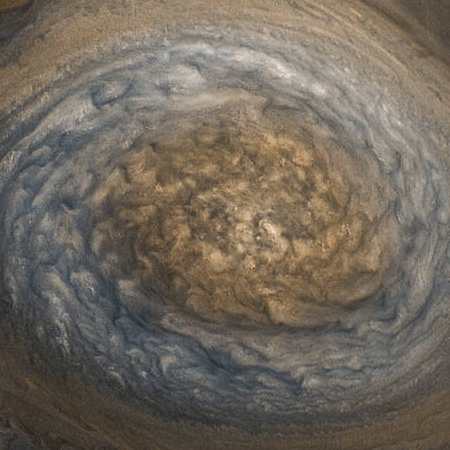
Cool image time! The Juno image on the right, cropped to show here, focuses in on one of Jupiter’s mid-sized storms near its high northern latitudes and just on the edge of the chaotic polar region.

This storm is a long-lived anticyclonic oval named North North Temperate Little Red Spot 1 (NN-LRS-1); it has been tracked at least since 1993, and may be older still. An anticyclone is a weather phenomenon where winds around the storm flow in the direction opposite to that of the flow around a region of low pressure. It is the third largest anticyclonic oval on the planet, typically around 3,700 miles (6,000 kilometers) long. The color varies between red and off-white (as it is now), but this JunoCam image shows that it still has a pale reddish core within the radius of maximum wind speeds.

Be sure to take a look at the full image, which provides a bit of context.

2 comments

The Great Red Spot

The Great Red Spot

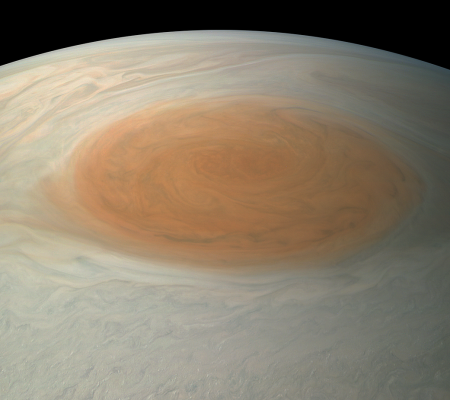
Cool image time! The image on the right, reduced in resolution to post here, shows one of the close-ups taken by Juno during its recent close fly-by of the Great Red Spot. What makes it different is its colors.

This image of Jupiter’s iconic Great Red Spot was created by citizen scientist Björn Jónsson using data from the JunoCam imager on NASA’s Juno spacecraft.

This true-color image offers a natural color rendition of what the Great Red Spot and surrounding areas would look like to human eyes from Juno’s position. The tumultuous atmospheric zones in and around the Great Red Spot are clearly visible.

Normally scientists enhance the colors to bring out the details. This version does not, which definitely makes it a little less dramatic but more accurate. Even so, the whirls and storms within the Spot are clearly visible.

The image was taken on July 10 from about 8,600 miles away. Note also that the entire Earth would fit inside the storm.

1 comment

Juno images of Great Red Spot released

The Juno science team has released the images taken by Juno as it flew past Jupiter’s Great Red Spot on June 11.

The three images at the link were all processed by citizen scientists, who took the raw images provided immediately and enhanced the colors. Not surprisingly, the images reveal that there are storms within storms within storms inside the Spot, which itself is a storm, the largest in the solar system.

0 comments

Jupiter gets two more moons

Astronomers using ground-based telescopes have identified two more moon circling Jupiter, bringing its total now to 69.

Both of these discoveries, as with the vast majority of Jupiter’s moons, occupy retrograde orbits, with inclinations greater than 90°, meaning that they move in directions opposite that of the planet’s spin. These distant, irregular orbits imply that these bodies formed elsewhere in the outer solar system and were captured while passing by early in the planet’s history.

A number of the moons recently discovered have since been lost because their orbits were too poorly constrained. However, some of these lost moons have also be recovered.

9 comments

Jupiter’s cloud-tops, up close

Jupiter's cloud tops

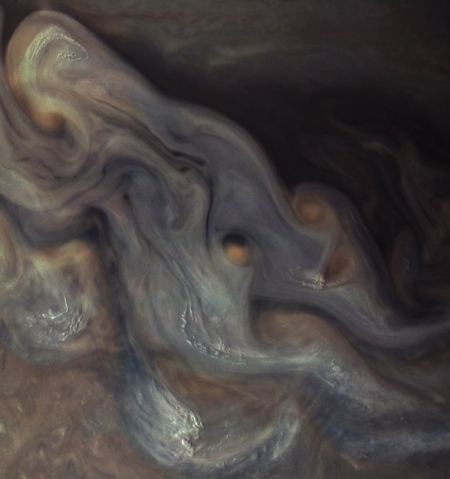
Cool image time! On the right is a cropped and reduced resolution section from this image from Juno. It shows the top of some of Jupiter’s clouds, swirling about chaotically.

What I find most fascinating is how this image reveals the different elevations of some of these cloud belts. The swirling clouds on the left and bottom of the image are clearly higher than the dark areas to the top and right. They are in fact casting their shadows on those lower cloud-tops.

To really understand the interactions taking place here, however, will require satellites capable of continually tracking these clouds over time. Unfortunately, Juno cannot do this. Though it will provide us periodic snapshots of specific areas, its long 53-day orbit means that it will not return to view the same areas very frequently. Making movies of the evolution of these clouds will be difficult, if not impossible.

2 comments

Looking at Jupiter’s southern hemisphere

Jupiter's southern hemisphere

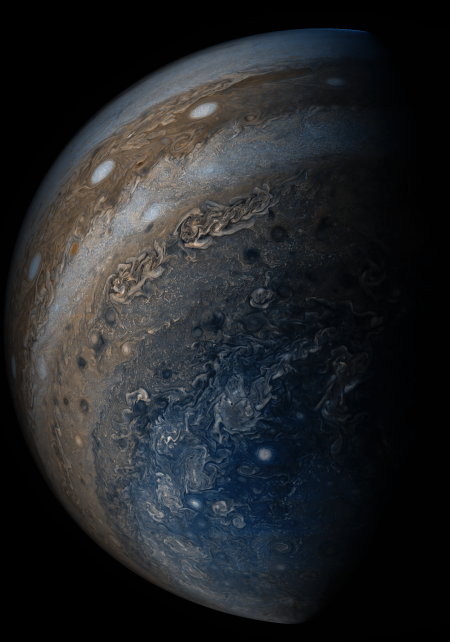
Cool image time! The image on the right, reduced to post here, shows Jupiter’s south pole and much of its southern hemisphere. It was taken during Juno’s last orbital fly-by of the gas giant’s cloud tops last week, and has been enhanced by Fevig-58, an ordinary citizen who downloaded the raw image and then uploaded his enhanced version to the Juno website.

It is definitely worthwhile taking a close look at the full resolution image. At the top its shows the horizontally banded Jupiter at equatorial- and mid-latitudes that has been that planet’s familiar face for centuries. In the middle is the transitional region from those horizontal bands to the chaotic polar regions. And at the bottom is the pole, where there the storms appear to follow no pattern and form a mish-mash.

One thing about Jupiter’s pole. It appears very different than Saturn’s. While I am certain they will find a vortex of some kind there, so far there is no indication of a coherent jet stream, as seen by Saturn’s hexagon. This once again demonstrates the one unbroken rule of planetary science that has been found with every planetary mission to every planetary body, whether they be pebbles, asteroids, dwarf planets, gas giants, or moons: Every single one of them is different and unique. They might fall into a single category, say gas giants, but each has its own unique features that make it different from every other member of that category.

5 comments

First science results from Juno

The Juno science team today released their first research results since the spacecraft entered orbit around Jupiter in July 2016.

“Although many of the observations have terrestrial analogs, it appears that different processes are at work creating the auroras,” said SwRI’s Dr. Phil Valek, JADE instrument lead. “With JADE we’ve observed plasmas upwelling from the upper atmosphere to help populate Jupiter’s magnetosphere. However, the energetic particles associated with Jovian auroras are very different from those that power the most intense auroral emissions at Earth.”

Also surprising, Jupiter’s signature bands disappear near its poles. JunoCam images show a chaotic scene of swirling storms up to the size of Mars towering above a bluish backdrop. Since the first observations of these belts and zones many decades ago, scientists have wondered how far beneath the gas giant’s swirling façade these features persist. Juno’s microwave sounding instrument reveals that topical weather phenomena extend deep below the cloudtops, to pressures of 100 bars, 100 times Earth’s air pressure at sea level.

“However, there’s a north-south asymmetry. The depths of the bands are distributed unequally,” Bolton said. “We’ve observed a narrow ammonia-rich plume at the equator. It resembles a deeper, wider version of the air currents that rise from Earth’s equator and generate the trade winds.”

Juno is mapping Jupiter’s gravitational and magnetic fields to better understand the planet’s interior structure and measure the mass of the core. Scientists think a dynamo — a rotating, convecting, electrically conducting fluid in a planet’s outer core — is the mechanism for generating the planetary magnetic fields. “Juno’s gravity field measurements differ significantly from what we expected, which has implications for the distribution of heavy elements in the interior, including the existence and mass of Jupiter’s core,” Bolton said. The magnitude of the observed magnetic field was 7.766 Gauss, significantly stronger than expected. But the real surprise was the dramatic spatial variation in the field, which was significantly higher than expected in some locations, and markedly lower in others. “We characterized the field to estimate the depth of the dynamo region, suggesting that it may occur in a molecular hydrogen layer above the pressure-induced transition to the metallic state.”

What I want to see is a depth map showing where Jupiter’s atmosphere ends and its solid core begins. I expect Juno will eventually be able to give us a first glimpse.

1 comment

Water plumes on Europa plus hydrogen in Enceladus plumes

Scientists have detected more evidence of underground oceans on both Europa (orbiting Jupiter) and Enceladus (orbiting Saturn).

In the case of Europa, the Hubble Space Telescope has once again detected plumes of water ice being shot up from cracks in the moon’s surface. This second detection confirms the first from two years ago.

In the case of Enceladus, Cassini data has detected the presence of hydrogen in the plumes totaling 1% of the total material in the plumes.

The Europa story is significant, in that it confirms that the moon is still active geologically, and that the underground ocean is interacting with the outside world by ejecting material from it to the surface. This increases the odds that there will be some very intriguing chemistry in that ocean, including the possibility of organic life.

The Enceladus story puzzles me. We already know that the plumes there are made of water, which in itself is one third hydrogen. Why should anyone be surprised that a portion of that water gets split so that some of the hydrogen gets released as an atom instead of part of the water molecule. In fact, this discovery does not seem to me to be much of a discovery at all, but simply a confirmation that the plumes have the materials from the water ocean below the surface. That NASA has pushed it this week so hard in conjunction with their future Europa Clipper mission suggests that this part of the press story is really about lobbying for funds and has little to do with science.

2 comments

Scientists find persistent cold spot on Jupiter

In reviewing data for the past fifteen years have scientists have identified an unexpected cold region in Jupiter’s upper mid-latitudes as large as the Great Red Spot.

“The Great Cold Spot is much more volatile than the slowly changing Great Red Spot, changing dramatically in shape and size over only a few days and weeks, but it has re-appeared for as long as we have data to search for it, for over 15 years,” Stallard said. “That suggests that it continually reforms itself, and as a result it might be as old as the aurorae that form it – perhaps many thousands of years old.”

The Great Cold Spot is thought to be caused by the effects of the magnetic field of the planet, with the massive planet’s spectacular polar aurorae driving energy into the atmosphere in the form of heat flowing around the planet.

Though they think the cold region is related to the aurora, I suspect they really do not have enough information to really understand what is going on.

1 comment

The storms of Jupiter

The storms of Jupiter

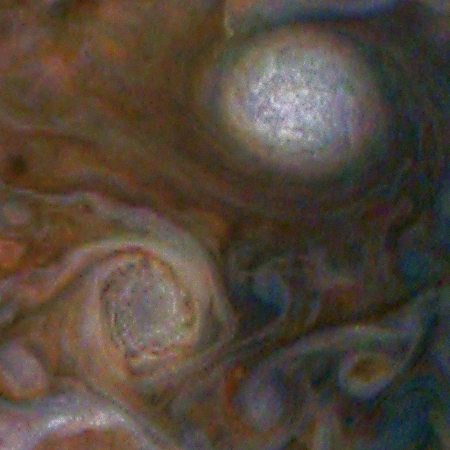
Cool image time! The image on the right, taken by Juno during its fifth close fly-by of Jupiter in late March and cropped to post here, shows two of the major storms in what I think is one of Jupiter’s main large mid-latitude belts. The full image, posted below in a significantly reduced form but annotated by me to indicate the location of the inset, covers a much larger area, but I have specifically zoomed into these two storms to highlight how large these storms are as well as how much detail is hidden within them.

In the bright spot in particular (officially called A6 by planetary scientists) you can see a hint of the existence of innumerable mini-storms. Juno’s camera does not have the resolution to image these smaller storms, but this image suggests that the gas giant’s atmosphere is far far far more complex than we can yet imagine.
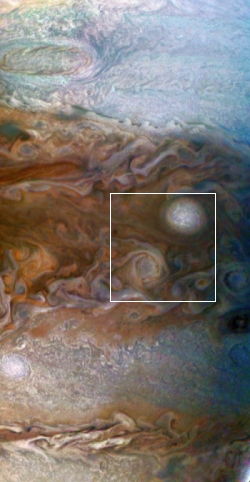
Full image of Jupiter reduced and annotated

Unfortunately, these images do not provide a scale. Based on a global image taken by Juno in October 2016 and matching the gas giant’s major horizontal bands, the annotated full image strip on the left appears to cover a little less than a third of Jupiter, from about 10 degrees latitude to about 50 degrees latitude. From this I estimate that if we put the Earth in the inset image it would probably be only slightly larger than the image itself, which means these two storms would cover most of one hemisphere.

In other words, the mini-storms inside the big bright oval are still larger than the biggest hurricanes on Earth, and they are packed together inside a much larger planet-sized storm.

What should fill us with even more awe is that this only covers a very thin slice of the top of Jupiter’s deep atmosphere. The planet itself is about 89,000 miles in diameter, more than ten times larger than Earth. The depth of its atmosphere is not really known, but it must be deeper than several Earths, piled on top of each other. In that depth there must be many atmospheric layers, each thicker and denser than the one above, and each with its own weather systems and complexities.

It will take centuries of research, including the development of new engineering capable of accessing this place, to even begin to map out its meteorology. And this is only one gas giant, of what we now know must be millions and millions throughout the galaxy.

If we have the nerve and daring, the human race has the opportunity to go out there and never be bored. There will always be something unknown to discover.

2 comments

Hubble snaps close-up of Jupiter

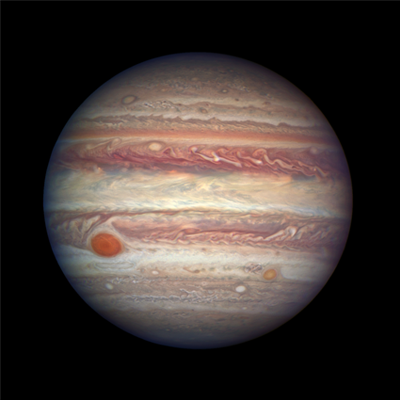
Jupiter by Hubble

Cool image time! The Hubble Space Telescope has taken a magnificent global view of Jupiter. The image on the right is only a thumbnail. Make sure to go to the link to see the full image, which amazingly compares quite favorably with the images being sent down by Juno in orbit around the gas giant.

This Hubble image once again demonstrates the remarkable advantages of an optical telescope in space. Equipped with the right instruments, it could do much of the research now being done by the planetary missions, and do it from Earth orbit.The research possibilities and the knowledge revealed from the ability to see things clearly in the optical bands is truly endless.

Even more important, we are wired to what we see. Give us a good visual image and many questions can immediately be answered.

4 comments
1 7 8 9 10 11 13