A lava tube on Venus?

Theorized lava tube on Venus

The uncertainty of science: Scientists in Italy have reanalyzed the radar data of Venus by the Magellan orbiter from 1990 to 1992 and concluded that at least one open pit on the side of a shield volcano might be the entrance to a underground lava tube.

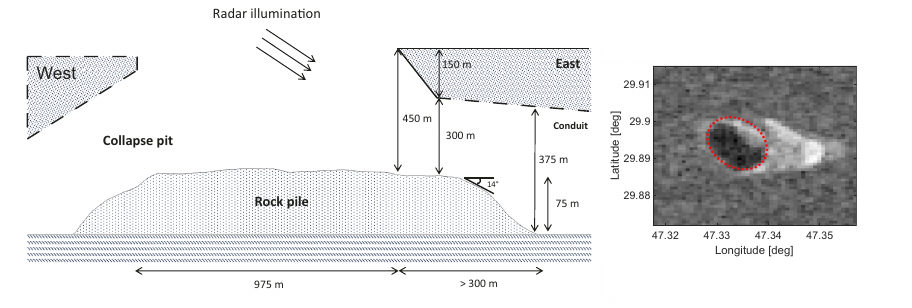
You can read their paper here [pdf]. The graphic above comes from figures 2 and 3 of their paper, with the radar image of the pit to the right, and the cartoon to the left their interpretation of that radar data. From the abstract:

Between 1990 and 1992, the Synthetic Aperture Radar (SAR) instrument on board the Magellan spacecraft mapped the Venusian surface. By leveraging a SAR imaging technique developed for detecting and characterizing accessible subsurface conduits in the proximity of skylights, we analysed
the Magellan radar images in locations where there is evidence of localized surface collapses. Our analyses reveal the existence of a large and open subsurface conduit in the Nyx Mons region. This feature is hypothesized to be a pyroduct, characterized by a diameter of about 1 km, a roof thickness of at least 150 m and an empty void height of no less than 375 m. The conduit extends in the subsurface for at least 300 meters from the skylight.

To strengthen their conclusions, which are based on a LOT of assumptions, the scientists also compared this radar data with radar data taken of similar-sized lava tube skylights on Earth.

Their conclusion is reasonable, as Venus is a planet of volcanoes, with more than a million detected in radar data. Lava tubes should exist. Nonetheless, their interpretation of the radar data is very uncertain, and must be viewed with a great deal of skepticism.
2 comments

Massive flow on Mars

Massive flow on Mars

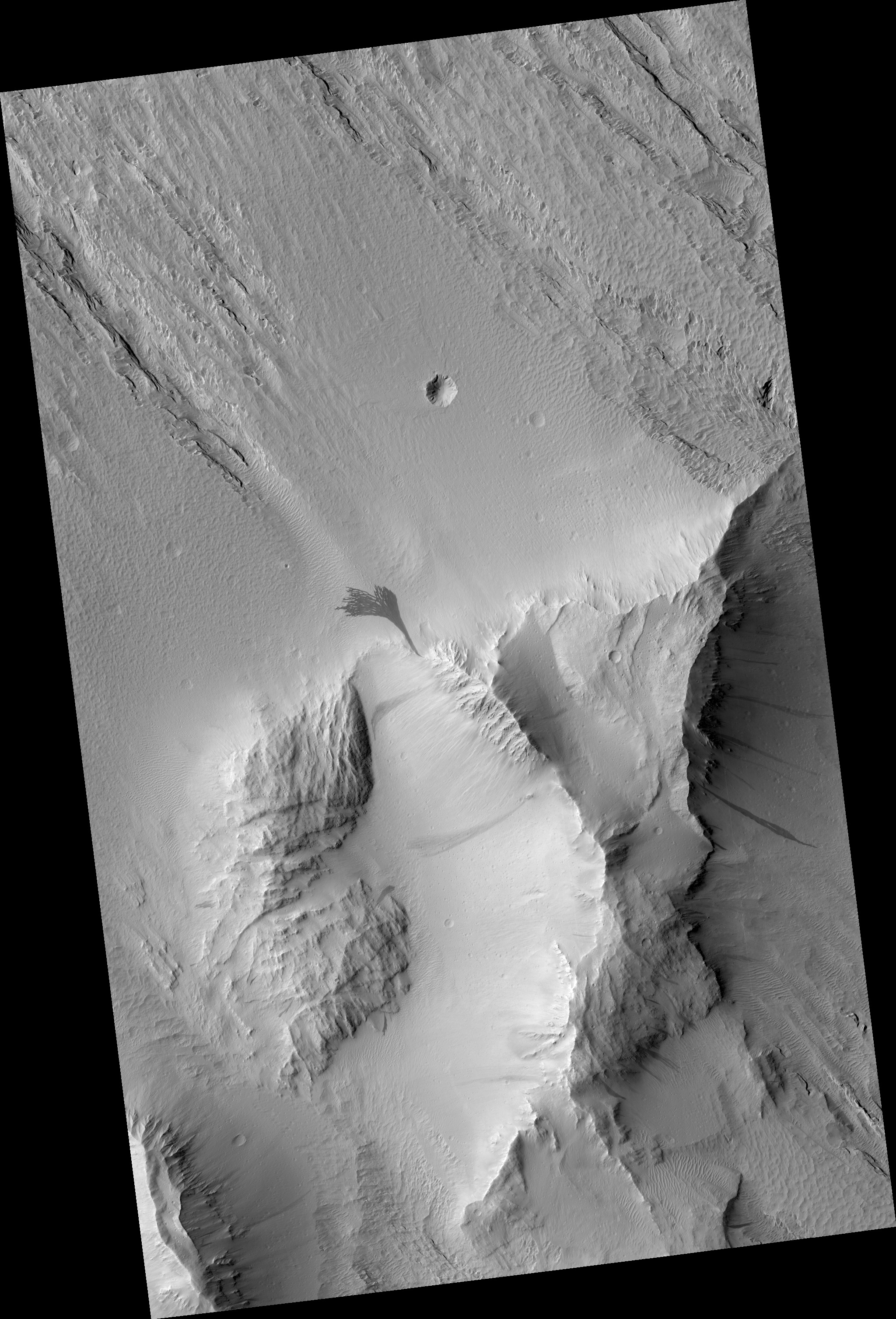
Cool image time! The image on the right, cropped to post here, comes from a Mars Reconnaissance Orbiter image that shows a massive relatively recent and dark slope streak that emanates out from a single point on the surface. (Note that the release at this link rotates the image so that north points down. I have rotated back so that north points up.)

Streaks form on slopes when dust cascades downhill. The dark streak is an area of less dust compared to the brighter and reddish surroundings. What triggers these avalanches is not known, but might be related to sudden warming of the surface.

These streaks are often diverted by the terrain they flow down. This one has split into many smaller streaks where it encountered minor obstacles. These streaks fade away over decades as more dust slowly settles out of the Martian sky.

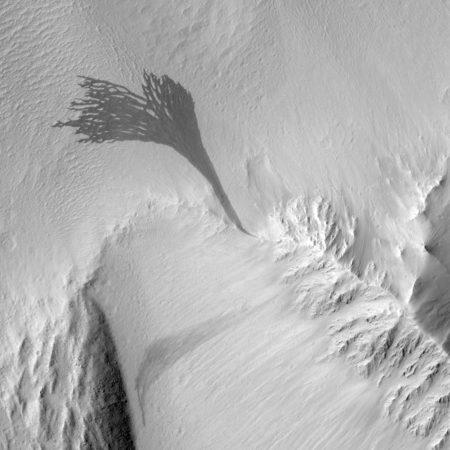
Point of origin for flow

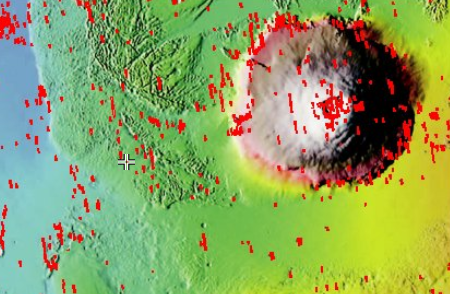
Location of flow, west of Olympus Mons

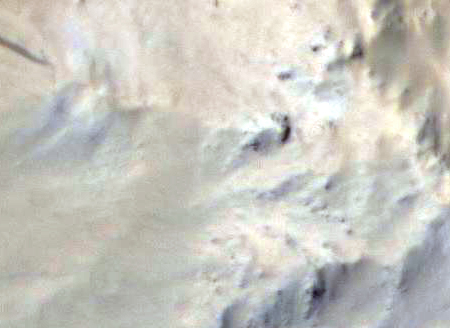
The MRO release focuses on the fingerlike breakup of the flow as it descends into sand-dune filled plain. What is more interesting to me is the terrain where this flow originated. A close-up of that area from the full image, shown on the right, reveals a feature that could be a wash running in line with the flow’s origin, and leading uphill to a dark feature that is a likely a cliff face. (The light in this image is coming from the southeast.)

This location, at 15.2N latitude, 214.9E longitude and shown by the small cross in the image on the right and captured from this page, is west of Olympus Mons, the largest volcano on Mars. This suggests to me that the originating feature might be an outlet from a lava tube, from which water suddenly seeped out to produce this massive slope streak. A look at the mesa from which this flow came, cropped from the full image and posted below the fold, shows numerous similar slope streaks of varying ages flowing out of this mesa, with some very faint because they occurred farther in the past. Some are even within the bowl at the top of the mesa.

Whether these come from lava tubes is definitely unclear, and I suspect I will be told by geologists not likely. The seeps however do suggest strongly that this mesa might be a very good location for future colonists to look for underground water ice. Since clouds form on the western slopes of Arsia Mons, the southernmost of the three giant volcanoes to the east of Olympus Mons, and that past glacial activity has been documented there, I wonder if some of these same conditions might also exist here, on the nearby terrain west of Olympus Mons.
» Read more

4 comments