
Tag: Mars
Mars’ clay minerals might have been formed by volcanic processes, not standing liquid water as generally believed.
The uncertainty of science: Mars’ clay minerals might have been formed by volcanic processes, not standing liquid water as generally believed, according to a new study.
Data collected by orbiting spacecraft show Mars’ clay minerals may instead trace their origin to water-rich volcanic magma, similar to how clays formed on the Mururoa atoll in French Polynesia and in the Parana basin in Brazil. That process doesn’t need standing bodies of liquid water. “The infrared spectra we got in the lab (on Mururoa clays) using a reflected beam are astonishingly similar to that obtained on Mars by the orbiters,” lead researcher Alain Meunier, with the University of Poitiers in France, wrote in an email to Discovery News. The team also points out that some of the Mars meteorites recovered on Earth do not have a chemistry history that supports standing liquid water.
If correct, this alternative explanation would mean that Mars was not that wet in the past, and would have been far less likely of ever having sustained life.
The Mars Reconnaissance Orbiter team today released a set of images showing Curiosity’s recent travel on Mars, as well as some fascinating closeups of the spacecraft’s heat shield, parachute, and descent stage.
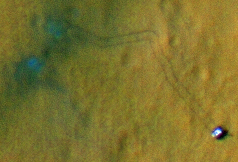
The Mars Reconnaissance Orbiter team today released a set of images showing Curiosity’s first steps on Mars, as well as some fascinating closeups of the spacecraft’s heat shield, parachute, and descent stage. The image on the left shows the tracks of the rover during its first few days of travel.
Climate changes on Mars are driven by the Sun.
Who would have thought? Climate changes on Mars are driven by the Sun.
Snark aside, the article describes how scientists have made a first attempt to link the visible layers of ice and dust at Mars’ north pole with expected past changes in climate due to the planet’s orbital variations around the Sun.
Curiosity heads east 52 feet on the first leg of its exploration of Gale Crater.The journey begins: Curiosity heads east 52 feet on the first leg of its exploration of Gale Crater.
The journey begins: Curiosity heads east 52 feet on the first leg of its exploration of Gale Crater.
Images from Curiosity have spotted some unexpected geology in Gale Crater.
Images from Curiosity have spotted some unexpected geology in Gale Crater.
A mosaic of high-definition images of Mount Sharp, the central peak dominating the landing site at Gale Crater, reveals tilted strata never before seen on Mars. The strata dip downwards at an angle close to that of the slope of the foothills of the 18,000-ft. tall mountain within which they are formed.
“The cool thing is the cameras have discovered something we were unaware of,” says mission chief scientist John Grotzinger. “This thing jumped out at us as being very different to what we expected,” he adds. Lying in the low-lying foothills beyond the dune field between the rover and the base of Mount Sharp, the inclined layers are a “spectacular feature” that could not be seen from orbit.
I think there are two reasons these tilted layers are puzzling scientists.
» Read more
Robot cavers in space.
Curiosity has made its first test drive, moving about fifteen feet.
Curiosity has made its first test drive, moving about fifteen feet.
NASA scientists in a battle with astronomers over who gets to name things on Vesta and Mars.
A rose by any other name: NASA scientists are in a battle with astronomers over who gets to name things on Vesta and Mars.
This is not a new problem. The International Astronomical Union (IAU) has maintained its power over naming everything in space since the 1960s, even though the IAU has sometimes ignored the wishes of the actual discoverers and explorers and given names to things that no one likes. For example, even though the Apollo 8 astronauts wanted to give certain unnamed features on the Moon specific names, the IAU refused to accept their choices, even though those astronauts were the first human beings to reach another world and see these features up close.
Eventually, the spacefarers of the future are going to tell the IAU where to go. And that will begin to happen when those spacefarers simply refuse to use the names the IAU assigns.
One of Curiosity’s two wind sensors has been found to be damaged and is inoperable.
One of Curiosity’s two wind sensors was apparently damaged in landing and is inoperable.
The Rems team first noticed there was something wrong when readings from the side-facing boom were being returned saturated at high and low values. Further investigation suggested small wires exposed on the sensor circuits were open, probably severed. It is permanent damage. No-one can say for sure how this happened, but engineers are working on the theory that grit thrown on to the rover by the descent crane’s exhaust plume cut the small wires. The wind sensor on the forward-facing mini-boom is unaffected. With just the one sensor, it makes it difficult to fully understand wind behaviour.
Curiosity flexed its robot arm today for the first time.
The invader prepares its attack: For the first time today Curiosity flexed its robot arm.
NASA has announced its next planetary mission, a lander to Mars that will drill down thirty feet into the planet’s surface
NASA has announced its next planetary mission, a lander to Mars that will drill down thirty feet into the planet’s surface.
Though exciting in its own right, this mission is far less ambitious than the two missions which competed against it, a boat that would have floated on the lakes of Titan and a probe that would have bounced repeatedly off the surface of a comet. I suspect the reason this mission was chosen is the tight budgets at NASA, combined with Curiosity’s success which makes it politically advantageous to approve another Mars mission. As the NASA press release emphasized,
» Read more