Ingenuity completes 32nd flight

According to a tweet from JPL, Ingenuity successfully completed its 32nd flight on Mars on September 18, 2022.

The 55.3-second flight covered 93.74m at a max speed of 4.75 meters per second.

That is about 308 feet distance, comparable to the helicopter’s previous flight. Though it probably continued to the west, as with that last flight, JPL’s tweet did not provide any directional information.

This second short hop in a row however suggests that the team’s focus has definitely shifted from scouting for Perseverance to practicing precision landings, thus gathering data to help build the future Martian helicopter that will be used to pick up Perseverance’s core samples some time in the future.
0 comments

Want to do a virtual hike in Jezero Crater on Mars? You can!

Using data from Mars orbiters, Perseverance, and Ingenuity, scientists have now created a virtual hiking map of Jezero Crater, allowing anyone to explore in detail the same places that the rover and helicopter have visited.

You can view the map here. From the press release:

The map allows virtual hikers to zoom in and out, and pan rapidly across scenes, so that they can explore the landscape from large scales down to centimetre-detail. Some of the 360ยฐ panoramas integrated with the waypoints have been synthetically rendered from orbital image data. Others are real panoramas stitched together from a multitude of single images taken by the Mastcam-Z camera instrument onboard the Mars 2020 Rover Perseverance, which have been provided by the University of Arizona. The sounds have been recorded by the SuperCam instrument on that same rover mission.

I’ve played with the map only a little, but find it quite amazing and useful, especially because it seems to work well on my relatively ordinary desktop Linux computer.

0 comments

InSight’s power level holding steady

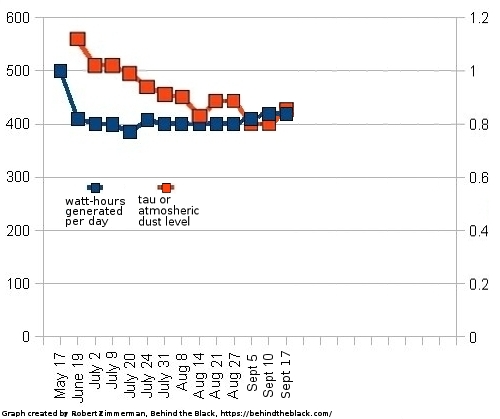
InSight's on-going power levels

The Energizer bunny of Mars, the InSight lander, continues to hold on. The engineering team tonight issued another status report, as shown in the graph to the right. For the past week the lander continued to produce 420 watt-hours per day, even though the tau level of dust in the atmosphere increased from 0.8 to 0.85.

The tau level of dust outside of the winter dust season is normally between 0.6 and 0.7. Even though Mars is moving out of winter, that level has increased slightly above InSight. And yet, even with a higher dust content and thus less sunlight, the lander’s dust-covered solar panels are generating power, at a very slightly higher level.

The InSight team had expected the lander to die in early September, at the latest. Instead, it keeps running, thus allowing it to detect on September 5th an impact created by a cluster of three asteroids, the first time scientists have ever pinpointed exactly when such a new impact occurred on Mars.

For the lander to survive for even longer, all it needs is one gust of wind across the solar panels to clean them off. The science team had expected this to happen periodically, based on past experience with the Spirit and Opportunity rovers. Unfortunately for InSight, it has not yet happened even once since it arrived on Mars in 2018. Nonetheless, it only has to happen once to save the lander.

Stay tuned. All is not yet lost.

2 comments

The strange scattered rocks of Gediz Vallis on Mars

The strange rocks of Gediz Vallis
Click for full image.

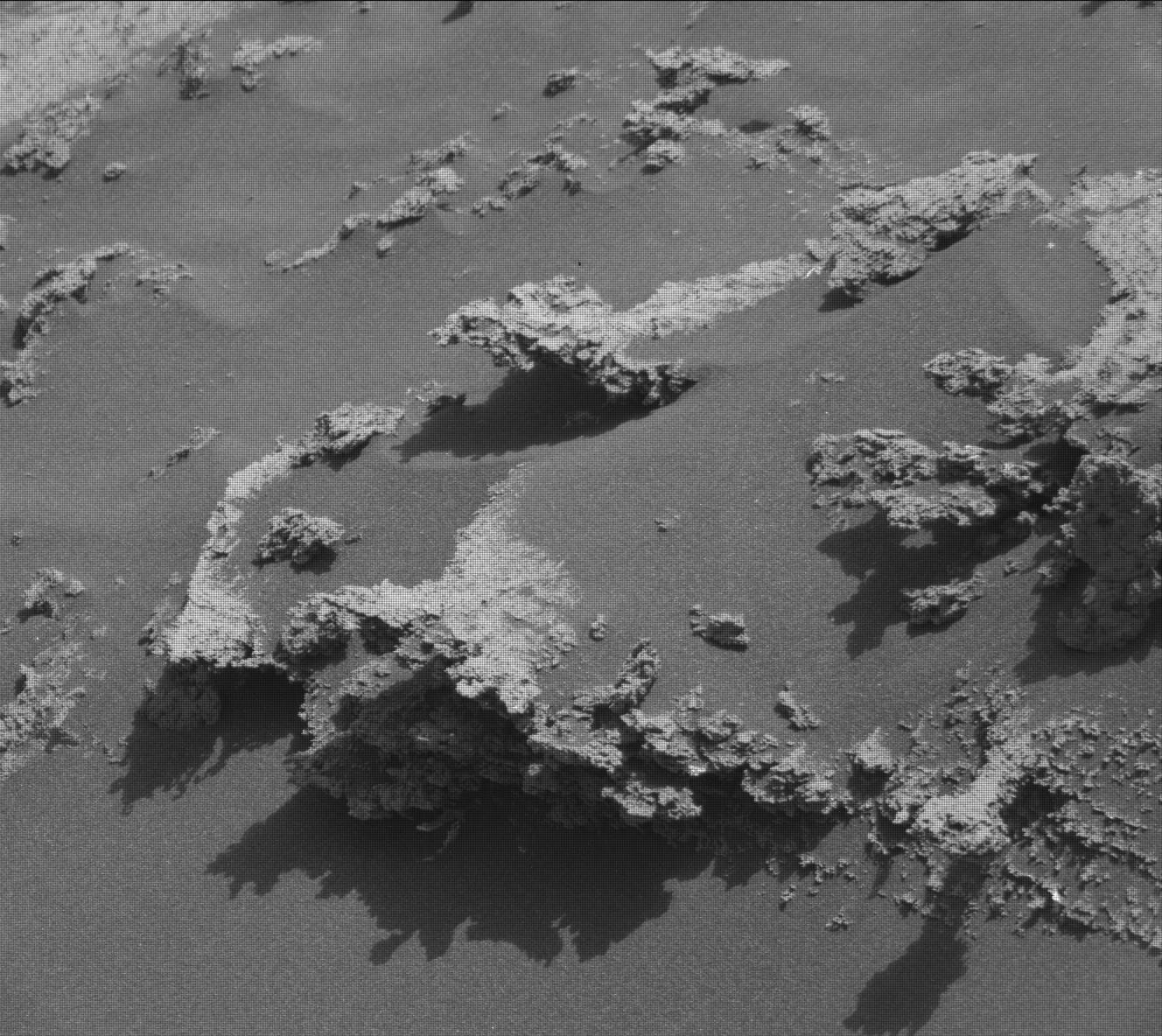
Cool image time! The photo to the right, reduced to post here, was taken on August 20, 2022 by Curiosity’s high resolution camera. It shows some of the scattered and very delicate rocks that it is finding on the floor of Gediz Vallis, the valley the rover had been striving for since landing more than a decade ago and finally entered in mid-August.

Because of Mars weak gravity, about 39% of Earth’s, and very thin atmosphere, about 1% of Earth’s, it is possible for surface rocks to erode into such delicate shapes. The shapes appear to be further encouraged by the many layers that exist in Mars, with each layer having different characteristics. In the case of the hanging flakes to the right, these layers were more resistant to erosion and thus remains intact while material above and below was slowly blown away.

0 comments

InSight’s seismometer detects its first new impact on Mars

Martian impact discovered by InSight
Click for full image.

Using data from InSight’s seismometer that suggested a new impact had occurred at a specific location on September 5, 2022 on Mars, scientists used the high resolution camera on Mars Reconnaissance Orbiter (MRO) to search and find that impact.

The photo to the right, reduced to post here, is that MRO photo.

The initial impact itself created a small marsquake that was detected by InSight’s seismometer. The instrument recorded seismological data that showed the moment the meteoroid entered Mars’ atmosphere, its explosion into pieces in the atmosphere, and finally, the impact that created a series of at least three craters in the surface.

MRO then flew over the approximate site where the impact was “felt” to look for darkened patches of ground using its Context Camera. After finding this location, HiRISE captured the scene in color. The ground is not actually blue; this enhanced-color image highlights certain hues in the scene to make details more visible to the human eye โ€“ in this case, dust and soil disturbed by the impact.

This was thus the first new Martian impact detected based on its actual occurrence, rather than simply finding a change between two photos taken at different times. The latter only tells you a time period when the impact occurred. InSight’s detection here marks the impact’s exact moment.

Nor is this the only such discovery. It appears that InSight detected at least two other impacts (here and here), that only subsequently were linked to MRO impacts. In those cases, the new impact had already been found by MRO, and only afterward were scientists able to identify its seismic vibration in InSight data, thus pinpointing the exact date it took place.

0 comments

Webb takes its first infrared image of Mars

Webb's first infrared image of Mars
Click for full image.

Astronomers have now released the the James Webb Space Telescope’s first infrared image of Mars, taken on September 5, 2022.

The image to the right, cropped and reduced to post here, shows some of the data obtained. Because Mars is so close, it is actually too bright for Webb’s instruments. To get any data, the exposures were very very short, and still the brightest areas — as indicated by large areas of yellow — are overexposed. The cause of the different brightness of Hellas Basin, however, is not simply because the basin — the deepest point on Mars — is cooler.

As light emitted by the planet passes through Marsโ€™ atmosphere, some gets absorbed by carbon dioxide (CO2) molecules. The Hellas Basin โ€“ which is the largest well-preserved impact structure on Mars, spanning more than 1,200 miles (2,000 kilometers) โ€“ appears darker than the surroundings because of this effect. โ€œThis is actually not a thermal effect at Hellas,โ€ explained the principal investigator, Geronimo Villanueva of NASAโ€™s Goddard Space Flight Center, who designed these Webb observations. โ€œThe Hellas Basin is a lower altitude, and thus experiences higher air pressure. That higher pressure leads to a suppression of the thermal emission at this particular wavelength range [4.1-4.4 microns] due to an effect called pressure broadening. It will be very interesting to tease apart these competing effects in these data.โ€

The NASA press release says the scientists are preparing a paper analyzing the spectral data and what it revealed about “dust, icy clouds, what kind of rocks are on the planetโ€™s surface, and the composition of the atmosphere,” I suspect however that Webb’s capabilities for studying Mars are much more limited than implied, and that it will over time take much fewer images of the red planet, compared to Hubble.

0 comments

Deep inside the youngest flood lava event on Mars

Deep inside the youngest flood lava event on Mars
Click for full image.

Cool image time! Today we return to the Athabasca Valles flood lava event, believed to be the youngest major lava event on Mars that I highlighted in a cool image last week.

Then, I showed two meandering lava flows near the edge of this Great Britain-sized flood lava plain, produced 600 million years ago in only a matter of weeks. Today, we take a look deep within the lava plain. The photo to the right, rotated, cropped, and reduced to post here, was taken on May 6, 2022 by the high resolution camera on Mars Reconnaissance Orbiter (MRO). It shows what the scientists label “a lava-crater interaction.”

In plain English, we are looking at a crater that has been inundated by the flood lava, filling it.
» Read more

1 comment

September 15, 2022 Quick space links

Courtesy of BtB’s stringer Jay, who trolls Twitter so I don’t have to.

0 comments

The shattered cliffs of Mount Sharp

A broken cliff on Mars

Cool image time! The picture above was taken on August 11, 2022 by the left navigation camera on the Mars rover Curiosity. It shows a great example of the strange manner in which the bedrock in the layered cliffs on Mount Sharp appear to break apart.

I am not certain exactly where this feature is, or its exact scale, but based on the date and where Curiosity was located when the photo was taken, it likely is a small section from one of two hills, Deepdale and Bolivar, that Curiosity passed between in mid-August. It is likely somewhere in the panorama included in my August 11th post, but I have not yet been able to locate it.

Nonetheless, the breakage here is typical of these cliff faces. The structural strength of these layered hills is not very high, so at some point one section can break away from another as the hill sags downward to the left. What makes the cracks here more intriguing is that something caused the higher sections surrounding the main block to widen. On Earth we would assume that this widening was caused by rainwater pouring in from the top. On Mars, that explanation doesn’t hold water.

Wind? Seasonal thermal changes? Neither explains the change in the width of the cracks along their length. Maybe the wider cracks indicate an increased sagging of the hill to the left. The layers below this broken block have simply not slid to the left as much.

1 comment

InSight’s power levels rise again

InSight's power levels through September 10th

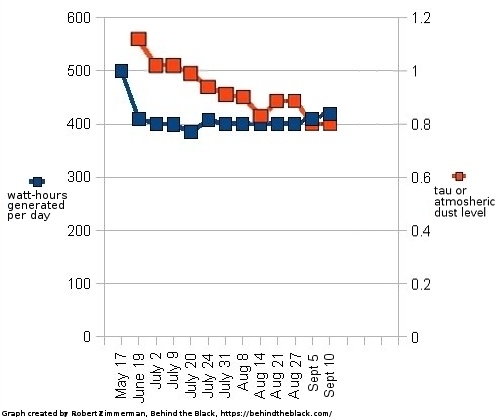
Based on another status update issued today by the InSight science team, the electricity generated by the Mars lander’s dust-covered solar panels increased again slightly in the past week, going from 410 watt-hours per day to 420 watt-hours per day.

The graph to the right shows the trends since May. The science team had expected the power levels to steadily drop throughout the summer so that by early September the lander would die.

Instead, the power levels remained steady throughout the summer, and have in the past two weeks actually risen slightly, thus extending InSight’s life.

If at any moment a strong gust of wind or dust devil sweeps over InSight, the panels could be blown clear and it would gain a rebirth. The longer it manages to survive, the greater the chance that this might happen.

0 comments

InSight’s power level goes up!

InSight's power levels as of September 5, 2022

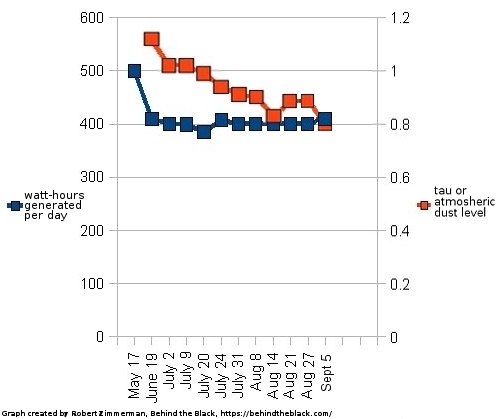
The most recent status update on the Mars lander InSight, released today, shows a slight rise in the amount of power generated by its dust-covered solar panels.

As shown on the graph to the right, on August 27, 2022 the power level was 400 watt-hours generated per Martian day. On September, 5, 2022, the power level was 410 watt-hours per Martian day, the first power increase since late July. At the same time, the dust in the atmosphere continued to clear, going from a tau level of .88 to 0.8. Outside of the winter dust season tau is usually between 0.6 and 0.7.

The slight power increase continues to suggest that the lander’s death might be delayed. At 400 watt-hours per day, it has been able to run its seismometer since the beginning of July. With this slight increase, the chance increases that InSight will finally get that one gust of wind or dust devil that will blow the dust off its solar panels and allow it to recover some power and operate for longer.

1 comment

Crazy badlands in the equatorial region of Mars

Badlands in the equatorial regions of Mars
Click for full image.

Cool image time! The photo to the right, rotated and cropped to post here, was taken on June 17, 2022 by the high resolution camera on Mars Reconnaissance Orbiter (MRO). The section highlighted is at full resolution, in order to make clear the absolutely crazy and complex terrain seen in the full image.

This terrain is not glacial, as the location is only about 1 degree south of the Martian equator. There might have been surface or near surface ice here once in the past, but there is none now.

Could we be looking at some form of lava flow? This is possible, because a close look at the context map at the image link suggests this region has been partly covered by some material, obscuring some craters to the east and west. However, there is no visible evidence anywhere in this region of a volcanic vent or caldera. If this covering material was volcanic it is very unclear where it came from.

The overview map below does not really provide any answers, but at least gives the context.
» Read more

5 comments
1 65 66 67 68 69 212