Martian crater and mesa sculpted by ancient flow

Martian crater and mesa sculpted by ancient flow
Click for full image.

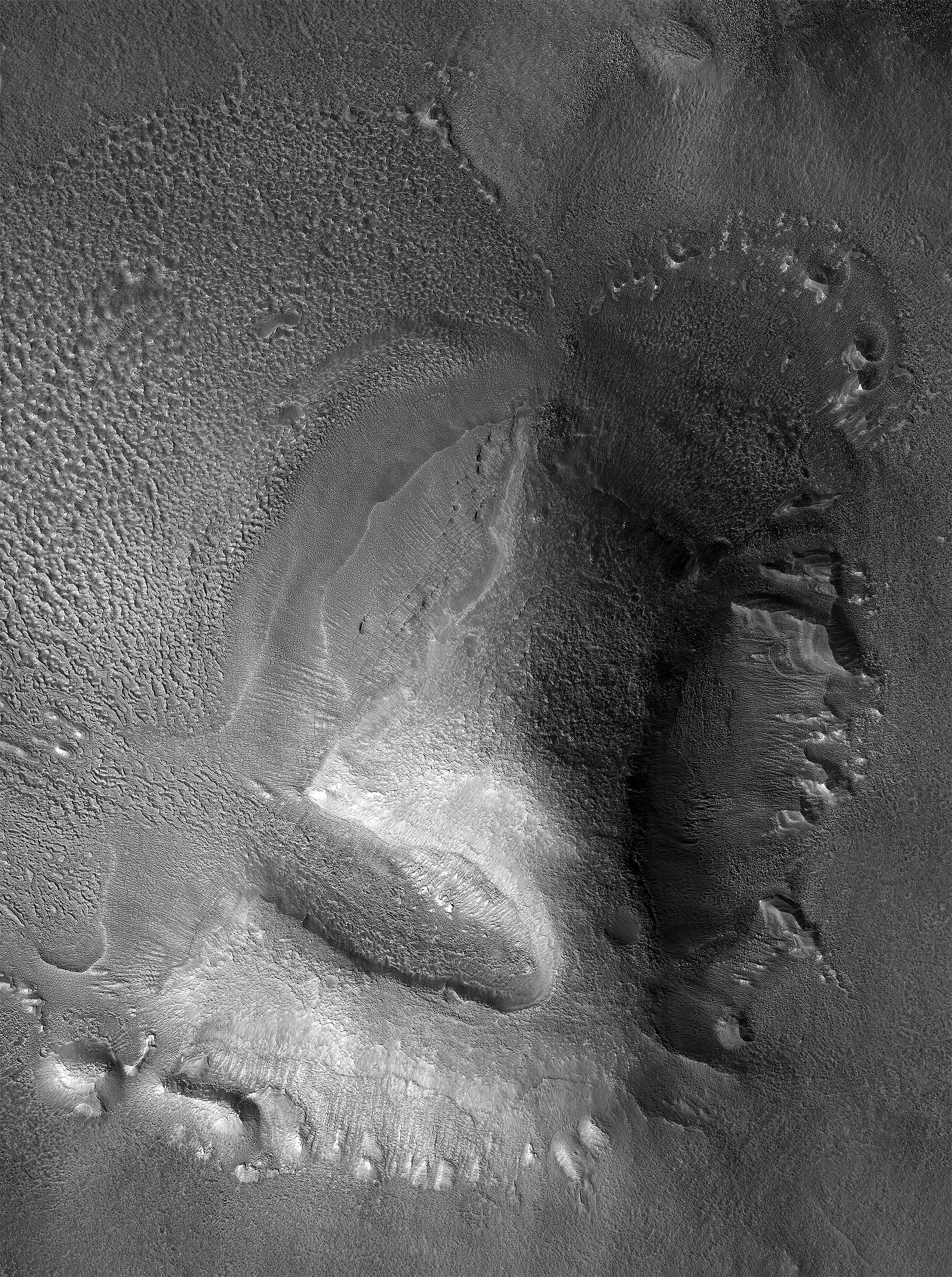
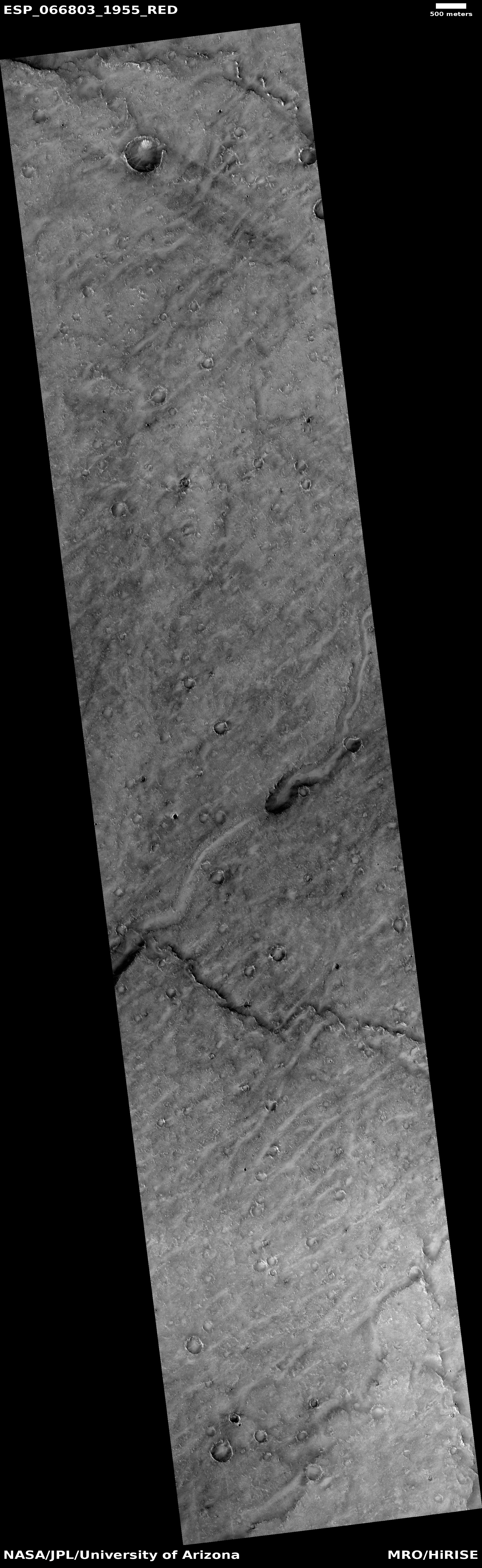
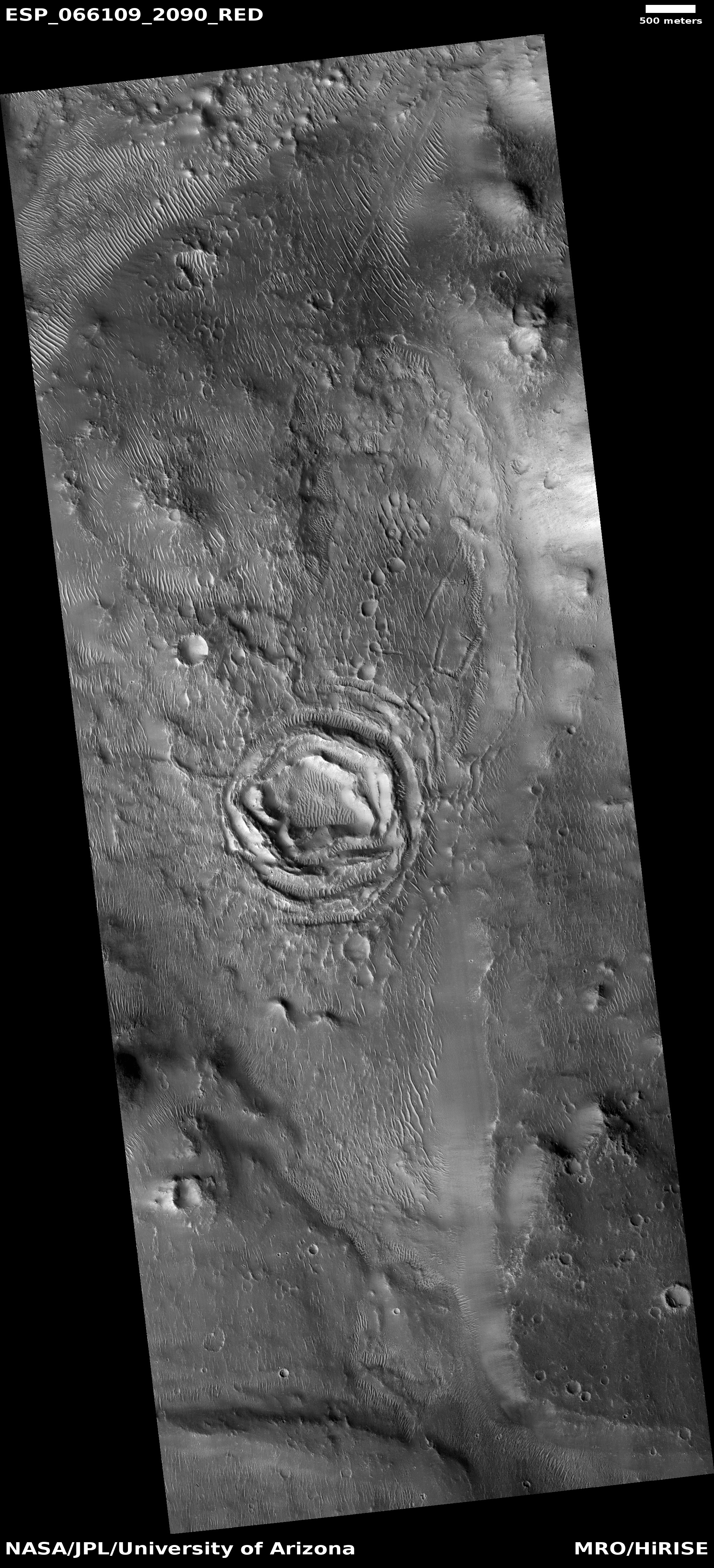
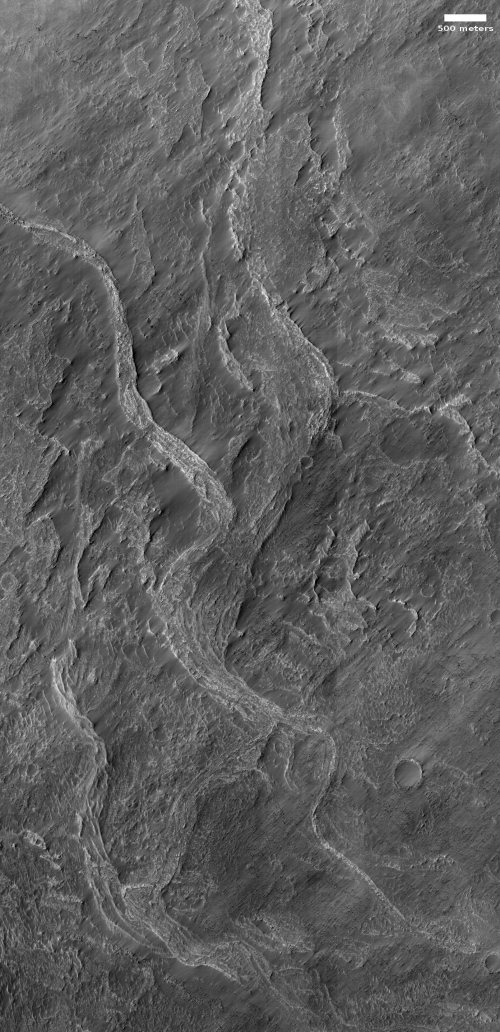
Cool image time! The picture to the right, rotated, cropped, and reduced to post here, was taken on June 15, 2022 by the high resolution camera on Mars Reconnaissance Orbiter (MRO). It shows a crater whose ejecta has been sculpted to the east into a teardrop-shaped mesa by some ancient flow, coming from the west.

The crater itself is located in one of several outflow canyons draining out from the volcanic Tharsis Bulge into the northern lowland plain of Chryse Planitia, the biggest of which is Valles Marineris. This particular canyon is one of the smaller and is dubbed Ravi Vallis.

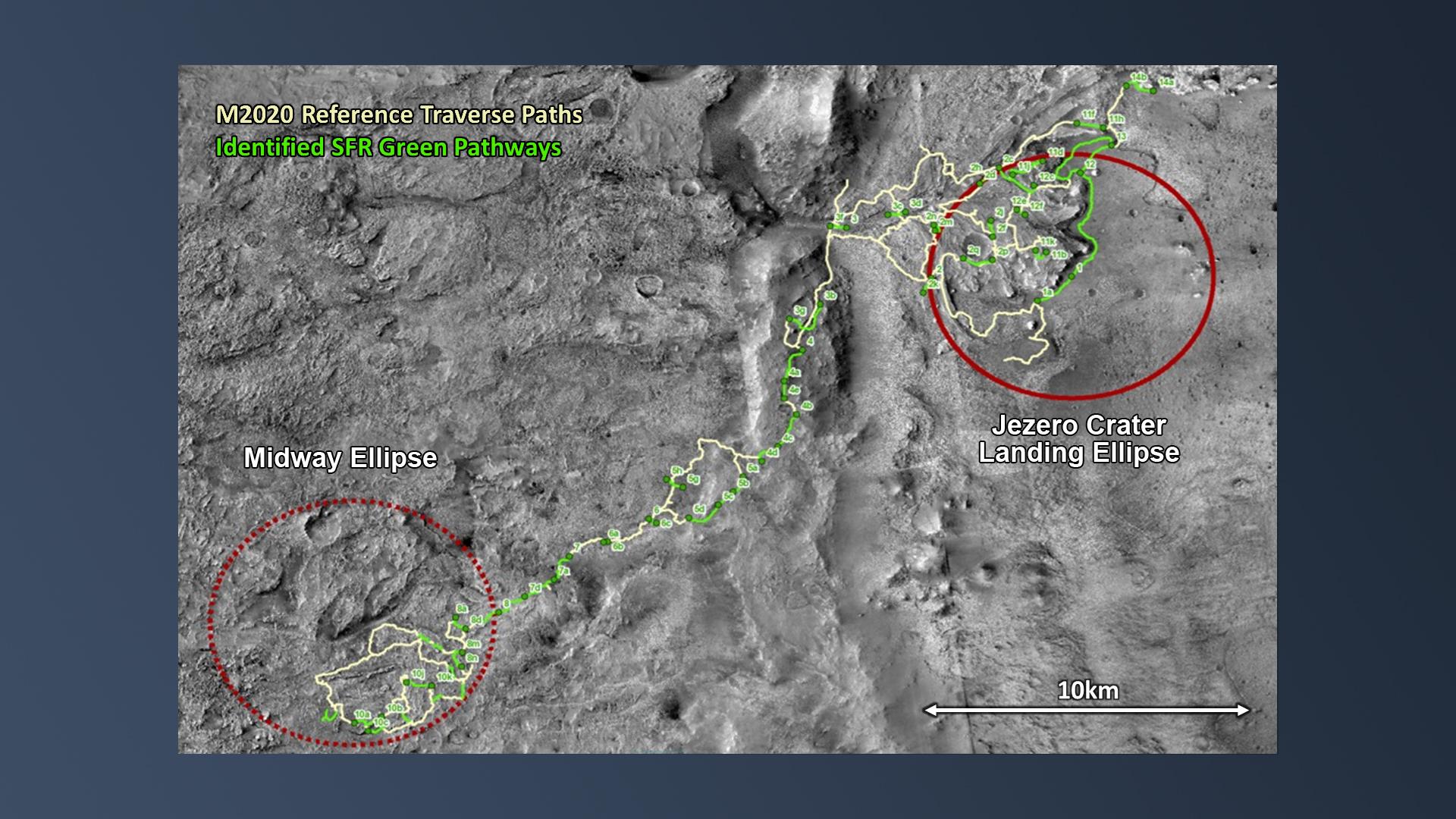
The overview map below illustrates why many scientists think the flow that shaped this mesa came from a catastrophic flood of liquid water, billions of years ago.
» Read more

2 comments

Another “What the heck?” formation on Mars

Another
Click for full image.

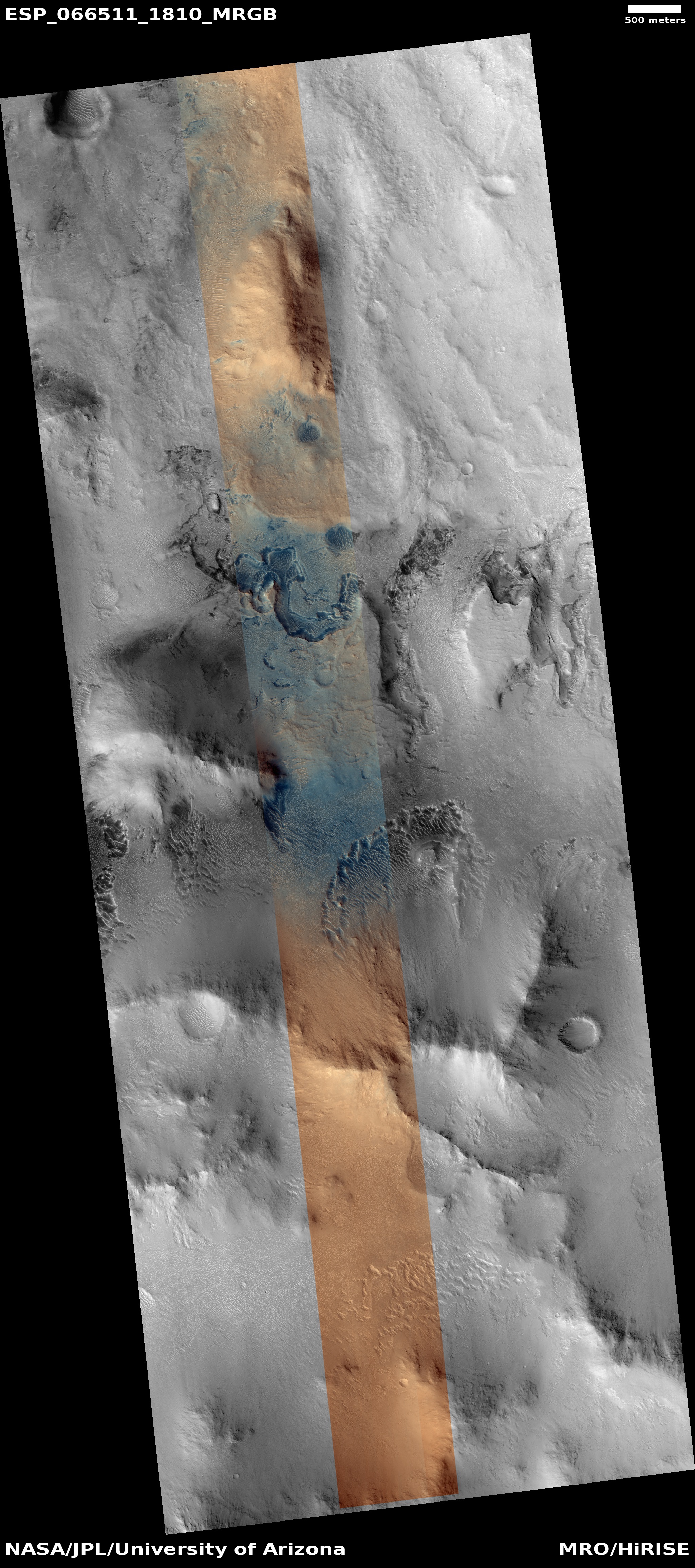
Cool image time! The photo to the right, cropped, reduced, and enhanced to post here, was taken on May 28, 2022 by the high resolution camera on Mars Reconnaissance Orbiter (MRO), and shows what the scientists label “unique terrain.”

I have increased the contrast to bring out the details. It appears that we have a flat plain of criss-crossing ridges that in large areas have somehow gotten flattened across their top. Imagine someone laying plaster on a wall and using a scraper tool to smooth the surface, but only partially. In this case on Mars, our imaginary worker only smoothed the surface a little, and only in some areas. To try to come up with a geological process however to explain this seems daunting.

And what created the criss-crossing ridges? The overview map provides only a little help in answering these questions.
» Read more

5 comments

Tiny cobbles on Mars

Tiny cobbles on Mars

Our second cool image takes us from grand galaxies, one of the universe’s largest coherent objects, to tiny cobbles on Mars. The picture to the right, taken by one of Perseverance’s close-up cameras on September 29, 2022, covers an area less than an inch across, making the largest rounded pebbles in this image only a few millimeters in size.

The rover presently sits on the floor of Jezero Crater, at the base of the delta that flowed into that crater eons ago. The data suggests that delta was created by flowing water entering a lake that filled the crater.

Did flowing water create these cobbles? These pebbles all have the look of the rounded cobble one finds either in river beds, or in glacial moraines. In both cases, the flow of the water or ice rolls the rocks along until they become rounded.

5 comments

India’s Mars orbiter mission ends after eight years

After eight years in orbit around Mars, India’s Mars orbiter mission, Mangalyaan, has run out of fuel for controlling its orientation, ending its mission.

The Rs 450 crore Mars Orbiter Mission was launched onboard PSLV-C25 on November five, 2013, and the MOM spacecraft was successfully inserted into Martian orbit on September 24, 2014 in its first attempt. “Right now, there is no fuel left. The satellite battery has drained,” sources in the Indian Space Research Organisation (ISRO) told PTI. “The link has been lost”.

There was, however, no official word from the country’s national space agency, headquartered here.

During its mission it produced more than a thousand images, though the mission’s primary objective was technological, proving that India itself could design, build, launch, and manage a planetary mission to another world. For India, Mangalyaan was thus an unqualified success.

0 comments

Fabric debris spotted on Ingenuity during 33rd flight

Tattered fabric debris on Ingenuity's leg during flight
Click to see full movie of flight.

In reviewing the images from Ingenuity’s 33rd flight on September 24, 2022, engineers have spotted what looks like a tattered piece of fabric fluttering on the end of one of the helicopter’s legs, and then disappearing.

The image to the right, cropped, enhanced, and labeled to post here, comes from an animation created from all images taken during the flight.

A small piece of foreign object debris (FOD) was seen in footage from the Mars helicopter’s navigation camera (Navcam) for a portion of its 33rd flight. This FOD was not visible in Navcam footage from the previous flight (32). The FOD is seen in Flight 33 Navcam imagery from the earliest frames to approximately halfway through the video, when it fell from the leg and drifted back to the Mars surface.

The engineers do not yet know what this was, but it apparently caused no harm to the helicopter. It also is likely not from either Ingenuity or Perseverance, as both are functioning perfectly. Most likely it is a piece of the parachute used during landing and then ejected.

7 comments

Ingenuity completed 33rd flight this past weekend

This notice is a bit late, but then, there really isn’t much to report. According to the Ingenuity flight log, engineers successfully completed the helicopter’s 33rd flight on September 24, 2022, flying about 364 feet for 55 seconds.

The plan had been to fly 365 feet for 55.6 seconds, so that matched their plan almost exactly. According to the interactive map that tracks the movement of both the rover Perseverance and the helicopter, this flight continued the helicopter’s movement almost due west, bringing it closer to the rover so as to facilitate communications.

The primary goal of Ingenuity’s engineering team at this time is to refine the accuracy of their software in order to better understand how to fly robots on Mars. This will help prepare the next helicopters for future missions.

3 comments

More glaciers in Mars’ glacier country

Overview map

glacial layering in Clasia Vallis
Click for full image.

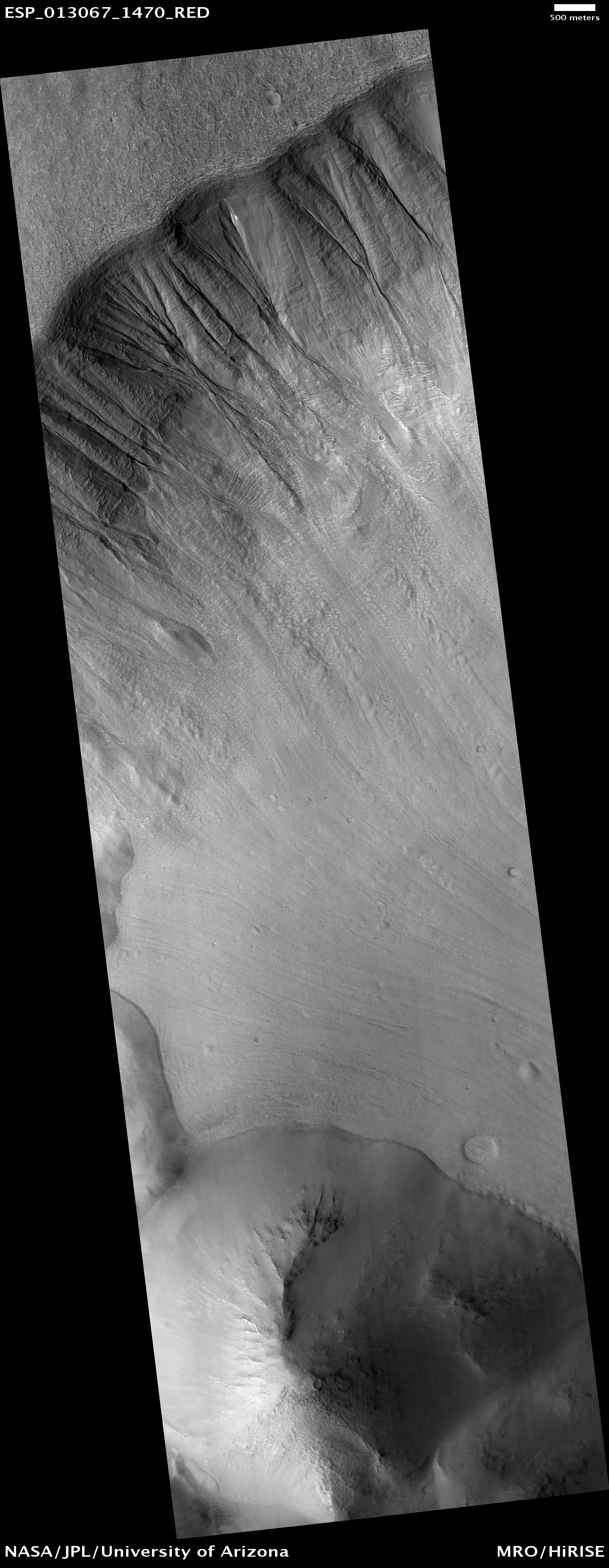
Cool image time! The photo to the right, rotated, cropped, and reduced to post here, was taken on June 18, 2022 by the high resolution camera on Mars Reconnaissance Orbiter (MRO). It shows what appear to be layered glacial features on the floor of what at first glance appears to be a crater.

It is not a crater however. The depression in the lower right of this image is the rim and floor of a 77-mile-long meandering canyon on Mars dubbed Clasia Vallis. The red cross in the overview map above marks its location, at 34 degrees north latitude. This channel drains downward from the southern cratered highlands into the 2,000-mile-long mid-latitude strip of mensae terrain that I dub glacier country because almost every hi-res image from this region shows glacial features.

Below is a wider view of Clasia Vallis, taken by the context camera on MRO on March 19, 2014.
» Read more

0 comments

Radar data from Zhurong finds no ice to a depth of 260 feet

Zhurong's ground-penetrating radar data

Overview map

Chinese scientists today finally published their results from the ground-penetrating radar instrument on their Mars rover Zhurong, revealing that to a depth of 260 feet (80 meters), it detected no clear signal of water ice.

Figure 2 of their paper, posted above, summarizes their results. It shows the radar profile to 328 feet (100 meters) depth along Zhurong’s route, as shown in the map to the right, with the last bit of its recent travels ending somewhere in the blue circle. From the paper:

Our low-frequency radar imaging profile shows radar signals within the depth range of 0–80 m (Fig. 2a), precluding the existence of a water-rich layer within this depth range as the existence of water would strongly attenuate the radar signals and diminish the visibility of deeper reflections. The estimated low (less than 9) dielectric permittivity (Fig. 2c) further supports the absence of a water-rich layer as water-bearing materials typically have high (greater than 15) dielectric permittivity.

We further tested this assessment with thermal considerations by conducting a heat conduction simulation based on available thermal parameters estimated from previous studies (Methods). Our thermal simulation results … show that the Zhurong landing area has an annual average temperature of around 220K in the RoPeR detection depth range, which is much lower than the freezing point of pure water (273K), and also lower than the eutectic temperatures of typical sulfate and carbonate brines, but slightly above those of perchlorate brine systems. This observation suggests that the shallow subsurface of the Zhurong landing area could not stably contain liquid water nor sulfate or carbonate brines, consistent with the radar imaging result.

The data suggests that below the surface topsoil layer, the regolith, there are two distinct layers of material that the scientists interpret as possible evidence of past catastrophic floods. That conclusion however is very very uncertain. The main take-away is that in the northern lowland plains of Utopia Planitia at 25 degrees north latitude, where Zhurong landed, Mars is definitely a dry desert, with no water close to the surface.

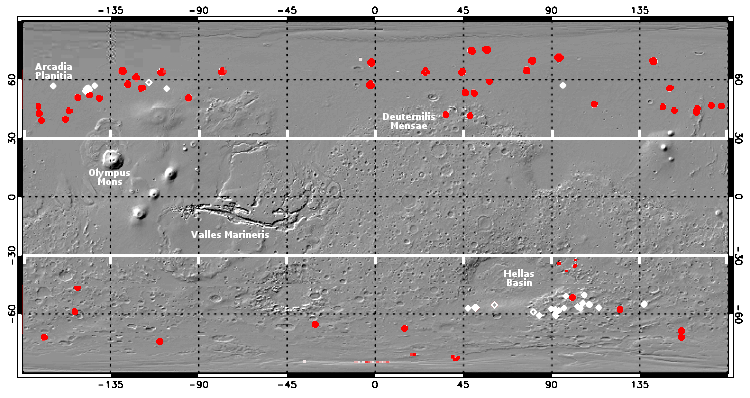
This data also suggests that if you establish a colony anywhere in Mars’ dry equatorial regions within 30 degrees latitude of the equator, you will likely have to travel north or south a considerable distance to get to easily accessible ice. The global map of Mars below shows the regions where ice is most evident, north and south of 30 degrees latitude.
» Read more

2 comments

Zig-zag ridges on Mars

Zig-zag ridges on Mars
Click for full image.

Cool image time! The photo to the right, cropped and reduced to post here, was taken on April 9, 2022v by the high resolution camera on Mars Reconnaissance Orbiter (MRO). It shows a series of parallel zig-zag ridges in a flat, knobby terrain.

I don’t presume to explain this at all. According to one research paper,

This interplana region consists of extensive networks of ridges—the eponymous Aeolis Dorsa—and is interpreted as having formed by topographic inversion of fluvial and alluvial deposits.

Why these ridges zig-zag however does not seem to fit into either a fluvial or alluvial explanation, both of which involve the flow of water. The quote implies these could be inverted stream channels (where the compacted streambed becomes a ridge when the surrounding terrain erodes away), but once again, the distinct zig-zag pattern seems wrong. Rivers meander, but they don’t generally turn right and left so sharply. And why should we see parallel zig-zags? This doesn’t seem to fit with a river channel origin.

The particular location, as shown on the overview map below, is close to the dry Martian equator, on the edge of Medusae Fossae Formation, the largest field of volcanic ash dust on Mars.
» Read more

1 comment

Above ground and underground Martian drainages

Overview map

Cool image time! Today we are going to zoom into our cool image. The overview map to the right provides us the context. Our target is the small white rectangle inside the small box just below the north rim of 185-mile-wide Newton Crater, located 200 to 800 miles from the southwest edge of the lava plains dubbed Daedalia Planum that flowed down from Mars’s biggest volcanoes.

Newton Crater has a number of interesting features. Only two weeks ago I featured 4-mile-wide Avire Crater in Newton’s western quadrant, long known to have many gullies on its interior slopes as well as glacier features on its floor. Scientists have been monitoring those gullies now for more than a decade to see if they change seasonally, in a attempt to figure out their cause.

Today’s cool image looks at the very intriguing meandering canyons that appear to flow south from Newton’s north rim.
» Read more

0 comments

Martian layers everywhere!

Layers in Argyre Basin
Click for full image.

Cool image time! The photo to the left, rotated, cropped, and reduced to post here, was taken on June 1, 2022 by the high resolution camera on Mars Reconnaissance Orbiter (MRO). It shows the rim edge to a fifteen-mile-wide canyon, with many apparent layers exposed on the high plateau.

The layers are intriguing in that they suggest several things. First, they give us a glimpse into the top and youngest layers that make up the interior canyon wall. Second, they tell us that erosion has removed much of those top and youngest layers, resulting in the mesas on that plateau.

Finally, the gullies flowing down into the canyon indicate further erosion processes, eating away at the canyon wall over time.

The location of this canyon is also intriguing.
» Read more

1 comment

Another model attempts to show how liquid water could have once existed on Mars

The uncertainty of science: Scientists today published a new model that attempts to show how it was possible in the distant past for liquid water to have existed on the surface of Mars.

New research published in Earth and Planetary Science Letters suggests that Mars was born wet, with a dense atmosphere allowing warm-to-hot oceans for millions of years. To reach this conclusion, researchers developed the first model of the evolution of the Martian atmosphere that links the high temperatures associated with Mars’s formation in a molten state through to the formation of the first oceans and atmosphere. This model shows that — as on the modern Earth — water vapor in the Martian atmosphere was concentrated in the lower atmosphere and that the upper atmosphere of Mars was “dry” because the water vapor would condense out as clouds at lower levels in the atmosphere. Molecular hydrogen (H2), by contrast, did not condense and was transported to the upper atmosphere of Mars, where it was lost to space. This conclusion – that water vapor condensed and was retained on early Mars whereas molecular hydrogen did not condense and escaped – allows the model to be linked directly to measurements made by spacecraft, specifically, the Mars Science Laboratory rover Curiosity.

As a model, this theory proves nothing, though it is very intriguing. The scientists propose that the heat from the planet’s interior replaces the known lack of energy that came from the Sun in Mars’ far past. While this could work, what makes it very uncertain is that its surface data is based on a single measurement from Curiosity, hardly a deep and convincing baseline.

0 comments
1 64 65 66 67 68 212