
Chinese cubesat using Saudi Arabian camera sends back first pictures

A Chinese cubesat, launched as a secondary payload with China’s lunar communications satellite for its upcoming Chang’e-4 mission, used a Saudi Arabian camera to successfully send back its first images this week.

Two of the three images show the Earth rising above the lunar horizon. The third looks down at the Moon’s cratered surface.

These images I think are the first interplanetary images ever taken and successfully transmitted to Earth by a interplantary cubesat mission. Both China and Saudi Arabia should be lauded for the success. It proves that cubesats have the potential to do everything that fullsize satellites do, at much lower cost, and therefore marks the beginning of a revolution in unmanned planetary spacecraft design.

In related news, that lunar communications satellite has now officially reached its Lagrande point.

The satellite, named Queqiao (Magpie Bridge) and launched on May 21, entered the Halo orbit around the second Lagrangian (L2) point of the Earth-Moon system, about 65,000 km from the Moon, at 11:06 a.m. Thursday after a journey of more than 20 days. “The satellite is the world’s first communication satellite operating in that orbit, and will lay the foundation for the Chang’e-4, which is expected to become the world’s first soft-landing, roving probe on the far side of the Moon,” said Zhang Hongtai, president of the China Academy of Space Technology (CAST).

The concept of the Halo orbit around the Earth-Moon L2 point was first put forward by international space experts in 1950s.

While in orbit, the relay satellite can see both the Earth and the far side of the Moon. The satellite can stay in the Halo orbit for a long time due to its relatively low use of fuel, since the Earth’s and Moon’s gravity balances the orbital motion of the satellite.
0 comments

Woman sues NASA to keep possession of moon dust

A Tennessee woman is proactively suing NASA in order to guarantee the agency will not try to steal a vial of moon dust that Neil Armstrong gave to her in the early 1970s.

Murray Cicco received the small glass vial full of gray moon dust in the early 1970s. The vial came with a note: “To Laura Ann Murray — Best of luck — Neil Armstron Apollo 11.” …Armstrong’s note and signature have been verified and testing has confirmed the contents in the vial he gifted her do include dust from the moon.

Decades after receiving the glass vial of moon dust, Murray Cicco is moving forward with her federal court case in Wichita, even though she lives in Tennessee. The reason for filing the case in Kansas goes back to a previous case in 2016 where a U.S. District Court judge in Wichita ruled in favor of a collector who bought a bag containing moon dust that was mistakenly placed in an online government auction. In that case, the bag was then sold at auction last year for $1.8 million.

While NASA hasn’t demanded Murray Cicco give up the vial of moon dust, Murray Cicco’s attorney has requested a jury trial in Wichita to stay ahead. “There is no law against private persons owning lunar material. Lunar material is not contraband. It is not illegal to own or possess,” the court document detailing the case says. “Therefore, she requests judgment declaring her the rightful and legal owner of the vial and its contents, and vesting title in her name.”

This is a very wise move on her part. NASA has for years made it clear that it thinks it owns all moon material brought back by the Apollo missions, and has had the arrogant policy of demanding the return of any moon dust or rocks that it discovered was in the possession of any private citizen, no matter how small, or how well documented the ownership. This court case acts to block such actions, before NASA can even think of them.

5 comments

China loses contact with one of two lunar cubesats

China has lost contact with one of the two test cubesats that were launched to the moon with their Queqiao Chang’e-4 communications satellite.

Though they continue to receive telemetry from one cubesat, without the second they will be unable to do the radio astronomy and interferometry experiments planned.

The interferometry experiments would have seen the observations made simultaneously by the DSLWP/Longjiang microsatellites to be combined. The test would be verification of technology for a constellation of small, low-frequency radio astronomy satellites that would emulate a telescope with a size equal to the maximum separation between the satellites.

The Chang’e-4 mission could however see some interferometry tests carried out, with Queqiao carrying the Netherlands-China Low-frequency Explorer (NCLE) astronomy instrument, and a Low Frequency Spectrometer (LFS) on the Chang’e-4 lander, which is expected to launch in November or December, following testing of Queqiao.

All is not lost. The cubesat that still functions has a camera, built in Saudi Arabia, and if it takes and successfully transmits any pictures this will be a cubesat landmark, the first interplanetary images ever taken by a cubesat.

Meanwhile, Queqiao Change’-4 is working as expected, laying the ground work for the launch of the Chang’e-4 lander later this year.

1 comment

China, the Moon, and the Outer Space Treaty

Link here. The article speaks to the problems of sovereignty, ownership, and political borders created by the language of Outer Space Treaty, specifically illustrated now by China’s newest effort to put a lander on the far side of the Moon.

[This] pioneering space travel has raised concern that China is also interested in the tiny spots on the moon that never go dark, the polar peaks of eternal light. Those peaks are vanishingly small, occupying one-one hundred billionth of the lunar surface − roughly equivalent to three sheets of NHL ice on Earth. But their near-ceaseless sunshine gives them great value as a source of solar energy, to power everything from scientific experiments to mining operations.

Their small size could also, scientists have argued, allow one country to take sole occupancy of this unique real estate without falling afoul of the Outer Space Treaty. That agreement stipulates that no state can exert sovereignty in outer space. But it also calls on countries “to avoid interference” with equipment installed by others.

That provides a loophole of sorts, researchers say. The installation of very sensitive equipment on the peaks of eternal light, such as a radio telescope − a 100-metre long uncovered wire used to study transmissions from the sun, and deeper corners of the universe − could use up much of the available space while also providing a rationale to bar others from the area on the grounds that the telescope is too sensitive to be disturbed.

“Effectively a single wire could co-opt one of the most valuable pieces of territory on the moon into something approaching real estate, giving the occupant a good deal of leverage even if their primary objective was not scientific inquiry,” researchers from Harvard University, King’s College London and Georg-August Universitat Gottingen wrote in a 2015 paper.

Because the Outer Space Treaty outlaws any nation from claiming territory, it provides no method for any nation, or private company, to establish its borders or property rights. To protect what they own nations are therefore will be forced to create their own rules, willy-nilly, such as the one speculated above. And when they disagree, only the use of force will be available to either defend or defy these arbitrary rules.

5 comments

China launches two test cubesats to the Moon

The launch this week of a Chinese communications relay satellite to be used for its Chang’e-4 lunar lander also included the launch of two test cubesats designed to test such satellites in interplanetary space.

One of the two Longjiang (‘dragon river’) microsatellites that launched with Queqiao but set to operate together in lunar orbit, carries an optical microcamera (Arabic) developed by the King Abdulaziz City for Science and Technology (KACST) of Saudi Arabia.

The instrument weighs around 630 g and is capable providing images of the Moon with a resolution of 38 m per pixel at a perilune of 300 km and 88 m per pixel at the expected apolune of 9, 000 km away the lunar surface.

The Longjiang-1 and -2 satellites, developed by Harbin Institute of Technology (HIT) in Northeast China, will test low-frequency astronomy and space-based interferometry in lunar orbit. However, they also carry amateur radio payloads, meaning amateurs can send commands to take and download an image of the Moon using the KACST camera.

It seems that China is trying to compete with the U.S. in the development of interplanetary cubesats. The inclusion of an instrument developed in Saudi Arabia is also another indication that the new colonial movement in space continues to pick up steam.

0 comments

China launches communications relay satellite for upcoming lunar mission

China successfully launched a satellite in the early hours this morning designed to relay communications between the Earth and an upcoming lunar lander aimed for the Moon’s far side.

The landing site for this mission is expected to be the Von Kármán crater in the South Pole-Aitken Basin. If successful, this will be the first spacecraft to land on the far side of the Moon.

As such, a communication relay will be required to communicate with Earth. Queqiao [the communication satellite’s name] will provide that role. Launched to an eventual L2 Halo Orbit (Earth-Moon L2 Lagrange Point), the satellite will have a lifetime of five years, covering both this and potentially another Chang’e mission.

The spacecraft is based on the CAST100 small satellite platform, with commonality to the often used DFHSat system that finds its way on to a number of Chinese spacecraft. It has a mass of 425kg and uses a hydrazine propulsion system. It will transmit telemetry back to Earth via its S-band antenna, while X-band data will provide the communication path between the lander and rover.

This Chinese lander could also be the first to confirm the existence of water ice on the lunar surface.

With this launch China once again ties the U.S. in launches for 2018. The leaders:

15 China
9 SpaceX
5 Russia
5 ULA

2 comments

A lava tube entrance near the Moon’s north pole?

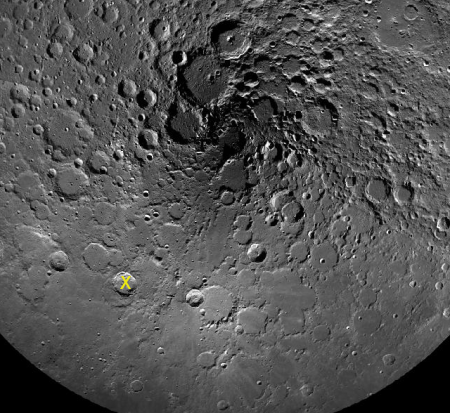
Philolaus Crater near lunar north pole

In reviewing Lunar Reconnaissance Orbiter data scientists think they have discovered several skylight entrances into a lava tube that is located near the Moon’s north pole.

The new pits were identified on the northeastern floor of Philolaus Crater, a large, 43 mile (70 km)-diameter impact crater located at 72.1oN, 32.4oW, about 340 miles (550 km) from the North Pole of the Moon, on the lunar near side. The pits appear as small rimless depressions, typically 50 to 100 feet across (15 to 30 meters), with completely shadowed interiors. The pits are located along sections of winding channels, known on the Moon as “sinuous rilles,” that crisscross the floor of Philolaus Crater. Lunar sinuous rilles are generally thought to be collapsed, or partially collapsed, lava tubes, underground tunnels that were once streams of flowing lava.

“The highest resolution images available for Philolaus Crater do not allow the pits to be identified as lava tube skylights with 100 percent certainty, but we are looking at good candidates considering simultaneously their size, shape, lighting conditions and geologic setting” says Pascal Lee, planetary scientist at the SETI Institute and the Mars Institute who made the new finding at NASA’s Ames Research Center in Silicon Valley.

…Prior to this discovery, over 200 pits had been found on the Moon by other researchers, with many identified as likely skylights leading to underground lava tubes associated with similar sinuous rilles. However, today’s announcement represents the first published report of possible lava tube skylights in the Moon’s polar regions.

The floor of the crater as a lot of rilles, and a close look at that crater floor reveals to me a lot of possible sky light entrances, more than indicated by the images at the llink. (Go here, click on projections and pick “Orthographic (North Pole).” Then zoom in on the crater indicated by the yellow X in my image on the right above.)

The key here is that caves or lava tubes provide a good place to cheaply and quickly establish a lunar colony. While it is suspected that water might survive in permanently shadowed regions near the poles, up until now no one had found any good underground locations there. If this suspected skylight entrances prove true, this crater then becomes prime real estate on the Moon.

2 comments

Japan’s Google Lunar X-Prize rover arrives in India for launch

Capitalism in space: The rover being built by the Japanese team competing for the Google Lunar X-Prize has arrived in India for installation on the PSLV rocket that will launch it into space.

The Sorato rover which is flight ready will be mounted on Team Indus lander at its facility in Jakkur. HAKUTO, one of the five teams competing for the Google Lunar XPRIZE, has signed a ride share agreement with Team Indus (India’s first private aerospace startup) for launching the Sorato along with the Indian rover.

Team Indus’s spacecraft, along with the two rovers, will also carry a few payloads and will be launched onboard ISRO’s workhorse, the PSLV-XL. The launch is expected to take place early next year (before March 8, 2018, the date set by Google to the five privately funded teams to launch the landers and the rovers on the Moon surface).

Several important details here. First, though the Japanese team appears to have all the necessary funds to pay for their flight, Team Indus is still searching for investment, and might not have the money to pay for its share of the flight. What will happen in that case is unclear.

Second, the word Hakuto in Japan means “white rabbit.” This name was chosen because Japanese folklore says a rabbit can be seen in the dark areas of the Moon’s face. This makes Japan’s rover the second rabbit to fly to the moon, after China’s Yutu rover, which in English means “jade rabbit” a name also based on Chinese folklore.

2 comments

Lawsuit reveals two customers for Soyuz circumlunar tourist flight

Capitalism in space: A lawsuit against Space Adventures, the company that has previously organized tourist trips to ISS using Russian rockets, has finally revealed the names of the two individuals who had purchased tickets for a circumlunar flight around the Moon using a modified Soyuz capsule.

The details are included in a lawsuit now winding its way through U.S. District Court in Virginia. Harald McPike, a wealth Austrian investor and adventurer who resides in the Bahamas, has sued Space Adventures, its chairman and CEO Eric Anderson, and its president Thomas Shelley seeking to recover the $7 million down payment he put down on the flight in March 2013.

The other lunar tourist? The lawsuit says Space Adventures told McPike that it was Anousheh Ansari, who flew to the International Space Station (ISS) as a tourist in 2006 on a Soyuz in a deal the company brokered with the Russians. Ansari’s family also sponsored the $10 million Ansari X Prize won by Burt Rutan’s SpaceShipOne in 2004.

The dispute centers on McPike’s realization, after paying $7 million of the $30 million down payment, that Space Adventures probably could not deliver on its promises, mostly because of a Russian reluctance to sent tourists on such a mission. He wants his money back, and Space Adventures doesn’t want to return it.

While several modified Soyuz capsules, called Zond, were sent around the Moon during the 1960s, that was a very long time ago. Configuring the modern Soyuz for such a manned mission would require a lot of work, and I suspect the Russians didn’t want to do it without money up front. Moreover, I’m not even sure that the $300 million from the two tourists would have been sufficient.

4 comments

Major fund-raising effort for Japanese lunar mining company

Capitalism in space: The Japanese company behind Japan’s Google Lunar X-Prize finalist, ispace, announced this week a major effort in the coming weeks to obtain investment capital for its proposed lunar mining projects planned for the next decade.

ispace’s website indicates the next phase beyond the prize competition involves prospecting the moon between 2018 and 2023. Missions will include “mapping valuable resources…to determine economic value of resources. Our rover swarms are deployed on the Moon to scout crater and cave locations on the lunar poles that have a high probability of resource discovery,” the company says. In the third phase from 2024 to 2030, the company plans to “work with our strategic partners to collect, store, and deliver these valuable resources to our government, institutional, scientific, and private space customers.”

Whether its team can win the X-Prize however remains unclear, since it is dependent on the same PSLV launch that the Indian X-Prize team is buying, and that team still needs to raise $35 million to pay for the launch.

2 comments

Former Google Lunar X-Prize competitor still alive

Capitalism in space: Part Time Scientists, a Germany company partly sponsored by Audi that was formerly a competitor for the Google Lunar X-Prize, has reiterated its plans to land a privately-built and funded rover near the Apollo 17 landing site, and to do it careful so as to not damage the site’s historical significance.

The company has pledged its support to the organization For All Moonkind, which is dedicated to protecting the Apollo landing sites.

A review of the PTScientists website however provides little information on the company’s test schedule leading up to this lunar rover mission. I must therefore remain skeptical.

0 comments
1 66 67 68 69 70 94