Astronaut Richard Gordon, 88, has died

R.I.P. Astronaut Richard Gordon, who piloted both a Gemini and an Apollo mission in the 1960s, has passed away at 88.

I described one of Gordon’s spacewalks during his Gemini 11 mission in 1966 as follows:

When he opened the hatch, both he and everything unfastened in the capsule was sucked toward space. Pete Conrad had to grab a leg strap on Gordon’s spacesuit to prevent him from drifting away. Later, Conrad had to pull him back using his umbilical cord. The arduous nature of the work caused both Gordon and his spacesuit to overheat, leading him to terminate the firs spacewalk after only 33 minutes.

On Gordon’s second and last flight on Apollo 12 he remained in orbit while Pete Conrad and Alan Bean went down to the surface, the third and fourth humans to walk on another world.

4 comments

Thirty mile cave on the Moon?

A new analysis of data from Japan’s Kaguya lunar orbiter suggests that one of the cave pits it found could be an entrance to a lava tube 30 miles long.

In 2009, the Kaguya probe found a large shaft with an opening about 50 meters in diameter in the Marius Hills area. The shaft descends about 50 meters beneath the surface.

The JAXA team analyzed data obtained from a lunar radar sounder on the probe that indicated an underground structure extended west from the shaft. The study confirmed that the cavern, likely created by volcanic activity, has not collapsed, and there is the possibility of ice or water existing in rocks within the cave, the team said.

Do a search on Behind the Black using the search terms “cave” and “moon” and you will see many images of this pit, taken by Lunar Reconnaissance Orbiter as a follow-up to the Kaguya mission.

6 comments

TeamIndus still searching for funds for Google Lunar X-Prize mission

Capitalism in space: TeamIndus, one of the five finalists in the Google Lunar X-Prize mission, is still searching for the funds it needs to pay for its launch.

Bengaluru-based aerospace start-up TeamIndus is scouting for funds and sponsors to build a spacecraft with a rover for landing and exploring the lunar surface. “The total budget of the moon mission is about Rs 450 crore, out of which we have raised more than half (Rs 225 crore) and have spent. We’re trying to accumulate the rest through sponsors and others interested in this mission,” TeamIndus Fleet Commander Rahul Narayan told reporters here on Thursday.

They have a contract to launch on India’s PSLV rocket, but have been trying to raise the funds needed to pay for it now for months. In July they had raised half the needed funds. Though this article says they have raised more than half (in Indian money: Rs 225 crore), that number remains half of the total budget listed (Rs 450 crore). From this it appears they have not yet found any additional sponsorship.

3 comments

Scientists finally image SMART-1 lunar impact site

SMART-1 impact site

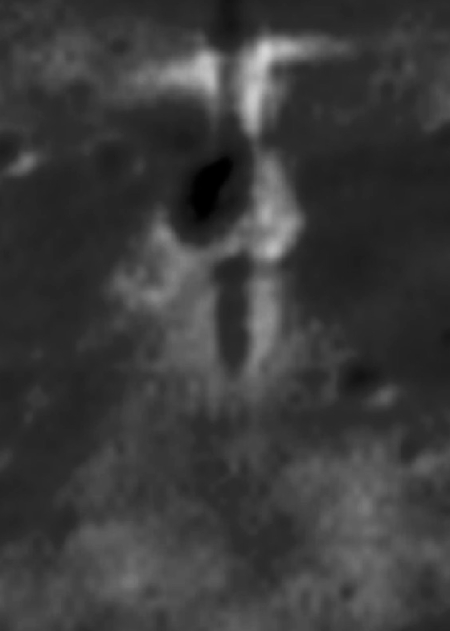
Eleven years after the European SMART-1 probe was sent crashing onto the Moon’s surface, scientists have finally identified in a Lunar Reconnaissance Orbiter image that crash site.

The image is shown on the right, reduced and cropped to post here.

The images show a linear gouge in the surface, about four metres wide and 20 metres long, cutting across a small pre-existing crater. At the far end, a faint fan of ejecta sprays out to the south. Foing said: โ€œThe high resolution LRO images show white ejecta, about seven metres across, from the first contact. A north-south channel has then been carved out by the SMART-1 spacecraft body, before its bouncing ricochet. We can make out three faint but distinct ejecta streams from the impact, about 40 metres long and separated by 20-degree angles.โ€

Stooke said: โ€œOrbit tracking and the impact flash gave a good estimate of the impact location, and very close to that point was a very unusual small feature. It now seems that impacts of orbiting spacecraft, seen here from SMART-1, and also in the cases from GRAIL and LADEE, will form elongated craters, most of whose rather faint ejecta extends downrangeโ€.

0 comments

First global map of the trace water on the Moon

Trace water on moon

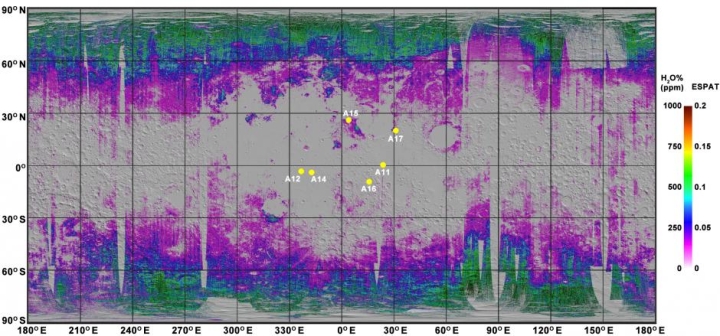
Using data collected by an American instrument on India’s Chandrayaan-1 lunar orbiter scientists have produced the first global map showing the locations and quantities of trace water on the Moon.

The map above, reduced to post here, is the result. The green areas at high latitudes show the most evidence of water, but the amounts remain very tiny, and the evidence remains somewhat uncertain.

Regardless, this map indicates that the high latitudes of the Moon will likely be the most valuable real estate for future colonists.

1 comment

Cell towers to the Moon!

Capitalism in space: A startup that intends to land two privately built rovers near the Apollo 17 landing site in 2018 also plans to use basic cell tower technology to relay what the rovers find back to Earth.

Part Time Scientists has a launch contract for late 2018 with Space X as a secondary payload on the Falcon 9 rocket. Becker said the company believes it will be the first private entity to reach the surface of the moon, suggesting that none of the Google Lunar X Prize participants are likely to meet the December 2017 deadline for the competition. (Part Time Scientists itself withdrew from the Google Lunar X Prize earlier this year due to the time constraints of the competition.)

The Falcon 9 will carry the team’s spacecraft, Alina, to the geostationary transfer orbit, a highly elliptical Earth orbit whose highest point is 26,000 miles (42,000 kilometers). From there, Alina will continue on its own to the moon. “We will soft-land on the moon and disembark our two rovers, the Audi Lunar Quatro rovers, with which we are going to drive up to Apollo 17,” Becker said. “The two rovers are essentially mobile phones that will communicate our video stream to Alina, which serves as an LTE base station, and Alina will communicate the data to us,” he said.

What is most significant about this is that even if no one wins the Google Lunar X-Prize this year, it appears that the contest succeeded nonetheless. At least two if not five different companies appear funded and about to launch private rovers to the Moon. Once they demonstrate this capability, they will certainly be positioned to make money offering it to nations and scientists worldwide. For example, NASA and China both want to place probes in remote places on the Moon, near the poles or on the Moon’s far side. If this mission by Part Time Scientists is a success, they will then be able to offer a cheap method for relaying communications from those locations.

1 comment

The difficult task of legally preserving the Apollo lunar sites

Link here.

While I heartily agree that these historic sites should be preserved, if you read the article you will notice how the focus with these people is not the future, but preserving relics of the past. I say we don’t need more memorials. The best memorial for Apollo 11 would be thriving city on the Moon, even if it trampled on Tranquility Base.

Note also that the restrictions imposed by the Outer Space Treaty once again make things worse. Under the treaty, there is no way for the U.S. to reasonably preserve these American historical sites, without first getting the approval of the UN. The result? I guarantee that any arrangement we manage to work out will almost certainly restrict the freedoms of future space colonists. This not a good thing, and it certainly isn’t something we here on Earth should be doing to the brave people who will someday want to build new civilizations on other worlds.

3 comments

Lunar landers/rovers for sale!

Moon Express, one of the five finalists trying to win the Google Lunar X-Prize (GLXP) before it expires at the end of this year, announced today its long range plans, focused on building low cost lunar landers rovers, and sample return missions that could be purchased and launched for a tenth the cost of a typical government mission.

The GLXP mission won’t be the last lunar voyage for Moon Express, if all goes according to plan. Its deal with Rocket Lab covers up to five launches, and Moon Express wants at least two more to occur in the next few years, Richards revealed during a news conference today.

The first post-GLXP mission, scheduled to launch in 2019, will set up a robotic research outpost near the lunar south pole and prospect for water and other resources. Then, in 2020, Moon Express will launch the first commercial lunar sample-return mission. That effort, Richards said, should prove out the company’s technologies and its business model, which is centered around creating low-cost access to the moon’s surface for a variety of customers. The core piece of hardware to make all of that happen is a single-engine lander called the MX-1, which will launch on the GLXP flight. Moon Express aims to mass-produce the MX-1, sell it as a stand-alone lunar explorer and have it serve as a building block for three larger, more capable spacecraft โ€” the MX-2, the MX-5 and the MX-9, Richards said today.

The MX-2 combines two MX-1s into a single package, boosting the MX-1’s payload capacity in Earth-moon space and potentially enabling missions to Venus or the moons of Mars. As their names suggest, the MX-5 and MX-9 incorporate five engines and nine engines, respectively, and broaden the exploration envelope even further, Richards said. All of these spacecraft will be available in orbiter, lander and deep-space variations, and the MX-5 and MX-9 vehicles will also come in a sample-return configuration.

Moon Express has not revealed how much it will charge for any of these spacecraft. However, company representatives have said that, together, the MX-1 and Electron can deliver a lunar mission for less than $10 million (that’s “cost,” not retail). Electron flights currently sell for about $5.5 million apiece, putting the lander’s raw cost at $4.5 million or less.

Essentially, they are taking the revolution in satellite technology that is making everything smaller and cheaper and applying it to planetary exploration. They are then offering this technology as a very cheap and fast option for scientists and governments. Based on these numbers, a mission to the Moon could cost a customer less than $20 million, which is nothing compared to a typical NASA mission. Even India’s Mars Orbiter was several times more expensive than this.

While I consider NASA’s planetary program second to none, and one of the best things it does, Moon Express is demonstrating, as has SpaceX with launch services, that private enterprise, if given the chance, can do it better.

0 comments

China begins 200-day simulated self-sufficient space station experiment

The new colonial movement: Four Chinese students yesterday began a 200 day experiment, living in a simulated ground-based space station that will attempt to be self-sufficient for the entire time.

The underlying but unstated goal is revealed by this quote:

But the 200-day group will also be tested to see how they react to living a for period of time without sunlight. The project’s team declined to elaborate. “We did this experiment with animals… so we want to see how much impact it will have on people,” Liu, the professor, said.

They aren’t just testing the self-sufficiency of a future interplanetary spaceship. They are also testing the self-sufficiency of a lunar base, which must undergo 14 days of darkness each lunar day. I wonder if the facility is also subjected to no sunlight during these tests.

2 comments

China to attempt to grow potatoes on Moon

China’s Chang’e-4 lunar rover/lander, set to launch in 2018, will include a small experiment that will attempt to grow potatoes from seeds.

Note that I have just realized that I have been confusing Chang’e-5 with Chang’e-4. Chang’e-5 is a sample return mission that they hope to launch this year. It does not include a rover. Chang’e-4 is a lander/rover mission that is planned for 2018.

14 comments

China reveals landing site for Chang’e-5 lander/rover

China has chosen the landing site for its Chang’e-5 lander/rover and sample return mission, planned to launch later this year.

Liu Jizhong, director of China Lunar Exploration and Space Engineering Center of China National Space Administration (CNSA), for the first time disclosed the probe landing site, an isolated volcanic formation located in the northwest part of the Moon’s near side.

They also said their focus will be the Moon’s south pole, where there is evidence of the possible presence of water ice.

2 comments
1 67 68 69 70 71 94