
Lunar Reconnaissance Orbiter has detected helium in the Moon’s tenuous atmosphere.
Lunar Reconnaissance Orbiter has detected helium in the Moon’s tenuous atmosphere.
Lunar Reconnaissance Orbiter has detected helium in the Moon’s tenuous atmosphere.
The leading team in the Google Lunar X-Price contest last week successfully tested by remote control the astronomical telescope they intend to include with their lunar lander.
[The Google Lunar X Prize] requires the participants to successfully land a lunar rover on the surface, drive it a minimum of 500 meters (about a third of a mile), and send back high definition video and imagery. Moon Express intends to land this first lunar lander near the Moon’s equator.
Moon Express is planning to send its first robotic lander to the Moon in late 2014. It will be launched atop either SpaceX’s Falcon 9 rocket or another commercial launch vehicle. It intends to fly ILOA’s shoebox-sized test telescope, called ILO-X, as part of its [X prize] entry. There are additional prizes available which might be won by an educational lunar telescope, such US$1 million prize for the entry which adds the most to diversity within space studies.
New computer models suggest that the Moon was created when a Mars-sized asteroid hit the Earth in a head-on collision at high speed, not a glancing blow at relatively slow speeds, as previously thought.
Back to the Moon: China has announced plans to land an unmanned probe on the Moon next year, the first such planned landing since the 1970s.
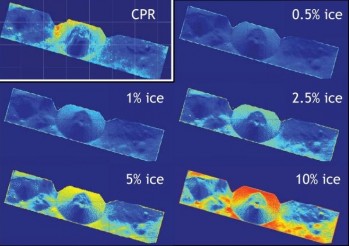
New results from the radar instrument on Lunar Reconnaissance Orbiter (LRO) has found evidence of water-ice on the slopes of Shackleton Crater, located at the Moon’s south pole. The paper, published on Saturday in Geophysical Research Letters – Planets, suggested that about 5 to 10 percent of the weight of the material on the slopes of the crater is comprised of water ice, to depths of 6 to 10 feet.
The box on the upper left in the image to the right shows the data from a radar sweep of the crater taken on April 18, 2010, and compares that to five computer models. As you can see, the data here most closely matches the 5% ice model. Two other sweeps showed similar results.
The water-ice, if there, is not in slabs of ice, as sometimes portrayed in the press, but would be mixed into the Moon’s regolith, or “topsoil”, and would have to be processed out like ore to be useful. Or to quote the paper’s conclusion:
The fundamental conclusions made with high resolution, ground based radar of Shackleton remain unaltered — that no large-scale, meters thick ice deposits are evident within the crater. Rather, Mini-RF data are consistent with roughness effects or with a small percentage of water-ice deposits admixed into the uppermost 1-2 meters of silicate regolith within Shackleton, possibly accounting for the observations made by the Clementine bistatic experiment.
Several points:
» Read more
An evening pause: Apropos of the on-going scientific debate, how about David Lanz’s beautiful piano piece, “Water from the Moon.”
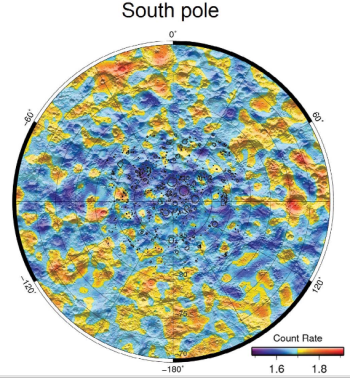
A little over a month ago I reported here on Behind the Black some recent results from the LEND instrument on Lunar Reconnaissance Orbiter (LRO) that had found significantly less water in the permanently shadowed craters at the lunar poles than previously thought. To quote again from that paper’s abstract, which I will henceforth refer to as Sanin, et al:
This means that all [permanently shadowed regions], except those in Shoemaker, Cabeus and Rozhdestvensky U craters, do not contain any significant amount of hydrogen in comparison with sunlit areas around them at the same latitude.
And from the paper’s conclusion:
[E]ven now the data is enough for definite conclusion that [permanently shadowed regions] at both poles are not reservoirs of large deposits of water ice.
Paul Spudis of the Lunar and Planetary Institute in Houston, Texas and one of the world’s top lunar scientists then commented as follows:
You neglect to mention yet another possibility — that this paper and its conclusions are seriously flawed in almost every respect. The veracity of the LRO collimated neutron data [produced by the LEND instrument] have been questioned on serious scientific grounds. Other data sets (spectral, radar) suggest significant amounts of water at both poles, billions of metric tons in total.
Spudis also discussed this scientific dispute at length on his own blog.
When I read Dr. Spudis’s comment I immediately emailed William Boynton of the Lunar and Planetary Laboratory at the University of Arizona, one of the authors of the Sanin et al paper, to get his reaction. Today he sent me the following detailed explanation, describing the basis of the controversy and why he believes the LEND data is valid.
» Read more
The competition heats up: Russia has announced it has begun construction on a manned lunar lander, set for its first unmanned test flight in 2015.
There have been many such announcements from Russia over the past decade with few ever coming true, since such announcements are generally nothing more than a public relations lobbying effort to get funding.
The most intriguing part of this article however was this quote:
Last week, head of the Lavochkin Scientific and Production Corp. Victor Khartov said Russia must “return to the Moon in 2015 in a Soviet style, to prove everyone and ourselves that we remember all the Soviet Union could do” at the Farnborough air show in Britain.
I would interpret this statement as a desire for Russia to compete more aggressively with the U.S. and others, as they did back in the days of the Soviet Union. It was also in that time period that the Lavochkin center was in its heyday, with lots of money and research work.
Researchers have concluded that the dust on the Moon’s surface might pose serious health risks for lunar colonists.
The uncertainty of science: According to this article, the water-ice discovery announced yesterday at Shackleton Crater is insufficient for human settlement.
The latest LRO data indicate “that water is not there … in a way that would facilitate human exploration,” says planetary scientist Maria Zuber, who led the team analyzing the data.
If the signatures the team saw in the soils on the crater floor do indicate water, how much water might there be? Roughly 100 gallons – enough to fill two or three residential rain barrels – spread over a surface of about 133 square miles. Leave the swim-suit at home. “This is not like Mars,” says Dr. Zuber, a professor at the Massachusetts Institute of Technology in Cambridge, in an interview. On the red planet, explorers would find thick layers of icy soil in many locations just by turning over a shovelful or two of topsoil. [emphasis mine]
This story seems to answer my question about Zuber’s participation in the water in Shackleton paper as well as the previous paper saying there is much less water on the Moon than previously believed. It also raises questions about the journalism work of many of the other stories published in the past few days, which heavily touted the possibility of water in Shackleton.
I intend to dig into this story a bit more. Stay tuned.
The uncertainty of science: New data from Lunar Reconnaissance Orbiter suggests that ice may make up as much as 22 percent of the surface material in Shackleton Crater.
What I find most interesting about this result is that the team leader of this paper, Maria Zuber, was also one of the co-authors of the paper I wrote about two days ago that said there was no water in Shackleton Crater.
The competition heats up: Excalibur Almaz has announced its plans for a privately funded trip to the Moon.