A new chemical analysis of lunar rocks from the Apollo missions has cast doubt on the theory that the Moon was formed when the Earth was hit by a Mars-sized object about 4.5 billion years ago.

The uncertainty of science: A new chemical analysis of lunar rocks from the Apollo missions has cast doubt on the consensus theory that the Moon was formed when the Earth was hit by a Mars-sized object about 4.5 billion years ago.

0 comments

If there is water ice on the Moon, scientists have found that the bombardment from interstellar cosmic rays has likely caused chemical reactions that “can create complex carbon chains similar to those that help form the foundations of biological structures.”

Life stranger than science fiction: If there is water ice on the Moon, scientists have found that the bombardment from interstellar cosmic rays has likely caused chemical reactions that “can create complex carbon chains similar to those that help form the foundations of biological structures.”

0 comments

Using its Space Launch System and Orion capsule, NASA is aiming for an unmanned test flight around the Moon in December 2017.

Using its Space Launch System (SLS) and Orion capsule, NASA is aiming for an unmanned test flight around the Moon in December 2017.

Two important tidbits revealed by this article: First, the first test flight of Orion will use a Delta 4 Heavy rocket. Two, NASA hopes to have its heavy lift SLS rocket ready for the 2017 mission.

Forgive me for being cynical, but I will believe the second tidbit only when it happens.

0 comments

The head of Russia’s space agency makes news again

The following stories are all the result of statements made by Vladimir Popovkin, the head of Roscosmos, the Russian Federal space agency, during a radio interview yesterday.

This is the same guy that only a few weeks ago was throwing accusations at the U.S. for the failure of Phobos-Grunt.

What should we make of these statements? First, everything Popovkin says is aimed at fund-raising. Whatever his background, he is a political appointee whose job is to generate interest and funding for Russia’s space program. Everything he says in public must be weighed against this reality. That he first tried to shift the blame to the U.S. for Phobos-Grunt’s loss was an effort to absolve his program from any blame and thus reduce the possibility that the Russian government might cut his funding. Now that his agency has gotten approval of its insurance payment for the failure, however, he is free to say otherwise.

Second, these announcements give us a clear indication of where the Russia space effort is heading, and that effort looks both thoughtful and intelligent.
» Read more

0 comments

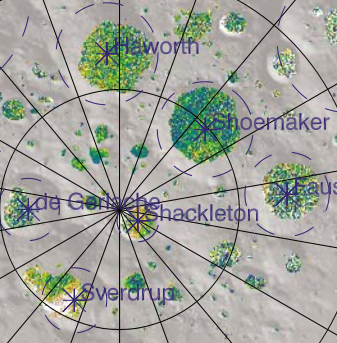
Studying the Moon by starlight

The Moon's south pole by starlight

In a paper published today in the Journal for Geophysical Research, Planets, the science team for Lunar Reconnaissance Orbiter describe how they have used starlight to peer into the permanently shadowed craters of the Moon’s north and south poles. Looking only during the lunar night, they measured the dim albedo of the Moon from reflected starlight. From this very weak signal they were able to cull two interesting facts about these very cold and very dark places.

  • The ground at the bottom of these craters is more porous than the surrounding unshadowed terrain.
  • There is evidence in the spectroscopy of 1 to 2% water frost in these craters.

» Read more

0 comments
1 83 84 85 86 87 94