
Twin GRAIL gravity probes on the way to the moon
The twin GRAIL gravity probes launched successfully on Saturday and are now on their way to the moon.
The twin GRAIL gravity probes launched successfully on Saturday and are now on their way to the moon.
GRAIL launch delayed again until Saturday.
Today’s launch of the lunar gravity probe GRAIL has been scrubbed due to high winds and rescheduled for tomorrow.
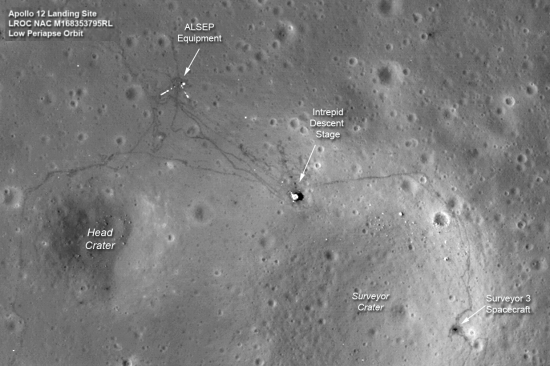
The Lunar Reconnaissance Orbiter team have released new images of the Apollo 12, 14, and 17 landing sites on the Moon. Below is a cropped image of the Apollo 12 site, showing the trails left by astronauts Pete Conrad and Alan Bean when they walked from their lunar module to Surveyor 3, an unmanned lunar lander that had soft landed there two years earlier. The full image shows some incredible detail.
China’s lunar probe, Chang’e 2, has reached the L2 point in space, almost a million miles from Earth.
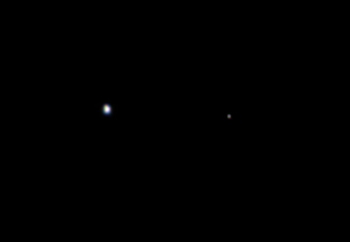
Juno, on its way to Jupiter, took a look back and snapped this picture of the Earth/Moon double planet.
The image was taken by the spacecraft’s camera, JunoCam, on Aug. 26 when the spacecraft was about 6 million miles (9.66 million kilometers) away.
Gives us a glimpse at what our home planet will really look like to future spacefarers, either on they way out or on their way home.
The science team of Lunar Reconnaissance Orbiter released an intriguing picture yesterday of what scientists call a granular flow down the side of a five mile wide crater on the far side of the moon. Looking at the image, one would swear that the darker material flowing down the slope of the crater rim is a lava flow frozen in place.
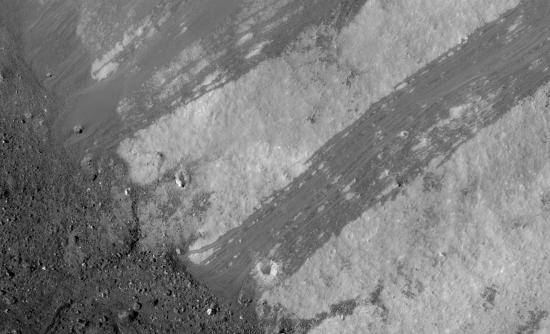
However, according to the scientists, that is not what it is. Instead, this is merely debris left behind from an avalanche.
» Read more
New research on the influence of a large moon to a habitable planet.
Did the Earth once have two moons?
Both satellites would have formed from debris that was ejected when a Mars-size protoplanet smacked into Earth late in its formation period. Whereas traditional theory states that the infant Moon rapidly swept up any rivals or gravitationally ejected them into interstellar space, the new theory suggests that one body survived, parked in a gravitationally stable point in the Earth–Moon system.
This new model also posits that the two moons eventually collided, producing the moon we have today.
Could this weird lunar crater be the crash site for Lunar Orbiter 2?
