Gilligan’s Island, if done today
An evening pause: As expected, this silly 1960s comedy has to become a predictable formula horror vehicle, filled with lots of AI and CGI slop. Quite funny, until you think about it for awhile.
Hat tip Wayne DeVette.
An evening pause: As expected, this silly 1960s comedy has to become a predictable formula horror vehicle, filled with lots of AI and CGI slop. Quite funny, until you think about it for awhile.
Hat tip Wayne DeVette.
An evening pause: From the 1944 movie Broadway Rhythm. Makes me want to go to a potluck picnic this weekend.
Hat tip Wayne DeVette.
An evening pause: A touch of gentle reality for the weekend.
Hat tip Cotour.
A evening pause: From the 1969 film Sweet Charity.
Hat tip Judd Clark.
An evening pause: From the 1942 film Casablanca, still one of the greatest movies ever made.
Hat tip Wayne DeVette.
An evening pause: From the 1956 film, Meet Me in Las Vegas. The dancing is great, but I really think Sammy Davis makes the piece with his singing.
Hat tip Judd Clark.
An evening pause: This 1940 short film won an Academy Award for best one-reel short. It provides a nice and witty demonstration of the first technology that allowed very high speed slow motion movies to be made.
Hat tip Wayne DeVette.
An evening pause: Performed live 2014 by the Beethoven Academy Orchestra with Sara Andon on the flute.
Some movies are made special because of their score, and I think this applies to the 1962 film, To Kill a Mockingbird. It is a superb work of art, but it rises above many comparable films due to the music that Elmer Bernstein wrote for it. His suite only gives a hint of its effectiveness, in the movie.
An evening pause: A truly hot dance from the 1948 film, On an Island with You.
Hat tip Judd Clark.
Tonight Diane and I decided to watch again the 1978 Richard Donner movie, Superman. The overall film is lighthearted entertainment that captures the myth of this super-hero perfectly. However, it has two scenes that remain among the best moments in movie history (which you can watch here and here). The first captures the myth in every way. The second shows us that Superman truly stood for the best in America.
In watching the movie tonight again and reliving the myth I grew up with — that great things are possible if you believe and follow sincerely Superman’s motto of “truth, justice, and the American way” — I decided to repost my essay from 2020 where I attempted to explain what that motto really meant.
Enjoy!
———————
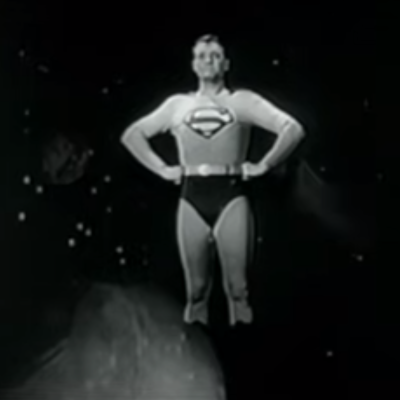
George Reeves as the heroic Superman as envisioned
in the 1950s television show, emulated later by Richard
Donner in his 1978 movie. Click for show’s opening credits.
Truth, Justice, and the American Way
The words spoken during the opening credits of a 1950s children’s television show:
Faster than a speeding bullet.
More powerful than a locomotive.
Able to leap tall buildings in a single bound.
Look up in the sky!
It’s a bird.
It’s a plane.
It’s Superman!
Yes, it’s Superman, strange visitor from another planet who came to Earth with powers and abilities far beyond those of mortal men.
Superman, who can change the course of mighty rivers, bend steel in his bare hands, and who, disguised as Clark Kent, mild-mannered reporter for a great metropolitan newspaper, fights a never-ending battle for truth, justice, and the American Way.
That television show was obviously Superman, starring George Reeves, and these opening words expressed the mythology and basic ideals by which this most popular of all comic-book super-heroes lived.
I grew up with those words. They had been bequeathed to me by the American generation that had fought and won World War II against the genocidal Nazis, and expressed the fundamental ideals of that generation.
Much of the meaning of these fundamental ideals is outright and clear.
» Read more

An evening pause: From the 1944 film, Meet me in St. Louis. I posted this in July 2010 as one of the very first evening pauses. As I wrote then, “The last line of the song says it all, about life and love.”
Hat tip to Judd Clark, who suggested it, which convinced me it was time to post it again.
An evening pause: From the 1955 film Love Me or Leave Me.
Hat tip Judd Clark.
An evening pause: From the 1980 film Grease.
Hat tip Judd Clark.
An evening pause: From the 1942 film Holiday Inn. Stay with this after the song for a truly spectacular dance number by Fred Astaire, dancing as a New Year’s Eve drunk with Marjorie Reynolds.
A eveningpause: From the 1947 musical Down to Earth, where Hayworth places the goddess of dance, who comes down from heaven to save the show.
Hat tip Judd Clark.
An afternoon pause: This TV movie, the first ever, was produced by NBC and first aired in 1957. It subsequently played every Christmas season for most of the next decade. It has been forgotten in the ensuing years, something I think must be rectified, especially for the children of today. It is clever, sophisticated, innocent, entertaining, and above all, firmly American in every way.
Thus, I will now renew that past tradition.
A mid-day pause: As I now do practically every Christmas, I bring you the classic 1951 version of Charles Dickens’ A Christmas Carol, starring Alastair Sim. In my opinion still by far the best adaption of the book and a truly wonderful movie.
And as I noted in a previous year:
Dickens did not demand the modern version of charity, where it is imposed by governmental force on everyone. Instead, he was advocating the older wiser concept of western civilization, that charity begins at home, that we as individuals are obliged as humans to exercise good will and generosity to others, by choice.
It is always a matter of choice. And when we take that choice away from people, we destroy the good will that makes true charity possible.
And in 2016 I said this:
I watched this again and felt like weeping, not because of the sentimentality of the story itself but because it is so seeped in a civilized world that increasingly no longer exists. There was a time when this was our culture. I fear it is no longer so. As noted by the Spirit of Christmas Present, “This boy is ignorance, this girl is want. Beware them both, but most of all beware this boy.”
It seems for the past few decades we have not heeded that warning, and are now reaping the whirlwind.
An evening pause: This was posted in 2023. Time to repost.
Original text:
—————————
This movie used to be a tradition for television on Thanksgiving. At that time the holiday was well linked with the then joyous and relatively Christian Macy’s Day Parade (now warped into a queer agenda demonstration). [Editor: an agenda that thank god appears to be on the run.]
I think it makes for a good opening to the holiday season.
An eveing pause: From the Hollywood film There’s No Business Like Show Business (1954).
Hat tip Judd Clark.
An evening pause: From the 1943 film of the same name.
Hat tip Judd Clark.