NASA requests proposals from private industry for deorbiting ISS

NASA on September 18, 2023 sent out a request for proposals from private industry for methods for deorbiting the International Space Station (ISS), with a deadline for such proposals of November 17, 2023.

You can review the request here. According to the press release at the first link, the bulk of any contract will be fixed price.

To maximize value to the government and enhance competition, the acquisition will allow offerors flexibility in proposing Firm Fixed Price or Cost Plus Incentive Fee for the Design, Development, Test and Evaluation phase. The remainder of the contract will be Firm Fixed Price.

That the development phase might be cost-plus allows a lot of room for budget growth, however, especially since the companies most likely to want such a contract are the old big companies (Boeing, Lockheed Martin, Northrop Grumman) that routinely go overbudget and behind schedule.

The full proposal is more than 600 pages long, so I have not reviewed it in its entirety. I wonder therefore if NASA would entertain proposals that include salvaging any ISS modules for use on other space stations.

7 comments

The actual truth behind the so-called “hidden figures” of the early space race

It is Monday, and thus the news in the morning is somewhat slim. With this in mind I offer my readers some worthwhile history, a long review dubbed “The Portrayal of Early Manned Spaceflight in Hidden Figures: A Critique. The actual review is available here [pdf].

The review uses primary source material, the actual words of the engineers and managers who worked next to black mathematician Katherine Johnson at NASA in the 1960s (both new and old writings and interviews), assessing the historical accuracy of Margot Shetterly’s book Hidden Figures, which essentially claimed that Johnson was a central figure making possible the entire American effort land on the Moon, and whose credit was purposely squelched because she was black, and a woman.

Not surprisingly, you will find that claim to be absurdly false. Not only was Johnson only one of many who did the work, she was treated then fairly and with respect. If anything, her place at NASA was proof that the agency was a forceful part of the civil rights movement, working to give qualified people of all races a fair chance.

Thus, the effort of modern leftist revisionists, led by Barack Obama when he gave Johnson the Presidential Medal of Freedom in 2015, to smear America and NASA in the 1960s as racist and bigoted in supposedly suppressing Johnson’s participation is not only unfair, it is an outright lie. If anything, her magnification to star status by today’s politicians, historians, and the entertainment industry has acted to discredit the work done by the many others who worked side-by-side with her, as co-workers.

If you’ve got the time, read the critique. It will not only teach you something about the behind the scenes effort that made the lunar landing possible, it will help you recognize the bigoted dishonesty that is so rampant in today’s intellectual and political culture.

Hat tip to reader Chris Dorsey for letting me know of this review.

6 comments

GAO blasts NASA for purposely failing to control the budget of its SLS rocket

In a new report [pdf] released yesterday, the Government Accountability Office (GAO) strongly blasted NASA’s non-budgeting process for financing the costs for this SLS rocket, which appear specifically designed to allow those costs to rise uncontrollably.

This one sentence from the report says it all:

NASA does not plan to measure production costs to monitor the affordability of the SLS program.

That non-plan is actually in direct defiance of four different reports by both the GAO and NASA’s inspector general over the past decade, all of which found that NASA was not using standard budgeting practices with SLS and which all demanded it do so forthwith. As this new report notes in reviewing this history, in every case NASA failed to follow these recommendations, and instead created budgetary methods designed to instead obscure the program’s cost.

This report notes that NASA continues to do so.
» Read more

7 comments

Endeavour Dragon capsule carrying four astronauts safely splashes down

SpaceX’s Endeavour Dragon capsule safely splashed down shorty after midnight last night in the Atlantic off the coast of Florida, completing a six month mission for two Americans, one Russian, and one astronaut from the United Arab Emirates (UAE).

The UAE astronaut, Sultan Al Neyadi, flew as a paying passenger, obtaining his flight through the private space station company Axiom, which in turn purchased the ferrying services to and from ISS from SpaceX. The Russian flew as part of the barter deal that NASA presently has with Russia, with each flying astronauts on the other nation’s capsules at no cost in order to make sure everyone knows how to use them in case of emergency.

Several additional details: First, in the post-splashdown press conference SpaceX officials revealed they are presently building a fifth manned Dragon capsule to add to its fleet, and are also aiming to fly each as much as fifteen times. This suggests they are anticipating a lot of business hauling both NASA and commercial passengers into space.

Meanwhile, the Russian-launched crew on ISS that launched last September and includes American Frank Rubio is targeting a return-to-Earth on September 27, 2023. If so, they will have completed a 371 day flight, or almost thirteen months. This I think is the second longest human flight so far in space, exceeded only by Valeri Polykov’s fourteen-and-half month mission in the 1990s.

3 comments

NASA reveals three year delay in its New Frontiers planetary mission program

NASA last week revealed that because of “budget uncertainty” it will not begin accepting project proposals in its New Frontiers planetary mission program this fall as planned, and will in fact not begin accepting new proposals until 2026.

At a NASA SMD town hall meeting July 27, Lori Glaze, director of NASA’s planetary science division, warned a potential extended delay in the release of the New Frontiers AO. “If the planetary science funding levels that are anticipated as a result of this tight budget environment are actually realized over the next two or so years,” she said, “it is unlikely we’ll be able to solicit New Frontiers perhaps not before 2026.” That delay was made official with the release of the community announcement.

The draft AO sought proposals for missions on six topics, as recommended by the planetary science decadal survey in 2011: a comet surface sample return, a mission to Jupiter’s volcanic moon Io, a lunar geophysical network, a sample return mission to the moon’s South Pole-Aitken Basin, a mission to characterize the potential habitability of Saturn’s icy moon Enceladus and a probe of Saturn’s atmosphere.

The New Frontiers program previously funded the New Horizons mission to Pluto, the Juno mission to Jupiter, and the OSIRIS-REx asteroid mission to Bennu.

The article at the first link above as well as the NASA officials quoted attempt falsely to blame the budget problems on the Republican House leadership, which insisted that the committee which reviews the NASA budget as well as the budgets of Justice and Commerce cut 28.8% from among those agencies in its 2024 budget review. That committee (as well as the Senate) however was very generous to NASA, essentially giving it the same budget as previously, with only a 1% cut, while slashing budgets for departments in Justice and Commerce to make up the difference.

The real blame for this delay in NASA’s planetary program almost certainly falls on the Mars Sample Return mission, which has seen gigantic budget overruns that are apparently swallowing the entire future planetary program. NASA’s planetary budget can’t pay for any other new planetary missions as long as it must pay for the cost overruns for the sample return mission.

This is no surprise, as we’ve seen this movie before. When Webb’s budget ballooned 20x, from its proposed $500 million to $10 billion, it essentially shut down the rest of NASA’s astrophysics program, delaying or cancelling all other space telescope projects for more than a decade. Now the planetary program is experiencing its own version of this same pain.

The problem is the Mars Sample Return mission itself. Its design has been haphazard and sloppy and constantly changing. It is also reliant on older technology ideas that will soon be made obsolete by Starship/Superheavy. NASA would be wiser to delay that project to await the development of the launch capabilities that will make it cost effective, and let a fleet of other missions happen instead.

I guarantee however that NASA won’t do that, because it will require some boldness. The philosophy in Washington remains the same: Do the same failed thing over and over again in the vain hope it might work next time.


4 comments

SpaceX launches four astronauts to ISS

Using its Falcon 9 rocket lifting off from Cape Canaveral, SpaceX early this morning put four astronauts into orbit for a six month mission to ISS.

The Dragon capsule, Endurance, was making its third flight. The first stage, flying for the first time, landed successfully back at Cape Canaveral.

The leaders in the 2023 launch race:

58 SpaceX
37 China
12 Russia
7 Rocket Lab

In the national rankings, American private enterprise now leads China in successful launches 67 to 37. It also leads the entire world combined, 67 to 60, while SpaceX by itself now trails the rest of the world (excluding American companies) 58 to 60 in successful launches.

10 comments

Axiom raises $350 million in private investment capital

Axiom's space station assembly sequence
The assembly sequence for Axiom’s space station while attached to ISS.
Click for original image.

Axiom announced today that in its most recent round of funding it raised an additional $350 million in private investment capital, almost tripling the private capital it has obtained in total.

Axiom Space announced today that it secured $350 million in its Series-C round of growth funding, lifting the total funds raised to over $505 million from investors and achieving more than $2.2 billion in customer contracts.

To date, Aljazira Capital and Boryung Co., Ltd., have anchored the round, paired with support from an array of diverse backers that include deep-tech venture capital funds and strategic brand partners, positioning Axiom Space as second to SpaceX for the most amount of money raised by a private space company in 2023, based on available pitchbook data.

The press release also reaffirms the company’s planned schedule for its space station project, with the first module launching and attaching to ISS in 2026. The graphic shows the assembly sequence, with the rear docking port the one linked to ISS. When assembly reaches the stage of the fourth image it will then be able to separate from ISS and fly independently in 2031. That last number however is one year later than NASA’s previous predictions for the retirement of ISS, suggesting Axiom knows something NASA has not yet told us.

Hat tip to Jay, BtB’s stringer.

4 comments

Ingenuity’s 55th flight completed

Overview map
Click for interactive map.

The Ingenuity engineering team today updated the helicopter’s flight log, showing that the 55th flight occurred on August 12, 2023, one day later than originally planned, and flew 881 feet for 143 seconds, 61 feet and 9 seconds longer than planned.

The overview map above shows the present locations of both Perseverance and Ingenuity. The green dot marks Ingenuity’s new position, while the blue dot marks where Perseverance presently sits in Jezero Crater. Based on this map, the main goal of the flight was apparently to fly Ingenuity over a route that Perseverance will likely use to return to its planned route, as indicated by the red dotted line.

0 comments

Intuitive Machines sets mid-November launch date for its Nova-C lunar lander


Click for interactive map.

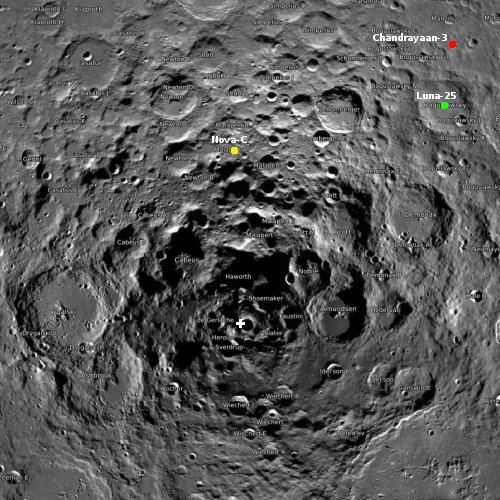
Intuitive Machines announced yesterday that the launch of its lunar lander, Nova-C, is now targeting a November 15-20, 2023 window, lifting off on a SpaceX Falcon 9 rocket.

The yellow dot on the map to the right indicates the landing site, Malapert A, in the southern latitudes of the Moon. The white cross indicates the south pole.

The lander had originally planned to launch in 2021, but delays in construction pushed the launch back two years. A second company, Astrobotics, has its own lander, Peregrine, that though also delayed two years, has been ready to launch since early this year. It won’t launch until the end of this year at the earliest, however, due to delays in readying its rocket, ULA’s Vulcan on its first flight.

Both India’s Chandrayaan-3 and Russia’s Luna-3 are right now on their way to the Moon, with each planning a landing next week.

1 comment

NASA engineers still struggling to understand why Orion’s heat shield ablated so much

NASA engineers still do not understand why the heat shield on its Orion capsule ablated as it did during its return to Earth on the first unmanned Artemis-1 mission.

The agency is still running tests. It also expressed confidence that the issue will not delay the Artemis-2 mission, the first intended to carry humans on SLS and in Orion and still scheduled for late 2024.

At the same time, agency officials hinted that the third Artemis mission, which has always been planned as putting humans on the Moon for the first time since Apollo, might not achieve that goal. It is still not clear whether the mission’s lunar spacesuits as well as SpaceX’s Starship lunar lander will be ready on time. The latter is facing serious regulatory problems imposed by the Biden administration that is generally preventing it from flight testing the spacecraft.

That second Artemis mission, the first planned to carry humans, is one that actually at present carries the most risk. It will not only use a heat shield that at present engineers do not entirely understand, it will be the first Orion capsule to have the environmental systems necessary for its human cargo. NASA is putting humans on the first test flight of those systems.

5 comments

Boeing delays first manned Starliner flight again, until March of 2024

Because of both parachute and wiring issues in its Starliner capsule, Boeing revealed today that it is delaying the first manned Starliner flight again, until March of 2024, so that it has time to change and test the parachutes as well as remove the flammable tape inside the capsule.

The company had been hoping to finally fly that first manned flight last month, but was forced to cancel when in June it discovered two shocking problems. First the connections between the parachutes and the capsule were too weak, and second, for some reason engineers had used tape to protect the capsule’s wiring that was too flammable and had to be replaced or covered somehow.

Boeing is taking the tape off in places where it’s easy and safe to do so and considering other remediation techniques, such as protective barriers or coatings over it, in trickier spots, Nappi said.

The parachute work is multifaceted as well. For example, Boeing has modified the soft link design to make it stronger, and the new version is being manufactured now, Nappi said. The company also decided to swap out Starliner’s parachute system, putting a new version slated for the first operational mission on board for [the crew flight test]. The new soft links will be incorporated into the new chutes, which will get to strut their stuff during a drop test soon. “We expect that the drop test will occur in mid to late November,” Nappi said. “That’s what the planning indicates at this point, and we’ll watch that closely.”

The seemingly endless number of mistakes and bad engineering that we have seen during the development of Starliner speaks very badly of Boeing in almost every way possible. These last two problems are especially egregious. Neither should have ever happened, and if so should never had been unnoticed until a mere month before launch and years into the project.

It must also be noted that March ’24 is merely a target date. Don’t bet the house on it happening then.

5 comments

NASA agrees to let Axiom fly a fourth private manned mission to ISS

NASA and Axiom have now signed a new agreement allowing Axiom to fly a fourth private manned mission to ISS, tentatively scheduled for no earlier than August 2024.

Through the mission-specific order, Axiom Space is obtaining from NASA crew supplies, cargo delivery to space, storage, and in-orbit resources for daily use. The order also accommodates up to seven contingency days aboard the space station. This mission is subject to NASA’s pricing policy for the services that are above space station baseline capabilities.

The order also identifies capabilities NASA may obtain from Axiom Space, including the return of scientific samples that must be kept cold and other cargo, and the capability to use the private astronaut mission commander’s time to complete NASA science or perform tasks for the agency.

The company has already hired SpaceX to provide the transportation to and from ISS, using its Falcon 9 rocket and one of its fleet of four manned Dragon capsules.

1 comment

Northrop Grumman’s Antares rocket successfully places Cygnus freighter into orbit

Northrop Grumman’s Antares rocket tonight successfully launched a Cygnus freighter into orbit to ISS, flying for the last time with a first stage built in the Ukraine with engines from Russia.

Until Firefly can provide Northrop Grumman with a new American-made first stage, for the next three Cygnus cargo missions to ISS the company has purchased SpaceX’s Falcon 9 rocket.

This was Northrop Grumman’s first launch in 2023, so there is no change to the leader board in the 2023 launch race:

51 SpaceX
30 China
9 Russia
6 Rocket Lab
6 India

American private enterprise now leads China in successful launches 59 to 30, and the entire world combined 59 to 50, with SpaceX by itself still leading the entire world (excluding American companies) 51 to 50.

2 comments

NASA puts off planetary mission competition for budget reasons

NASA has decided for budget reasons to delay the competition by scientists for a planetary mission by at least one year because of new budget constraints which the agency claims come from the budget limits imposed by Congress.

NASA has planned to release the announcement of opportunity, or AO, for the fifth New Frontiers mission in November, after releasing a draft version for public comment early this year. The release of the final AO would have kicked off a competition ending with the selection of a mission in the fall of 2026 for launch in the early 2030s.

However, after a debt-ceiling agreement enacted in early June that would keep non-defense discretionary spending at 2023 levels for fiscal year 2024, NASA tapped the brakes on those plans. Lori Glaze, director of NASA’s planetary science division, said at a June 21 meeting of the agency’s Planetary Science Advisory Committee that the release of the AO would likely be delayed beyond November as NASA evaluates the implications of the debt-ceiling deal.

That claim is likely bogus. I suspect the real reason the agency has been forced to delay this project is because of cost overruns in other already existing planetary missions, most specifically the Mars Sample Return mission, whose budget has apparently doubled from about $4 billion to $8-$9 billion. Congress is likely not going to increase NASA’s budget in 2024, so this cost overrun forces it to find savings elsewhere.

0 comments

NASA changes have cost Northrop Grumman $36 million on its Lunar Gateway module

Northrop Grumman yesterday revealed that unexpected requirement changes to the specifications of its HALO module for NASA’s Lunar Gateway space station has raised its cost for this fixed price contract by $36 million.

In the company’s fiscal second quarter financial results released July 27, the company announced an unfavorable estimate-at-completion adjustment of $36 million for its work on the Habitation and Logistics Outpost (HALO) module, one of the first elements of the Gateway. The company blamed the charge on “evolving Lunar Gateway architecture and mission requirements combined with macroeconomic challenges” that caused cost growth on the program.

…“We think that is best applied for commercial items or production programs with stable requirements and mature designs,” [the company’s CEO] said of fixed-price contracts. “As it’s turning out on the HALO program, the requirements are not as stable as we or the government anticipated, and we’re working with them to address that change management as we go forward.”

The HALO module was an upgrade of the company’s Cygnus cargo freighter, with its original fixed-price contract for $935 million.

On a fixed-price contract, NASA is not supposed to change its specifications. The company gets somewhat general requirements from NASA, and then builds the product to its own specifications. It appears that either NASA managers don’t seem to understand this and are causing the company problems, or the company itself had not anticipated some design and construction issues before bidding and are struggling to address them now. In the latter case Northrop Grumman managers might have themselves not understood the nature of fixed-price contracts, and had assumed NASA would simply pick up any increase in the project’s budget, as it does in cost-plus contracts. It apparently is not, and thus this old big space company is now suddenly forced to face reality.

1 comment

Houston mission control loses contact with ISS for about 90 minutes

NASA’s mission control in Houston yesterday lost contact with ISS for about ninety minutes during work at the Johnson Space Center, an outage apparently caused or related to upgrade work being done there.

Back-up systems were activated but not used, while communications continued through Russia’s mission control in Moscow. Nor was anyone on the station ever in any danger, according to NASA officials.

The only concern with such an outage would be the many systems on the American half of ISS that are closely controlled and maintained by the ground. On the Russian half the goal has always been to build its station modules so they could run independent of ground operations.

2 comments

JPL employee admits he used COVID money fraudulently to grow pot

A JPL employee has pled guilty to lying on his applications for COVID loans in order to use the money “to pay off a real estate debt and fund his illegal cultivation of marijuana.”

Armen Hovanesian, 32, of Glendale, agreed to plead guilty to defrauding a government sponsored loan plan in 2020, admitting to using some of the fraudulently obtained cash to fund an illegal marijuana cultivation operation. Hovanesian works as a cost-control and budget-planning resource analyst for the JPL, which is a federally funded research lab for NASA, according to the United States Department of Justice.

From June 2020 to October 2020, Hovanesian submitted three loan applications to the Economic Injury Disaster Loan Program for businesses he operated. The program provided low-interest financing to small businesses, renters and homeowners affected by disasters, including the coronavirus pandemic. As part of his plea agreement, he admitted to making false and fraudulent statements when applying for the loans, including lying about each business’s revenue from the previous year, as well as making “false and fraudulent” statements regarding what he planned to do with the money if approved for the loans. [emphasis mine]

That this guy’s job at JPL was essentially a bean counter suggests this might help explain the center’s recent budget and management problems. It certainly indicates the quality of its management has declined.

8 comments

NASA awards 11 small development contracts to a variety of companies

Capitalism in space: NASA today announced that it has awarded small contracts to eleven different companies, ranging from big established companies like ULA and Lockheed Martin to small startups like Varda and Zeno, for developing a range of new technologies, from power production on the Moon to making building materials from lunar soil.

Five of the technologies will help humanity explore the Moon. For astronauts to spend extended periods of time on the lunar surface, they will need habitats, power, transportation, and other infrastructure. Two of the selected projects will use the Moon’s own surface material to create such infrastructure – a practice called in-situ resource utilization, or ISRU. Redwire will develop technologies that would allow use of lunar regolith to build infrastructure like roads, foundations for habitats, and landing pads.

Blue Origin’s technology could also make use of local resources by extracting elements from lunar regolith to produce solar cells and wire that could then be used to power work on the Moon.

Astrobotic’s selected proposal will advance technology to distribute power on the Moon’s surface, planned to be tested on a future lunar mission. The company’s CubeRover would unreel more than half a mile (one kilometer) of high-voltage power line that could be used to transfer power from a production system to a habitat or work area on the Moon.

The contracts range in price from $1.6 to $34.7 million, with Blue Origin getting that largest award.

0 comments

NASA gives up on finding a new asteroid target for Janus

Without funding for its own launch vehicle, and unable to find a new asteroid target that can be reached by any future planned NASA launch, NASA has decided to shelf the Janus asteroid mission, putting the spacecraft into storage.

Designed to send twin small satellite spacecraft to study two separate binary asteroid systems, Janus was originally a ride-along on the Psyche mission’s scheduled 2022 launch. Psyche’s new October 2023 launch period, however, cannot deliver the two spacecraft to the mission’s original targets, and Janus was subsequently removed from the manifest.

The spacecraft will remain in storage, and might be revived at some point in the future, should another mission’s launch allow it to reach some other asteroid.

2 comments

NASA awards new spacesuit contracts

NASA yesterday issued two relatively small spacesuit contracts to the two companies it already has hired to develop different spacesuits, one for the Moon (Axiom) and the other for orbital spacewalks (Collins).

The new contract awards provides each company $5 million to begin design work for adapting their suits for the other tasks, with the goal aimed at having two different suits for Moonwalks and spacewalks, from two different companies. For the companies, having suits that work both in orbit and the Moon will enhance their product. For Axiom, it will also allow it to develop its own suit it can use on its own space station.

The original contracts awarded Axiom $228.5 million for its Moonsuit, and Collins $97.2 million for a new orbital suit. NASA has previously spent about a billion dollars and fourteen years trying to build its own new orbital spacesuit, and had failed to create anything.

2 comments
1 25 26 27 28 29 117