Is Trump considering re-nominating Jared Isaacman for NASA administrator?

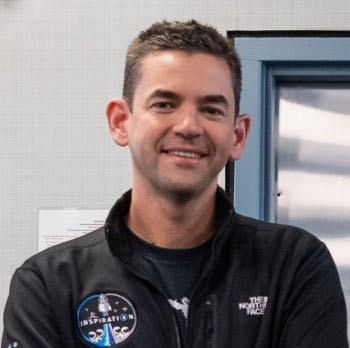
Jared Isaacman
Billionaire Jared Isaacman

According to a report late today (based on anonymous sources), President Trump has held several face-to-face meetings in the past few weeks with billionaire Jared Isaacman, and those meetings have raised the possibility of Trump re-nominating him for NASA administrator.

According to Bloomberg News, President Trump has reportedly met with Isaacman several times in recent weeks to discuss NASA’s operational plans and future plans. Isaacman is the founder of fintech company Shift4 Payments and a private astronaut at SpaceX who has had a longstanding relationship with Elon Musk.

Isaacman, who has flown two private missions in space (and done one spacewalk), had been nominated by Trump for NASA administrator in December 2024, and was only days away from a Senate confirmation vote when Trump suddenly withdrew the nomination on May 31, 2025. Though it has never been clear why Trump withdrew the nomination, Isaacman’s past support of Democrats and his close links to Musk have been raised as issues, especially because of the Trump-Musk kerfuffle in the spring. Isaacman has also expressed some opinions since then about NASA and what it should do that might not have fit with Trump’s plans.

At the same time, NASA is presently without its own administrator, with Transportation Secretary Sean Duffy holding down the job as an interim head. It appears Trump might be reconsidering his earlier decision in order to get someone in charge of NASA who isn’t distracted by other responsibilities.

Note however that this report is solely from anonymous sources, and we all know how unreliable those are. The whole story could be fantasy cooked up by someone in DC for any number of devious political purposes.

12 comments

Saturn as seen by Cassini in 2004, four months before orbital insertion

Saturn as first seen up close by Cassini
Click for original.

Cool image time! As most of the new cool images coming down from space seem mostly limited to Mars and deep space astronomy, I decided today to dig into the archive of the probe Cassini, which orbited Saturn from July 1, 2004 until September 15, 2017, when it was sent plunging into the gas giant’s atmosphere.

The picture to the right heralded the start of that mission, in that it was taken on February 19, 2004, a little over four months before the spacecraft fired its engines and entered orbit. I have rotated the image and cropped it to post here.

When Cassini snapped this picture it was just approaching the gas giant. The image itself is relatively small, with the resolution also relatively poor. You can see one of Saturn’s moons above the planet, but I can’t tell you which one. As noted at the webpage, this is a raw image that has not been “validated or calibrated.”

While not up to the amazing standard exhibited by Cassini’s images during its thirteen year stay at Saturn, it gave us a flavor of the wonders to come. Of all the planets, Saturn might be the most beautiful.

7 comments

Congressional budget action appears to just save two of seventeen on-going NASA missions

Though no final budget has yet been approved, based on the language in the budget the House has approved and sent to the Senate, only two of the seventeen on-going missions presently in space are specifically allocated money, thus allowing the Trump administration to zero out funding for the remaining fifteen.

The two missions saved are Osiris-Apex, on its way to the potentially dangerous asteroid Apophis, and the Magnetospheric Multiscale Mission (MMS), four satellites in orbit that observe the Earth’s magnetosphere.

The article at the link is typical of our propaganda press. It clearly opposes any cuts to NASA, and lobbies repeatedly for all funding to be reinstated. This pattern has gotten quite boring and tedious. It would be so refreshing to see a more objective take, at least one in a while.

However, its reporting confirms my own reporting from mid-September, where I noted that the vague language in the House budget bill would allow Trump to cut these missions. Congress wants to preen itself as supporting all funding for NASA, while carefully allowing Trump to go ahead with large cuts.

It is a good thing these two missions have been saved, though it does appear their funding has been trimmed. Of the fifteen missions in limbo, the only two that seem worth keeping is the Chandra X-Ray Observatory and New Horizons, though the second should likely be set up similar to the two Voyager spacecraft, with a very small crew aimed mainly at keeping the spacecraft functioning and able to send back data periodically.

We are in great debt. It is time that the federal government make some real choices. We can no longer afford to buy all the candy in the store.

14 comments

The Juno mission at Jupiter is almost certainly over

An article yesterday at Space.com speculated that the Juno mission to Jupiter is likely over, but added that we cannot yet be sure because the government shutdown has prevented NASA from making any definitive announcement.

NASA’s management had previously extended the orbiter’s mission several times, with the last extension going until the end of the 2025 fiscal year, that ended on September 30, 2025. No new budget has yet been approved, and the proposed Trump budget had included no money for extending the mission farther.

Due to the government shutdown, NASA is currently unable to say whether Juno is still operating or already powered down. At the time of publication, responses from agency officials state that “NASA is currently closed due to a lapse in government funding … Please reach back out after an appropriation or continuing resolution is approved.”

Under shutdown rules, only missions that fall under “excepted activities” — those required to protect life, property, or national security — can continue operations or communications. NASA’s continuity plans also specify that carryover funding may only be applied to “presidential priorities,” which limits what science programs can proceed during a lapse.

Juno does not fall into those protected categories, and was also zeroed-out on the President’s fiscal year 2026 budget request — making the mission, presumably, not a priority. So, until normal government operations resume, the spacecraft’s future is uncertain.

I think Juno’s future at this point is not uncertain in the least. While other active missions that the Trump proposed shutting down might get revived, Juno is unlikely to be one of them. I suspect the science team has put it in hibernation, and is already beginning to move on to other projects and work. They are being coy about this in the faint hope Congress will save Juno, but this should not be a priority. At this point I think NASA would be wiser to spend its resources elsewhere.

2 comments

Axiom successfully tests two of its lunar spacesuits underwater

Axiom's two spacesuits being tested underwater
Axiom’s two spacesuits being tested underwater.
Click for original.

The space station startup Axiom this week successfully completed underwater testing of two of its lunar spacesuits, making them ready for astronaut training.

Axiom won the contract to build these suits for NASA in 2022. It speaks well of the company that only three years later the suits are now ready for use. It also shows NASA’s own incompetence, because before it awarded this contract to Axiom the agency tried to build its own suits, spending more than a billion dollars and fourteen years to produce nothing.

Furthermore, this success underlines yesterday’s NASA inspector general report that lambasted Collins Aerospace’s incompetence in maintaining the spacesuits on ISS. Collins in 2022 had won a similar spacesuit contract to build new space station suits, but two years later backed out of the deal, unable to get the job done.

For Axiom, this spacesuit success adds an essential component to its own space station plans. Though these suits are intended for the Moon, the company now has the basics down for its own space station suit. It owns this suit design, and will not only sell suits to NASA, it can market the suits to any one else.

0 comments

Inspector General: The state of NASA’s spacesuits on ISS is becoming critical

NASA's failed spacesuit
NASA’s failed Moon spacesuits

A new NASA inspector report issued today [pdf] has found that the single contractor NASA uses to maintain the spacesuits on ISS, Collins Aerospace, has increasingly been unable to do the job, and NASA has no alternative contractor to turn to. From the report’s executive summary:

We previously reported on NASA’s spacesuit management in 2017 and 2021, finding that the Agency faced a wide array of risks to sustaining the EMUs [the spacesuits], including design inadequacies, health risks, and low inventories of spacesuit life support systems, ultimately leading to NASA’s efforts to design and develop next-generation suits to replace the existing EMUs. Specifically, the EMU design flaws have increased the chance of and led to unexpected water in helmets, thermal regulation malfunctions, and astronaut injuries. Given that spacesuits are necessary to meet future ISS maintenance needs until its planned decommissioning in 2030, it is critical that NASA effectively manages the contract performance and subsequent safety risks associated with ESOC [the contract with Collins].

…Until the ISS’s planned decommission at the end of the decade, NASA will continue to require spacewalking capabilities to perform upgrades and corrective and preventative maintenance to the Station. However, Collins’ performance on ESOC increases programmatic risks to NASA as it attempts to conduct safe spacewalks outside the ISS and maintain critical EMU life support component inventories. The contractor is experiencing considerable schedule delays, cost overruns, and quality issues that significantly increase the risk to maintaining NASA’s spacewalking capability.

Collins was awarded this five-year cost-plus maintenance contract in 2010 for $324 million. Since then NASA has been repeatedly extending it, so that it now runs through 2027 and has funneled $1.4 billion into Collins’ bank account. Yet Collins has repeatedly failed to deliver necessary repair parts, even as there have been more frequent problems on ISS, including several cases where spacewalks had to be aborted because an astronaut’s life was in danger. Here are just a few examples cited in the report:
» Read more

10 comments

NASA cancels Sierra Space’s contract for Dream Chaser cargo missions to ISS

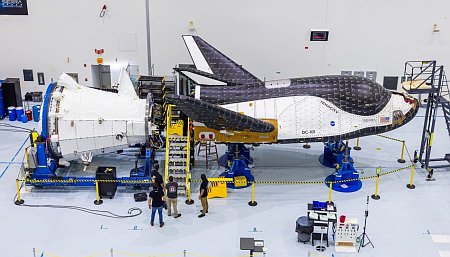
Tenacity grounded in a warehouse
Tenacity grounded in a warehouse, with the
Shooting Star small cargo capsule attached to
its aft port.

NASA today announced it has modified its fixed-price cargo contract with Sierra Space, canceling the planned seven cargo missions as well as a demo docking mission, replacing this with one test flight that will simply go into orbit and then return to Earth.

After a thorough evaluation, NASA and Sierra Space have mutually agreed to modify the contract as the company determined Dream Chaser development is best served by a free flight demonstration, targeted in late 2026. Sierra Space will continue providing insight to NASA into the development of Dream Chaser, including through the flight demonstration. NASA will provide minimal support through the remainder of the development and the flight demonstration. As part of the modification, NASA is no longer obligated for a specific number of resupply missions, however, the agency may order Dream Chaser resupply flights to the space station from Sierra Space following a successful free flight as part of its current contract.

The first launch of Tenacity, the only Dream Chaser so far constructed, has been repeatedly delayed for the past two years, with no explanation from either the company or NASA. Those delays started in 2023 as engineers began the final ground testing before launch, so though we do not know what the issue is it is likely that testing found something fundamentally wrong with the spacecraft that Sierra could not afford to fix.

According to Sierra’s own press release, the company will target a late 2026 launch for that free flyer mission. The company still hopes that mission will make further flights possible, either purchased by NASA or by others wishing to use Tenacity for in-orbit manufacturing, something it first proposed last year.

In the past two years, Sierra has shifted its focus away from commercial manned space and more towards winning military defense contracts. Part of that decision might have come from the problems with Dream Chaser. The decision might have also been fueled by the company’s generally unsatisfactory experience working with Blue Origin on their proposed Orbital Reef space station. While Sierra committed cash to develop and test its LIFE inflatable module, including a full scale prototype, Blue Origin appeared to do nothing at all. As early as September 2023 there were rumors the partnership was falling apart.

24 comments

Starlab selects Vivace to build the primary structure of its proposed space station

The American space stations under construction
The American space stations under development

The Starlab consortium today announced that it has chosen the Louisiana space hardware company Vivace to build the primary structure of its proposed space station, designed to launch as one very large module inside SpaceX’s Starship.

The aluminum-based structure, one of the largest single spaceflight structures ever developed for launch, will be built at Vivace’s facility in New Orleans, La., with additional development and testing support from [NASA’s] Michoud Assembly Facility (MAF) in Louisiana.

…The program will use Vivace’s New Orleans facility at MAF for fabrication, with support from U.S. government partners for subject matter expertise, structural analysis and potential test infrastructure. MAF will also support specialized large-scale manufacturing and assembly operations.

It appears Starlab chose this subcontractor because of its extensive ties to NASA, likely in the hope this will increase the chances it will win the upcoming station construction contracts NASA is expected to issue in the next year or so.

The four commercial stations under development, ranked by me based on their present level of progress:
» Read more

2 comments

NASA awards orbital servicing startup Katalyst contract to save the Gehrels Swift space telescope

Katalyst's proposed Swift rescue mission
Katalyst’s proposed Swift rescue mission.
Click for original image.

NASA today announced that it has awarded the orbital servicing startup Katalyst a $30 million contract to use a robotic servicing satellite to rendezvous and attach itself to the Gehrels Swift space telescope and raise its orbit.

Right now the telescope’s orbit is decaying, and it will burn up sometime in 2029 if something isn’t done. As one of the most successful low-cost astronomy space telescopes ever launched — central to the study of gamma ray bursts — spending this small amount to save Gehrels seems a no-brainer. In mid-August NASA had awarded Katalyst and a second company small contracts to study whether they could do this mission. Today’s announcement means NASA liked Katalyst’s proposal.

Whether this startup can do it however remains unknown. It appears from its own press release today describing this contract award that the company decided to add Gehrels to its already planned first demo servicing mission planned for next year.

The schedule is also unprecedented: while satellite servicing typically takes years to plan, Katalyst must be ready to launch in eight months, with docking operations scheduled for mid-2026, to save Swift before it burns up.

…Katalyst was already on schedule for an in-space demonstration of its rendezvous, proximity operations, and docking technology for June 2026. The demonstration would buy down technical risk ahead of the planned launch of Katalyst’s multi-mission robotic spacecraft, NEXUS, in 2027. When NASA raised the alarm about Swift, Katalyst seized the opportunity to pivot to a live rescue operation which would demonstrate similar capabilities.

The mission is even further risky in that Swift has no grapple or docking port for Katalyst’s satellite to attach to. Instead, it “will rely on a custom-built robotic capture mechanism that will attach to a feature on the satellite’s main structure–without damaging sensitive instruments.”

0 comments

NASA now targeting a February-to-April launch window for first manned Artemis mission

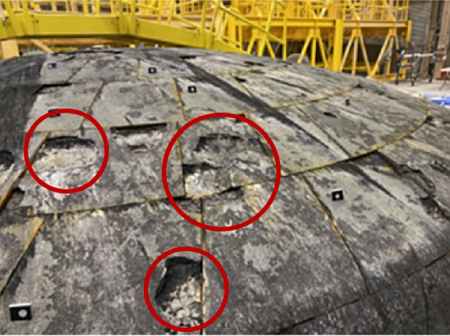
Orion's damage heat shield
Damage to Orion’s heat shield caused during re-entry in 2022,
including “cavities resulting from the loss of large chunks”.
Nor has this issue been fixed.

According to a NASA official at an event yesterday, the agency is now targeting launch window starting on February 5, 2026 and extending into April for the first manned Artemis mission, dubbed Artemis-2, that will slingshot four astronauts around Moon and back to Earth on a 10-day-flight.

If Artemis 2 does lift off on Feb. 5, it will be at night, NASA officials said. The space agency has about five days apiece in February, March and April to launch the flight. The latest possible date is April 26, according to NASA. NASA will aim to hit the earlier part of that launch window, Hawkins said, but she stressed that crew safety will drive the timeline.

That mission will fly with an Orion capsule that has safety concerns, including a questionable heat shield (see picture above) and an untested environmental system.

Meanwhile, as part of NASA’s never-ending PR effort to sell the mission, it announced today that the mission’s four astronauts have now given their Orion capsule a name, Integrity.

The name Integrity embodies the foundation of trust, respect, candor, and humility across the crew and the many engineers, technicians, scientists, planners, and dreamers required for mission success.

Considering NASA’s level of dishonesty during the entire development of SLS and Orion, the ironies of this name and these claims is quite breath-taking.

6 comments

Two launches by China and SpaceX

Both China and SpaceX completed launches today. First, China launched another 11 satellites for its Geely internet-of-things constellation, its Smart Dragon-3 rocket lifting off from a ocean platform off the nation’s eastern coast.

This was the sixth launch for this constellation, bringing the number of satellites in orbit to 64, out of a planned 240. The constellation is designed to provide positioning and communications for trucking and other ground-based businesses.

Next, SpaceX successfully placed three government science satellites into orbit (two for NASA and one for NOAA), its Falcon 9 rocket lifting off from the Kennedy Space Center in Florida. The first stage completed its second flight, landing on a drone ship in the Atlantic. The two fairings both completed their first flight.

The two NASA satellites were the Interstellar Mapping and Acceleration Probe (IMAP) to study the Sun’s heliosphere at the edge of the solar system and the Carruthers Geocorona Observatory to study the exosphere, the outermost layer of the atmosphere. The NOAA probe, Space Weather Follow On – Lagrange 1 (SWFO-L1), will observe the Sun from one million miles from Earth, providing advance knowledge of strong solar flares and eruptions so that utility companies can shield the electric grid appropriately.

The leaders in the 2025 launch race:

123 SpaceX
55 China
13 Russia
12 Rocket Lab

SpaceX now leads the rest of the world in successful launches, 123 to 94.

0 comments

NASA’s new class of astronauts illustrates its increasing shift to capitalism

NASA being conquered by Americans
NASA is being conquered by Americans

That two different former SpaceX employees, one of whom had already flown on a private mission in space, applied and were accepted by NASA yesterday — as part of the 24th class of astronauts since its creation three-quarters of a century ago — reveals the major shift that is occurring across the entire space industry, and most especially within NASA.

This new class of ten included four men and six women, the first time women were the majority chosen. More significantly however were the two former SpaceX employees.

Yuri Kubo, 40, is a native of Columbus, Indiana. He earned a bachelor’s degree in electrical engineering and a master’s in electrical and computer engineering from Purdue University. He spent 12 years working across various teams at SpaceX, including as launch director for Falcon 9 rocket launches, director of avionics for the Starshield program, and director of Ground Segment.

Anna Menon, 39, is from Houston and earned her bachelor’s degree from Texas Christian University with a double major in mathematics and Spanish. She also holds a master’s in biomedical engineering from Duke University. Menon previously worked in the Mission Control Center at NASA Johnson, supporting medical hardware and software aboard the International Space Station. In 2024, Menon flew to space as a mission specialist and medical officer aboard SpaceX’s Polaris Dawn. The mission saw a new female altitude record, the first commercial spacewalk, and the completion of approximately 40 research experiments. At the time of her selection, Menon was a senior engineer at SpaceX.

Menon is also married to another NASA astronaut, Anil Menon, making them the fourth married couple picked by NASA.

At first I wondered why either would want to leave the private sector to work at NASA, especially considering that the opportunity to fly in space through NASA is going to decline significantly in future years. Its Artemis program will at best launch once a year, carrying four, and when ISS retires NASA’s flights to the commercial stations will be fewer and farther apart.

Then I realized the financial and personal benefits of getting picked and trained by NASA as an astronaut. It is a wonderful item to put on one’s resume. These astronauts don’t have to stay at NASA forever. As the private commercial stations and other private manned capsules begin flying, those companies are going to need trained individuals to fly their ships and run their stations. Most will look for candidates from NASA’s astronaut corps.

The presence of those two SpaceX employees in this class also shows us the shift from the government to private enterprise. In the past almost all of NASA’s astronaut picks would have come from the military and academia (In fact, the other eight astronauts picked this time all have such backgrounds). Rarely would NASA have chosen anyone from the private sector.

The choice of two such private sector individuals by NASA yesterday is simply another indication of the agency’s shift from the top-down government model to the capitalism model. It is finally recognizing the private sector is (and has always been) the heart of America’s space effort, and it is beginning to reward it appropriately.

Even as that private sector begins to take over NASA itself.

4 comments

Blue Origin wins contract to bring NASA’s Viper rover to the Moon

NASA yesterday awarded Blue Origin a contract to use its Blue Moon lunar lander to transport the agency’s troubled Viper rover to the Moon’s south pole region.

The CLPS task order has a total potential value of $190 million. This is the second CLPS lunar delivery awarded to Blue Origin. Their first delivery – using their Blue Moon Mark 1 (MK1) robotic lander – is targeted for launch later this year to deliver NASA’s Stereo Cameras for Lunar-Plume Surface Studies and Laser Retroreflective Array payloads to the Moon’s South Pole region.

With this new award, Blue Origin will deliver VIPER to the lunar surface in late 2027, using a second Blue Moon MK1 lander, which is in production. NASA previously canceled the VIPER project and has since explored alternative approaches to achieve the agency’s goals of mapping potential off-planet resources, like water.

The contract does not guarantee this mission. NASA has several options along the way to shut things down, depending on the milestones Blue Origin achieves. The first of course is the success of that first lunar lander.

The announcement does not make clear how NASA is going to pay for the work needed to finish Viper. VIPER was originally budgeted at $250 million. When cancelled in 2024 its budget had ballooned to over $600 million, and that wasn’t enough to complete the rover for launch. Moreover, after getting eleven proposals from the private sector companies to finish and launch Viper, in May 2025 NASA canceled that solicitation.

It is very likely Blue Origin is picking up the tab, but if so the press release does not say so.

10 comments

NASA and Northrop Grumman work out rendezvous plan to get Cygnus to ISS

UPDATE: The plan worked and Cygnus is safely berthed at ISS.

According to a press release tonight, NASA and Northrop Grumman have figured out a new rendezvous plan to get Cygnus to ISS after its previous engine burns yesterday cut off prematurely and left it in the wrong orbit.

NASA and Northrop Grumman are targeting the safe arrival of the company’s Cygnus XL at approximately 7:18 a.m. EDT Thursday, Sept. 18, to the International Space Station. The Cygnus XL now will conduct a series of burns to bring the spacecraft to the space station for its robotic capture and installation.

NASA astronaut Jonny Kim is scheduled to capture Cygnus XL using the station’s Canadarm2 robotic arm with backup support from NASA astronaut Zena Cardman. After capture, the spacecraft will be installed on the Unity module’s Earth-facing port and will remain at the space station until March 2026.

The release also added this detail about why that engine burn ended too soon:

Data shared by the spacecraft confirmed that Cygnus XL operated as intended during two planned maneuvers when an early warning system initiated a shutdown command and ended the main engine burn because of a conservative safeguard in the software settings.

Apparently this cause has reassured them that the engine is in good shape for the final rendezvous burns.

4 comments

Premature engine cutoff forces postponement of Cygnus berthing to ISS

During the second of two engine burns today, designed to raise the orbit of Northrop Grumman’s Cygnus freighter to match ISS’s, the burn ended prematurely, placing the capsule in the wrong orbit.

Early Tuesday morning, Cygnus XL’s main engine stopped earlier than planned during two burns designed to raise the orbit of the spacecraft for rendezvous with the space station, where it will deliver 11,000 pounds of scientific investigations and cargo to the orbiting laboratory for NASA. All other Cygnus XL systems are performing normally.

The berthing, using one of the robot arms on ISS, had been planned for early tomorrow, Wednesday, but will not occur until both NASA and Northrop Grumman engineers have analyzed the issues and come up with “an alternate burn plan”.

0 comments

Progress docks safely with Zvezda module at ISS

ISS as of today
ISS as of today. Click for original.

In what is increasingly a worrisome procedure, Russia’s just launched Progress freighter successfully docked with the aft port of the Zvezda module at ISS this past weekend, bringing with it more than 5,000 pounds of supplies and research equipment.

The image to the right, annotated additionally by me, shows the present configuration of spacecraft at ISS. The concerns center on the stress fractures that have been found in the Zvezda hull, fractures that have caused the air leak on ISS and are believed attributable to the many dockings to the module since its launch in the late ’90s, as well as the module’s age. It was first built in the late ’80s, making it almost four decades old.

For recent dockings, NASA now closes the hatch between the Russian and American halves of the stations, just in case Zvezda experiences a catastrophic failure. The Russians seem less concerned, but nonetheless they also take extra care during dockings. It is my understanding their astronauts prepare their Soyuz capsule as a lifeboat and immediately escape during these operations.

11 comments

Space station startup Vast endorses NASA’s new strategy that no longer requires a continuous human presence in space

The American space stations under construction
The American space stations under development

Officials from the space station startup Vast revealed at a conference last week that they endorse NASA’s new strategy that, not only no longer requires the commercial stations to immediately establish a continuous human presence in space, will also award multiple development contracts to the commercial stations.

Speaking Sept. 11 at the Global Aerospace Summit, Max Haot [chief executive of Vast] endorsed NASA’s new strategy, announced more than a month ago, that calls for multiple Space Act Agreements to support development leading to a four-person, 30-day demonstration mission. “We think it’s really the right direction,” he said, noting it accelerates the award timeline. NASA said in a draft solicitation this month it expects to award multiple funded agreements by April 2026, months sooner than under earlier plans.

The original plan had been to choose at most two, but likely only one of the four consortiums/companies that are developing station proposals. The winner would have gotten a big contract that would have also required it to push hard for continuous full time occupation, from day one.

The new plan will instead award smaller development contracts to as many as three of the four station projects, aimed at getting them off the ground and operating, even if astronauts only fly in them intermittently. Eventually the hope is that their capabilities will expand quickly to permanent occupation, especially if they start earning revenue from the private sector, outside NASA. In fact, the smaller government contracts will force them to seek investment and profits elsewhere.

The four commercial stations under development, ranked by me based on their present level of progress:
» Read more

0 comments

SpaceX launches Northrop Grumman’s Cygnus freighter to ISS

SpaceX today successfully launched Northrop Grumman’s Cygnus freighter with more than five tons of cargo, its Falcon 9 rocket lifting off from Cape Canaveral in Florida.

The first stage completed its fourth flight, landing back at Cape Canaveral. The two fairing halves completed their 3rd and 6th flights respectively. Cygnus is expected to be berthed to ISS using the robot arm on September 24, 2025. This is also the first flight of the stretched version of Cygnus, capable of carrying more cargo.

The leaders in the 2025 launch race:

118 SpaceX
53 China
13 Russia
12 Rocket Lab

SpaceX now leads the rest of the world in successful launches, 118 to 92. China also had its own launch scheduled for this evening, but no information about it has yet been released.

2 comments

House committee support for threatened NASA missions is actually quite questionable

According to a House appropriations committee spending bill that it approved this week, it appears on the surface that it is canceling the proposed 24% cut by Trump to NASA’s budget as well as endorsing continued funding for some threatened missions. A close look however suggests this congressional support for NASA is somewhat superficial, and might actually be ephemeral.

The key is the language of the bill. From the link above:

The bill was largely unchanged from what the CJS [commerce, justice and science] subcommittee approved July 14. It includes $24.838 billion for NASA, nearly the same as the $24.875 billion the agency received in fiscal 2024 and 2025, and far above the $18.8 billion the administration proposed for fiscal 2026 in May.

Members adopted a manager’s amendment, a package of noncontroversial changes and corrections, on a voice vote. That amendment also made additions to the report accompanying the bill. The report includes language expressing support for several NASA missions targeted for cancellation, including the Chandra X-ray Observatory, the Juno mission at Jupiter and the New Horizons mission in the Kuiper Belt.

The report does not specify funding levels for those missions, but the “continues support” language signals to NASA that it should fund continue operations within the agency’s science budget. [emphasis mine]

It is the vagueness of this language that suggests the support is ephemeral. The courts recently have consistently ruled that if Congress doesn’t specifically mandate spending on a project, the White House is free to move money around as it sees fit. By not expressly outlining funding for Chandra, Juno, and New Horizons, these congressmen are playing a shell game, whereby to their constituents they can point to this vote and claim they wholeheartedly supported NASA and these missions. At the same time, they also appear to be allowing Trump the freedom to go ahead and shut the missions down, as his budget has already proposed.

None of this is yet real. The bill still must be passed by the full House, as well as the Senate. It then has to be signed by Trump. A lot of changes would happen in that process.

Either way, it appears that within the House at least, there is some movement to at least make some budget cuts possible. The sad thing is that the House is not actually cutting the budget, even as it is allowing Trump a way to cut these relatively inexpensive on-going missions. Considering the debt, it would have been much better had the committee actually trimmed NASA’s budget, even a little, while at the same time allocating specific funds to keep these very cost-effective missions alive.

6 comments

NASA bans Chinese citizens from its facilities or operations

Earlier this week NASA moved to block Chinese citizens with visas from having access to its facilities as well as its entire operations, citing security concerns.

“NASA has taken internal action pertaining to Chinese nationals, including restricting physical and cybersecurity access to our facilities, materials and network to ensure the security of our work,” NASA press secretary Bethany Stevens said on Wednesday. According to Bloomberg, Chinese nationals had previously been allowed to work as contractors or students contributing to research, although not as staff.

But on 5 September several individuals told the outlet they were suddenly locked out of IT systems and barred from in-person meetings. They spoke on condition of anonymity.

Though both the Chinese press and the leftist news outlet above (The Guardian) whine about this move, it makes great sense, and should have been done years ago. Though I am sure most of these Chinese citizens are not spies, China’s policy has been to consistently use such citizens for spying, and letting such people into NASA operations makes no sense.

Moreover, shouldn’t NASA be hiring Americans first and foremost?

9 comments
1 6 7 8 9 10 116