NASA awards small orbital tug study contracts to six companies

NASA yesterday awarded six companies small study contracts in connection with orbital tug operations, with some to study using their rocket upper stage for this purpose while others to see how they can refine the use of their tugs.

The press release was not entirely clear on how much money was involved in each contract, though in each case the amounts are relatively small.

The firm-fixed-price awards comprise nine studies with a maximum total value of approximately $1.4 million. The awardees are:

Arrow Science and Technology LLC, Webster, Texas [tug study]
Blue Origin LLC, Merritt Island, Florida [both tug and upper stage studies]
Firefly Aerospace Inc., Cedar Park, Texas [tug study]
Impulse Space Inc., Redondo Beach, California [tug study]
Rocket Lab, Long Beach, California [both tug and upper stage studies]
United Launch Services LLC, Centennial, Colorado [upper stage study]

The studies are expected to be finished by September 2025, and will be used by NASA to determine how it will get some of its future spacecraft to their intended orbits.

0 comments

Russia desperately lobbies the U.S. to continue and expand its space partnership

Roscosmos: a paper tiger

A string of short articles in Russia’s state-run press today, describing the meetings between the head of Roscosmos, Dmitry Bakanov, and interim NASA administrator Sean Duffy, suggest strongly that Russia is desperate to link itself with someone in order to continue its generally bankrupt space program.

Bakanov is making his first visit to the U.S. He and Duffy are also conducting the first face-to-face talks by the heads of their respective agencies in eight years. While the U.S. press has been entirely uninterested in these discussions, mostly because it knows little of substance will come of them other than an agreement to maintain the partnership at ISS through its planned retirement in 2030, the reaction by Russia’s press has been remarkably fawning, repeatedly proposing the U.S. and Russia expand their partnership beyond ISS:

Very clearly, Bakanov was trying to convince Duffy to consider a greater partnership, whereby Roscosmos and NASA do other space projects together. He might have even been offering to join NASA’s Artemis program to explore the Moon.

It appears from the other Russian state-run reports, however, that Duffy’s response was diplomatic but unenthused by such a proposal. All he apparently agreed to was to continue the ISS partnership, until the station’s retirement.
» Read more

27 comments

Endeavour launched successfully, carrying four astronauts to ISS

SpaceX’s Endeavour Dragon capsule has been successfully placed in orbit carrying four astronauts to ISS, its Falcon 9 rocket lifting off from Kennedy in Florida.

This is Endeavour’s sixth flight. It will dock at ISS in the early hours tomorrow. The first stage completed third flight, landing back in Florida.

The leaders in the 2025 launch race:

96 SpaceX
41 China
10 Rocket Lab
9 Russia

SpaceX now leads the rest of the world in successful launches, 96 to 71.

1 comment

The word that best describes our present NASA lunar program is “delusional.”

Artemis, a program based on fantasy

Increasingly it appears everyone in Congress, the White House, and NASA, as well as our bankrupt mainstream press, has become utterly divorced from reality in talking about NASA’s Artemis lunar program. The claims are always absurd and never deal with the hard facts on the ground. Instead, it is always “Americans are piorneers! We are great at building things! We are going to beat China to the Moon!”

An interview of interim NASA administration (and Transportation secretary) Sean Duffy yesterday on the Sean Hannity Show made all these delusions very clear. First Hannity introduced Duffy by stating with bald-faced ignorance that “NASA has a brand-new program. It is called Artemis that aims to get astronauts back on the Moon in the next couple of years.”

I emphasize “brand-new” because anyone who has done even two seconds of research on the web will know that Artemis has existed now for more than a decade. Hannity illustrates his incompetence right off the bat.

Duffy then proceeds to insist that the next Artemis mission, dubbed Artemis-2, will fly in April 2026 and send four astronauts around the Moon, followed by the Artemis-3 manned landing one year later.

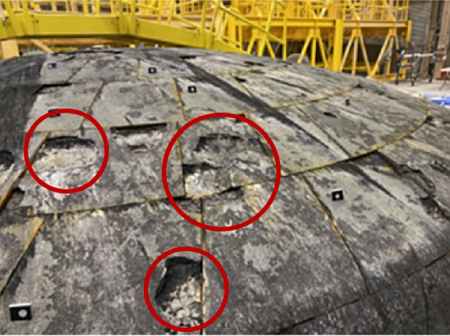
Being an incompetent member of the propaganda press, Hannity of course accepts these claims without question. He fails to question Duffy about the serious issues with the Orion heat shield, which experienced extensive unexpected damage that is still not understood during its return on the first Artemis mission in 2022.

Nor does either Duffy or Hannity mention the fact that for Artemis to land humans on the Moon SpaceX’s Starship not only has to become operational for human passengers, it needs an in-orbit refueling capability that does not yet exist. I have full confidence that SpaceX will eventually succeed in achieving these benchmarks, but I also doubt it will be able to do it by mid-2027, as claimed by Duffy.

Duffy and Hannity however are not alone in living in this dream world. » Read more

36 comments

Thales Alenia ships the orbit insertion module for the Mars sample return mission

Though the entire project remains in limbo at NASA and might be cancelled, the European aerospace company Thales Alenia this week completed construction of the orbit insertion module for the Mars sample return mission that will place the orbiter — also built by European companies — in Mars orbit and will eventually bring the samples back to Earth.

On 28 July, Thales Alenia Space announced that the module had passed its test campaign with “excellent results.” According to the update, the company had packed and shipped the Orbit Insertion Module from its Turin facilities to Airbus in Stevenage a few days earlier. The delivery marks a key milestone in the development of the Mars Return Orbiter.

The broader Earth Return Orbiter project passed a key milestone in July 2024 with the completion of the Platform Critical Design Review. This review confirmed the performance, quality, and reliability of the mission’s systems. With its successful conclusion, Airbus advanced to full spacecraft development, including the integration and testing of its various components, among them the Orbit Insertion Module.

Under the project’s present very complex design, NASA is supposed to provide the ascent rocket and capsule to bring the samples to Europe’s return orbiter. At the moment it is unclear who will build this, or even if it will ever get built. Thus, Europe might be building a very expensive Mars orbiter with no clear mission.

4 comments

Firefly wins new NASA lunar lander contract, worth $176.7 million

NASA announced yesterday that it has awarded Firefly a $176.7 million contract to use the company’s Blue Ghost lunar lander to deliver two rovers and three other science instruments to the Moon’s south pole region.

Under the new CLPS task order, Firefly is tasked with delivering end-to-end payload services to the lunar surface, with a period of performance from Tuesday to March 29, 2030. The company’s lunar lander is targeted to land at the Moon’s South Pole region in 2029.

This is Firefly’s fifth task order award and fourth lunar mission through CLPS. Firefly’s first delivery successfully landed on the Moon’s near side in March 2025 with 10 NASA payloads. The company’s second mission, targeting a launch in 2026, includes a lunar orbit drop-off of a satellite combined with a delivery to the lunar surface on the far side. Firefly’s third lunar mission will target landing in the Gruithuisen Domes on the near side of the Moon in 2028, delivering six experiments to study that enigmatic lunar volcanic terrain.

One of the rovers is being built in partnership with Canada.

2 comments

Starlab partners with the interior design company Journey

Starlab design in 2025
The Starlab design in 2025. Click
for original image.

The consortium designing the commercial Starlab space station has now signed a partnership deal with the interior design company Journey for the latter to design the station’s habitable interior.

Journey brings a deep portfolio of globally recognized projects, including the Sphere in Las Vegas, the Empire State Building observatory in New York City and the Sun Princess Dome for Princess Cruises. The agency will be working closely with Hilton, one of the original strategic partners in the Starlab program, designing the Starlab hospitality and crew experience. Journey’s role adds a vital layer of design and experiential innovation, shaping a space that reflects both function and humanity.

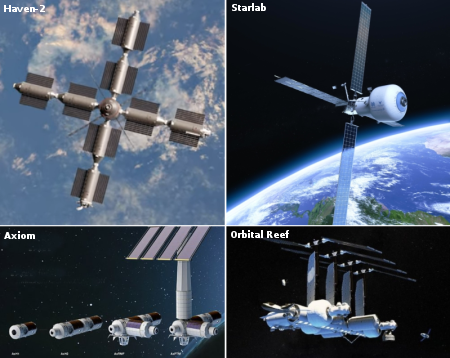
Much of the press release is similar blather. It is good that Starlab is thinking about making the living space in its station “both a cutting-edge research platform and a welcoming, livable habitat,” but this deal doesn’t include any actual design work. Apparently nothing concrete will be done until Starlab wins the big NASA construction project — assuming it does so. Thus, I still rank Starlab low in my rankings of the four commercials stations being built or proposed, but this deal has convinced me to raise its ranking above Orbital Reef. Both have built little, but Starlab is at least making a lot of partnership deals with others, strengthening the quality of its team.

  • Haven-1, being built by Vast, with no NASA funds. The company is moving fast, with Haven-1 to launch and be occupied in 2026 for an estimated 30 days total. It hopes this actual hardware and manned mission will put it in the lead to win NASA’s phase 2 contract, from which it will build its much larger mult-module Haven-2 station..
  • Axiom, being built by Axiom, has launched four tourist flights to ISS, with the fourth carrying government passengers from India, Hungary, and Poland. Though there have been rumors it has cash flow issues, development of its first module has been proceeding more or less as planned.
  • Starlab, being built by a consortium led by Voyager Space, Airbus, and Northrop Grumman, with an extensive partnership agreements with the European Space Agency and others. It recently had its station design approved by NASA, but it has built nothing. The company however has now raised $383 million in a public stock offering, which in addition to the $217.5 million provided by NASA gives it the capital to begin some construction.
  • Orbital Reef, being built by a consortium led by Blue Origin and Sierra Space. Overall, Blue Origin has built almost nothing, while Sierra Space has successfully tested its inflatable modules, including a full scale version, and appears ready to start building its module for launch.

Hat tip to BtB’s stringer Jay.

1 comment

One of NASA’s two Tracers satellites just launched has an issue

During the commissioning phase shortly after their launch earlier this week, one of NASA’s two Tracers satellites designed to study the solar wind and its interaction with the Earth’s magnetic field has had an as yet unnamed issue.

During the commissioning process, the team made routine adjustments to the power subsystem on both vehicles. While the adjustments achieved the desired results on one satellite, the other satellite requires further investigation by the team. Commissioning operations are temporarily paused while the team analyzes the situation and determines the appropriate response.

Though the press release provides no other information, it appears the satellite is having a problem producing the power expected.

1 comment

NASA’s work force is shrinking by about 4,000

The number of NASA employees that have accepted the Trump offer to leave has now grown to more than 4,000 people, reducing the entire workforce from 18,000 to 14,000.

Nearly 4,000 employees, or more than 20% of NASA’s workforce, have applied to leave the agency, NASA confirmed to CBS News Friday. About 3,870 employees have applied to depart NASA over two rounds through the Trump administration’s deferred resignation program, NASA disclosed. The deadline for applications to the program is midnight Friday.

With those deferred resignations, NASA’s civil servant workforce would shrink from about 18,000 to 14,000 personnel. This figure also includes about 500 employees who were lost through normal attrition, the agency said.

It is certain that while Trump is office these workers will not be replaced. While most of the press and pro-government activists will claim this is terrible news, it is actually the best thing that can happen. Since NASA is now trying to use the capitalism model across the board, it doesn’t need that many employees. It is hiring the private sector to do most of its work. It doesn’t take that many people to review and issue a contract.

So, even if Congress rejects Trump’s proposed 24% cut to NASA’s 2026 budget and funds it entirely at the same levels as in 2025, the money will be more effectively used.

11 comments

Like the Senate the House appropriation committee rejects Trump’s NASA cuts, but differently

The NASA 2026 budget approved this week by the House appropriation committee has rejected the 24% cut proposed by the Trump administration, in a similar manner as the parallel Senate committee.

However, the two congressional committees are not in agreement on any of their spending proposals.

The totals recommended by the two committees are similar — $24.8 billion in the House, $24.9 billion in the Senate — but the specifics are different in many cases.

For example, the House wants to spend $300 million for NASA’s very messed-up Mars Sample Return project, while the Senate eliminated it entirely. The House also increases NASA’s manned exploration budget over Trump’s proposal, while the Senate cuts it. In science spending the House is less generous than the Senate, though both houses reject Trump’s cuts. In education the House agrees with Trump, zeroing out that funding, while the Senate wants to increase the ’25 budget slightly.

Before the 2026 budget is approved the two houses will have to negotiate an agreement to make their numbers match. What has usually happened in past negotiations is that the houses agree to approve the highest spending numbers in any budget item so that nothing gets cut and the budget continues to go up uncontrollably. We should not be surprised if our corrupt Congress does exactly that.

Even so, we should expect Trump to force significant changes at NASA, including budget reductions. Recent Supreme Court rulings have confirmed the president’s right to reorganize and even eliminate bureaucracies, as long as Congress doesn’t specify a particular spending item.

1 comment

Government employees: The most spoiled and privileged individuals on Earth

NASA: home to the privileged and perfect

Timed to coincide with the anniversary of the Apollo 11 lunar landing, NASA employees and many of their supporters gathered yesterday for protests, demanding that their jobs be saved and that Congress not only cancel Trump’s proposed budget cuts to NASA, that Congress even consider increasing the budget because the work they do is so so SO vital.

The protests appeared to be organized by several groups, all claiming to be “grassroots” but all seeming to be well funded and comparable to other recent government protest groups at other agencies, issuing sanctimonious “declarations” that claim the cuts “to waste public resources, compromise human safety, weaken national security.”

Yet, the Trump cuts would only reduce NASA’s staffing of 17,000 by about 2,600 employees. How horrible!

This quote from the first link above is typical of the attitude of these government workers:
» Read more

17 comments

Axiom’s ticket price for India’s astronaut on Ax-4 mission: $59 million

According to reports today in the India press, the price Axiom charged India’s space agency ISRO for training and then flying its astronaut on the just completed Ax-4 two-week mission to ISS was $59 million.

The expenditure by ISRO includes cost of [Shubhanshu] Shukla’s training for the mission as well as that of a seat on SpaceX’s Dragon spacecraft for the 20-day trip that launched Shukla, and three others — Peggy Whitson from the US, Slawosz Uznanski-Wisniewski of Poland and Tibor Kapu of Hungary — to space.

Earlier reports had suggested Axiom was charging $70 million per ticket. If the $59 million is accurate and applies to the charges Poland and Hungary paid, then Axiom’s revenue for the flight was $177 million. From that it would have to pay SpaceX (for the launch and the use of its Grace capsule) and NASA (for the use of ISS). Based on past history, SpaceX likely charged around $70 million for the launch. The cost for using Grace is unknown. NASA’s fees for a two-week visit to ISS were probably around $10 million plus.

My guess, based on this very limited information, is that Axiom made some profit from the flight, ranging from $20 to $50 million.

1 comment

House follows Senate in canceling most of Trump’s proposed NASA budget cuts

Like pigs at the trough

The House appropriations committee’s draft budget for NASA has followed the Senate appropriations committee in canceling all of Trump’s proposed NASA budget cuts, though it has shifted that funding significantly from science to manned space operations.

The House Appropriations Committee released the draft text of their version of the FY2026 Commerce-Justice-Science bill that funds NASA today. Like their Senate counterpart, the House committee would essentially keep NASA at its current funding level instead of imposing the severe 24.3 percent budget cut proposed by the Trump Administration. The CJS bill also includes almost $2 million for a White House National Space Council even though the Trump Administration has yet to establish one.

Unlike the Senate, which mostly kept the budget the same across all NASA departments, this House draft budget would reduce science and aeronautics spending from about $8.2 billion to $6.8 billion. Trump had requested only $4.5 billion for these departments.

In turn, the House would increase Trump’s request for NASA’s manned operations from $10.8 billion to $11.9 billion. Note that Trump’s proposed budget had already called for an increase here, so the House is clearly shifting funding to manned space in an enthusiastic manner.

At the same time, the House continues funding for the SLS and Orion programs Trump wishes to cancel. Both of these projects are over budget and behind schedule. Neither is very useful in the long run for exploring the solar system. If the House truly wanted to save money, it could easily fund all the cuts in science by cutting the billions spent yearly on these pork projects, and still lower NASA’s budget in total.

Based on the draft budget’s language [pdf], it is unclear whether the House has also funded the Lunar Gateway space station, as the Senate has, another useless pork project that Trump wishes to cancel.

I should note that the appropriations committee’s overall draft budget [pdf] does reduce the federal budget by about 2.8 percent. This is a marked change from past budgets, which often claimed (a lie) to cut spending but really only reduced the rate of budget growth. It appears the House is finally making some effort to shrink the size of the budget, though that effort is quite wimpy.

1 comment

Senate committee moves to cancel most of Trump’s proposed NASA budget cuts

Like pigs at the trough

We’ll just print it! Though disagreements prevented the Senate’s appropriations committee from approving the 2026 bills covering the commerce, justice, and science agencies of the federal government (including NASA) , the committee yesterday appeared poised to cancel most of Trump’s proposed NASA budget cuts and even add more spending across the board.

Sen. Chris Van Hollen (D-Maryland), the top Democrat on the CJS subcommittee, said this morning the bill would fund NASA at $24.9 billion, slightly above its current $24.8 billion level, with the Science Mission Directorate (SMD) remaining level at $7.3 billion.

By contrast, the Trump Administration wants to cut NASA overall by $6 billion, from $24.8 billion to $18.8 billion. SMD’s portion would drop 47 percent, from $7.3 billion to $3.9 billion.

The disagreements centered not on NASA, but on the Trump administration’s effort to cancel a very expensive new FBI headquarters building in the Maryland suburbs and instead shift the agency to an already existing building in DC. Van Hollen opposed this, and the ensuing political maneuvering forced the committee to cancel the vote.

This bill would once again continue full funding for SLS, Orion, and Lunar Gateway. It also includes funding for NASA’s very messed-up Mars Sample Return mission (which comprises the large bulk of the money added back in for science). From this it appears that the Republicans in the Senate are quite willing to join the Democrats in spending money wildly, as they have for decades. They have no interest in gaining some control over the out-of-control federal budget, in any way, as Trump is attempting to do.

What remains unknown is this: Who has the support of the American people? The election suggests the public agrees with Trump. History suggests that this support for cutting the budget is actually very shallow, and that while the public says it wants that budget brought under control, it refuses to accept any specific cuts to any program. “Cut the budget, but don’t you dare cut the programs I like!”

It is my sense that the public’s view is changing, and it is now quite ready to allow big cuts across the board. The problem is that the vested interests in Congress and in the DC work force are quite powerful, and appear to still control the actions of our corrupt elected officials.

Thus, the more of that work force that Trump can eliminate as quickly as possible, on his own, the more chance he will have to eventually bring this budget under some control.

28 comments

Why did Trump suddenly pick Transportation Secretary Sean Duffy to become temporary head of NASA?

The reason for Trump’s sudden decision yesterday to name Transportation Secretary Sean Duffy as interim NASA administrator, replacing long-time NASA manager Janet Piro — who had held the job since Trump took office — remains unclear.

This article suggests the president wanted someone with more political clout who was also part of his inner circle.

Two articles (here and here) imply the decision was related to the recent clashes politically between Trump and Musk, adding that Duffy and Musk have been reported to be in conflict over air traffic controller issues. Picking Duffy thus directly reduces Musk’s influence at NASA.

The truth is that we really don’t know exactly what motives brought Trump to make this appointment. It could be that Trump wants someone in charge who will have the political clout to push through his proposed NASA cuts. It also could be Trump wants someone with that clout to review those cuts and change them.

The bottom line is that NASA remains a political football, a situation that in the end had done decades of harm to the American space industry. The sooner it can be made irrelevant and replaced by a commercial, competitive, and (most important) profitable space industry, the better.

We really don’t need a “space agency.” We didn’t have such a thing when we settled the American west.

9 comments

Senate reconciliation budget bill includes Cruz’s big spending additions to NASA

Senate NASA budget increases

According to a tweet yesterday by Representative Marjorie Taylor Greene (R-Georgia), the reconciliation budget bill that was passed by the Senate included the budget additions that Senator Ted Cruz (R-Texas) had proposed to save SLS, Orion, and Lunar Gateway.

The graphic to the right lists these budget numbers. It is not clear whether the launch taxes on payloads that Cruz proposed were also included, though likely not based on the rules under which the reconciliation bill was passed.

This additional money for these projects contradicts directly the NASA 2026 budget proposal put forth by Trump that aimed to cancel Lunar Gateway and end SLS and Orion after only two more flights. Their existence in this passed Senate bill suggests that Congress is cool with the idea of spending this money and continuing these projects, even though they do nothing but waste taxpayer money and get us no where in space.

It also appears from the language in the graphic that the Senate is eager to also spend more money on NASA’s Mars sample return project, even though NASA itself still has no idea how to accomplish the task.

9 comments

NASA still hoping to save its Lunar Trailblazer mission

Though the odds of success are very dim, NASA has decided to give engineers another few weeks to try to activate its Lunar Trailblazer orbiter, that stopped communicating with Earth the day after it was launched in late February.

NASA has extended recovery efforts of its Lunar Trailblazer spacecraft from mid-June to early July. Updated modeling of the spacecraft’s trajectory by the mission team indicates lighting conditions will continue to be favorable and may provide enough sunlight for the spacecraft’s solar panels to recharge its batteries to an operational state and turn on its radio.

…Should enough sunlight reach Lunar Trailblazer’s solar panels, the batteries may charge to a level that allows the spacecraft’s radio system to boot up. But as Lunar Trailblazer travels farther away, it will soon be too distant to recover because its telecommunications signals to Earth will be too weak for the mission to receive telemetry and command.

The mission team has determined that if they can regain command of the spacecraft, the propulsion system isn’t frozen, and the instruments remain operable, the spacecraft may be able to achieve an elliptical lunar orbit and complete its lunar science objectives.

As I said, the chance of success are not good.

1 comment

NASA sets another new date for Axiom’s Ax-4 commercial manned mission to ISS

NASA today announced a new launch date of June 25, 2025 for Axiom’s Ax-4 commercial manned mission to ISS carrying a three passengers from India, Poland, and Hungary respectively and commanded by former NASA astronaut Peggy Whitson (now working for Axiom).

As with previous announcements, the information provided was sparse:

NASA, Axiom Space, and SpaceX are targeting 2:31 a.m. EDT, Wednesday, June 25, for launch of the fourth private astronaut mission to the International Space Station, Axiom Mission 4.

The mission will lift off from Launch Complex 39A at NASA’s Kennedy Space Center in Florida. The crew will travel to the orbiting laboratory on a new SpaceX Dragon spacecraft after launching on the company’s Falcon 9 rocket. The targeted docking time is approximately 7 a.m. Thursday, June 26. NASA will provide more details and its coverage information shortly.

The launch had previously been delayed several times because NASA and Russia wanted to first assess the repair work on the leaks in the Russian Zvezda module before allowing another docking at the station. No information however has been released so far detailing that assessment. Though there have been indications that the loss of air in ISS was stopped by the repair, neither NASA nor Roscosmos have provided any specific data.

7 comments

Ispace: Resilience’s failure was due to a hardware issue in laser range finder

In a press conference today, officials of the Japanese startup Ispace explained that the failure of its second lunar lander, Resilience, to land softly on the Moon on June 5, 2025 was due to a hardware issue in its laser range finder that prevented it from providing correct altitude data.

At the same time, they have not yet been able to pin down precisely what caused the failure. It could have been because of unexpected degradation during flight, or possibly a technical fault with the range finder in gathering data at the speeds and altitudes experienced.

The company is forming a task force in partnership with Japan’s space agency JAXA as well as NASA to try to figure out the issue. It is also going to add lidar instrumentation to future missions to provide a backup to the laser range finder. These actions will add about $11 million in additional costs, an amount Ispace says it can absorb.

Ispace is building two more lunar landers, one for NASA in partnership with the American company Draper, and the second for JAXA. It appears both missions are still moving forward.

16 comments

Parker completes its 24th close fly-by of the Sun

The Parker Solar Probe has successfully completed its 24th close fly-by of the Sun, the last of its initial primary mission, matching the distance and speed record set during two previous fly-bys.

Parker Solar Probe checked in with mission operators at the Johns Hopkins Applied Physics Laboratory (APL) in Maryland — where it was also designed and built — on Sunday, June 22, reporting that all systems are healthy and operating normally. The spacecraft was out of contact with Earth and operating autonomously during the close approach.

During this flyby, the spacecraft also equaled its record-setting speed of 430,000 miles per hour (687,000 km per hour) — a mark that, like the distance, was set and subsequently matched during close approaches on Dec. 24, 2024, and March 22, 2025.

The data obtained during this fly-by will be beamed back to Earth in the coming months, as Parker moves to the outer part of its orbit, farther from the Sun.

Though this completes the planned orbits of the mission’s primary mission, the proposed Trump budget continues to fund the spacecraft’s operation for the next five years, allowing it to monitor changes in the Sun as it ramps down from solar maximum to solar minimum.

1 comment
1 7 8 9 10 11 116