Voyager-2’s most detailed look at Neptune’s moon Triton
Triton
Click for original image.

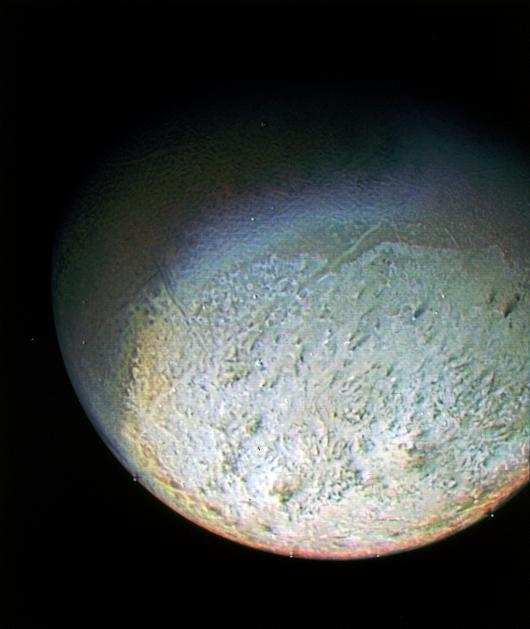
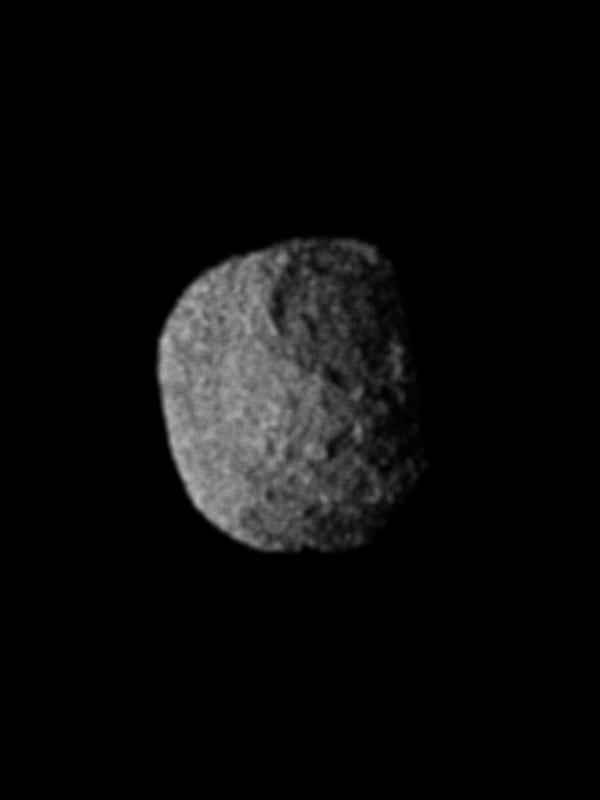
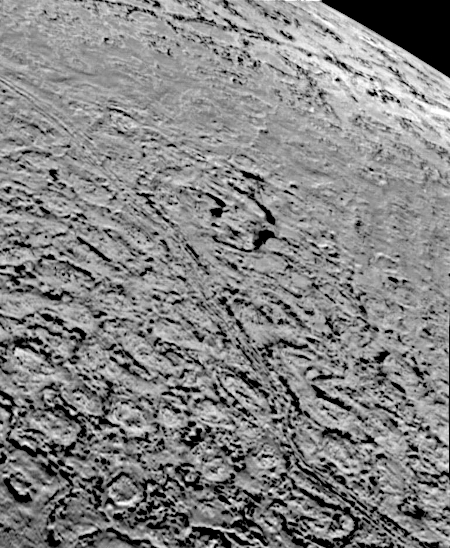
Today we conclude our tour of the Voyager-2 fly-bys of Uranus in 1986 and Neptune in 1989 with what is the most detailed look at the alien surface of Neptune’s moon Triton, taken on August 25, 1989 and shown to the right, cropped, rotated, reduced, and sharpened to post here.

Taken from a distance of only 25,000 miles, the frame is about 140 miles across and shows details as small as [a half mile in width]. Most of the area is covered by a peculiar landscape of roughly circular depressions separated by rugged ridges. This type of terrain, which covers large tracts of Triton’s northern hemisphere, is unlike anything seen elsewhere in the solar system. The depressions are probably not impact craters: They are too similar in size and too regularly spaced. Their origin is still unknown, but may involve local melting and collapse of the icy surface.

A conspicuous set of grooves and ridges cuts across the landscape, indicating fracturing and deformation of Triton’s surface. The rarity of impact craters suggests a young surface by solar system standards, probably less than a few billion years old.

What this photograph as well as the handful of other Voyager-2 images of Triton tell us is that we only have gotten a tiny taste of what’s there, only enough to tell us we don’t understand what we are seeing in the slightest. This is a truly alien world, cold, dark, and composed of materials far different then that found in the inner solar system. Its formation is a mystery, and its subsequent geological history a cypher. Scientists have made some guesses, but to get a real understanding we need to go back, and be there for a long time.

In fact, this is the final conclusion of all of the Voyager-2 images from both Uranus and Neptune. That probe gave humanity its first good close look at these distant worlds, but the look was still a quick and very superficial one. The images and data left us with far more questions than answers.

Unfortunately, there is at present no mission approved and under development to go to either Uranus or Neptune, though several have been proposed. Thus, it will likely be at least two decades before any mission gets there, if that soon.
Neptune’s rings, as seen by Voyager-2 in 1989

The rings of Neptune as seen by Voyager-2
Click for original image.

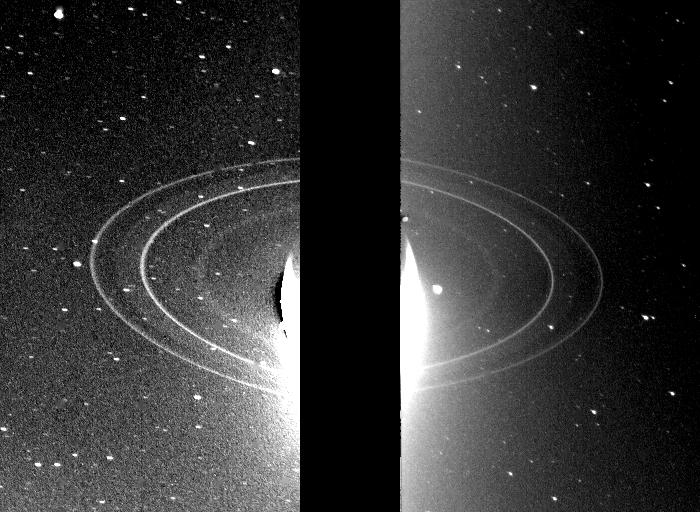
Cool image time! The picture to the right, cropped, reduced slightly, and sharpened to post here, was taken by Voyager-2 on August 26, 1989 shortly after it had completed its close fly-by of Neptune, looking back at the planet from a distance of about 175,000 miles.

The two main rings are clearly visible and appear complete over the region imaged. … Also visible in this image is the inner faint ring at about 25,000 miles from the center of Neptune, and the faint band which extends smoothly from the 33,000 miles ring to roughly halfway between the two bright rings. Both of these newly discovered rings are broad and much fainter than the two narrow rings.

These long exposure images were taken while the rings were back-lighted by the sun at a phase angle of 135 degrees. This viewing geometry enhances the visibility of dust and allows fainter, dusty parts of the ring to be seen. The bright glare in the center is due to over-exposure of the crescent of Neptune. The two gaps in the upper part of the outer ring in the image on the left are due to blemish removal in the computer processing. Numerous bright stars are evident in the background. Both bright rings have material throughout their entire orbit, and are therefore continuous.

While Voyager-2 took other pictures of these rings (here, here, here, here, and here), I think this picture shows the rings best, if not terrible well. Images using the Hubble and Webb space telescopes as well as others have not been better.

The rings were first confirmed to exist in the mid-1980s, shortly before Voyager-2’s fly-by. We now think there are five rings total, all made of dark material, likely a mix of carbon-based molecules, much of it the equivalent of dust and soot.

Voyager-2 discovered Neptune to be a planet of quickly changing weather

Neptune's fast changing weather
Click for source.

Cool image time! When Voyager-2 flew past Uranus in 1986, the data showed the gas giant’s weather to be relatively sedate and quiet, with little changing during the fly-by. Scientists expected this: Uranus’s distance from the Sun meant it got little energy to fuel an active climate, with any activity produced by internal heating due to the gravitational pressure of its mass. And Uranus did not produce that much heat internally.

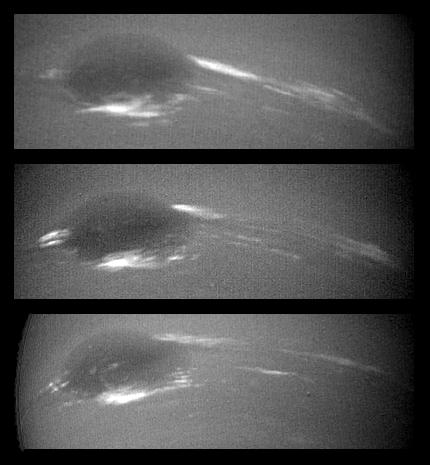
When Voyager-2 passed Neptune three year later, the scientists expected something similar, or even less, due to Neptune’s greater distance from the Sun. Instead, Voyager-2’s data showed Neptune’s weather patterns to be changing constantly and quickly, as illustrated by the three images of the Great Dark Spot to the right, the biggest storm on Neptune at that time and located in the planet’s southern mid-latitudes.

The bright cirrus-like clouds of Neptune change rapidly, often forming and dissipating over periods of several to tens of hours. In this sequence spanning two rotations of Neptune (about 36 hours) Voyager 2 observed cloud evolution in the region around the Great Dark Spot at an effective resolution of about 60 miles per pixel. The surprisingly rapid changes which occur over the 18 hours separating each panel shows that in this region Neptune’s weather is perhaps as dynamic and variable as that of the Earth. However, the scale is immense by our standards — the Earth and the [Great Dark Spot] are of similar size.

In Neptune’s frigid atmosphere, where temperatures are as low as 55 degrees Kelvin (-360 F), the cirrus clouds are composed of frozen methane rather than Earth’s crystals of water ice.

Subsequent observations by the Hubble Space Telescope in 1994 found this Great Dark Spot was gone, replaced by a comparable storm in the northern hemisphere. Further Hubble observations found Neptune’s storms tend to last about two years, fading as they drifted towards the equator. Those observations however also detected storms drifting away from the equator. Other research suggested the storms might be influenced by the Sun’s sunspot cycle.

All of the data post-Voyager-2 remains very coarse and uncertain, as we are looking at Neptune at a great distance. Thus, no theory about what is happening carries much weight, especially because we do not know why Neptune produces so much more internal heat than Uranus, fueling this fast-changing weather. For example, Neptune gets 1/20th of the energy received by Jupiter, yet its atmosphere appears even more active and variable.

Voyager-2’s view of clouds on top of clouds on Neptune

Neptune's upper clouds
Click for original image.

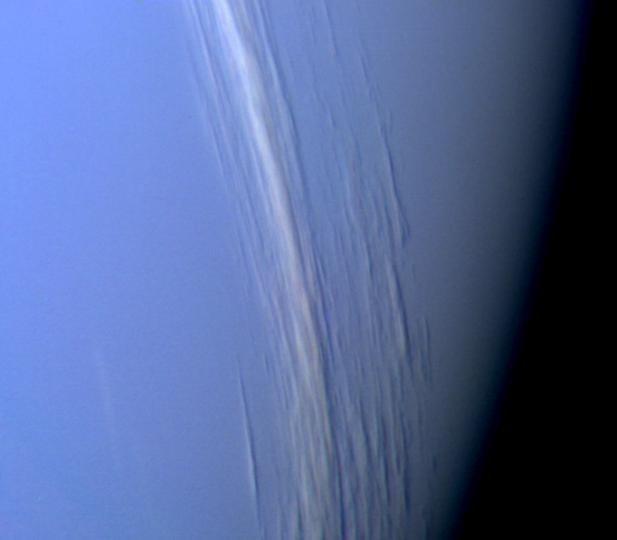
Time to continue our cool image tour this week of the Voyager-2 archive of Neptune, taken during the spacecraft’s August 25, 1989 close fly-by of the gas giant, zipping only 2,700 miles above the cloud-tops. This remains the only mission to visit Neptune so far.

The picture to the right, rotated, cropped, reduced, and sharpened to post here, was taken two hours before Voyager-2’s closest approach. From the caption:

These clouds were observed at a latitude of 29 degrees north near Neptune’s east terminator. The linear cloud forms are stretched approximately along lines of constant latitude and the sun is toward the lower [right]. The bright sides of the clouds which face the sun are brighter than the surrounding cloud deck because they are more directly exposed to the sun. Shadows can be seen on the side opposite the sun.

These shadows are less distinct at short wavelengths (violet filter) and more distinct at long wavelengths (orange filter). This can be understood if the underlying cloud deck on which the shadow is cast is at a relatively great depth, in which case scattering by molecules in the overlying atmosphere will diffuse light into the shadow. Because molecules scatter blue light much more efficiently than red light, the shadows will be darkest at the longest (reddest) wavelengths, and will appear blue under white light illumination.

The resolution of this image is 6.8 miles per pixel and the range is only 98,000 miles. The width of the cloud streaks range from 30 to 125 miles, and their shadow widths range from 18 to 30 miles. Cloud heights appear to be of the order of 31 miles.

Of all the high resolution images taken of Neptune by Voyager-2, this is the only one that clearly shows some dimensionality. Later photographs taken by Hubble and other ground- and space-based telescopes can only show global views that are far less sharp than the global views produced by Voyager-2.

This picture hints at Neptune’s very complex weather patterns, which has no well-defined surface and is made up mostly of gas and liquid. Though scientists have used Hubble to roughly track those weather patterns, they can only glean the most basic facts. For example, its fast-changing weather appears to be driven by high winds, thought to move as fast as 1,300 miles per hour. This fact however is woefully incomplete and very uncertain, as we have no way to track detailed weather patterns at multiple depths.

Our tour will continue tomorrow.

Neptune as seen by Voyager-2 in 1989, four days before closest approach

Neptune as seen by Voyager-2 on approach
Click for original image.

Cool image time! In two earlier posts I highlighted the pictures taken by Voyager-2 of Neptune’s two largest moons, Triton and Proteus, when it made its close fly-by of Neptune in 1989. Other than a very distant low resolution picture of 105-mile-wide Nereid, Voyager-2 took no other good images of Neptune’s other known moons.

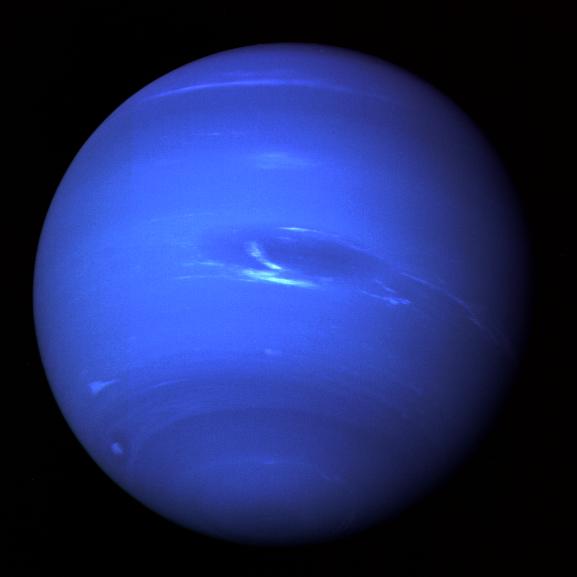
So today, let’s begin a tour of some of Voyager-2’s imagery of Neptune itself. The picture to the right, reduced slightly to post here, was taken on August 20, 1989 as the spacecraft was beginning its approach to Neptune. It shows the full daylight hemisphere of the gas giant. From the caption:

The images were taken at a range of 4.4 million miles from the planet, 4 days and 20 hours before closest approach. The picture shows the Great Dark Spot and its companion bright smudge; on the west limb the fast moving bright feature called Scooter and the little dark spot are visible. These clouds were seen to persist for as long as Voyager’s cameras could resolve them. North of these, a bright cloud band similar to the south polar streak may be seen.

Next week I will post some of the other good shots taken of Neptune, as well as one or two close-ups of Triton that need highlighting. Sadly, at that point we will have more or less reviewed most of the best data now available of this distant world. Astronomers have used the Hubble Space Telescope in subsequent years to attempt to track its weather patterns, but even Hubble really can’t provide enough resolution to really make that research substantive.

But stay tuned. The Voyager-2 images to come are worth viewing.

Proteus, Neptune’s second largest moon, discovered by Voyager-2 in 1989

Proteus, Neptune's second largest moon
For original images go here and here.

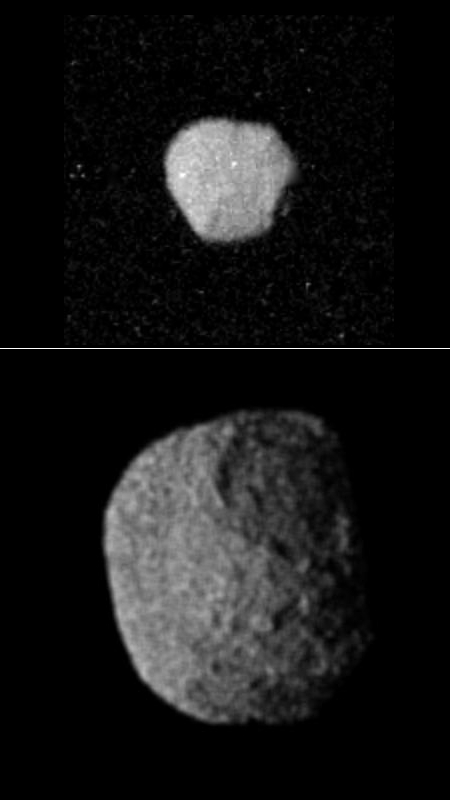
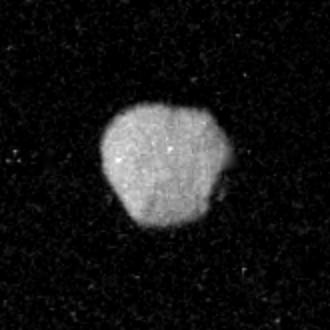
Our tour continues of the only close visit to Neptune on August 25, 1989 by Voyager-2. The two pictures to the right were taken by the spacecraft during that fly-by of Neptune’s second largest moon, dubbed Proteus. Both pictures are shown as Voyager-2 took them.

The top picture was taken from a distance of about 540,000 miles, and has a resolution of about five miles per pixel.

The satellite has an average radius of about 120 miles and is uniformly dark with an albedo of about 6 percent. The irregular shape suggests that 1989N1 has been cold and rigid throughout its history and subject to significant impact cratering.

The bottom picture was taken from a distance of about 91,000 miles, and can resolve objects as small as 1.7 miles in size.

Hints of crater-like forms and groove-like lineations can be discerned. The apparent graininess of the image is caused by the short exposure necessary to avoid significant smear.

Proteus was not known prior to Voyager-2’s fly-by, because it orbits so close to Neptune (about 73,000 miles) that the ground-based telescopes of the time could not see it in the glare of the gas giant. It was discovered in early global pictures of Neptune as Voyager-2 approached.

While planetary scientists have made some educated guesses about the moon’s origin and geology based on these two images, they are simply guesses. These are the only detailed images we have of Proteus, and neither is particularly good.

Triton: Neptune’s largest moon

The southern mid-latitudes of Neptune's moon Trident
Click for original image.

Triton

Today’s cool image begins a new tour I plan on doing over the next week or so of the few close-up photographs we have of Neptune and its moons, sent back by Voyager-2 when it did its close fly-by of this distant planet on August 25, 1989. That fly-by was almost 37 years ago, and it remains our only close look. While at the time it shined a quick flashlight of new knowledge on Neptune, its moons, and its ring system, we remain generally in the dark about what’s there, despite some good imagery produced in subsequent years by Hubble and some ground-based telescopes.

The image above, cropped and enhanced to post here, shows a portion of the southern mid-latitudes of Triton, Neptune’s largest moon, as Voyager-2 made its closest pass at a distance of about 25,000 miles. The photo to the right, cropped and reduced, shows a more global view to provide some context, with the box indicating the approximate area covered by the upper image. It was taken when Voyager-2 was on approach, at a distance of about 330,000 miles. The top picture captures several dozen black plumes that appear to vent material from below. From the caption:

The plumes originate at very dark spots generally a few miles in diameter and some are more than 100 miles long. The spots which clearly mark the source of the dark material may be vents where gas has erupted from beneath the surface and carried dark particles into Triton’s nitrogen atmosphere. Southwesterly winds then transported the erupted particles, which formed gradually thinning deposits to the northeast of most vents.

It is possible that the eruptions have been driven by seasonal heating of very shallow subsurface deposits of volatiles, and the winds transporting particles similarly may be seasonal winds. The polar terrain, upon which the dark streaks have been deposited, is a region of bright materials mottled with irregular, somewhat dark patches. The pattern of irregular patches suggests that they may correspond to lag deposits of moderately dark material that cap the bright ice over the polar terrain.

As we only have a few images of this planet, and those provided views of only about 40% of its surface, any theory that tries to explain the weird geology here is certain to be wrong to some degree.

More to come in the next few days. As much as we think we know, these pictures are going instead highlight how sparse that knowledge really is.

Scientists posit that Neptune and Uranus might be rockier than previously theorized

Scientists doing new computer modeling of the known data now posit that Neptune and Uranus might not be as icy as previously believed and instead could be more like the inner terrestrial planets like Earth, much rockier in their interior.

According to the work carried by the UZH scientific team, Uranus and Neptune might actually be more rocky than icy. The new study does not claim the two blue planets to be one or the other type, water- or rock- rich, it rather challenges that ice-rich is the only possibility. This interpretation is also consistent with the discovery that the dwarf planet Pluto is rock-dominated in composition.

…With their new agnostic, and yet fully physical model, the University of Zurich team found the potential internal composition of the “ice giants” of our Solar system, is not limited at all to only ice (typically represented by water). “It is something that we first suggested nearly 15 years ago, and now we have the numerical framework to demonstrate it,” reveals Ravit Helled, a professor at the University of Zurich and initiator of the project. The new range of internal composition shows that both planets can either be water-rich or rock-rich.

This new hypothesis might also help explain the multi-polar magnetic fields of both planets.

All is uncertain of course, as this is just a computer model based on limited data. Nor is it a surprise that an alternative conclusion appears to work. We know so little about these distant worlds that it is likely that multiple theories could fit the data, and all could be wrong when we finally learn more.

Webb images in the infrared the aurora of Neptune

The aurora of Neptune
Click for original image.

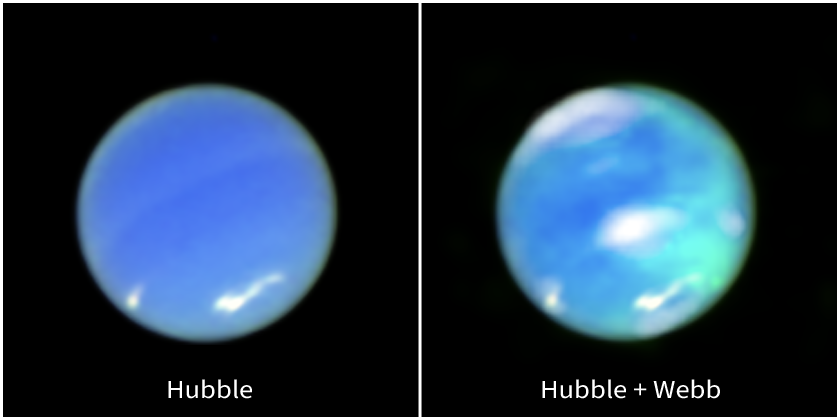
Astronomers using the Webb Space Telescope have captured the first infrared images of the aurora of Neptune, confirming that the gas giant produces this phenomenon.

The picture to the right combines infrared data from Webb and optical imagery from the Hubble Space Telescope. The white splotches near the bottom of the globe are clouds seen by Hubble. The additional white areas in the center and near the top are clouds detected by Webb, while the greenish regions to the right are aurora activity detected by Webb.

The auroral activity seen on Neptune is also noticeably different from what we are accustomed to seeing here on Earth, or even Jupiter or Saturn. Instead of being confined to the planet’s northern and southern poles, Neptune’s auroras are located at the planet’s geographic mid-latitudes — think where South America is located on Earth.

This is due to the strange nature of Neptune’s magnetic field, originally discovered by Voyager 2 in 1989, which is tilted by 47 degrees from the planet’s rotation axis. Since auroral activity is based where the magnetic fields converge into the planet’s atmosphere, Neptune’s auroras are far from its rotational poles.

The data also found that the temperature of Neptune’s upper atmosphere has cooled significantly since it was first measured by Voyager 2 in 1989, dropping by several hundred degrees.

Astronomers discover new moons around Neptune and Uranus

Using a observations over several years from a number of ground-based telescopes, astronomers have now identified two new moons around Neptune and one new moon circling Uranus.

The new Uranian member brings the ice giant planet’s total moon count to 28. At only 8 kilometers, it is probably the smallest of Uranus’ moons. It takes 680 days to orbit the planet. Provisionally named S/2023 U1, the new moon will eventually be named after a character from a Shakespeare play, in keeping with the naming conventions for outer Uranian satellites.

…The brighter Neptune moon now has a provisional designation S/2002 N5, is about 23 kilometers in size, and takes almost 9 years to orbit the ice giant. The fainter Neptune moon has a provisional designation S/2021 N1 and is about 14 kilometers with an orbit of almost 27 years. They will both receive permanent names based on the 50 Nereid sea goddesses in Greek mythology.

The two new Neptune moons raises its moon total now to sixteen. The orbits of all three are tilted and eccentric and far from the planets, strongly suggested they are capture asteroids, not objects formed at the same time as the planet.

Space Perspective unveils test balloon capsule for unmanned test flights

Space Perspective's Neptune Capsule

The high altitude balloon company Space Perspective yesterday unveiled the test balloon capsule, dubbed Excelsior, which it plans to use for a program of ten flights beginning this year, prior to beginning manned flights on its Neptune manned capsule, shown in the graphic to the right.

Neptune is designed to take eight passengers to altitudes of twenty miles for several hours, not quite space but high enough to see the curvature of the Earth. The company had said in 2022 it would begin commercial flights by the end of 2024, but it now says it is targeting 2025.

Florida-based Space Perspective is one of two American companies attempting to fly high altitude balloon flights for tourists, with Tucson-based World View the other. There is presently no word when World View will begin its first manned flights.

Scientists: Neptune’s clouds appear to ebb and grow in conjunction with sunspot cycle

Graph showing correlation between Neptune's clouds and the sunspot cycle

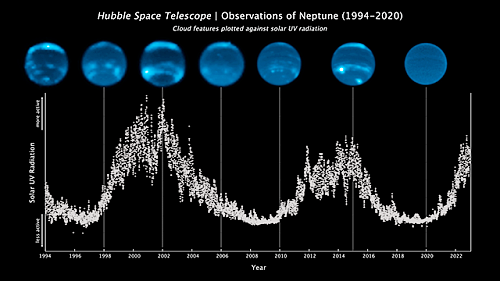
Scientists have now discovered what appears to be a link between the coming and going of clouds on Neptune to the Sun’s 11-year-long sunspot cycle, despite Neptune receiving only 1/900th the sunlight of the Earth.

To monitor the evolution of Neptune’s appearance, Chavez and her team analyzed images taken from 1994 to 2022 using Keck Observatory’s second generation Near-Infrared Camera (NIRC2) paired with its adaptive optics system (since 2002), as well as observations from Lick Observatory (2018-2019) and the Hubble Space Telescope (since 1994). In recent years the Keck Observatory observations have been complemented by images taken as part of Keck Observatory’s Twilight Observing Program and by Hubble Space Telescope images taken as part of the Outer Planet Atmospheres Legacy (OPAL) program.

The data revealed an intriguing pattern between changes in Neptune’s cloud cover and the solar cycle – the period when the Sun’s magnetic field flips every 11 years, causing levels of solar radiation to fluctuate. When the Sun emits more intense ultraviolet (UV) light, specifically the strong hydrogen Lyman-alpha emission, more clouds appear on Neptune about two years later. The team further found a positive correlation between the number of clouds and the ice giant’s brightness from the sunlight reflecting off it.

“These remarkable data give us the strongest evidence yet that Neptune’s cloud cover correlates with the Sun’s cycle,” said de Pater. “Our findings support the theory that the Sun’s UV rays, when strong enough, may be triggering a photochemical reaction that produces Neptune’s clouds.”

The graph to the right shows the correlation between the clouds and the sunspot cycle. The paper is available here.

This conclusion remains uncertain because of the overall sparseness of the data. Yet, it is intriguing, and also underlines the importance of the Sun on the Earth’s climate. If the solar cycle can impact Neptune’s climate so significantly from 2.8 billion miles away, it certainly must have a major impact on the Earth’s climate at only 100 million miles distance.

Space Perspective buys ship to use for launching and recovering its passenger balloons

The high altitude balloon company Space Perspective has now purchased a 292-foot long ship to use as both a launch and recovery vessel for its planned flights of its Neptune capsule carrying tourists to 20-plus miles above the Earth.

Named in honor of the Voyager 1 space probe, the vessel was acquired to allow the company to launch and recover its spacecraft capsule Neptune from anywhere in the world, starting with pre-approved locations near Florida. The company completed its first test flight in June 2021, launching from land near Kennedy Space Center. The capsule splashed down in the Gulf of Mexico roughly seven hours later. On that occasion, the capsule was recovered from the water using a chartered commercial vessel, GO America.

Building on that first recovery, Voyager will have the capability to both launch and recover the spacecraft in an integrated, flexible solution that can also relocate to avoid bad weather — a problem that often plagues traditional rocket launches and marine capsule recovery operations. Space Perspective has previously stated it expects Voyager to be the first in a fleet of marine spaceports globally.

It is now expected that Voyager will begin operations late this year, when Space Perspective begins test flights of Neptune.

The article also notes near the end the growing congestion at Port Canaveral due to the numbers of space-related ships, either already operating or anticipated. It appears a marina for these ships will soon become necessary, as the port does not want them taking up docking space when not in use.

Webb’s first infrared image of Neptune

Webb's infrared view of Neptune
Click for full image.

The science team for the James Webb Space Telescope today released that telescope’s first infrared image of Neptune.

That image is to the right, cropped and reduced slightly to post here. It is, as the press release touts, the best view in decades of Neptune’s rings. From the caption:

The most prominent features of Neptune’s atmosphere in this image are a series of bright patches in the planet’s southern hemisphere that represent high-altitude methane-ice clouds. More subtly, a thin line of brightness circling the planet’s equator could be a visual signature of global atmospheric circulation that powers Neptune’s winds and storms. Additionally, for the first time, Webb has teased out a continuous band of high-latitude clouds surrounding a previously-known vortex at Neptune’s southern pole.

The dots around the gas giant are the heat signatures of seven of its fourteen moons.

New theory: Saturn’s rings came from a lost and destroyed moon

The uncertainty of science: According to a new computer simulation, scientists have proposed that the reason Saturn’s rings are tilted 27 degrees is because they were created by the destruction of a moon 160 million years ago, an event that was also linked to the way the orbits of Saturn and Neptune interact, combined with the on-going slow evolutionary changes in Titan’s orbit around Saturn.

Wisdom and his colleagues believe Saturn acquired its tilt because of a peculiar synchronicity: the precession of Saturn’s spin axis—the way it wobbles like a top with a particular rhythm—is suspiciously in tune with a precession in Neptune’s orbit. If Saturn and Neptune were trapped in this resonance, Saturn’s tilt would be “kind of vulnerable to other forces that could cause it to change,” says Rola Dbouk, an MIT graduate student in planetary science. In 2020, Cassini scientists discovered what the study team thinks is that external stimulus: Titan, Saturn’s largest moon, is migrating away from Saturn by 11 centimeters a year. In a study published today in Science, Dbouk, Wisdom, and colleagues show how Titan’s migration, in combination with the Saturn-Neptune resonance, could have ratcheted up Saturn’s tilt over the course of 1 billion years.

The work also yielded a potential explanation for the origin of Saturn’s rings. Using Cassini’s measurements of Saturn’s gravitational fields to model the planet’s interior structure, the researchers refined calculations for the wobble of Saturn’s spin axis and found it is no longer in sync with Neptune. “Something kicked it out of the resonance,” Dbouk says. They first ruled out the possibility that chaotic changes in the orbits of some of the largest of Saturn’s dozens of moons could be responsible. But when they added another moon to the mix, things got interesting.

In simulations, the researchers included an object about the size of Iapetus, Saturn’s third largest moon, orbiting about 43 Saturn radii out—between the orbits of Titan and Iapetus. They found this moon could have provided the necessary nudge to the resonance if it were suddenly knocked from its orbit because of chaotic interactions with its neighbors about 160 million years ago.

To say that this theory is uncertain is no different that saying the sky is blue. It is so uncertain that it is difficult to take it seriously. It could be right, but as one scientist quoted at the article noted, there is no way to test it.

Space Perspective unveils design of its Neptune tourist balloon capsule

Space Perspective's Neptune Capsule

Capitalism in space: Space Perspective yesterday unveiled the final design of its Neptune balloon capsule that it hopes to fly tourists to altitudes of almost 20 miles.

The graphic to the right reveals the biggest takeaway from this design: The “splash cone” at the bottom of the capsule tells us that the company intends to land its Florida-launched missions in the ocean, not on land.

An enhanced patent pending splash cone, refined from hundreds of digital iterations, to attenuate splashdown for a gentle and safe landing that improves customer experience and hydrodynamics. With water landings considered by NASA as the low risk way of returning a capsule from space, following the gradual, two-hour descent to Earth and a gentle splash down in the ocean, a Space Perspective crew will retrieve passengers, the capsule, and the SpaceBalloon™ by ship.

The company is presently targeting the end of ’24 for the start of commercial flights. It says it has sold about 900 $125K tickets.

The U.S. now has two balloon companies planning similar near-space missions. World View is planning flights from a variety of locations worldwide for a ticket price of $50K, with the first flights occurring no earlier than ’24.

Neptune’s cooling when it should be warming

Neptune since 2006

The uncertainty of science: Observations of Neptune during the past seventeen years using the Very Large Telescope have shown the planet mostly cooling during this time period, even though Neptune was moving into its summer season.

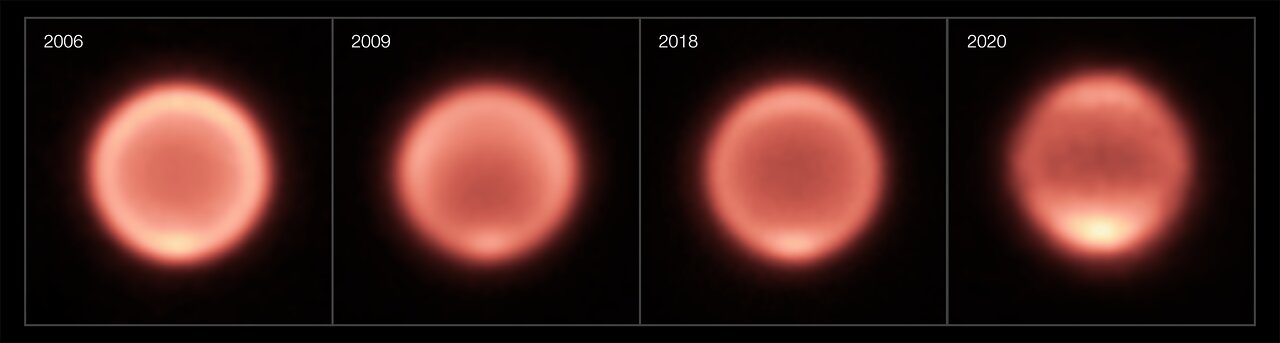
Astronomers looked at nearly 100 thermal-infrared images of Neptune, captured over a 17-year period, to piece together overall trends in the planet’s temperature in greater detail than ever before. These data showed that, despite the onset of southern summer, most of the planet had gradually cooled over the last two decades. The globally averaged temperature of Neptune dropped by 8 °C between 2003 and 2018.

The astronomers were then surprised to discover a dramatic warming of Neptune’s south pole during the last two years of their observations, when temperatures rapidly rose 11 °C between 2018 and 2020. Although Neptune’s warm polar vortex has been known for many years, such rapid polar warming has never been previously observed on the planet. “Our data cover less than half of a Neptune season, so no one was expecting to see large and rapid changes,” says co-author Glenn Orton, senior research scientist at Caltech’s Jet Propulsion Laboratory (JPL) in the US.

The sequence of photos above show that change over time. Lower latitudes generally get darker, or cooler, while the south pole suddenly brightens, getting hotter, in 2020.

The scientists have no idea why this has happened, though they have theories, ranging from simple random weather patterns to the influence of the Sun’s sunspot cycle.

Hubble’s 2021 survey of the outer solar system

Jupiter in 2021 by Hubble
Click for full Jupiter image.

Saturn in 2021 by Hubble
Click for full Saturn image.

Uranus in 2021 by Hubble
Click for full Uranus image.

Neptune in 2021 by Hubble
Click for full Neptune image.

NASA today released the annual survey of images taken each year by the Hubble Space Telescope of the large planets that comprise the outer solar system, Jupiter, Saturn, Uranus, and Neptune.

These Hubble images are part of yearly maps of each planet taken as part of the Outer Planets Atmospheres Legacy program, or OPAL. The program provides annual, global views of the outer planets to look for changes in their storms, winds, and clouds. Hubble’s longevity, and unique vantage point, has given astronomers a unique chance to check in on the outer planets on a yearly basis. Knowledge from the OPAL program can also be extended far beyond our own solar system in the study of atmospheres of planets that orbit stars other than our Sun.

The four photos, all either cropped or reduced slightly to post here, are to the right. Each shows some changes in these planets since the previous survey images the year before.

On Jupiter for example the equatorial region shows several new storms, with that band remaining a deep orange color longer than expected.

On Saturn the various bands have continued to show the frequent and extreme color changes that the telescope has detected since it began these survey images back in the 1990s.

The photo of Uranus meanwhile looks at the gas giant’s northern polar regions, where it is presently spring. The increased sunlight and ultraviolet radiation has thus caused the upper atmosphere at the pole to brighten. The photo also confirms that the size of this bright “polar hood” continues to remain the same, never extending beyond the 43 degree latitude where scientists suspect a jet streams acts to constrain it.

The image of Neptune, the farthest and thus hardest planet for Hubble to see, found that the dark spot in the planet’s northern hemisphere appears to have stopped moving south and now appears to be heading north. Also,

In 2021, there are few bright clouds on Neptune, and its distinct blue with a singular large dark spot is very reminiscent of what Voyager 2 saw in 1989.

Balloon company begins selling tickets for high-altitude flights

Capitalism in space: The Florida-based balloon company Space Perspectives has announced that it is now selling tickets for high-altitude flights on its Neptune balloon vehicle, beginning in ’24.

From the company’s press release:

Introducing a new era in luxury travel experiences: Space Perspective reimagines the thrill of space exploration with the world’s most radically gentle voyage to space. Space Explorers and travel adventurers looking to upgrade their bucket list can now savor 360-degree views of planet Earth from 20 mi/30 km above in a luxurious six hour trip, inside Spaceship Neptune, propelled by a state-of-the-art spaceballoon the size of a football stadium. Up to eight guests can have the sensational experience from the comfort of plush, reclining seats in a beautifully appointed capsule, complete with a bar and a bathroom, for $125,000 each.

To secure your seat you need to send them a $1,000 deposit. The entire flight will take about six hours, with about two at the highest elevation.

Dark storm on Neptune changes direction unexpectedly

Dark storm on Neptune
Click for full image.

Using the Hubble Space Telescope, astronomers have found that a dark storm discovered on Neptune in 2018 has been drifting across the gas giant in unexpected ways.

The storm, which is wider than the Atlantic Ocean, was born in the planet’s northern hemisphere and discovered by Hubble in 2018. Observations a year later showed that it began drifting southward toward the equator, where such storms are expected to vanish from sight. To the surprise of observers, Hubble spotted the vortex change direction by August 2020, doubling back to the north. Though Hubble has tracked similar dark spots over the past 30 years, this unpredictable atmospheric behavior is something new to see.

Equally as puzzling, the storm was not alone. Hubble spotted another, smaller dark spot in January this year that temporarily appeared near its larger cousin. It might possibly have been a piece of the giant vortex that broke off, drifted away, and then disappeared in subsequent observations.

The photo to the right, cropped and reduced to post here, shows both storms. The smaller dark spot can be seen faintly to the right of the larger storm.

Since Hubble has been observing Neptune in 1993 it has seen four such storms, all of which have faded away after about two Earth years. What causes the storms as well as their motions in Neptune’s atmosphere remains unknown, and any theories posited (such as those noted at the link) are highly unreliable, considering the paucity of data we have about Neptune’s atmosphere and the meteorology of such gas giants.

Space tourism balloon company raises $7 million

Capitalism in space: The space tourism balloon company Space Perspectives has now raised $7 million for the initial development of their Neptune stratospheric balloon, designed to take tourists up to about 30 miles for long flights at the edge of space.

The company, with about 15 employees currently, will use the funding to continue development of Spaceship Neptune, a stratospheric balloon system designed to carry people to an altitude of 30 kilometers. Such flights would give people an experience similar to some aspects of spaceflight, notably the view.

A first test flight of the system, without people on board, is scheduled for the first half of 2021 from the Shuttle Landing Facility at the Kennedy Space Center in Florida. “It will really take us through the concept of operations” of the system, Taber MacCallum, co-founder and co-chief executive of Space Perspective, said in an interview. “It allows us to jump into serious hardware testing.”

If all goes well, they plan to begin selling tickets next year as well, with the first commercial flight targeted for ’24. This funding round also likely puts the company ahead of its two Spanish competitors, who are presently tied up in litigation against each other.

The article also quotes company officials as lauding the FAA’s new revised licensing procedures, the first industry response I’ve seen to these new licensing procedures. The new rules [pdf] required a document 785 pages long (actually larger than the FAA’s first proposed revision), making it hard to determine their effect — for good or ill — without actually using them. This positive review by an industry user is a very positive sign.

War between two Spanish space balloon companies

Capitalism in space: A legal battle is developing between two different Spanish high altitude space balloon companies, one that came first, and a second that is being backed by a venture capitalist who had previously worked at the first.

Jose Mariano Lopez Urdiales, an MIT-trained aeronautics engineer who founded Zero 2 Infinity 11 years ago, says Kemel Kharbachi, the now CEO of EOS X Space, worked closely with the company to raise a €1m investment for Zero 2 Infinity. But the funding deal never happened.

Instead, Kharbachi, whose previous experience has focused on tourism and catering, has emerged to build his own rival space balloon business.

It does appear, from the details outlined in the article, that Kharbachi essentially stole the concept and designs from Zero 2 Infinity in order to form his own company.

As these Spanish companies fight it out, a third company in America, Space Perspectives, hopes to begin flying tourists on its stratospheric balloon, dubbed Neptune, by ’24.

Another high altitude balloon company enters the space tourism market

Capitalism in space: Another high altitude balloon company, this time from Spain, is now vying for the space tourism market.

EOS-X Space, a Spanish startup, wants to take 10,000 people to the frontier of space within the next 10 years. With EOS-X Space, the journeys won’t be in rockets or ultrasonic planes. They’ll instead take place in a pressurized capsule propelled by a balloon that will rise to an altitude of up to 40 kilometers, or nearly 25 miles.

This means space tourists won’t have to wear a suit for the duration of the trip, nor will they have to do any physical preparation. Depending on the weather, each trip is set to last four or five hours.

They are targeting the same market as the American company Space Perspectives, which hopes to begin flying tourists on its stratospheric balloon, dubbed Neptune, by ’24.

Members-only resort club teams up with Space Perspective for stratospheric balloon rides

Capitalism in space: Space Perspectives, which hopes to fly commercial tourist balloon flights to the stratosphere has teamed up with the members-only resort club Exclusive Resorts for future flights.

Space Perspective is partnering with the members-only vacation club Exclusive Resorts, which will become the first privately chartered travel group to fly aboard Spaceship Neptune, a pressurized capsule carried by a massive balloon, representatives of both outfits announced Wednesday (Sept. 16).

“The club has always sought ways to give members once-in-a-lifetime opportunities to see and explore the world in transformational, meaningful ways,” Exclusive Resorts CEO James Henderson said in a statement. “Our partnership with Space Perspective will offer our members a unique view of our planet that only a few people have ever had the opportunity to experience.”

No ticket price has yet been announced. They hope to do the first commercial flights by 2024.

The dance of two Neptunian moons

Scientists have discovered that the orbital interplay between two of Neptune’s moon keep them close together but never touching. Instead, they dance about each other.

In this perpetual choreography, Naiad swirls around the ice giant every seven hours, while Thalassa, on the outside track, takes seven and a half hours. An observer sitting on Thalassa would see Naiad in an orbit that varies wildly in a zigzag pattern, passing by twice from above and then twice from below. This up, up, down, down pattern repeats every time Naiad gains four laps on Thalassa.

Although the dance may appear odd, it keeps the orbits stable, researchers said.

I have embedded below the fold a video that illustrates this.

» Read more

New Hubble images of Uranus and Neptune

Uranus (top) and Neptune

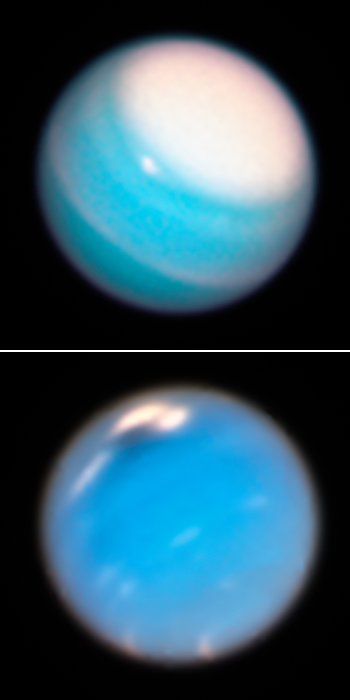
The Hubble Space Telescope’s new annual images of Uranus (top) and Neptune (bottom) has revealed new atmospheric features for both, a giant north pole cloud cap on Uranus and a new dark storm developing on Neptune.

For Neptune:

The new Hubble view of Neptune shows the dark storm, seen at top center. Appearing during the planet’s southern summer, the feature is the fourth and latest mysterious dark vortex captured by Hubble since 1993. Two other dark storms were discovered by the Voyager 2 spacecraft in 1989 as it flew by the remote planet. Since then, only Hubble has had the sensitivity in blue light to track these elusive features, which have appeared and faded quickly. A study led by University of California, Berkeley, undergraduate student Andrew Hsu estimated that the dark spots appear every four to six years at different latitudes and disappear after about two years.

Hubble uncovered the latest storm in September 2018 in Neptune’s northern hemisphere. The feature is roughly 6,800 miles across.

For Uranus:

The snapshot of Uranus, like the image of Neptune, reveals a dominant feature: a vast bright cloud cap across the north pole.

Scientists believe this feature is a result of Uranus’ unique rotation. Unlike every other planet in the solar system, Uranus is tipped over almost onto its side. Because of this extreme tilt, during the planet’s summer the Sun shines almost directly onto the north pole and never sets. Uranus is now approaching the middle of its summer season, and the polar-cap region is becoming more prominent. This polar hood may have formed by seasonal changes in atmospheric flow.

The images are part of an annual program that monitors both planets with images every year when the Earth is best placed to view them. This allows scientists to track atmospheric changes over time.

The sharpness of both images matches that of previous Hubble images, so these photographs do not show any decline in the telescope’s image capability. However, when they lose that next gyroscope and shift to one gyroscope mode, I believe it will be very difficult to get images even this sharp of the outer planets. In fact, I suspect this monitoring program will likely have to end, or will be badly crippled.

Interorbital completes static fire test of upper-stage engine

Capitalism in space: The smallsat rocket company Interorbital (IOS) today released a short video showing a successfully static fire test of the upper-stage engine for its Neptune rocket.

The IOS rocket team successfully completed the first test of Interorbital’s NEPTUNE series launch vehicle’s liquid upper-stage rocket engine (GPRE 0.75KNTA). Engine performance was well within its design parameters, generating a sea-level thrust of 750 pounds and a sea-level specific impulse of 245 seconds. This translates to a thrust of 1,000 pounds and a specific impulse of 300 seconds in a vacuum (with expansion nozzle). The ablatively-cooled rocket engine is powered by the hypergolic combination of White Fuming Nitric Acid (WFNA) and Turpentine/Furfuryl Alcohol. These high-density storable auto-igniting propellants power all IOS liquid rocket engines. Interorbital’s N1 launch vehicle utilizes two GPRE 0.75KNTA engines for its second stage and a single GPRE 0.75KNTA engine for its third stage.

I have embedded the video below the fold. This is the first real news update from Interorbital in months. In April 2017 they looked like they were close to a launch, but until today there were no further updates. Part of the issue appears that they changed their approach for manufacturing their rocket in order to save cost, and this might have thrown a wrench in their schedule.

» Read more

Watch a rocket tank being built, mostly by robots

Capitalism in space: The video below the fold shows the process by which Interorbital Systems built a rocket test tank for the Neptune smallsat rocket it is developing. It is definitely worth watching if you want to see the future of complex manufacturing. Robotic equipment does most of the work, in a precise manner that would be impossible for humans, which therefore allows for the construction of engineering designs that were previously impossible or too expensive. Now, such designs can be built relatively cheaply, and repetitively.

Hat tip Doug Messier at Parabolic Arc.

» Read more

Unexpected big storm on Neptune

The uncertainty of science: Astronomers have spotted a new very big storm on Neptune, occurring unexpectedly near the plane’s equator.

A large, high-pressure vortex system deep within Neptune’s atmosphere is thought to drive the white storm clouds. As methane gases rise up in the vortex, they cool below the condensation temperature, forming clouds in the same way that water vapor does on Earth.

The location of the vortex caught astronomers by surprise, though. “Historically, bright clouds have occasionally been seen on Neptune, but usually at latitudes closer to the poles, around 10 to 60 degrees north or south” says de Pater. “Never before has a cloud been seen at, nor close to the equator, or anything so bright.”

Neptune is the windiest planet in the solar system, with observed equatorial wind speeds of up to 1,000 miles per hour (450 m/s). Since wind speeds vary drastically with latitude, a storm crossing more than 30° of latitude should quickly break apart. Something, such as an underlying vortex, must be holding it together. But a long-lasting vortex right at the equator would be hard to reconcile with our current understanding of the planet’s atmosphere.

I think any theory about Neptune’s weather should treated with a great deal of skepticism. I am sure the theories are based on what is known, but what is known is very little. Until we have been able to observe this gas giant up close and for decades, our understanding of its weather is going to be sketchy, at best.

Interorbital’s first test rocket, Neptune 1, is almost ready for flight

Capitalism in space: Interorbital, a smallsat rocket company building what they hope will be the world’s smallest and cheapest rocket, have announced that their first test rocket, Neptune 1 Guidance Test Vehicle (N1 GTV), is nearing completion.

During the test flight, the rocket will simulate an orbital launch trajectory by using the main rocket engine’s throttling capability to vary the thrust-to-weight ratio, thus simulating the actual conditions that will be experienced during an orbital launch. After the rocket passes through the transonic phase and Max Q, the engine will gradually throttle down, slowing the rocket until it begins to hover. At this point, the rocket engine will be shut down and the rocket will be allowed to fall. At a safe altitude, a parachute will be deployed for vehicle and payload recovery.

They then plan to follow this with an orbital test flight. No dates however for any of these test flights have as yet been announced.

1 2