Firefly’s delays launch of its Eclipse rocket to 2027

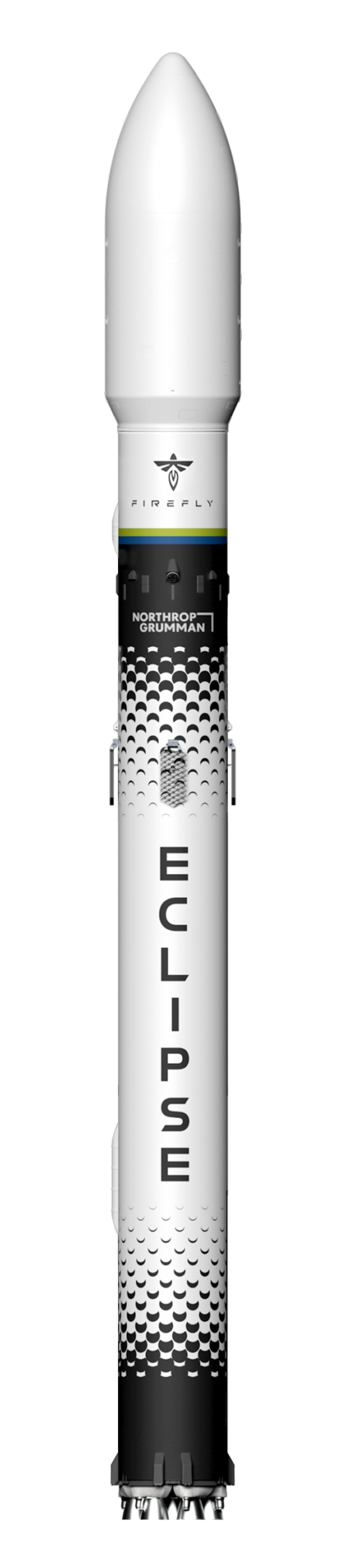
Eclipse as of April 2026
Click for original image.

It appears that Firefly has delayed the first launch of its new more powerful Eclipse rocket — being built in partnership with Northrop Grumman — to 2027.

The company made no specific announcement, but in a tweet today touting the rocket’s “fresh look”, with no details, the company linked to its Eclipse webpage (in the first link above) that describes the rocket in detail. In the last paragraph adds that the first launch is now scheduled for “no earlier than 2027”, a delay from the 2026 launch date both companies were originally targeting.

This guarantees that SpaceX’s Falcon 9 is going to get more launch contracts taking Northrop Grumman’s Cygnus capsule to ISS.

Firefly says Eclipse is being built for re-usability, but the graphics of the rocket, as shown above, are puzzling in that they show grid fins but no landing legs.

Three launches, two by SpaceX and one by China

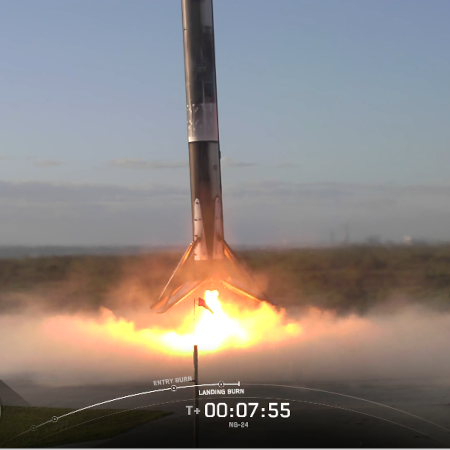
Falcon 9 landing for its seventh time
Falcon 9 landing for its seventh time on today’s
third launch. See below.

Since last night there were three launches globally, two by SpaceX, and one by China.

First, in the wee hours of the morning SpaceX placed 25 more Starlink satellites into orbit, its Falcon 9 rocket lifting off from Vandenberg Space Force Base in California. The first stage (B1063) completed its 32nd flight, landing on a drone ship in the Pacific. With this flight, 43 days after the stage’s previous flight, it moved into a tie for fourth place in the rankings of the most reused launch vehicle:

39 Discovery space shuttle
34 Falcon 9 booster B1067
33 Atlantis space shuttle
32 Falcon 9 booster B1071
32 Falcon 9 booster B1063
30 Falcon 9 booster B1069
28 Columbia space shuttle
27 Falcon 9 booster B1077
27 Falcon 9 booster B1078

Sources here and here.

Next China launched a classified satellite to test “internet technology”, its Smart Dragon-3 (Jielong-3) rocket lifting off from a sea platform in international waters in the South China Sea. Though China has launched numerous times from this sea platform, previous launches were very close to the shore. This was the first time the platform was moved this far into the ocean.

Finally, SpaceX completed its second launch in less than eight hours, sending Northrop Grumman’s Cygnus capsule on its way to ISS with 11,000 pounds of cargo, its Falcon 9 rocket lifting off from Cape Canaveral Space Force Station in Florida. The first stage completed its seventh flight, landing back at Cape Canaveral. Of the two fairings, one was making its first flight, while the other was on its fifth flight.

This was SpaceX’s fourth Cygnus launch for Northrop Grumman. The company originally launched Cygnus on its own Antares rocket, but when that rocket ran out of its Russian first stage engines it was grounded. The company hired Firefly to build a new first stage, but that project remains uncompleted.

Cygnus is scheduled to berth with ISS in two days, on Monday, April 13, at 12:50 pm (Eastern).

The leaders in the 2026 launch race:

44 SpaceX
19 China
5 Rocket Lab
4 Russia

For the third straight year SpaceX continues to lead the entire world combined in total launches, 44 to 33.

Northrop Grumman’s Minotaur-4 rocket launches three payloads for War Department

Northrop Grumman early this morning successfully placed three experimental payloads into orbit for the War Department’s Naval Research Laboratory (NRL), its Minotaur-4 rocket lifting off from Vandenberg Space Force Base in California.

NRL’s payloads included the Lasersheet Anomaly Resolution and Debris Observation (LARADO) instrument; the Global Navigation Satellite System (GNSS) Orbiting Situational Awareness Sensor (GOSAS); and the Gadolinium Aluminum Gallium Garnet (GAGG) Radiation Instrument (GARI-1C).

The first is testing new methods for tracking space junk, the second improved GPS-type location and navigation for military operations, and the third new gamma-ray detection technology for tracking nuclear tests.

This was Northrop Grumman’s first launch in 2026, so the leader board for the 2026 launch race remains unchanged:

42 SpaceX
16 China
5 Rocket Lab
4 Russia

SpaceX continues to lead the entire world combined in total launches, as it did in both ’24 and ’25.

Engineers have shut down the Gehrels-Swift space telescope in a last attempt to save it

Katalyst's proposed Swift rescue mission
Katalyst’s proposed Swift rescue mission.
Click for original image.

In order to delay the moment the orbit of the Gehrels-Swift Observatory decays — to increase the chance a rescue mission can get there in time — engineers have now stopped almost all scientific observations temporarily.

On Feb. 11, NASA’s Neil Gehrels Swift Observatory temporarily suspended most science operations in an effort to reduce atmospheric drag and slow the spacecraft’s orbital decay. Halting these activities will enable controllers to keep the spacecraft in an orientation that minimizes drag effects, extending its time in orbit in anticipation of a reboost mission.

“Normally, Swift quickly turns to view its targets — especially the fleeting, almost daily explosions called gamma-ray bursts — with multiple telescopes,” said principal investigator S. Bradley Cenko at NASA’s Goddard Space Flight Center in Greenbelt, Maryland. “Swift’s Burst Alert Telescope will continue to detect gamma-ray bursts, but the spacecraft will no longer slew to observe targets with its other telescopes.”

…To maximize the orbit boost’s chances of success, Swift’s average altitude needs to be above about 185 miles. As of early February, Swift’s average altitude had fallen below about 250 miles.

NASA has awarded the orbital repair startup Katalyst the contract to rescue Gehrels-Swift, but the company has a very challenging mission. It got the contract only a few months ago, in September 2025, and is refitting its planned satellite rescue demo mission to save the space telescope instead. The graphic to the right shows how its rescue robot will approach and grab Gehrels-Swift to raise its orbit, but it must be noted that the telescope has no planned grapple points, and Katalyst’s robot has never done this before.

Moreover, the robot will be launched using the last Pegasus rocket in Northrop Grumman’s warehouse, with a launch scheduled now for sometime this summer. That means Katalyst has had to go from contract award to launch in less than a year, a pace that up until now has been unheard of in the space business. If successful however Katalyst will once again demonstrate the benefits of the capitalism model, whereby NASA buys the product from the private sector rather than building it itself. Left to NASA, this rescue mission would never happen.

And even if Katalyst’s rescue fails, that the company could get it built and launched in such a short time still proves the value of the capitalism model. Freedom and capitalism and competition at least made the attempt possible.

NASA and Northrop Grumman work out rendezvous plan to get Cygnus to ISS

UPDATE: The plan worked and Cygnus is safely berthed at ISS.

According to a press release tonight, NASA and Northrop Grumman have figured out a new rendezvous plan to get Cygnus to ISS after its previous engine burns yesterday cut off prematurely and left it in the wrong orbit.

NASA and Northrop Grumman are targeting the safe arrival of the company’s Cygnus XL at approximately 7:18 a.m. EDT Thursday, Sept. 18, to the International Space Station. The Cygnus XL now will conduct a series of burns to bring the spacecraft to the space station for its robotic capture and installation.

NASA astronaut Jonny Kim is scheduled to capture Cygnus XL using the station’s Canadarm2 robotic arm with backup support from NASA astronaut Zena Cardman. After capture, the spacecraft will be installed on the Unity module’s Earth-facing port and will remain at the space station until March 2026.

The release also added this detail about why that engine burn ended too soon:

Data shared by the spacecraft confirmed that Cygnus XL operated as intended during two planned maneuvers when an early warning system initiated a shutdown command and ended the main engine burn because of a conservative safeguard in the software settings.

Apparently this cause has reassured them that the engine is in good shape for the final rendezvous burns.

Premature engine cutoff forces postponement of Cygnus berthing to ISS

During the second of two engine burns today, designed to raise the orbit of Northrop Grumman’s Cygnus freighter to match ISS’s, the burn ended prematurely, placing the capsule in the wrong orbit.

Early Tuesday morning, Cygnus XL’s main engine stopped earlier than planned during two burns designed to raise the orbit of the spacecraft for rendezvous with the space station, where it will deliver 11,000 pounds of scientific investigations and cargo to the orbiting laboratory for NASA. All other Cygnus XL systems are performing normally.

The berthing, using one of the robot arms on ISS, had been planned for early tomorrow, Wednesday, but will not occur until both NASA and Northrop Grumman engineers have analyzed the issues and come up with “an alternate burn plan”.

SpaceX launches Northrop Grumman’s Cygnus freighter to ISS

SpaceX today successfully launched Northrop Grumman’s Cygnus freighter with more than five tons of cargo, its Falcon 9 rocket lifting off from Cape Canaveral in Florida.

The first stage completed its fourth flight, landing back at Cape Canaveral. The two fairing halves completed their 3rd and 6th flights respectively. Cygnus is expected to be berthed to ISS using the robot arm on September 24, 2025. This is also the first flight of the stretched version of Cygnus, capable of carrying more cargo.

The leaders in the 2025 launch race:

118 SpaceX
53 China
13 Russia
12 Rocket Lab

SpaceX now leads the rest of the world in successful launches, 118 to 92. China also had its own launch scheduled for this evening, but no information about it has yet been released.

Firefly’s stock value far exceeds the predicted price

When Firefly announced it was going public at the end of July, it predicted the stock price would range from $35 to $39, with the initial public offering raising about $600 million in capital for the company. Less than a week later it revised these predictions upward to $45 and about $700 million.

When trading opened yesterday, these numbers were still too low, with the stock immediately trading at $70 per share> and raising almost $900 million.

The space and defense technology company reached a peak valuation of more than $9.84 billion during intraday trading, after its shares began trading at $70 — up more than 55% from the initial public offering price of $45. The stock climbed as high as $73.80 during the session before closing at $60.35.

Firefly sold more than 19 million shares in the offering, raising at least $868 million. By the end of trading Thursday, total volume had approached 30 million shares.

This confidence and enthusiasm by Wall Street reflects Firefly’s success this year in becoming the first private company to land an unmanned spacecraft softly on the Moon. It also suggests the market expects the company’s orbital tug and rockets to succeed. Though its Alpha rocket has had a mixed record of success, its new larger Eclipse rocket is being built in partnership with Northrop Grumman, which has invested $50 million into its development.

Nozzle blows off of Northrop Grumman SLS solid rocket booster during static fire test

During a static fire test of a new upgraded strap-on solid-fueled booster to be used on the second version of NASA’s SLS rocket, it appears the nozzle broke off near the end of the test.

I have embedded the video below.

This failure is not good for getting the upgraded version of SLS built, dubbed Block 2. Block 1 has flown once unmanned, and is planned for the next two manned missions. Block 2 would be for further manned missions beyond that. The Trump administration has proposed cancelling it, ending SLS after those two Block 1 flights. Senator Ted Cruz (R-Texas) has instead introduced a bill that would save it in order to fly two Block 2 SLS manned missions.

This failure is definitely going to delay and add cost to Block 2 development, a program that is already over budget many times over and a decade-plus behind schedule. These additional delays and cost overruns are not going to help it politically. It justifies the Trump administration’s desire to cancel it.

Moreover, this nozzle failure suggests a very fundamental design problem. Northrop Grumman, which built and was testing this booster, also builds the solid-fueled strap-on boosters used on ULA’s Vulcan rocket, which had a similar nozzle failure during Vulcan’s second launch in October last year. Both Northrop Grumman and ULA have said they had identified and fixed the cause of that failure, and the military has certified it for operational launches, but nonetheless Vulcan still remains sidelined, more than eight months later.

I suspect ULA is going to have to do more testing of the Northrop Grumman Vulcan side boosters before its next Vulcan launch, delaying that rocket further.
» Read more

Northrop Grumman invests $50 million in Firefly and new rocket

Northrop Grumman and the rocket startup Firefly announced yesterday that the former has invested $50 million in the latter in order to develop a fully new rocket, dubbed Eclipse, with capabilities allowing it to compete with SpaceX for customers.

“Firefly is incredibly grateful for Northrop Grumman’s investment that further solidifies our first-of-its-kind partnership to build the first stage of Antares 330 and jointly develop Eclipse,” said Jason Kim, CEO of Firefly Aerospace. “…With a 16 metric ton to orbit capability, Eclipse is a sweet spot for programs like NSSL Lane 1 and a natural fit to launch proliferated constellations in LEO, MEO, GEO, and TLI.”

Built upon Northrop Grumman’s Antares and Firefly’s Alpha rocket, Eclipse offers a significant leap in power, performance, production cadence, and payload capacity. The launch vehicle retains the flight-proven avionics from the Antares program with additional upgrades, including a larger 5.4 meter payload fairing. Eclipse also utilizes the same first stage Firefly is developing for Antares 330 and retains scaled-up versions of Alpha’s propulsion systems and carbon composite structures, allowing the team to rapidly build and test Eclipse with significant production efficiencies and economies of scale.

The companies say that because of its reliance on already proven launch rockets, they hope Eclipse’s first launch will take place in 2026 from Wallops Island.

As I noted yesterday, the demand for launch services — especially for heavier payloads — presently exceeds the supply, as already established rocket companies ULA and Blue Origin have so far failed to deliver as promised. Rocket Lab is developing its medium-lift Neutron expressly to grab this market. It now appears Northrop Grumman wants a share as well, and is partnering with Firefly to get it.

If all goes as planned this partnership will soon have two rockets to offer customers, the Antares 330 and Eclipse.

SpaceX launches cargo Dragon to ISS; Problems with Tenacity?

Early this morning SpaceX successfully launched a cargo Dragon to ISS, its Falcon 9 rocket lifting off from the Kennedy Space Center in Florida.

The first stage completed its fifth flight, landing back at Kennedy. The capsule is on its fifth flight, and is carrying significantly more cargo than previous SpaceX cargo missions because it has had to replace much of the cargo that would have been launched on a Cygnus capsule whose launch was cancelled because it had been damaged during transport.

Furthermore, as part of their updates on this mission NASA officials revealed that Sierra Space’s cargo mini-shuttle, Tenacity, is facing more delays, and is now not expected to launch until late this year. This Dream Chaser spacecraft had begun ground testing early in 2024, with a first launch planned for shortly thereafter. For reasons that have not been explained, that ground testing has now been going on for more than a year, and will apparently continue for most of 2025. My guess is that the spacecraft has experienced engineering problems during that testing, and has required fixes that neither Sierra Space nor NASA wishes to reveal.

The result has been that NASA has had a shortage of cargo vehicles to keep ISS supplied. A significant number of science experiments had to be removed from today’s Dragon to make room for consumerables. NASA officials also stated publicly during this update that it is now definitely considering using Starliner as a cargo vehicle on its next flight, a plan that previously had only been hinted at.

The leaders in the 2025 launch race:

45 SpaceX (with another launch scheduled for later today)
20 China
5 Rocket Lab
5 Russia

SpaceX now leads the rest of the world in successful launches, 45 to 35.

Northrop Grumman’s first Mission Extension Vehicle completes first commercial undocking in space

On April 9, 2025 Northrop Grumman’s first Mission Extension Vehicle (MEV-1) successfully undocked from an Intelsat communications satellite five years after attaching itself to it and extending its operational life for that time period.

This was the first autonomous undocking by two commercial spacecraft ever.

MEV-1 has provided five years of life-extension services to IS-901, allowing Intelsat to operate this space-based asset beyond its design life. In 2020, MEV-1 successfully proved docking with IS-901 was possible in the GEO graveyard orbit and brought IS-901 back into operation in GEO. Now that life-extension services are complete, MEV-1 released the IS-901 satellite back into the GEO graveyard and is relocating to the next servicing mission.

The company did not name the satellite for MEV-1’s next servicing mission. Meanwhile the company’s second MEV remains docked to another Intelsat communications satellite, its contract extended to double the amount of time it will provide service to the satellite.

Northrop Grumman launches reconnaissance satellite

Northrop Grumman yesterday successfully launched a National Reconnaissance Office surveillance satellite, its Minotaur-4 rocket lifting off from Vandenberg in California.

This was the company’s first launch since 2023. Northrop Grumman’s Antares rocket has been out of commission since the company used up its Ukrainian-built first stages, waiting for Firefly to complete its replacement. The repurposed Minotaur-4 missile does not have the capability to replace it.

The leader board for the 2025 launch race remains unchanged:

43 SpaceX
19 China
5 Rocket Lab
5 Russia

SpaceX still leads the rest of the world in successful launches, 43 to 33.

NASA: Cygnus capsule damaged in transit to launchpad is too damaged to launch

According to this Ars Technica article today, the Cygnus cargo capsule that was reported to be damaged several weeks ago while being transported in a shipping container to its launchpad has now been found too damaged for launch, according to NASA.

On Wednesday, after a query from Ars Technica, the space agency acknowledged that the Cygnus spacecraft designated for NG-22 is too damaged to fly, at least in the nearterm. “Following initial evaluation, there also is damage to the cargo module,” the agency said in a statement. “The International Space Station Program will continue working with Northrop Grumman to assess whether the Cygnus cargo module is able to safely fly to the space station on a future flight.” That future flight, NG-23, will launch no earlier than this fall.

As a result, NASA is modifying the cargo on its next cargo flight to the space station, the 32nd SpaceX Cargo Dragon mission, due to launch in April. The agency says it will “add more consumable supplies and food to help ensure sufficient reserves of supplies aboard the station” to the Dragon vehicle.

It will be at least half a year before the next Cygnus will be ready for launch.

As the article notes (and immediately occurred to me also), this incident creates an opportunity to help Boeing and Starliner. Last year there were rumors that NASA might pay Boeing to fly Starliner as an unmanned cargo flight to ISS. This would allow the company to test its fixes to the capsule without having to pay for another test flight. These rumors however have faded since Trump took power, suggesting the new administration did not want to pay that extra money.

The loss however of this Cygnus cargo mission not only frees up NASA cash that could be transferred to a Starliner cargo mission, it frees up a slot in the cargo schedule. It actually makes a lot of sense to give Boeing the job.

Unfortunately, unless someone higher up in the Trump administration (possibly Trump himself) makes the decision, we should not expect any action on this idea until NASA’s new administrator is confirmed by the Senate and takes office. And that event remains in limbo at this point.

In the meantime, NASA has no redundancy for getting cargo to ISS, and must rely entirely on SpaceX and its Dragon cargo capsules. A third option, Sierra Nevada’s Tenacity Dream Chaser reusable cargo mini-shuttle, is still not ready to launch. It was supposed to do its first test flight to ISS a year ago, but could not because ground testing had to be done first, and for reasons that are very unclear, it appears that testing has not yet been completed.

ULA & Northrop Grumman complete static fire test of Vulcan strap-on booster

As part of its investigation into the loss of a strap-on booster nozzle during the second launch of ULA’s Vulcan rocket in October 2024, ULA and Northrop Grumman on February 13, 2025 successfully completed a static fire test of another strap-on booster.

The test was also apparently done in order to convince the Space Force to certify Vulcan for military launches. The Pentagon originally required Vulcan to complete two launches before certification, something that second launch achieved despite the loss of the nozzle. It has held off that certification however, insisting on more information into the nozzle loss.

The investigation has scrambled ULA’s planned launch schedule. The company had hoped after the second certification launch to fly two Space Force commercial launches before the end of 2024. Both launches were pushed back into 2025, so much so that ULA has been forced to de-stack a Vulcan rocket so it can instead do an Atlas-5 launch first, carrying the first set of Amazon’s Kuiper satellites.

Whether the results of this static fire test will satisfy the military is at present unknown. No details about the test were revealed, other than the companies were studying the results.

ULA recovers nozzle debris that fell off during second Vulcan launch

ULA has recovered some of the debris that fell to earth after the nozzle on one of Vulcan’s two solid-fueled strap-on boosters fell off during the early stages of the rocket’s second launch on October 4, 2024.

Julie Arnold, a ULA spokesperson, confirmed to Ars that the company has retrieved some of the debris. “We recovered some small pieces of the GEM 63XL SRB nozzle that were liberated in the vicinity of the launch pad,” Arnold said. “The team is inspecting the hardware to aid in the investigation.”

The booster was built by Northrop Grumman. Vulcan can use from from two to six on each flight (in pairs), depending on the mass of its payload and the mission requirements. At the moment ULA has 35 of these boosters in storage awaiting future flights. It is expected that once the company has an idea of the root cause of the failure, it will have to inspect each booster to avoid a repeat of the problem.

Though ULA has not announced any changes in its plans to launch twice more before the end of the year, both for the Pentagon, that schedule is now uncertain due to this problem. For example, there as yet is no word on whether the military is willing to certify the launches. It had required ULA to complete two test flights of Vulcan before doing so, and the nozzle issue has cast a cloud on that plan.

Major layoff expected at Northrop Grumman’s facility at Redondo Beach, California

On February 26, 2024 Northrop Grumman issued a required notice to its employees at its facility at Redondo Beach, California, that a major layoff of about a thousand employees, about 14% of its workforce at this location, is upcoming.

No reason was given for the cuts, nor did the notice indicate what divisions at the facility would be most affected. However, the cancellation only two weeks ago of a $733 million satellite contract with the Space Force — due to scheduling issues and budget overages — is likely a factor. In addition, the cost overruns in building the habitable module for NASA’s Lunar Gateway space station probably also contributed.

The company has also had problems with its Antares rocket, which relied on Russian engines and a Ukrainian-built first stage. It is presently grounded while Firefly designs and constructs a new American-built first stage. Northrop has had to also spend extra money to buy launch services from SpaceX to get its Cygnus cargo capsule to ISS.

Space Force cancels major satellite contract with Northrop Grumman

The Space Force today announced it has cancelled a major multi-satellite contract with Northrop Grumman, worth almost a billion dollars, because of cost overruns and scheduling delays.

Northrop was formally notified last month of the termination within “our restricted Space Business,” the defense contractor said in a regulatory filing, using jargon for classified programs. The filing offered no details on the classified satellite or the reasons it was called off, which were provided by people who commented on condition of anonymity because of its secret status.

Based on previous contract announcements, this cancellation appears to be the contract awarded to Northrop Grumman in August 2023, as part of two awards, one to Northrop and the second to Lockheed Martin, with each building 36 satellites of a 72 satellite communications constellation. The Northrop contract was valued at $733 million.

Apparently in the six months since, the Space Force found that Northrop Grumman wasn’t doing a satisfactory. Whether Lockheed Martin will pick up the contract to replace Northrop however is not clear. The Space Force might put it up for bid again.

SpaceX launches Northrop Grumman’s Cygnus capsule to ISS

SpaceX today for the first time launched a Northrop Grumman Cygnus cargo freighter to ISS, its Falcon 9 rocket lifting off from Cape Canaveral.

The first stage completed its 10th flight, landing back at Cape Canaveral. Cygnus will rendezvous with ISS in two days, where it will be berthed to the station using a robot arm. It will then stay docked for six months as astronauts unload about 8,200 pounds of cargo.

SpaceX was used as a launch provider because Northrop Grumman’s own rocket Antares is presently unavailable because the engines for the first stage as well as the stage itself were previously built by Russia and the Ukraine respectively, both of which the company cannot no longer buy due to the Ukraine War. SpaceX has a contract for three flights, with today’s launch the first. Firefly has a contract from Northrop Grumman to built a new first stage for Antares, with a first launch targeting mid-2025.

The launch was SpaceX’s 10th in January. With a goal of 150 launches in 2024, this puts the company slightly behind the pace required to meet that goal.

The 2024 launch race:

10 SpaceX
6 China
2 Iran
1 India
1 ULA
1 Japan

The Pentagon picks Northrop Grumman’s orbital refueling port as its standard

Having reviewed the designs of several orbital refueling ports, the Space Force has chosen Northrop Grumman’s port as the standard it wishes future military satellites to use.

In a move that could shape the in-orbit satellite servicing market, the U.S. Space Force’s Space Systems Command designated Northrop Grumman’s Passive Refueling Module (PRM) as a favored interface to enable future in-space refueling of military satellites. The PRM has a docking mechanism to allow a refueling vehicle in orbit to transfer propellant to another satellite to extend its useful life.

Northrop Grumman said the Space Systems Command, which oversees in-space logistics and services programs, also will support the company’s development of an orbital fuel tanker for geosynchronous orbit missions that would carry up to 1,000 kilograms of hydrazine fuel and deliver it to client satellites on demand.

Lauren Smith, program manager for in-space refueling at Northrop Grumman, said the selection of the PRM was based on the maturity and technical viability of the design, as well as the company’s experience servicing satellites in orbit. Northrop Grumman’s SpaceLogistics subsidiary remains the only commercial firm to have successfully serviced satellites in geostationary orbit, having docked twice with client Intelsat satellites some 22,000 miles above Earth to extend spacecraft life.

Note that even though Northrop Grumman’s MEV spacecraft has twice docked with defunct Intelsat satellites to return them to service, the spacecraft did no refueling. Instead, it brought its own fuel and engine, and used that to control the satellite.

Other companies developing refueling services with ports they had hoped would become the standard include Astroscale and Orbit Fab. Both have launched demo missions, but neither has yet completed a refueling mission as well. Though this Space Force decision is not exclusive, and leaves open the possibility of further awards to these other commercial refueling port designs, it will likely force everyone to move towards the Northrop Grumman design.

Northrop Grumman writes off $100 million on its fixed-price Lunar Gateway contract

Northrop Grumman announced on January 25, 2024 that it has written off another $42 million on its fixed-price contract with NASA to build the main habitable module for its Lunar Gateway space station, bringing the total losses so far to $100 million.

The company blamed the latest charge primarily on “cost growth stemming from evolving Lunar Gateway architecture and mission requirements combined with macroeconomic challenges.” The company offered the same explanation when it reported the charge in the second quarter.

Northrop received a $935 million fixed-price contract from NASA in July 2021 to build the module, which is based on the company’s Cygnus cargo spacecraft. HALO will provide initial living accommodations on the Gateway and includes several docking ports for visiting Orion spacecraft and lunar landers as well as additional modules provided by international partners. It will launch together with the Maxar-built Power and Propulsion Element (PPE) on a Falcon Heavy.

In a fixed price contract NASA is not suppose to issue change orders. What must be happening is that either the company or NASA are recognizing there are some issues with the initial and then revised designs, forcing Northrop Grumman to issue its own change orders, delaying development and adding costs.

That the company is having problems however is a bit baffling. First, space station module design is not new. There is a history going back decades on how to do this. Second, Northrop is basing this module design on its already launched Cygnus freighters. Though unmanned, these freighters still have to be habitable after docking with ISS. It should not be so difficult to upgrade them.

Regardless, the company has now become hostile to bidding on any future fixed price contracts, or if it does, it will bid much higher (a decision that caused it to lose in another recent bidding contest). Hopefully this decision on fixed price contracts, similar to Boeing’s own decision, will not cause NASA to abandon such contracts. Just because these big, old-space companies can’t work efficiently doesn’t mean others can’t. Fixed-price is how every business in the real world must function. For most NASA projects such a deal is realistic. If these old companies can’t function practically let new companies bid instead. This will be better for NASA and the entire American space industry.

NASA awards more money to two private space station proposals

Because Northrop Grumman has dropped its plans to build its own private space station, joining instead the Starlab station consortium led by Voyager Space, NASA has been able to shift the funding planned for Northrop Grumman’s station to two other two private space station projects.

Voyager Space’s Starlab station development will receive an additional $57.5 million from NASA, which brings NASA’s total funding for Starlab so far to $217.5 million, the space agency said.

…The Orbital Reef space station of Blue Origin and Sierra Space is receiving an additional $42 million, bringing that project’s total NASA funding so far to $172 million.

NASA says the extra money will help both consortiums meet their schedules.

A third private station, Axiom, also under development in partnership with NASA, plans to dock its initial modules to ISS, and then undock when completed to fly free.

A fourth American private space station is also being built, but independent of NASA entirely. The company, VAST, has teamed up with SpaceX to launch its first modules on Starship/Superheavy, followed by at least two manned missions.

Northrop Grumman abandons its own proposed space station; partners with Voyager’s Starlab

Northrop Grumman today officially confirmed rumors from earlier this week: It is abandoning construction of its own proposed space station and will instead join Voyager Space’s Starlab station project, using an upgraded version of its Cygnus freighter to be the station’s cargo ferry.

As part of this new partnership, Northrop will provide cargo services to Starlab for up to five years. The upgrades will allow Cygnus to dock directly to a station port, rather than rendezvous and get berthed using a robot arm. This upgrade will also make Cygnus a more saleable product for providing cargo to other stations as well, as they come on line.

Northrop Grumman was one of four proposed private space stations projects that won NASA contracts, Axiom in 2020 and the other three in December 2021, with its award fixed at $125.6 million, of which $36.6 million has been paid to the company for meeting specific development milestones. NASA is now going to distribute the rest of that award among the remaining projects after some renegotiations.

Northrop Grumman cancelling its NASA space station project?

According to anonymous sources, Northrop Grumman — one of four company partnerships chosen by NASA to build private commercial space stations to replace ISS — is considering cancelling its project for NASA.

At the International Astronautical Congress meeting this week in Azerbaijan, sources report that there is widespread speculation that one of these four companies, Northrop Grumman, is dropping out of the competition. Northrop’s plan had been to leverage its successful Cygnus spacecraft design to build a free-flying space station.

However, Northrop no longer plans to do so. Rather, it will join the venture backed by Voyager Space, which is partnering with Europe-based Airbus to develop a commercial space station. It’s likely that Northrop would provide cargo transportation services, with Cygnus as part of the team. Officials from Voyager and Northrop Grumman declined to comment on the change in strategy, which could be announced soon.

The original four were Axiom, Voyager Space (then called Nanoracks), Northrop Grumman, and Blue Origin. By teaming up with Voyager Space the number would drop to three, with Northrop simply providing freighter service to Voyager’s station.

Nor is this the only rumored change to these station projects. Last week sources suggested that the partnership between Blue Origin and Sierra Space was breaking up. If so, it remains unclear how that would effect its project for NASA.

These changes to the four proposed NASA stations would leave only Axiom’s space station unchanged and on its original course. Meanwhile, another company, Vast, is developing its own independent station, and SpaceX is considering developing a space station version of Starship.

All these shifts and changes are not to be unexpected, nor are they really bad news. They simply indicate the uncertain nature of any new product, even if that product is as unconventional as a private space station.

Space Force awards multi-satellite contracts to Lockheed Martin and Northrop Grumman

Capitalism in space: In what is a landmark deal indicating the complete shift by the military from building its own satellites to letting private enterprise do it, the Space Development Agency (SDA) of the Space Force yesterday announced it has awarded Lockeheed Martin and Northrop Grumman each a contract to build and operate 36 satellites.

The 72 satellites will make up a portion of SDA’s network known as Tranche 2 Transport Layer. SDA is building a large constellation called the proliferated warfighter space architecture that includes a Transport Layer of interconnected communications satellites and a Tracking Layer of missile-detection and warning sensor satellites. Northrop Grumman’s contract for 36 satellites is worth approximately $733 million. The agreement with Lockheed Martin, also for 36 satellites, is worth $816 million, SDA said.

What makes this contract different than previous military satellite contracts is that the military will do relatively little design. It has released the basic specifications, and is asking private enterprise to do the work for it. It is a customer, not a builder. When the military attempted its own design and construction, the job would take sometimes a decade or more, cost many billions (with cost overruns), and often failed. This new constellation is targeting a 2026 launch, only two years from now.

The constellation will also be more robust than the gold-plated giant satellites the military would build previously. Rather than rely on a single do-it-all satellite which is easy to take out, the constellation has many satellites, and can easily compensate if one or even a few are damaged or destroyed.

This shift was one of the fundamental reasons the military wanted to create a separate Space Force. As part of the Air Force the office politics within that branch of the military had been impossible to make this shift. Too many managers in the Air Force liked building big gold-plated satellites. Once the Space Force took over those managers were taken out of the equation.

Update on the development of a new first stage for Northrop Grumman’s Antares rocket

Link here. The first stage of the Antares rocket has previously relied on Russian engines in a Ukrainian-built body. The Ukraine War made getting both impossible, and thus Northrop Grumman hired Firefly to provide it a new first stage, presently targeting mid-2025 for its first flight. In the meantime in order to meet its contractual obligations with NASA, it has hired SpaceX’s Falcon 9 rocket to fly the next three Cygnus freighters to ISS.

The report at the link gets some interesting details about Firefly’s engines and first stage. Both will raise the payload capabilities of Antares, which as yet has failed to garner any commercial payloads outside of Northrop’s own Cygnus capsule. That increase in capability might make it more appealing to commercial satellite companies.

Northrop Grumman’s Antares rocket successfully places Cygnus freighter into orbit

Northrop Grumman’s Antares rocket tonight successfully launched a Cygnus freighter into orbit to ISS, flying for the last time with a first stage built in the Ukraine with engines from Russia.

Until Firefly can provide Northrop Grumman with a new American-made first stage, for the next three Cygnus cargo missions to ISS the company has purchased SpaceX’s Falcon 9 rocket.

This was Northrop Grumman’s first launch in 2023, so there is no change to the leader board in the 2023 launch race:

51 SpaceX
30 China
9 Russia
6 Rocket Lab
6 India

American private enterprise now leads China in successful launches 59 to 30, and the entire world combined 59 to 50, with SpaceX by itself still leading the entire world (excluding American companies) 51 to 50.

NASA changes have cost Northrop Grumman $36 million on its Lunar Gateway module

Northrop Grumman yesterday revealed that unexpected requirement changes to the specifications of its HALO module for NASA’s Lunar Gateway space station has raised its cost for this fixed price contract by $36 million.

In the company’s fiscal second quarter financial results released July 27, the company announced an unfavorable estimate-at-completion adjustment of $36 million for its work on the Habitation and Logistics Outpost (HALO) module, one of the first elements of the Gateway. The company blamed the charge on “evolving Lunar Gateway architecture and mission requirements combined with macroeconomic challenges” that caused cost growth on the program.

…“We think that is best applied for commercial items or production programs with stable requirements and mature designs,” [the company’s CEO] said of fixed-price contracts. “As it’s turning out on the HALO program, the requirements are not as stable as we or the government anticipated, and we’re working with them to address that change management as we go forward.”

The HALO module was an upgrade of the company’s Cygnus cargo freighter, with its original fixed-price contract for $935 million.

On a fixed-price contract, NASA is not supposed to change its specifications. The company gets somewhat general requirements from NASA, and then builds the product to its own specifications. It appears that either NASA managers don’t seem to understand this and are causing the company problems, or the company itself had not anticipated some design and construction issues before bidding and are struggling to address them now. In the latter case Northrop Grumman managers might have themselves not understood the nature of fixed-price contracts, and had assumed NASA would simply pick up any increase in the project’s budget, as it does in cost-plus contracts. It apparently is not, and thus this old big space company is now suddenly forced to face reality.

Northrop Grumman’s robotic servicing satellites gets third contract, this time from Intelsat

With an announced contract with Intelsat today, Northrop Grumman has now obtained contracts for all three of its robotic servicing pods that will be launched on its Mission Servicing Vehicle in 2025.

Intelsat ordered the third and last pod available on the debut mission of the company’s new servicing spacecraft, called Mission Robotic Vehicle (MRV).

Australian communications satellite operator Optus was the first customer to sign up for the Mission Extension Pods, which are propulsion jet packs that add six years to the life of geostationary satellites. Intelsat in April said it purchased one of the pods, followed by today’s announcement that it ordered a second one.

The MRV is an upgrade from Northrop Grumman’s earlier robot, the Mission Extension Vehicle (MEV), which proved that it could autonomously rendezvous and dock with the nozzle of a defunct satellite and provide it with a new thruster and fuel so as to extend its life. With the MRV, multiple revised versions of the MEV are essentially launched at the same time.

Northrop Grumman wins $45.6 million contract to launch Space Force weather smallsat

Northrop Grumman has won $45.6 million contract from the Space Force to launch a weather smallsat, using its Minotaur-4 rocket that was formerly a military ICBM.

The weather satellite, built by General Atomics, is part of an effort by the military to stop building its big expensive and continuously delayed weather satellites and instead buy the services from the private sector. This three year demonstration mission will prove whether General Atomics’ weather satellite can do the job. The Space Force has also contracted with Orion Space Systems to test its own weather satellite in orbit.

For Northrop Grumman, this contract helps keep its launch business alive while it awaits a new American engine for its Antares rocket, replacing the Russian engines it has previously depended on.

1 2 3 4