Activists sue Texas commission for allowing SpaceX to use its Superheavy deluge launch system

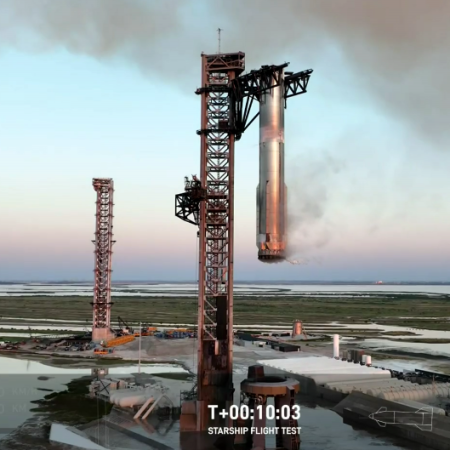
The same activist groups that have repeatedly used lawfare to try to block SpaceX’s operations at Boca Chica have now sued the Texas Commission on Environmental Quality (TCEQ) for allowing SpaceX to use its deluge launch system during Starship/Superheavy launches, claiming that dumping potable drinking water into the ground somehow damages the environment.

The groups — the South Texas Environmental Justice Network, along with the Carrizo/Comecrudo Nation of Texas, and Save RGV — filed the lawsuit Monday after the agency decided last month to allow SpaceX to continue its operations for 300 days or until the company obtained the appropriate permit.

These three groups represent only a very tiny handful of people in the Rio Grande Valley. The people the media interviews from Save RGV always includes the same persons, suggesting that few people in south Texas support it. The “Carrizo/Comecrudo Nation of Texas” in turn is a fake Indian tribe. It no longer exists, and when it did it existed in Mexico, not Texas. Finally, the “South Texas Environmental Justice Network” is simply an umbrella organization created on top of other two to make it appear they have more support than they do.

The real question that local journalists should be asking is where are these groups getting their money for all their lawsuits? I suspect it comes from outside the region, from leftist political organizations whose goals have nothing to do with the environment.

3 comments

FAA issues license for SpaceX’s seventh test flight of Starship/Superheavy

My, what a difference an election makes! FAA today proudly announced that it has issued the launch license for SpaceX’s seventh test flight of Starship/Superheavy at Boca Chica, now tentatively set for mid-January.

I say “proudly” because of this quote in the announcement:

“The FAA continues to increase efficiencies in our licensing determination activities to meet the needs of the commercial space transportation industry,” said the Associate Administrator for Commercial Space Transportation Kelvin B. Coleman. “This license modification that we are issuing is well ahead of the Starship Flight 7 launch date and is another example of the FAA`s commitment to enable safe space transportation.”

For the past three years it was like pulling teeth to get the FAA to issue these licenses for Starship/Superheavy test flights. Every time SpaceX had to wait from one to six months extra, and would only get the license mere hours before launch. During that time the FAA made no effort to “increase efficiencies” in its licensing process. Instead it found more ways to slow things down, not just for SpaceX but for the entire launch industry.

Trump gets elected and now suddenly the agency is interested in reducing red tape? What you are seeing instead a lot of bureaucrats desperately trying to convince the incoming administration that the delays for the past three years were not their fault, that they were really against red tape!

Or to put it more bluntly: “Please don’t fire us!”

I hope Trump doesn’t fall for this. A major house-cleaning in management and regulations is necessary at the FAA, and it must be done fast.

6 comments

Thailand signs the Artemis Accords

Thailand yesterday became the 51st nation to sign the Artemis Accords, joining the American alliance in space.

The full list of nations now part of this American space alliance: Angola, Argentina, Armenia, Australia, Austria, Bahrain, Belgium, Brazil, Bulgaria, Canada, Chile, Colombia, Cyprus, Czech Republic, Denmark, Dominican Republic, Ecuador, Estonia, France, Germany, Greece, Iceland, India, Israel, Italy, Japan, Lithuania, Luxembourg, Mexico, the Netherlands, New Zealand, Nigeria, Panama, Peru, Poland, Romania, Rwanda, Saudi Arabia, Singapore, Slovakia, Slovenia, South Korea, Spain, Sweden, Switzerland, Thailand, the United Kingdom, the United Arab Emirates, the Ukraine, the United States and Uruguay.

Trump created the accords with the goal to create an alliance with enough clout to overcome the Outer Space Treaty’s restrictions on private property. Biden rewrote the goal to accomplish the exact opposite, as NASA states in all recent press releases about new nations joining:

The Artemis Accords are grounded in the Outer Space Treaty and other agreements including the Registration Convention, the Rescue and Return Agreement, as well as best practices and norms of responsible behavior that NASA and its partners have supported, including the public release of scientific data.

I expect there to be a shift back to the original goals in the second Trump administration.

2 comments

FAA eliminates a stupid licensing requirement imposed when it “streamlined” its launch licensing regulations

We’re from the government and we’re here to help! The Federal Aviation Administration (FAA) announced last week that it will stop demanding rocket companies redo a flight safety analysis that have already been done by the rocket’s spaceports, a new bit of red tape that was apparently added when the agency introduced its Part 450 “streamlined” licensing regulations in 2021.

The FAA announced Dec. 13 that it will accept flight safety analyses performed by federal launch ranges in California, Florida and Virginia in applications for launch licenses under regulations known as Part 450. That decision means that companies will no longer have to perform similar analyses specifically for the FAA as part of the licensing process. Launch companies had complained of the duplication of work needed to carry out FAA analyses in addition to those required by the ranges they were launching from.

The FAA’s own bureaucracy had recognized the stupidity of this requirement (as well as many others) in July 2023 report [pdf], but the agency’s management did nothing. Apparently the political appointees who ran the agency during the Biden administration either liked this red tape — slowing American business — or were too dense to take action.

Trump’s election victory has now obviously forced some action. Not only has the agency suddenly recognized this particular problem, one week after Trump’s victory it announced the formation of an independent committee of industry and academia to review, once again, its Part 450 regulations.

It seems this committee is largely a Potemkin Village to make the Trump leadership think the agency is doing something. Instead, the FAA should do what it did last week, and adopt the many recommendations of the July 2023 report, now. The committee can then move forward cleaning up Part 450 in other areas instead of simply repeating that past work.

4 comments

Head of FAA resigns

You could leave now for all I care: Mike Whitaker, who has been director of the Federal Aviation Administration (FAA) under the Biden administration and who has apparently been the main source of that agency’s increased red tape that has almost destroyed the new rocket industry that had been emerging during the first Trump administration, announced today that he is stepping down next month.

Mike Whitaker announced his pending resignation in a message to employees of the FAA, which regulates airlines and aircraft manufacturers and manages the nation’s airspace. He became the agency’s administrator in October 2023.

Since then, the challenges confronting Whitaker have included a surge in close calls between planes, a need for stricter oversight of Boeing. antiquated equipment and a shortage of air traffic controllers at a time of high consumer demand for air travel.

The article at the link is from PBS, so of course it makes this federal bureaucrat appear a hero. Instead, he was a disaster for America’s space industry, forcing unnecessary delays in SpaceX’s Starship/Superheavy program, imposing new regulations that claimed to streamline the launch licensing process but did exactly the opposite, and generally forcing FAA regulators to take a fearful attitude to any new technology, so much so that it became almost impossible for that new technology to launch.

As for the aviation industry, Whitaker’s term did little to change things. For example, he did nothing to shut down the DEI programs at major airline and airplane companies that were causing the hiring of unqualified people.

All I can say is good riddance.

5 comments

Two congressmen demand FAA streamline its launch licensing process

In a letter [pdf] sent to the FAA on December 6, 2024, two congressmen have called for the FAA to fix what it calls its Part 450 launch licensing process, established in 2021, that has been choking off rocket development in the U.S.

The congressmen, Sam Graves (R-Missouri) and Rob Wittman (R-Virginia), specifically focused on the problems these new regulations have imposed during what the FAA calls its “pre-application review.” From the letter:

In November of 2024, the FAA indicated that 98 percent of applications are met within the statutory 180 day timeline. However, this timeframe does not include the months, and oftentimes years, of pre–application review that create extensive delays for companies seeking a launch and reentry license. [emphasis mine]

Consider the implications of this one quote. The FAA is proud of the fact that it approves license applications within six months — an ungodly long time for a startup — but doesn’t mention that the approval process is actually far longer because it requires new applications to be reviewed at length, before they can even be submitted.

In November, a week after Trump’s election victory, the FAA announced that it was forming a committee made up of people from the launch industry as well as academia to review Part 450. In their letter the congressmen approved of this new committee, but noted its work would not be completed until mid-2025, and that “the system is broken and must be fixed” immediately.

We, however, urge the FAA to act now and ensure that all actions short of rulemaking that can help mitigate the deficiencies of the part 450 regulation are taken in advance of any necessary regulatory changes to ensure that the commercial space industry does not have to wait years for relief.

I suspect we shall see some real action at the FAA come January 20, 2025, after Trump takes office.

1 comment

Superheavy to be used on next test flight completes 15-second static fire test

SpaceX has successfully completed a launchpad 15-second static fire test of the 33 engines on the Superheavy booster that will be used on the next test flight (the seventh) of its Starship/Superheavy rocket.

The video at the link is remarkable in that it appears all 33 Raptor-2 engines fired for the entire test with no problems either to the rocket or launchpad, despite producing more thrust in that time than any rocket ever in the history of space exploration.

According to this report, it appears SpaceX is targeting January 11, 2025 for that seventh test flight.

SpaceX has not yet announced a launch date for Starship’s seventh test flight, but the company appears to be eyeing Jan. 11; an email sent by NASA to the U.S. Federal Aviation Administration identifies that date as the target. (According to that email, NASA plans to deploy a Gulfstream V jet to observe the upcoming flight.)

This date however has not yet been confirmed by SpaceX. Nor has the FAA indicated it will issue a license. The FAA’s approval will depend on the flight plan SpaceX chooses for the test. If similar to the previous two test flights, then that approval will be fast. If not, the red tape will likely cause several more months of delays.

0 comments

One of Australia’s proposed spaceports moves

Australia's spaceports
Australia’s spaceports

“I’m from the government and I’m here to help!” Because of its inability to get the proper permissions from a local council, the management of Equatorial Launch Australia (ELA) has abandoned its original spaceport location on the Gove peninsula in the Northwest Territory of Australia and shifted east to a new location on the York peninsula in Queensland.

On the map to the right the “X” shows the old location, with the new location near the town of Weipa on the west coast of the peninsula. The change was forced on the company when it could not get proper approvals from the Northern Land Council (NLC), which manages the Arnhem Land Aboriginal Land Trust where the original site was located.

In a statement late on Monday, ELA said its most recent attempt to finalise a lease for the expansion of the ASC in October had been unsuccessful, following three other failed attempts in the last 12 months. In each case, it said the NLC had “failed to meet its own specified deadline for the approval of the Head Lease” or “provide any official reason for the delay”, despite pleas from the NT government and the Gumatj Aboriginal Corporation.

Because ELA has a launch contract with a South Korea rocket startup Innospace that intends to launch next year, it decided the switch had to occur now to make sure it could meet its obligations under this launch contract.

2 comments

Panama and Austria to sign Artemis Accords

NASA yesterday announced that both Panama and Austria will sign Artemis Accords tomorrow, bringing the total number of nations in the alliance to fifty.

The full list of nations now part of this American space alliance: Angola, Argentina, Armenia, Australia, Austria, Bahrain, Belgium, Brazil, Bulgaria, Canada, Chile, Colombia, Cyprus, Czech Republic, Denmark, Dominican Republic, Ecuador, Estonia, France, Germany, Greece, Iceland, India, Israel, Italy, Japan, Lithuania, Luxembourg, Mexico, the Netherlands, New Zealand, Nigeria, Panama, Peru, Poland, Romania, Rwanda, Saudi Arabia, Singapore, Slovakia, Slovenia, South Korea, Spain, Sweden, Switzerland, the United Kingdom, the United Arab Emirates, the Ukraine, the United States and Uruguay.

The accords were created by the first Trump administration with the goal to create an alliance with enough clout to overcome the Outer Space Treaty’s restrictions on private property. Under the Biden administration, the goal has been rewritten to accomplish the exact opposite, as noted by NASA yesterday:

The Artemis Accords are grounded in the Outer Space Treaty and other agreements including the Registration Convention, the Rescue and Return Agreement, as well as best practices and norms of responsible behavior that NASA and its partners have supported, including the public release of scientific data.

With Trump back in charge, expect him to bring the accords back to its original goal. Unlike his first term, the alliance is now large, and he can use it to quickly apply pressure on the international community to overcome the Outer Space Treaty’s limitations on private property.

0 comments

Ten stupid academic studies funded by the federal government

Campus Reform last week posted a list of ten academic studies funded by federal government that any sane person would not only consider stupid, but an utter waste of money.

Number 1 on the list was a grant of almost a half million dollars to researchers at Reed College in Oregon to study the gambling habits of pigeons. The researchers claimed the study would shed light on human gambling behaviors, but if you believe that then you would likely also fork over your life savings to buy the Brooklyn Bridge.

Of the ten studies listed, the National Institute of Health (NIH) and the National Science Foundation (NSF) funded four each, while the National Endowment for the Humanities and the National Cancer Institute funded one each.

National Cancer Institute’s study is surely going to help cure cancer, as it gave $7 million to the con artists faking as researchers at Stanford University to build an AI toilet equipped with cameras to scan the user’s waste and backside.

The studies were done at a range of other major universities, including Cornell, the University of California, the University of Illinois, and the University of Connecticut. Most are publicly funded institutions.

This list demonstrates clearly the bankruptcy of the government agencies involved and justifies any effort to slash their budgets by significant amounts. It does more however. It shows us the bankruptcy of the academic community as well. If scientists at major universities think this drivel is valid research, then we know they are teaching their students garbage as well. The public funding to these colleges should be slashed also.

7 comments

Why Orion’s heat shield problems give Jared Isaacman the perfect justification to cancel all of SLS/Orion

Orion's damage heat shield
Damage to Orion heat shield caused during re-entry in 2022,
including “cavities resulting from the loss of large chunks”

In yesterday’s press conference announcing new delays in NASA’s next two SLS/Orion Artemis missions to the Moon, agency officials were remarkably terse in providing details on why large chunks of Orion’s heat shield material broke off during its return to Earth in 2022 during the first Artemis mission. That damage, shown to the right, is one of the main reasons for the newly announced launch delays.

All they really said was that the damage was caused during re-entry, the atmosphere causing more stress than expected on the heat shield.

Today NASA finally released a more detailed explanation.

Engineers determined as Orion was returning from its uncrewed mission around the Moon, gases generated inside the heat shield’s ablative outer material called Avcoat were not able to vent and dissipate as expected. This allowed pressure to build up and cracking to occur, causing some charred material to break off in several locations.

…During Artemis I, engineers used the skip guidance entry technique to return Orion to Earth. … Using this maneuver, Orion dipped into the upper part of Earth’s atmosphere and used atmospheric drag to slow down. Orion then used the aerodynamic lift of the capsule to skip back out of the atmosphere, then reenter for final descent under parachutes to splashdown.

[Ground testing during the investigation showed] that during the period between dips into the atmosphere, heating rates decreased, and thermal energy accumulated inside the heat shield’s Avcoat material. This led to the accumulation of gases that are part of the expected ablation process. Because the Avcoat did not have “permeability,” internal pressure built up, and led to cracking and uneven shedding of the outer layer.

In other words, instead of ablating off in small layers, the gas build-up caused the Avcoat to break off in large chunks, with the breakage tending to occur at the seams between sections of the heat shield.
» Read more

51 comments

Republican California state legislator introduces bill to overturn California Coastal Commission’s effort to block SpaceX

Wants to be a dictator

Republican state assemblyman Bill Essayli has now introduced a bill that would overturn the decision by the California Coastal Commission to reject SpaceX’s request to increase its launch rate at Vandenberg spaceport, a decision the commissioners readily and publicly stated was made not to protect the state’s beaches (the commission’s prime function) but because they did not like Musk’s political positions.

“AB 10 will reverse the politically-motivated decision by the California Coastal Commission to restrict SpaceX launches for the Space Force due to their hatred of Elon Musk. This dangerous and illegal decision threatens our national security and erodes the public trust we place in our officials to act in the best interest of the people — not politics,” Essayli said in a statement this week.

SpaceX has already sued the commission and its commissioners for violating Musk’s first amendment rights as well as exceeding their statutory authority.

The bottom line however is that the commission’s decision carries no legal weight. Vandenberg is an federally operated military base, and thus this state commission has no authority to dictate what happens there. The Space Force has simply tried to work with it in the past.

Thus, if the commission’s fangs are not pulled by Essayli’s legislation as well as SpaceX’s lawsuit, the military will likely just ignore it.

4 comments

Japan awards $32.5 million contract for lunar GPS-type satellite constellation to startup

Capitalism in space: As part of the multi-billion dollar fund the Japanese government has allocated to encourage private enterprise by new Japanese startups, its space agency JAXA has now awarded a $32.5 million development contract to the startup ArkEdge Space to design and fly a GPS-type satellite in orbit around the Moon, thus demonstrating the technology.

Under the agreement, ArkEdge Space will plan and design the mass production and operation of micro-satellite constellations to lead the development of a next-generation Lunar Navigation Satellite System (LNSS), a vital component to the International “LunaNet” initiative driven by National Aeronautics and Space Administration (NASA), European Space Agency (ESA) and JAXA. LunaNet seeks to establish essential infrastructure to support sustainable lunar exploration and foster the growth of the lunar economy.

The real significance of this contract award is that it signals JAXA’s growing shift from designing, building, and owning everything to simply becoming the customer who gets what it needs from the private sector. The Japanese government had established that fund for this express purpose, but JAXA has shown a reluctance to proceed, as it directly threatens its turf. This award indicates that reluctance is finally being pushed aside.

3 comments

Orbex gives up on the Sutherland spaceport, switches to SaxaVord

Map of spaceports surrounding Norwegian Sea
Spaceports surrounding the Norwegian Sea

In a very sudden decision, the rocket startup Orbex, based in Great Britain, has “paused” its long-delayed work to develop a launch facility at the Sutherland spaceport in northern Scotland and instead decided to launch its first rockets from the competing SaxaVord spaceport on the Shetland islands.

Orbex says it is halting construction work on the £20 million spaceport and instead is mothballing the project, which has received a £14.6 million public investment package. The space company, which was to have made the Sutherland Spaceport its home port, will now launch its rockets carrying commercial satellites from another north spaceport – SaxaVord on Unst, Shetland.

According to the company’s CEO, it will retain its 50-year lease at Sutherland to give it “flexibility to increase launch capacity in the future.”

The company had originally hoped to launch its Prime rocket from Sutherland in 2022, but has been faced with red tape from the Civil Aviation Authority (CAA), which has still not issued a launch licence, even though the application was submitted almost three years ago. Orbex has also faced lawfare opposition from local activists as well as a major local landowner, billionaire Anders Povlsen, who is also a major investor in SaxaVord.

That last detail might help explain this decision. In private talks Orbex might have learned that the red tape and opposition would disappear if it switched to SaxaVord. The timing is also suggestive, as only a few days ago construction started on a new spaceport in Scotland, located on the island of North Uist.

All told, Orbex might have decided that the stars were aligned against it at Sutherland, and it was better to move. It now hopes to complete the first test launch of its Prime rocket from SaxaVord next year.

1 comment

The real proof that the American political scene is about to experience a new revolution

The Democratic Party for the past half century

While the conservative press is today going ga-ga over Joe Biden’s pardoning of his son Hunter yesterday — noting accurately that Biden’s action proved himself once again to be a liar and a fraud, having spent the last four years insisting he would never do such a thing while also insisting that “no one is above the law” — I think it more instructive to look at what some of the most rabid partisan leftists have been saying, before and after the election of Donald Trump.

You see, some of these partisan leftists are actually doing something I have not seen a partisan leftist do since before Bill Clinton was president — they are showing an ability to have an open mind.

Let’s begin with two members of a leftist podcast group dubbed the Young Turks that for years saw nothing good about any Republican and considering Donald Trump the epitomization of the devil himself. Anything Trump did was wrong. Everything Trump and the Republicans represented was evil and must be opposed blindly. During and after this presidential election campaign however two of the more noted members of this podcast, Ann Kasparian and Cenk Uygar, changed their tune, and did so in an astonishing way.

First there was Kasparian’s announcement in October that she has left the Democratic Party. Watch:
» Read more

36 comments

Construction begins for 3rd spaceport in Scotland

Map of spaceports surrounding Norwegian Sea

Construction of a third spaceport in Scotland has now begun, its location on the northwest coast of the island of North Uist (as shown on the map to the right), with its plans to serve suborbital launches initially.

The Highlands and Islands Enterprise, a Scottish government agency focused on regional development, has allocated £947,000 for the construction of the site’s enabling infrastructure. Additionally, the Comhairle is contributing £675,000 from its 2023-2028 capital programme. The total cost of the enabling works project is estimated to be £2.6 million.

After the construction of the enabling infrastructure is complete, which is expected to occur by Spring 2025, a private sector operator will take over to complete the second phase of construction and manage the spaceport.

According to the Wikipedia page for this area on North Uist, the project was first proposed in 2019, and was then hoping to attract orbital launches. Subsequent opposition by activists slowed development and likely reduced the project from orbital to suborbital, at least for now.

0 comments

Trump’s picks to run all the federal health agencies guarantees major change is coming

Trump defiant after being shot
Trump defiant

Fight! Fight! Fight! The announcement late yesterday that president-elect Donald Trump has picked Jay Bhattacharya, the director of Stanford University’s Center for Demography and Economics of Health and Aging, to head the National Institutes of Health (NIH) underlined quite forcefully the certainty that the outsider nature of all of Trump’s picks to head all the health-related agencies in the federal government will led to major changes in how those agencies operate.

Bhattacharya had been blacklisted for his very vocal opposition to the government’s lockdown and mandate policies during the COVID epidemic. He along with Martin Kulldorff, one of the world’s foremost experts on vaccines and who was also blacklisted during the epidemic, co-authored the Great Barrington Declaration that strongly criticized the policies imposed by these health agencies, calling instead for a return to the standard response to infectious diseases that had been followed successfully for more than a century.

Putting Bhattacharya in charge of NIH is incredibly ironic. When he along with Kulldorff had come out opposed to the lockdown and jab mandates advocated by Francis Collins, then-head of the NIH, Collins in league with Anthony Fauci, then head of National Institute of Allergy and Infectious Diseases (NIAID), put together a back-room campaign to have Bhattacharya, Kulldorff, and many others blacklisted across social media. This campaign also had Kulldorff removed as a member of the CDC’s vaccine safety advisory committee.

Two years later, Collins is now gone, is being sued for his actions, and Bhattacharya has replaced him.

Trump’s defiant choice of Bhattacharya however is only one of many similar decisions, beginning last month with the choice of Robert Kennedy Jr. to run the Department of Health and Human Services.
» Read more

16 comments

Judge dismisses lawsuit against SpaceX by activists

A federal judge has now thrown out a lawsuit that had been filed by anti-Musk activists in an attempt to halt all launches by SpaceX of its Starship/Superheavy rocket at Boca Chica.

U.S. District Judge Rolando Olvera issued his ruling last Thursday in response to the request filed by Save RGV on Oct. 9. The group has alleged that SpaceX’s water deluge system is releasing untreated industrial wastewater during launches and sought to halt the launches.

The water deluge system is designed to dampen the effects of Starship’s rocket engine blasts during liftoff and static fire engine testing.

“At the beginning of the Starship-Super Heavy Launch System’s development, it became evident that a deluge water system was necessary to protect the launch site and surrounding areas during launches,” Olvera wrote in the order. “A deluge water system sprays large quantities of potable water at the base of the spacecrafts during launch to prevent fires and reduce dispersal of dust and debris.

“Because of these dangers, Defendant cannot launch its spacecrafts without the deluge water system.”

SpaceX had argued that environmental reviews by both federal and state agencies had determined that the deluge system caused no harm. Olvera concurred, and also noted that to block launches would do significant harm to SpaceX and NASA’s entire lunar program.

This activist group, which represents almost no one in southern Texas, has no real interest in the environment. It filed this and other lawsuits simply as lawfare to try to stymie SpaceX for political reasons, knowing that we have more than seven decades of data at spaceports in Florida and California that prove rocket launches and deluge systems cause no environmental harm. In fact, they help wildlife by creating a large refuge where that wildlife can thrive.

Expect further similar lawsuits, all of which will be summarily dismissed afterward.

What I wonder is who is paying for this lawfare? SaveRGV likely doesn’t have the resources.

8 comments

If ordinary people don’t show up at those upcoming FAA Starship/Superheavy public meetings they WILL be screwed

Starship splashing down vertically
Starship splashing down vertically in the
Gulf of Mexico on November 19, 2024

Yesterday radio host Robert Pratt sent me a news story from a Texas newspaper, the Texas Tribune, which attempted quite surprisingly to capture fairly the local response to the most recent Starship/Superheavy test launch out of Boca Chica on November 19, 2024.

The reporter, Bernice Garcia, clearly made it a point to talk to a lot of people, especially those who came out to see the launch. As a result, she showed that in general, no matter what people felt about Donald Trump or Elon Musk, the local population was almost entirely in favor of SpaceX’s efforts there. For example:

Sanchez was slightly concerned about [the rocket’s sonic booms] but believed the benefits of jobs created by SpaceX was worth the risk. “They know what they’re doing,” Sanchez said.

But his favorable opinion of Musk’s company did not extend to Trump. A naturalized citizen who gained amnesty under the Reagan administration, Sanchez didn’t view Trump’s immigration policies as logistically sound. “If you throw those people out, who’s going to work?” Sanchez said. “You don’t see a white man laboring out in the sun. On the other hand, Mexicans, foreigners, people from other countries –– that’s why they come here, to work.”

While the story found locals with a whole range of opinions about Trump, both positive and negative, it only quoted one person who was hostile to SpaceX, and that quote and person tells us a great deal about the bankrupt nature of that opposition:
» Read more

7 comments
1 16 17 18 19 20 388