Watch video from Varda’s return capsule as its comes back to Earth

I have embedded below video taken from inside the capsule of the commercial startup Varda from its release from the Rocket Lab service module throughout its descent back to Earth.

The capsule had been launched in June 2023, carrying equipment to manufacture HIV drugs in space and then return them to Earth for sale. Even though the company had begun negotiations with the FAA and the Air Force two years prior for landing that capsule in the Air Force’s test range in Utah, those agencies blocked its planned return in the September of 2023, and was only able to do it last month. This mission is demo flight, with three others now scheduled.

For the video, Varda included a window looking up outside the capsule, and a camera to film everything that occurred outside that window during descent, release of parachutes, and impact on the ground. It is quite fascinating, as you can see that the capsule initially tumbles, then as the atmosphere thickens its aerodynamic shape causes it to stablize with its heat shield at its bottom.
» Read more

8 comments

German rocket startup ships suborbital test rocket to Australia for launch

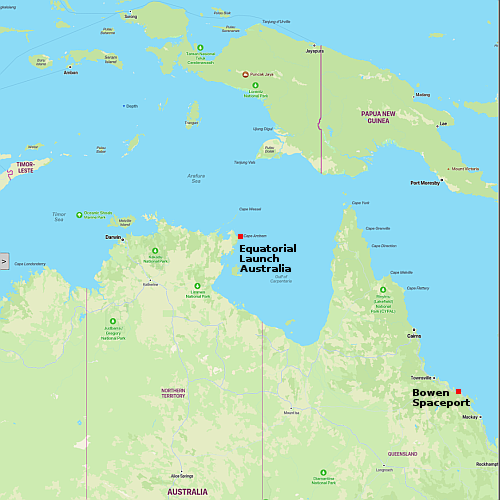
The German rocket startup Hyimpulse has now packed its SR75 test rocket for shipment to Australia for a suborbital test flight taking off from Koonibba Test Range on that nation’s southern coast.

The launch at Koonibba will also assist HyImpulse as they continue development of their SL1 Orbital Launcher. The SL1 Orbital Launcher will use ten of the SR75 rocket motors to lift payloads of up to 600kg to low earth orbit and could be launched from the Whalers Way Orbital Launch Complex [part of Koonibba] in the future.

The launch campaign is scheduled to begin from mid-April with both companies targeting a launch at the end of April through to early May subject to regulatory approval. [emphasis mine]

The highlighted phrase immediately raises concerns, as Australia is part of the British Commonwealth, with laws based on Great Britain’s. In Great Britain the red tape from those laws has acted to stymie all launches, destroying one company (Virgin Orbit) and threatening the viability of two spaceports. In Australia there have been indications that such red tape is doing the same to new spaceports on the northern coast. We shall see if that April launch happens. If it is delayed because of “pending regulatory approvals” it will confirm that the Australian government is as much a problem as Great Britain’s.

Hyimpulse is one of three German rocket startups, with Rocket Factory Augburg and Isar Aerospace the other two. It however has been very quiet in the past few years, with the other two companies garnering the most publicity as they prepare for their own first test launches. This story suggests however it might actually be the first to fly, despite the lack of news reports about it.

0 comments

Update on Starship/Superheavy preparations at Boca Chica

Link here. After two separate but aborted dress rehearsal countdowns, the rocket has been destacked with Superheavy rolled back to the assembly building.

After two Wet Dress Rehearsal (WDR) aborts, SpaceX opted to destack Ship 28 before removing Booster 10 from the Orbital Launch Mount (OLM). The Booster has since rolled back to the Production Site, while Ship 28 conducted standalone testing on Pad B, opening with a Spin Prime test on Monday.

A March launch of Flight 3 for Starship is still possible, pending the completion of full stack testing and approval from the FAA.

While the aborts suggest some technical issues occurred that need addressing, the destacking and additional work could also be for other reasons. The FAA has still not issued a launch license, and is demanding certain actions before doing so. It could be that the company is being forced to make certain upgrades on these prototypes it would have rather left to the next test launch with more advanced prototypes.

Either way, it now appears that a March launch is possibly threatened.

3 comments

FAA announces it has rubber-stamped SpaceX’s investigation of the November Starship/Superheavy test launch

The FAA yesterday announced that it has completed its review of SpaceX’s investigation of the November Starship/Superheavy test launch and has approved the company’s conclusions.

The Federal Aviation Administration has concluded its review of SpaceX’s investigation of the second Starship launch in November, with the regulator saying Monday that it accepted the “root causes and 17 corrective actions” identified by the company.

While this means the investigation is now closed, SpaceX must implement all the corrective actions and apply for a modified launch license before it can fly Starship again. “The FAA is evaluating SpaceX’s license modification request and expects SpaceX to submit additional required information before a final determination can be made,” the regulator said in a statement Monday.

You can read a SpaceX update of its investigation here. As previously reported, when Starship vented the extra oxygen carried to better simulate a payload it caused “a combustion event” and fires that cut off communications.

This resulted in a commanded shut down of all six engines prior to completion of the ascent burn, followed by the Autonomous Flight Safety System detecting a mission rule violation and activating the flight termination system, leading to vehicle breakup. The flight test’s conclusion came when the spacecraft was as at an altitude of ~150 km and a velocity of ~24,000 km/h, becoming the first Starship to reach outer space.

Despite SpaceX’s report, which states the company “has implemented hardware changes” to prevent a reoccurance, the FAA has still not yet issued a launch license. Based on these updates and Elon Musk’s own prediction, it appears a license will be forthcoming in the next two weeks, matching my December prediction of a March launch. Expect SpaceX to quickly launch, as it has “more Starships ready to fly,” and it wants to fly them fast in order to refine the engineering so as to move to operational flights.

It is also possible that the FAA will continue to slow-walk its approvals, and SpaceX might be left hanging for more than two weeks. Had the government not been involved, all signs suggested that SpaceX would have done its third test flight in January, and would have now been gearing up for its fourth flight. That was the kind of pace SpaceX set when it was doing its first Starship test flights during the Trump administration. The government under Joe Biden’s presidency however is not allowing that kind of launch pace.

9 comments

Rocket Lab begins maneuvers to bring Varda’s capsule back to Earth

With the FAA finally giving its okay (six months late), Rocket Lab has now begun the orbital maneuvers required to bring Varda’s small manufacturing capsule back to Earth at the Utah test range.

For more than eight months in space, Rocket Lab’s 300kg-class spacecraft has successfully provided power, communications, ground control, and attitude control to allow Varda’s capsule to grow Ritonavir crystals, a drug commonly used as an antiviral medication for HIV and hepatitis C.

Due to the initial planned reentry date being adjusted from late 2023, Rocket Lab’s spacecraft has been required to operate for more than double its intended orbital lifespan, which it has done without issue.

If all goes as planned, the capsule will land on February 21, 2024. Whether those drugs are still viable and sellable remains unknown. The delay due to government red-tape might have made them useless.

Nonetheless, a success in recovering those samples, viable or not, would establish Varda’s business plan. With three more missions planned, all to be launched and controlled by Rocket Lab, it will be positioned well for the future, its capsule a method for manufacturing a number of products in weightlessness that are needed on Earth but can only be made in space.

9 comments

India deorbits a defunct satellite early, in a controlled manner

India’s space agency ISRO yesterday successfully deorbited its defunct Cartosat-2 satellite, using the satellite’s leftover fuel to bring it down in a controlled manner, about three decades sooner than its orbit would have decayed naturally.

The satellite was launched in 2007 to provide detailed ground images of India, and completed its mission in 2019. As noted in ISRO’S press release:

ISRO opted to lower its perigee using leftover fuel to comply with international guidelines on space debris mitigation. This involved reducing collision risks and ensuring safe end-of-life disposal, following recommendations from organizations like the United Nations Committee on the Peaceful Uses of Outer Space (UN-COPOUS) and the Inter-Agency Space Debris Coordination Committee (IADC).

While such actions are a good thing, that governments in India and Europe are suddenly making a big deal about it now — after almost 3/4s of a century of inaction — is not for those reasons, but to lay the political groundwork for allowing the international community, led by the UN, to impose new regulations on all space efforts, both government and private.

Be warned. They are the government, and they are here to help you.

0 comments

SpaceX moves its corporation home from Delaware to Texas

As had been threatened by Elon Musk, SpaceX has now officially filed to move its incorporation home from Delaware to Texas, taking with it signicant tax dollars.

SpaceX, which was incorporated in the famously corporation-friendly Delaware, filed to relocate its business incorporation with the Texas Secretary of State, Bloomberg reported.

SpaceX CEO Elon Musk publicly railed against the Diamond State and a judge’s decision to void his $55 billion Tesla pay package.

Another Musk company, Neuralink, has also shifted its incorpoation from Delaware to Nevada.

None of this involves the movement of any physical facilities. However, Musk is making it very clear once again that if a state government interferes unreasonably with his business operations, he will leave it. He did this by the actual shifting previously large parts of SpaceX operations from California to Texas when California government officials attempted to punish him for remaining open during the Wuhan panic. Now he is doing the same to Delaware because it appears one judge decided he didn’t like Musk’s Tesla’s pay package, even though 80% of the company’s stockholders approved.

7 comments

Varda finally gets FAA permission to land its capsule

After more than six months of paper-pushing, the FAA has finally agreed to let the commercial in-space manufacturing startup Varda land its orbiting capsule in Utah.

After months of effort and one rejected application, Varda Space Industries said Feb. 14 it has received a license from the Federal Aviation Administration to return a capsule from its first mission.

The FAA’s Office of Commercial Space Transportation issued a reentry license for Varda’s W-Series 1 spacecraft. The license will allow the company to land a capsule from that spacecraft at the Utah Test and Training Range (UTTR) and neighboring Dugway Proving Ground west of Salt Lake City. Varda said that reentry is scheduled for Feb. 21.

…The company had hoped to return the capsule as early as mid-July, but said then was still working with the FAA to obtain a reentry license, required for any commercial spacecraft returning to Earth. One issue the company said it was facing was that it was the first company seeking a reentry license under new regulations called Part 450 intended to streamline the licensing process, but which some companies reported difficulties adjusting to. [emphasis mine]

The highlighted sentence dishonestly implies it has been the companies that are having problems adjusting to these so-called “streamlined” regulations, when the truth is that the FAA has been the one having the problem. Since Part 450 was established all FAA appovals have slowed to a crawl, when previously the FAA moved much faster.

In fact, that sentence is proven dishonest in the article’s very next paragraphs, which describe how the July approval didn’t happen because two government agencies couldn’t get their act together. Varda really had nothing to do with this lack of approval.

The capsule contains pharmaceuticals for sale on Earth that can not be manufactured in gravity. For the government to delay their return almost half a year simply because of red-tape is disgusting, especially because this delay might end up destroying the startup entirely. It is even more disgusting in that these government agencies have had had no problem approving the return of NASA capsules from space, to this very same Utah range.

1 comment

Update on SpaceX preparations for 3rd Superheavy/Starship orbital test launch

Link here. SpaceX is apparently now gearing up for a wet dress rehearsal countdown, whereby it performs a full countdown, including fueling both stages and taking everything to T-0. Such rehearsals are a standard procedure for all SpaceX launches.

Whether this launch will occur in early March, as Musk claimed yesterday, remains very uncertain, but not for technical reasons.

The FAA said that the mishap investigation for OFT-2 is still open, pending more information from SpaceX. The license modification requires all needed information to be submitted and reviewed, and the investigation needs to be closed before Starship returns to flight.

Apparently SpaceX has not yet completed its own investigation of the November second test launch. If so, this third launch might be delayed until April, since after the first test launch in April the FAA and Fish & Wildlife took three months after receiving SpaceX’s completed investigation report to approve it and issue a license. The FAA falsely claimed it was doing its own investigation, but the GAO has made it clear this is not so. All it does is rubber stamp the investigations of private companies.

We shall see. Some reports have said that no Fish & Wildlife approval will be required this time, which will speed things up. Others have indicated that the FAA is ready to move quicker. Even so, there remains the outstanding lawsuit by activists against the closing of nearby beaches for each launch. If those litigants demand a court injunction against such closures while the case is on-going, this launch could be delayed far longer.

3 comments

Musk: 3rd Starship/Superheavy test launch expected in early March

According to a tweet on X by Elon Musk, the third test flight of SpaceX’s heavy-lift Starship/Superheavy rocket is now expected in about three weeks, in early March.

The rocket is presently on the launchpad, undergoing final tests.

This confirms my December prediction that the launch would not happen earlier than March. SpaceX was ready to launch in January, but as I predicted red tape in the federal government have left the rocket sitting on the ground.

However, that prediction may have been too optimistic. First, SpaceX has still not gotten its launch license from the FAA, with no word from that agency when it will rubber-stamp SpaceX’s investigation into the second test launch in November. Second, the lawsuit by activists challenging the right of local authorities to close beaches at Boca Chica for launches remains active. It is very possible those activists will be successful in getting the court to issue an injunction preventing any beach closures (and thus launches) while the case is being litigated. If so, the next test launch could be months away.

7 comments

Greece signs Artemis Accords

Greece yesterday became the 35th nation to sign the Artemis Accords, joining the American alliance established by these bi-laterial individual agreements between the U.S. and each nation.

The full list of signatories to the Accords is now as follows: Angola, Argentina, Australia, Bahrain, Belgium, Brazil, Bulgaria, Canada, Columbia, Czech Republic, Ecuador, France, Germany, Greece, Iceland, India, Israel, Italy, Japan, Luxembourg, Mexico, the Netherlands, New Zealand, Nigeria, Poland, Romania, Rwanda, Saudi Arabia, Singapore, South Korea, Spain, the United Kingdom, the United Arab Emirates, the Ukraine, and the United States.

The original goal of the Artemis Accords, established during the Trump administration, was to create an alliance focused on allowing property rights in space that would also act to establish legal rules to protect those rights, something that the Outer Space Treaty forbids. It appears that under the Biden administration those goals have increasingly been pushed aside for the globalist goals of the UN. The language of NASA’s press release illustrates this:

“As humanity embarks on a great adventure, returning to the Moon and preparing for traveling beyond the Moon, the Artemis Accords serve as a beacon of collaboration and cooperation among nations, paving the way for a sustainable and peaceful exploration of space,” said [Giorgos Gerapetritis, Greek’s foreign minister].

The Artemis Accords reinforce and implement key obligations in the 1967 Outer Space Treaty. They also strengthen the commitment by the United States and signatory nations to the Registration Convention, the Rescue and Return Agreement, as well as best practices NASA and its partners support, including the public release of scientific data. [emphasis mine]

The highlighted word is one of the many buzzwords used by globalists to signal their priorities, similar to the use of the term ” equitable access” by Belgium officials when it signed the accords in January. Rather than focus on allowing private enterprise and freedom, the focus now is to establish rules to control what people do.

The right leadership from the United States could change this shift in focus, but right now the U.S. does not have such leadership.

6 comments

A sign of hope and disaster: Students rip out tampon dispenser in boy’s bathroom 20 minutes after it was installed

Marc Belanda, principal of Brookfield and leading the way to a queer future!
Marc Belanda, principal of Brookfield HS,
leading the way to a queer future!

Last week a story made news when administrators at Brookfield High School in Connecticut installed a woman’s tampon dispenser in the boy’s bathroom, as now required by an insane law passed by the state legislature in 2022.

A bill passed in the 2022 legislative session requires public school Boards of Education to provide free menstrual products to students in all girls restrooms, in any all-gender restrooms, and in at least one boys restroom. According to Connecticut’s Department of Public Health (DPH) “The intention of the law is to address period poverty, meaning the struggle to purchase period products due to lack of income.”

It wasn’t however the installation that made news, but the fact that only twenty minutes after the dispenser was installed students at the school (likely teenage boys) ripped it out.
» Read more

12 comments

Texas state court rules in favor of activist lawsuit against SpaceX

The activists who sued SpaceX and local authorities, claiming the beach closures required during tests and launches at Boca Chica violate the Texas constitution, have had their lawsuit reinstated by a higher state court after a lower court had dismissed it.

Texas’ 13th district court of appeals ruled in favor of SaveRGV, the Sierra Club and the Carrizo/Comecrudo Nation of Texas in suits alleging that a 2013 state law allowing beach closures for space flight activities goes against the Open Beaches Amendment to the Texas Constitution.

In July 2022, Cameron County’s 445th District Court dismissed the coalition’s lawsuit, saying the organizations lacked standing in their complaint against Texas Land Commissioner Dr. Dawn Buckingham, the Texas Land Office, Cameron County and Texas Attorney General Ken Paxton.

The appeals court reversed that decision Thursday, allowing the lawsuit to proceed.

The lawsuit still must be litigated, so these activists have not yet won their case. However, this decision might prevent further beach closures while the case plays out in the courts, which would essentially shut down any further tests or launches at Boca Chica. If so, it will not matter if the FAA finally finishes its paperwork and approves a third test launch of Starship/Superheavy later this month. The launch will not be possible.

18 comments

Bi-partisan bill proposed giving space traffic management to Commerce, not FCC

On January 25, 2024 a bill sponsored by a bi-partisan group of senators was introduced assigning the job of managing orbital traffic and the removal of defunct satellites to the Commerce Department, essentially telling both the FCC and NOAA that the attempt by those agencies to grab this power, outside of their statutory authority, will be opposed by elected officials.

The bill puts the responsibility of managing satellite and spacecraft traffic and the regulations regarding de-orbiting satellites to Office of Space Commerce (OSC) within Commerce. It is also supported by the comercial industry, which has not been happy especially with the FCC’s regulatory power grab. Unlike the regulations the FCC is creating, this bill relies heavily on industry advice and consensus, the very people who not only know best what needs to be done, but are the only ones qualified to do it.

Of course, the bill must pass both the Senate, House, and be signed by the President before it becomes law. Whether that can happen remains uncertain, especially since there appear to be a lot of factions inside DC who want to give federal agencies like the FCC legal carte blanche to regulate however they see fit, superseding Congress, the Constitution, and the law. And it seems that Congress now is so weak, those factions might just get what they want.

3 comments

NASA’s useless safety panel once again sticks its nose where it isn’t qualified to go

For the third year in a row, the annual report of NASA’s generally useless and often corrupt safety panel, the Aerospace Safety Advisory Panel (ASAP), is once again focused not on technical safety issues related specifically to engineering — the reason the panel was first formed in 1968 following the Apollo 1 launchpad fire that killed three asteronauts — but NASA’s general management and long term strategies and plans, something that is entirely the responsibility of Congress and elected officials.

As the press release notes right at the top, “The report highlights 2023 activities and observations on NASA’s Strategic Vision and Guiding Principles, Agency Governance, and Moon to Mars Program Management.” On none of these issues does this panel have any expertise, or even qualifications. Most of its membership are former government bureaucrats, with only one panel member coming mostly from the private sector.

More important, while the panel is supposed to be review NASA’s engineering to make sure it is not getting sloppy, its panelists are all management types, not engineers.

To give the panel some credit, its report [pdf] does actually note the many risks NASA is taking on its various Artemis manned lunar flights, including more than a dozen engineering designs which will be flown for the first time on the first Artemis manned mission to land on the Moon. However, while this should be the panel’s number one concern, it buries it inside the report, and simply recommends that NASA redistribute these firsts across multiple missions. How NASA should do this is not addressed.

Last year I simply noted ASAP’s annual report in a quick links post, adding that “It has been so wrong so many times in the past, clearly biased against private space while favoring NASA, its analysis is simply worthless.” That conclusion still applies.

The sooner Congress stops wasting any money on this panel, the better. It provides no real service except to slow down development. And it is now putting itself above Congress in its effort to influence strategic and programming.

0 comments

African lawfare to take control of space

Modern academia: Marching with Lenin!
Modern African academia, proudly marching with Lenin!

It appears that a growing cadre of African lawyers are working within international organizations such as the UN and the International Astronautical Union (IAU) to use the Outer Space Treaty as a wedge to take control of space, wresting it from the hands of private commerical companies.

I make this assessment based upon a long article about this new lawfare published today in Wired, describing the training and political goals of a number of young African layers in the field of international space law.

[S]ome players in the global south are gearing up for the orbital future not just by scrambling to launch satellites, but by building up skills in outer space law—the evolving area of international jurisprudence that introduced the “province of all mankind” concept in the first place.

Though the Outer Space Treaty is still the cornerstone of space law, other international agreements have built up around it over the years—and more still are desperately needed to regulate today’s realities in space. “This is an area of rulemaking where they’re just setting up the rules for the future, so you need to have a perspective now,” explains Timiebi Aganaba, a British-Canadian-Nigerian professor at Arizona State University who has been instrumental in driving African interest in space law. “If the system gets built without you—if you come in later—people will start quoting laws to you.”

In 2011, Aganaba helped organize the first teams of African law students to enter something called the Manfred Lachs Space Law Moot Court Competition. The global tournament, named after an architect of the Outer Space Treaty, uses fictional court cases to train young lawyers how to think through the plausible conflicts that could soon arise beyond the atmosphere—and it is far and away the most important professional conduit into the field of space law. Students who make it to the final round of the competition argue their cases before actual judges from the International Court of Justice—the world’s highest forum for legal disputes between countries. And since 2011, teams from Africa have become a force in the competition. In 2018, South Africa’s University of Pretoria won the international championship.

If Aganaba’s name rings a bell to my readers, it is no surprise. » Read more

9 comments

Belgium signs the Artemis Accords

Belgium yesterday became the 34th nation to sign the American-led Artemis Accords, bi-laterial agreements initially conceived by the Trump administration as a way to get around the legal limitations on private property created by the Outer Space Treaty.

Based on the wording of Belgium’s press release, it appear however that this goal is slowly being watered down by the many nations who have signed:

Belgium’s signature of the Artemis Accords is part of its proactive participation in the work of the United Nations Committee on the Peaceful Uses of Outer Space (UNCOPUOS). As a party to the five United Nations treaties on outer space, Belgium, in close collaboration with other Member States, has launched several actions within the Committee over the past decade to promote the establishment of an international multilateral legal framework for equitable access to and benefits from space resources, as well as for the safe and sustainable use of these resources. [emphasis mine]

The highlighted word, “equitable”, is one of the key words in Critical Race Theory, and when translated into plain English means providing guaranteed benefits for those who feel oppressed, whether or not they deserve it. Note too Belgium’s effort here to get the United Nations involved. By outlawing any nation from claiming territory and establishing its legal framework, the Outer Space Treaty essentially gave that power to the UN. The accords were conceived as a political way of breaking that restriction, shifting power back to the nations who signed. By inserting the UN into the Artemis alliance Belgium is trying to shift power to the UN again. And it appears it is attempting to form its own alliance of the smaller nations within the accords for this purpose.

The full list of signatories to the Accords is as follows: Angola, Argentina, Australia, Bahrain, Belgium, Brazil, Bulgaria, Canada, Columbia, Czech Republic, Ecuador, France, Germany, Iceland, India, Israel, Italy, Japan, Luxembourg, Mexico, the Netherlands, New Zealand, Nigeria, Poland, Romania, Rwanda, Saudi Arabia, Singapore, South Korea, Spain, the United Kingdom, the United Arab Emirates, the Ukraine, and the United States.

The competing alliance of communist nations, led by China, includes only Russia, Venezuala, Pakistan, Belarus, Azerbaijan, and South Africa. That former deep Soviet bloc nations like Bulgaria and Romania, as well as previously very Marxist Angola, went with the west rather than China illustrates the international distrust of China and its authoritarian methods.

0 comments

More academics demand that space activity be controlled and regulated, by them

Modern academia: Marching with Lenin!
Modern academia, proudly marching with Lenin!

Yesterday I linked to a student newspaper article at the University of Alberta advocating more regulation over all space activity, focused on replacing private ownership with collective ownership while simultaneously imposing Marxist racial quotas to get rid “old white men”.

Today there was another story from academia demanding similar regulation. On January 12, 2024 there was a public panel discussion at Arizona State University (ASU), where four academics argued for the need for more government regulation of space. The description of the panel’s goals at the event’s website gives us a good hint of the goals of these academics:

Space exploration and utilization is a rapidly expanding sector, and there is growing consensus that the complex space governance system must evolve with it. Faced with this dynamic nature, in this fireside chat, with leading experts in space governance, policy law and space science, we present a clear framework for conceptualizing the space governance system as a tool for discussions on space law and policy, demystifying its structure and the actors, instruments and collaborations within it. We then consider key debates in the space policy field within this framework from a global and transdisciplinary perspective.

This is typically bad academic writing, designed to intentionally hide its meaning. One of the panelists however translated it most bluntly in this quote from article about the event:
» Read more

10 comments

College professors insist all private activity in space must be regulated, by them

Now that private enterprise and free civilians are beginning to fly missions to space, independent of the government, “an international team of experts” have published a paper that demands that all future private activity in space be strictly regulated. From an article in the student newspaper of the University of Alberta:

Private citizens or corporations that collect data or research in space pose unique ethical concerns, Caulfield said. Previously, space travel was “largely funded by the public purse.” For example, the National Aeronautics and Space Administration (NASA) receives its funding from the United States government. Publicly funded research has to follow certain rules and there is a degree of oversight, Caulfield explained. But, “if space flight is funded primarily or largely by private companies like Blue Origin [and] SpaceX, what rules do they need to follow?”

Caulfield is Timothy Caulfield, the Canada Research Chair in Health Law and Policy and a professor in the University of Alberta’s faculty of law. He is also one of the twenty co-authors of this paper, the authors of which somehow think that because they teach at colleges they have better ethics that the owners of private space companies. Not only do they want to establish strict rules over what can be done in space, they want all research and data to be open source. The private data obtained by missions paid for by others must be available to everyone, even if they didn’t do a damn thing to get it.

These control freaks also insist that commercial space must follow standards of diversity, inclusion, and equity.

“This has been for too long dominated by old white men,” [Caulfield] said. “We’ve got to change that.”

O joy! We are here to help you! These idiots have ruined the entire academic community, making colleges worldwide cesspools of bigotry and race hate. They now want to impose their Marxist ideals to commercial space, probably because deep down they resent the fact that others are doing it and they are incapable of accomplishing anything on their own.

That Alberta’s student newspaper is all-in on these foolish ideas is especially disturbing. The students appear to have been brainwashed to accept such stupidity, and since they represent the future, it tells us what that future will be like.

14 comments

Elon Musk’s employee update released January 12th

I have embedded below an employee update of the status of all of SpaceX’s projects, given by Elon Musk and released publicly on January 12, 2023. The video has been edited only to remove the many enthusiastic applauses by Musk’s audience of co-workers in order to shorten it.

Though Musk provided a lot of general information about the company’s long term goals with Starlink, Starship, Mars, the Moon, and other topics, these are the most important take-aways relating to its ongoing efforts now:

  • Falcon 9: The company is now upgrading its first stage so that it will be able to fly reused forty times, not twenty. Musk also noted that they have now reused the rocket’s fairings more than 300 times.
  • They are now aiming for about 150 launches in 2024. (It appears now that the biggest obstacle to this goal will be weather, as seen by the weather delays that have stalled Falcon 9 launches this very week.)
  • The Dragon fleet has now spent more days at and flights to ISS than the NASA’s entire shuttle fleet.
  • Starlink: It is a supplement to present phone and internet service, not a replacement, serving remote areas. Its biggest obstacle now however to providing that service is government approvals. The company is blocked by regulators in many places where the service is operational.

On Starship/Superheavy, he revealed these facts:

  • They are planning to double its payload capacity to 200 tons to orbit, twice the Saturn-5.
  • Starship would have made orbit on the second orbital test if it had had a payload. To simulate the weight of payload it had carried extraoxidizer, and when it vented these as it approached orbit it caused problems that activated the self-destruct system.
  • The third orbital test flight will thus almost certainly reach orbit, and will then test engine burns, some refueling technology, payload deployment, and de-orbit procedures.

Musk emphasized that they must be able to fly these tests frequently to get Starship/Superheavy functioning, not just for SpaceX but for NASA’s Artemis program. As he said, “Time is the one true currency.” With each launch they refine the system to make it more reliable and operational. Without those launches they can’t.

He did not mention why launches might not happen frequently, probably because the last thing he needs to do is antagonize the regulators who are slowing him down. I (and other journalists) however are not under that restriction. The biggest obstacle to SpaceX’s success is the red-tape being wound around it by the Biden administration and its love of strict regulation, possibly instigated by its political hostility to Elon Musk as a person.

This government action to stymie freedom must end, and the sooner the better.
» Read more

31 comments
1 11 12 13 14 15 105